
Why Did WTI Crude Break $99 as Middle East Tensions Flare?
WTI crude oil prices have climbed above $99.00 per barrel as a volatile geopolitical situation in the Middle East intensifies, threatening global energy supply routes. Early European trading on Monday saw West Texas Intermediate (WTI) reach approximately $99.10, a move that reflects a growing risk premium being factored into energy markets.
Market Context: Escalation Fears Grip Oil
Oil prices opened the week on a firm footing, holding near multi-year highs amidst a rapidly deteriorating geopolitical climate between the United States and Iran. While WTI saw a modest uptick to $98.61, Brent crude experienced a slight retreat to $111.90. However, these seemingly stable figures mask a growing market apprehension, with traders anticipating significant price swings. The primary catalyst is a stark ultimatum issued by President Trump, demanding the immediate reopening of the Strait of Hormuz within 48 hours, under threat of severe retaliation against Iran's power infrastructure. Iran's response has been equally forceful, signaling potential retaliatory strikes on regional energy assets should its infrastructure be targeted. Further complicating the situation, Iran has indicated that financial institutions supporting the U.S. military could also be considered legitimate targets.
Analysis & Drivers: Geopolitics and Supply Chain Fears
The core driver behind the current market jitters is the direct confrontation and the looming deadline for Iran's compliance, set for late Monday U.S. time. This ultimatum injects a substantial element of uncertainty into the global oil market, with the potential for further regional escalation being a paramount concern. The situation is compounded by reports of increased aerial bombardments across Iran early Monday morning, adding another layer of immediate risk.
Adding to the supply-side concerns, Saudi Aramco, the world's largest oil exporter, has announced a reduction in crude supply to Asian buyers for the second consecutive month in April. This decision, coming amid the heightened tensions and potential disruptions via the Strait of Hormuz, further tightens global oil flows and supports higher prices. The Strait of Hormuz is a critical chokepoint, responsible for a significant portion of the world's oil transit. Any disruption here has immediate and far-reaching consequences for global energy security and pricing.
Understanding the benchmarks is crucial. West Texas Intermediate (WTI) is a light, sweet crude oil grade primarily produced and refined in the United States, with its logistics heavily reliant on the Cushing, Oklahoma hub. Its price is a key indicator of global energy market health. While fundamental factors like global economic growth and OPEC+ production decisions typically influence WTI, geopolitical events have taken center stage, overriding typical supply-demand dynamics in the short term.
Trader Implications: Volatility and Key Levels to Watch
Traders should brace for heightened volatility in the coming sessions as the 48-hour ultimatum deadline approaches and potential retaliatory actions unfold. The immediate focus will be on any further escalation of military activity or definitive responses from either the U.S. or Iran.
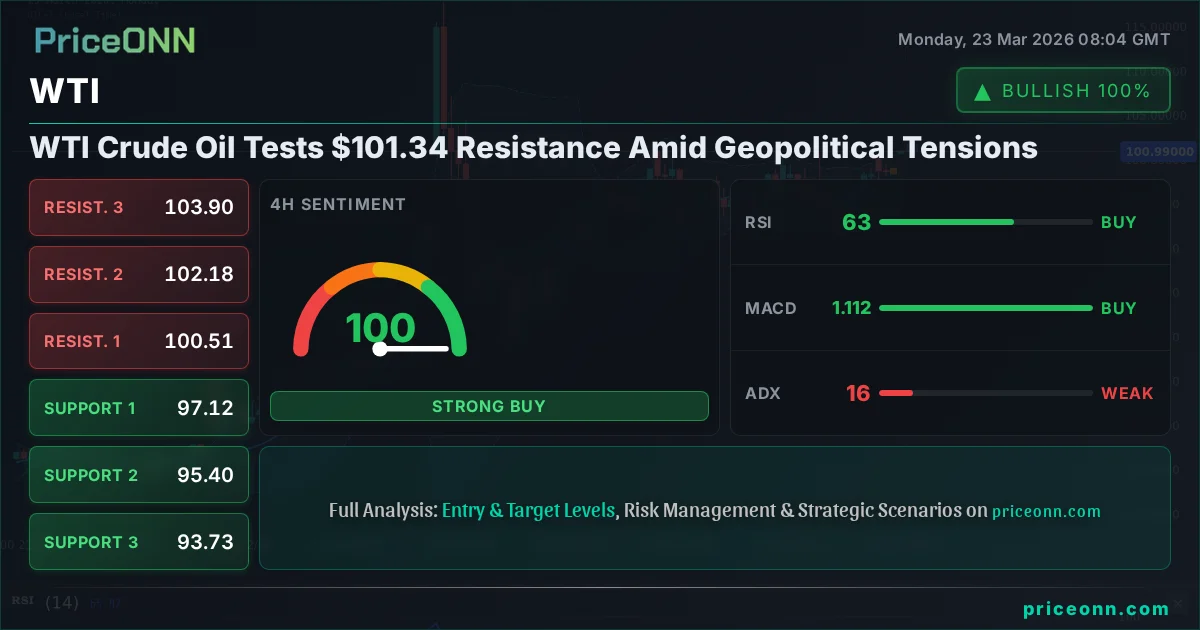
Key price levels to monitor include the psychological $100.00 mark for WTI, which could be tested if tensions escalate further. Conversely, a de-escalation or a diplomatic resolution, however unlikely at this juncture, could lead to a sharp price correction, with $95.00 acting as an initial support level.
The risk of supply disruptions remains elevated. Any confirmed impact on oil production or transit from the Persian Gulf region could send prices soaring, potentially pushing WTI towards $105.00 or higher. Traders should maintain strict risk management protocols, considering the unpredictable nature of geopolitical events. Monitoring news flow from the Middle East will be paramount in navigating this complex market environment.
Outlook: A Tightrope Walk for Oil Prices
The immediate outlook for oil prices remains heavily dependent on the geopolitical developments in the Middle East. The expiration of the U.S. ultimatum to Iran presents a critical juncture. Should tensions escalate into direct conflict or significant supply disruptions, prices are likely to surge further. Conversely, any sign of de-escalation or a diplomatic breakthrough could trigger a sharp sell-off. For now, the market is pricing in a significant risk premium, and significant price swings are expected as the situation evolves.
Frequently Asked Questions
What is the current price of WTI crude oil?
As of early European trading on Monday, WTI crude oil is trading around $99.10 per barrel, an increase driven by escalating Middle East tensions.
What is the main driver of the current oil price surge?
The primary driver is the heightened geopolitical tension between the United States and Iran, including a U.S. ultimatum regarding the Strait of Hormuz and potential retaliatory actions, coupled with reduced Saudi oil exports to Asia.
What are the key price levels to watch for WTI crude?
Traders should monitor the $100.00 level as a potential upside target if tensions escalate. Conversely, $95.00 could serve as an initial support level if de-escalation occurs.
Track markets in real-time
Empower your investment decisions with AI-powered analysis, technical indicators and real-time price data.
Join Our Telegram Channel
Get breaking market news, AI analysis and trading signals delivered instantly to your Telegram.
Join Channel

PriceONN