
Why Did WTI Crude Oil Stall Near $91 Despite Gold's Tentative Recovery?
West Texas Intermediate (WTI) crude oil is navigating a period of consolidation, hovering near the $91.00 mark during Thursday's trading sessions. This pause in price action suggests a market digesting mixed geopolitical signals from the Middle East against a backdrop of ongoing supply considerations. For three consecutive days, WTI has been confined to a narrow trading band, indicating a temporary equilibrium between potential supply disruptions and sentiment leaning towards de-escalation.
Market Context
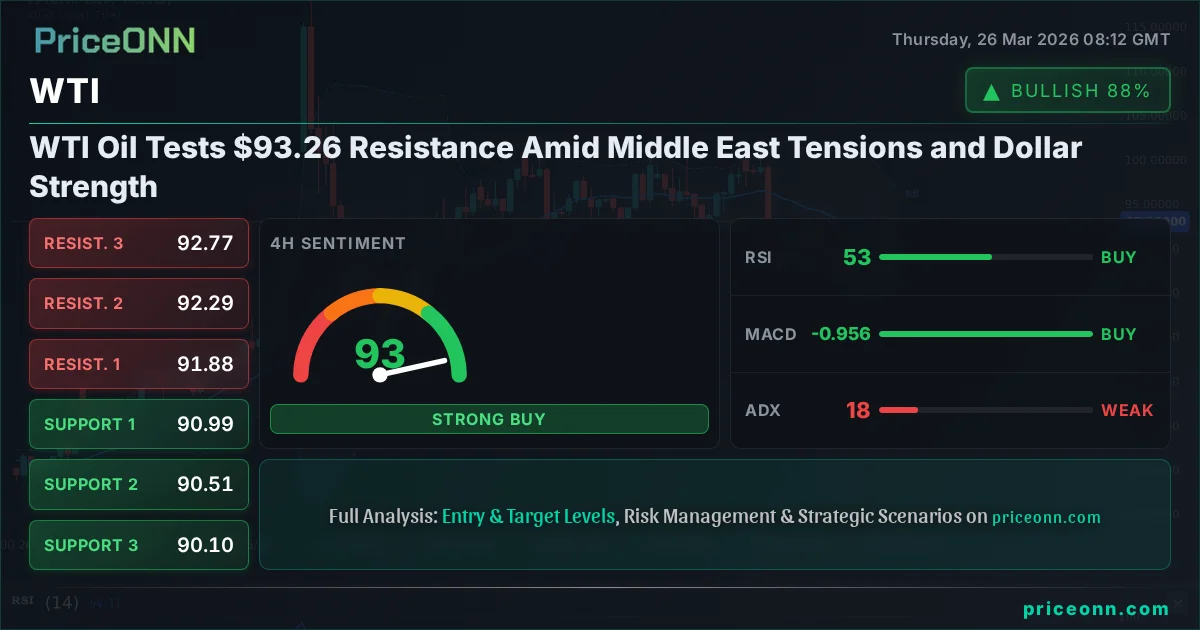
The benchmark WTI contract has been trading within a tight range, reflecting indecision among market participants. While gold (XAU/USD) has shown signs of a tentative recovery, climbing back above the $4,300 and $4,400 levels from its recent dip to around $4,100, crude oil's upward momentum appears more subdued. WTI's inability to decisively break above key resistance levels, such as the $95 and $98 marks, suggests that bullish conviction is currently lacking. This consolidation around $90.50 to $91.00 highlights the delicate balance of factors influencing the energy market.
Analysis & Drivers
Several key drivers are at play, contributing to the current stalemate in WTI prices. Geopolitical tensions in the Middle East remain a significant underlying factor, capable of disrupting supply routes and impacting production. However, recent assessments suggest a potential for de-escalation, which is tempering the immediate bullish supply-side premium. Simultaneously, traders are closely monitoring economic data and the broader global growth outlook, which directly influences demand for crude. The U.S. dollar's performance also plays a critical role; a weaker dollar typically makes oil more attractive to holders of other currencies, potentially boosting demand and prices. Conversely, a stronger dollar can exert downward pressure. Decisions by OPEC and its allies (OPEC+) regarding production quotas remain a powerful tool that can tighten or loosen the market, but their immediate impact is currently being overshadowed by geopolitical considerations and inventory data. Weekly oil inventory reports from the American Petroleum Institute (API) and the Energy Information Administration (EIA) are also crucial. A significant drop in inventories can signal increased demand and push prices higher, while rising stockpiles can indicate oversupply and lead to price declines.
Trader Implications
Traders should watch for a decisive breakout above the 200-hour exponential moving average (EMA), which currently acts as a near-term resistance around the $91.00 level. A sustained move above this threshold could signal renewed bullish sentiment, potentially targeting the $95.00 resistance. Key support levels to monitor include the recent low around $90.50, followed by the psychological $90.00 mark. A break below $90.00 could open the door for a test of lower levels, potentially down to the $88.00 vicinity. The interplay between geopolitical developments and inventory data will be critical. Traders should remain vigilant for any shifts in supply dynamics or demand forecasts. A break above the major bearish trend line for gold around $4,850, while not directly impacting WTI, could signal a broader risk-on sentiment in commodities, potentially offering some indirect support to oil prices if it coincides with positive crude-specific news.
Outlook
The immediate outlook for WTI crude oil remains one of cautious consolidation. While geopolitical risks provide an underlying bullish bias, the lack of clear catalysts for de-escalation or significant demand surges keeps prices range-bound. Traders will be looking for a clear signal, either a confirmation of supply concerns pushing prices higher or evidence of de-escalation and weakening demand leading to a correction. The upcoming inventory reports and any further developments in the Middle East will be pivotal in determining the next directional move for crude oil prices.
Frequently Asked Questions
What is the current trading range for WTI crude oil?
WTI crude oil is currently consolidating, trading within a tight range primarily between $90.50 and $91.00. This range has persisted for the past three trading days.
What technical levels should traders watch for WTI?
Key levels to watch include resistance at the 200-hour EMA around $91.00 and the $95.00 mark. Support is found at $90.50, with a significant psychological level at $90.00.
What is the short-term outlook for WTI crude oil prices?
The short-term outlook suggests continued consolidation. Prices are likely to remain sensitive to geopolitical news from the Middle East and U.S. inventory data. A decisive move above $91.00 would be needed to confirm a bullish trend.
Track markets in real-time
Empower your investment decisions with AI-powered analysis, technical indicators and real-time price data.
Join Our Telegram Channel
Get breaking market news, AI analysis and trading signals delivered instantly to your Telegram.
Join Channel

PriceONN