
Why is the US Government Stress-Testing $200 Oil Prices Amid Escalating War Risk?
Crude oil prices are at the forefront of global economic concern as the U.S. federal government undertakes a critical stress test, modeling a potential surge to $200 per barrel. This unprecedented scenario assessment is being conducted to understand the profound economic fallout that such a price shock could inflict upon the U.S. economy and the wider world.
Market Context: Escalating Tensions and Economic Vulnerability
The prospect of oil prices reaching such stratospheric heights was first brought to the fore by market analysts in early March. This concern intensified as it became apparent that the ongoing conflict involving Iran was unlikely to see a swift resolution. While Brent crude is currently trading significantly below the $200 mark, the ripple effects of elevated energy costs are already being felt globally. Europe, in particular, continues to grapple with the aftermath of its previous energy crisis. Data indicates that energy import expenditures for the European Union have risen substantially since 2022, significantly constraining its financial maneuverability. This has resulted in considerable economic strain, even with Brent crude hovering around the $100 per barrel level.
The United States, despite its more resilient domestic oil and gas production capabilities, is also experiencing the pinch. Evidence of this is directly observable at the gasoline pump. Average prices have seen an approximate 30% increase since the onset of heightened geopolitical instability. According to AAA data from March 25th, the national average price for gasoline stood at $3.982 per gallon, a marked climb from the $3.139 per gallon average recorded just a year prior. This inflationary pressure at the pump serves as a fundamental driver for broader price hikes across nearly all goods and services, making it a central concern for policymakers and consumers alike.
Analysis & Drivers: Geopolitics and Supply Chain Fragility
The primary driver behind the escalating concern for oil prices is the precarious geopolitical landscape. Increased tensions and the potential for wider conflict in key oil-producing regions create a palpable risk premium in the market. Should supply disruptions occur, even for a limited duration, the immediate impact on prices could be severe, amplified by already tight global inventories. Analysts note that the market's sensitivity to supply-side shocks has been heightened by years of underinvestment in new production capacity and the ongoing energy transition, which has not yet fully offset traditional energy sources.
Furthermore, the U.S. government's proactive modeling suggests a recognition of the fragility within the global energy supply chain. A sudden spike to $200 per barrel would not only impact consumer spending through higher fuel costs but would also significantly raise operational expenses for businesses across all sectors. This could lead to reduced industrial output, further exacerbating inflationary pressures and potentially triggering a recession. The modeling aims to identify critical vulnerabilities and develop contingency plans to mitigate the economic shockwaves, particularly for developing nations that possess fewer financial buffers to absorb such a crisis.
Trader Implications: Navigating Volatility and Risk
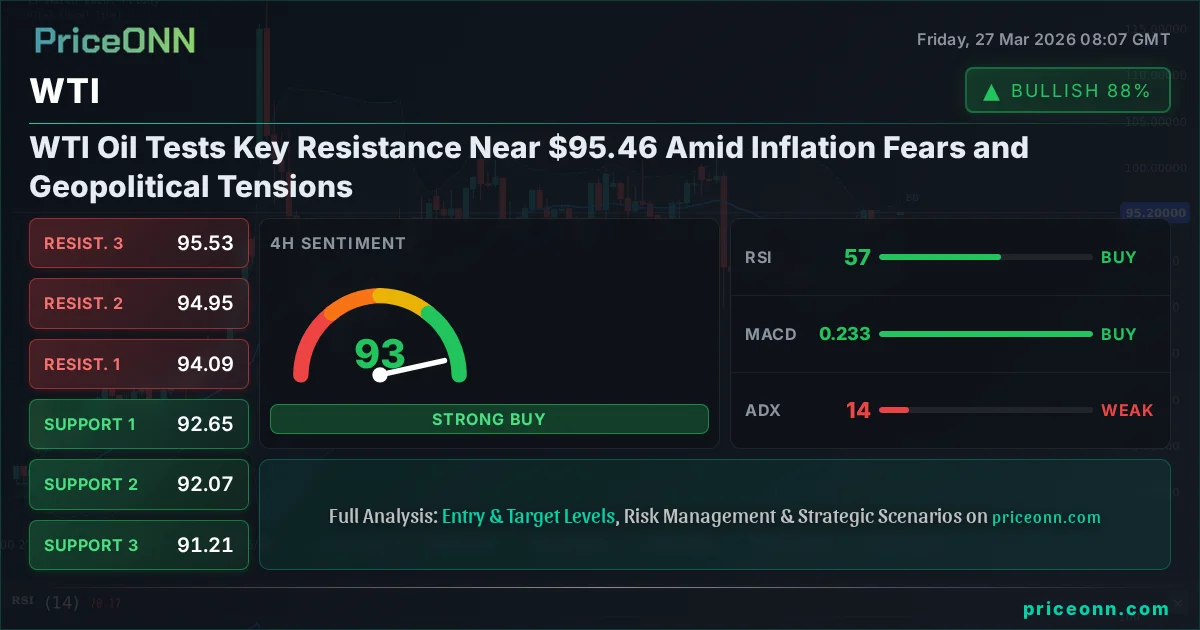
For traders, the current environment presents both significant opportunities and substantial risks. The heightened geopolitical uncertainty suggests that oil prices could experience sharp, unpredictable swings. Key levels to watch for Brent crude include immediate resistance around the $100 mark and support potentially forming near the $90 level. A decisive break above $100, fueled by escalating conflict, could indeed pave the way for a rapid ascent towards higher price targets, though the $200 mark remains a theoretical worst-case scenario.
Traders should closely monitor news flow from the Middle East and any official statements from major oil-producing nations and consuming countries. Technical indicators may offer short-term signals, but fundamental drivers, particularly those related to geopolitical events and supply disruptions, are likely to dominate price action. Risk management is paramount. Employing strategies such as stop-loss orders and considering options for hedging against extreme volatility could be prudent. The potential for a $200 oil price scenario, while extreme, underscores the need for traders to remain vigilant and prepared for significant market dislocations.
Outlook: A Tightrope Walk for Energy Markets
The immediate future for oil prices hinges precariously on the geopolitical situation. If diplomatic efforts succeed in de-escalating tensions and averting major supply disruptions, prices may stabilize or even retreat from current levels. However, any further escalation in conflict could quickly propel crude oil towards the higher end of analyst expectations, reinforcing the validity of the U.S. government's stress-testing exercises. The global economy remains sensitive to energy price shocks, making the path forward for oil a critical determinant of broader economic stability in the coming months.
Frequently Asked Questions
What is the main reason for the US government modeling $200 oil prices?
The U.S. government is modeling a $200 per barrel oil price scenario to assess the potential economic fallout of such a severe price surge, driven by escalating geopolitical risks and the potential for major supply disruptions.
How have gasoline prices in the US already been affected by recent geopolitical instability?
Gasoline prices in the U.S. have already increased by approximately 30% since geopolitical instability heightened. The national average price reached $3.982 per gallon as of March 25th, up from $3.139 per gallon a year ago.
What are the key price levels traders should watch for Brent crude?
Traders should monitor Brent crude for immediate resistance around the $100 per barrel level. Significant support might be found near the $90 per barrel mark, with a decisive break above $100 potentially signaling further upward momentum.
Track markets in real-time
Empower your investment decisions with AI-powered analysis, technical indicators and real-time price data.
Join Our Telegram Channel
Get breaking market news, AI analysis and trading signals delivered instantly to your Telegram.
Join Channel
PriceONN