
Will More Strategic Oil Releases Be Enough to Stabilize Prices Amid Iran Tensions?

Global energy markets are navigating a precarious period, with the International Energy Agency (IEA) indicating a willingness to deploy additional crude from strategic stockpiles should escalating disruptions necessitate further intervention. This potential move comes as geopolitical tensions, particularly concerning Iran, continue to cast a long shadow over supply security and price stability.
Market Context
The readiness for further emergency oil releases follows the IEA's coordinated deployment of 400 million barrels earlier this month, an unprecedented action aimed at cushioning the blow from severe global supply chain disruptions. Despite this substantial release, crude benchmarks have shown volatility. As of late Friday, Brent crude for May delivery was trading around $112.02 per barrel, down from recent highs exceeding $118. Similarly, West Texas Intermediate (WTI) crude for May delivery hovered near $98.32 per barrel, retreating from Thursday's peak above $101. These price levels, while off their recent peaks, remain elevated, reflecting persistent anxieties about supply availability.
Analysis & Drivers
The primary driver of current market unease is the escalating geopolitical situation involving Iran. Concerns are mounting over the containment of Iran's nuclear program, with the possibility of ground troop deployment to secure enriched uranium reserves posing a significant risk of widening regional conflict. This uncertainty is directly impacting oil prices, which remain sensitive to any perceived threat to Middle Eastern supply routes, particularly the Strait of Hormuz, a critical chokepoint for global energy transit. The IEA's executive director, Fatih Birol, has characterized the current supply challenges as potentially exceeding the combined impact of the 1970s oil crisis and the conflict in Ukraine, underscoring the gravity of the situation.
While the prospect of further strategic reserve releases can provide temporary market comfort by signaling intervention, it is widely recognized as a short-term palliative rather than a fundamental solution. The underlying issue remains the physical disruption or threat to supply, which reserve releases do not directly address. The IEA, established to manage such shocks, is thus in a delicate balancing act, providing market reassurance without creating false expectations of a complete resolution.
Trader Implications
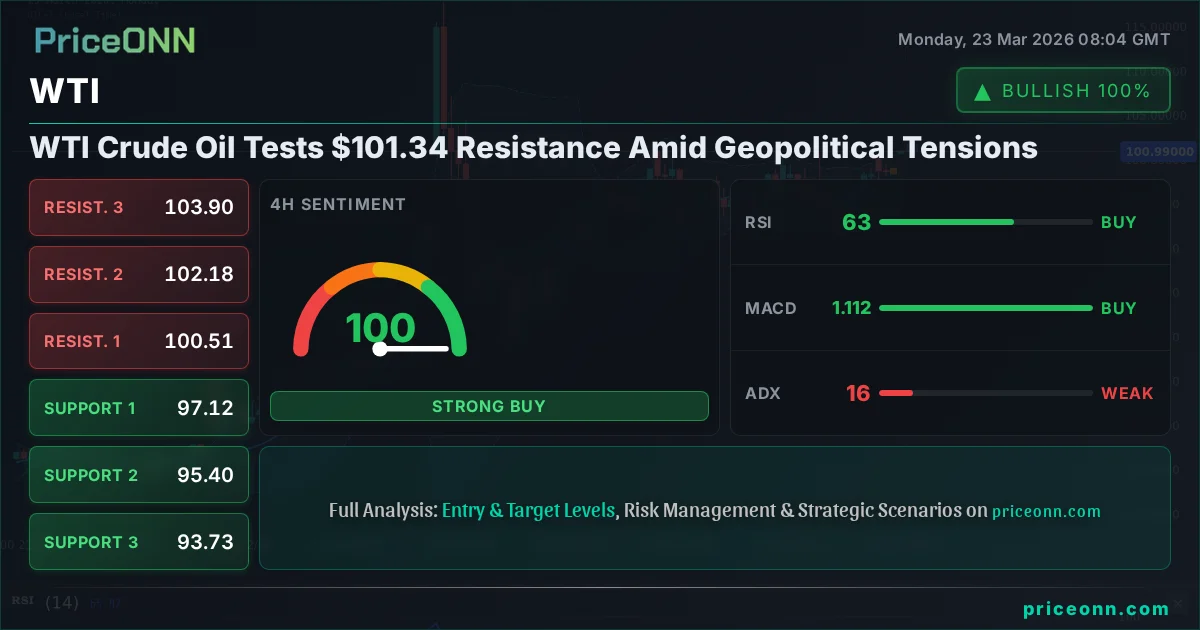
Traders should closely monitor geopolitical developments in the Middle East, as these are likely to remain the dominant price catalysts. Key levels to watch for Brent crude include potential resistance near the $118-$120 range and support around $105. For WTI, resistance may appear near $101-$103, with support found around $95. The IEA's communication regarding potential future releases will also be critical; any definitive statements could trigger short-term price reactions, though the market's sustained reaction will depend on the actual impact on supply and demand dynamics.
The reluctance of key European nations to commit to direct military intervention in the Gulf, despite condemning Iran's actions, adds another layer of complexity. This diplomatic standoff suggests that the burden of ensuring passage through critical waterways may continue to fall disproportionately on certain actors, potentially prolonging market uncertainty. Traders should consider strategies that account for heightened volatility, potentially utilizing options or focusing on shorter-term trading horizons until a clearer geopolitical resolution or supply stabilization emerges.
Outlook
The immediate outlook for oil prices remains highly dependent on the geopolitical situation surrounding Iran and the IEA's actions. While further reserve releases could offer a temporary reprieve, they are unlikely to resolve the fundamental supply concerns. Traders and investors should brace for continued volatility, with prices likely to remain sensitive to news flow from the Middle East and any official pronouncements from major energy agencies. The long-term stability of oil markets hinges on a de-escalation of tensions and a clear pathway to securing global energy transit routes.
Frequently Asked Questions
What is the current price of Brent crude and how has it reacted to recent events?
As of late Friday, Brent crude for May delivery was trading around $112.02 per barrel. While this is down from recent highs exceeding $118, the price remains elevated due to ongoing geopolitical tensions and supply concerns in the Middle East.
What role can strategic oil reserve releases play in stabilizing prices?
Strategic reserve releases, such as the 400 million barrels deployed by the IEA, can offer temporary market comfort by increasing available supply and signaling intervention. However, they are not a long-term solution to fundamental supply disruptions or geopolitical risks.
What are the key risks for oil prices in the coming weeks?
The primary risk remains the escalation of geopolitical tensions in the Middle East, particularly concerning Iran's nuclear program and threats to shipping through the Strait of Hormuz. Any direct military confrontation or further disruption to transit could send prices sharply higher, potentially testing resistance levels near $118-$120 for Brent crude.
Track markets in real-time
Empower your investment decisions with AI-powered analysis, technical indicators and real-time price data.
Join Our Telegram Channel
Get breaking market news, AI analysis and trading signals delivered instantly to your Telegram.
Join Channel


PriceONN