
Will Oil Prices Break $100 as Middle East Tensions Surge?

Oil prices have opened the trading week with an elevated but mostly stable posture, holding near multi-year peaks. This resilience comes amid a rapidly intensifying geopolitical situation in the Middle East that has market participants bracing for significant volatility. The core of the concern centers on an ultimatum issued by U.S. President Trump regarding the Strait of Hormuz, with an expiration date that is injecting a substantial risk premium into global energy markets.
Market Context: Mideast Instability Drives Prices Higher
As of early Monday trading, West Texas Intermediate (WTI) crude was trading around $99.10 per barrel, showing a modest uptick. Brent crude, the international benchmark, was trading near $111.90 per barrel. While these figures might appear stable on the surface, they mask a deeply uncertain environment. The market is keenly aware that these prices are being supported by escalating fears of supply chain disruptions, particularly concerning Iran's potential actions regarding the vital Strait of Hormuz shipping lane.
The immediate catalyst for this heightened market alert is a stark warning issued late Saturday. President Trump demanded the immediate and complete reopening of the Strait of Hormuz within 48 hours, threatening severe repercussions, including the obliteration of Iran's power plants, should this demand not be met. Iran's response has been equally forceful, signaling that any aggression against its energy infrastructure would provoke retaliatory strikes targeting vital energy and infrastructure assets throughout the wider region.
Analysis & Drivers: Supply Disruption Fears Mount
The primary driver behind the current oil price strength is the palpable fear of significant supply disruption. Analysts at Goldman Sachs have revised their price forecasts upwards, now anticipating Brent crude to average $85 per barrel and WTI to average $79 per barrel for the year. This revision from previous estimates of $77 and $72, respectively, reflects a growing concern over the stability of global oil flows.
Projections suggest that the supply loss from the current crisis could peak at an astounding 17 million barrels per day. This figure underscores the sheer scale of potential disruption should tensions escalate further. Goldman Sachs' analysis factors in a projected six-week disruption to tanker traffic in the Strait of Hormuz, followed by a gradual recovery within approximately one month. However, this timeline is contingent on the de-escalation of the conflict, a scenario that appears increasingly unlikely given the aggressive rhetoric from both sides.
The situation is further complicated by reports of significant aerial bombardments occurring across Iran early Monday morning, suggesting that the conflict may already be escalating beyond rhetoric. This adds another layer of uncertainty, as the potential for widespread damage to energy infrastructure, both within Iran and in allied nations, becomes a tangible risk.
Trader Implications: Watching Key Levels and Geopolitical Headlines
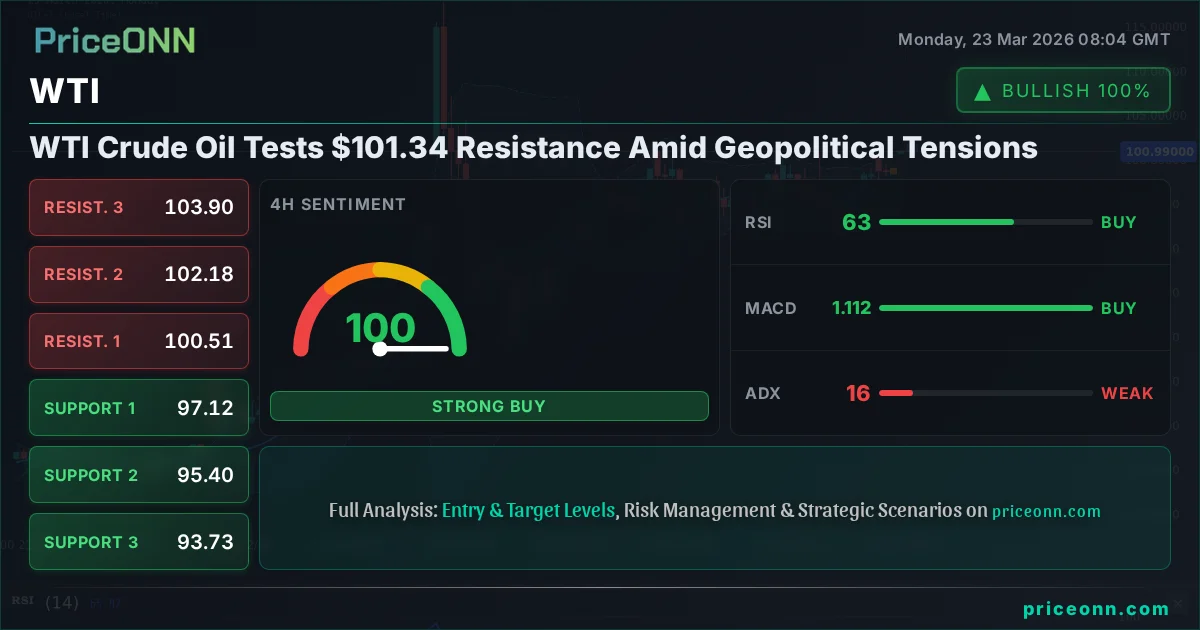
Traders should remain highly attuned to geopolitical developments out of the Middle East. The expiration of President Trump's ultimatum late Monday U.S. time is a critical inflection point. Any further escalation, including military action or confirmed disruptions to shipping in the Strait of Hormuz, could send prices soaring past the $100 per barrel mark for WTI and significantly higher for Brent.
Key levels to watch include:
- WTI Support: $95.00 – a previous resistance level that may now act as a floor.
- WTI Resistance: $100.00 – a significant psychological barrier. A sustained break above this level would signal strong bullish momentum.
- Brent Support: $110.00 – a key psychological level.
- Brent Resistance: $115.00 – a level not seen in some time, breach could indicate further upside.
Conversely, any unexpected diplomatic breakthrough or de-escalation could lead to a sharp price correction as the risk premium evaporates. The market's reaction to potential retaliatory strikes or infrastructure damage will be crucial. Traders should consider employing strategies that account for high volatility, such as using wider stop-losses or focusing on shorter-term trades until the geopolitical situation clarifies.
Outlook: Volatility Likely to Persist
The immediate outlook for oil prices remains heavily dependent on the geopolitical narrative. Should tensions continue to simmer or escalate, the upward pressure on oil prices is likely to persist, with the potential for further gains as supply disruption fears remain at the forefront of market sentiment. However, the market is also sensitive to shifts in global economic outlook, and any signs of significant economic slowdown could temper bullish sentiment, even amidst geopolitical turmoil. For now, traders should prepare for a period of heightened volatility, with Middle East developments dictating the pace and direction of oil prices.
Frequently Asked Questions
What is the current price of WTI crude oil?
As of early Monday trading, West Texas Intermediate (WTI) crude oil was trading around $99.10 per barrel, reflecting a modest increase amid escalating Middle East tensions.
Why are oil prices rising sharply?
Oil prices are rising due to escalating geopolitical tensions in the Middle East, particularly concerning Iran and the Strait of Hormuz. Fears of potential supply disruptions and the imposition of a significant risk premium are driving prices higher, with forecasts now anticipating averages of $85 for Brent and $79 for WTI this year.
What are the key levels to watch for WTI crude?
Traders should monitor WTI crude for support around the $95.00 level, which was a previous resistance. A significant psychological barrier and potential resistance lies at $100.00 per barrel; a sustained break above this could signal further bullish momentum.
Track markets in real-time
Empower your investment decisions with AI-powered analysis, technical indicators and real-time price data.
Join Our Telegram Channel
Get breaking market news, AI analysis and trading signals delivered instantly to your Telegram.
Join Channel
PriceONN