

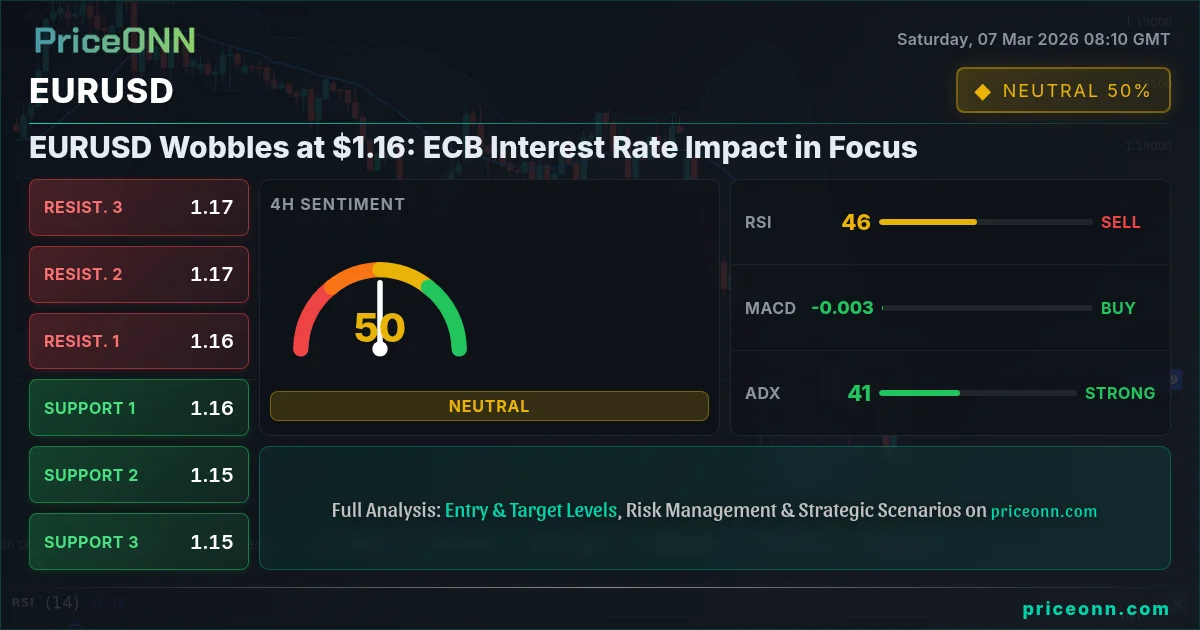
EURUSD is currently trading around $1.16, a level that has proven to be a key pivot point in recent sessions. As we approach the weekend, market participants are keenly focused on the upcoming PMI data next week, which could provide crucial insights into the strength of the Eurozone economy and the potential impact of the ECB's interest rate policy on the euro. This analysis will delve into the technical and fundamental factors influencing EURUSD, providing a comprehensive outlook for the week ahead.
- EURUSD is trading near $1.16, a critical level to watch for potential breakouts.
- RSI at 34.32 on the daily chart suggests further downside potential, but oversold conditions may present a buying opportunity.
- Key resistance lies at 1.16499, while support is at 1.15614, defining the current trading range.
- Next week's PMI data will be crucial in determining the ECB interest rate impact on euro and future direction.
Time Horizon: This analysis is for swing traders and medium-term investors.
EURUSD Technical Analysis: Sideways Consolidation
The EURUSD pair has been trading in a relatively tight range recently, consolidating around the $1.16 level. On the daily timeframe, the Relative Strength Index (RSI) is currently at 34.32, indicating that the pair is approaching oversold territory. This suggests that the bearish momentum may be waning, and a potential reversal could be on the horizon. However, it's important to note that the Moving Average Convergence Divergence (MACD) histogram remains negative, signaling that selling pressure is still present. The ADX, or Average Directional Index, is at 24.76, indicating a moderate downtrend, so any bullish reversal will need to be confirmed by strong volume and price action.
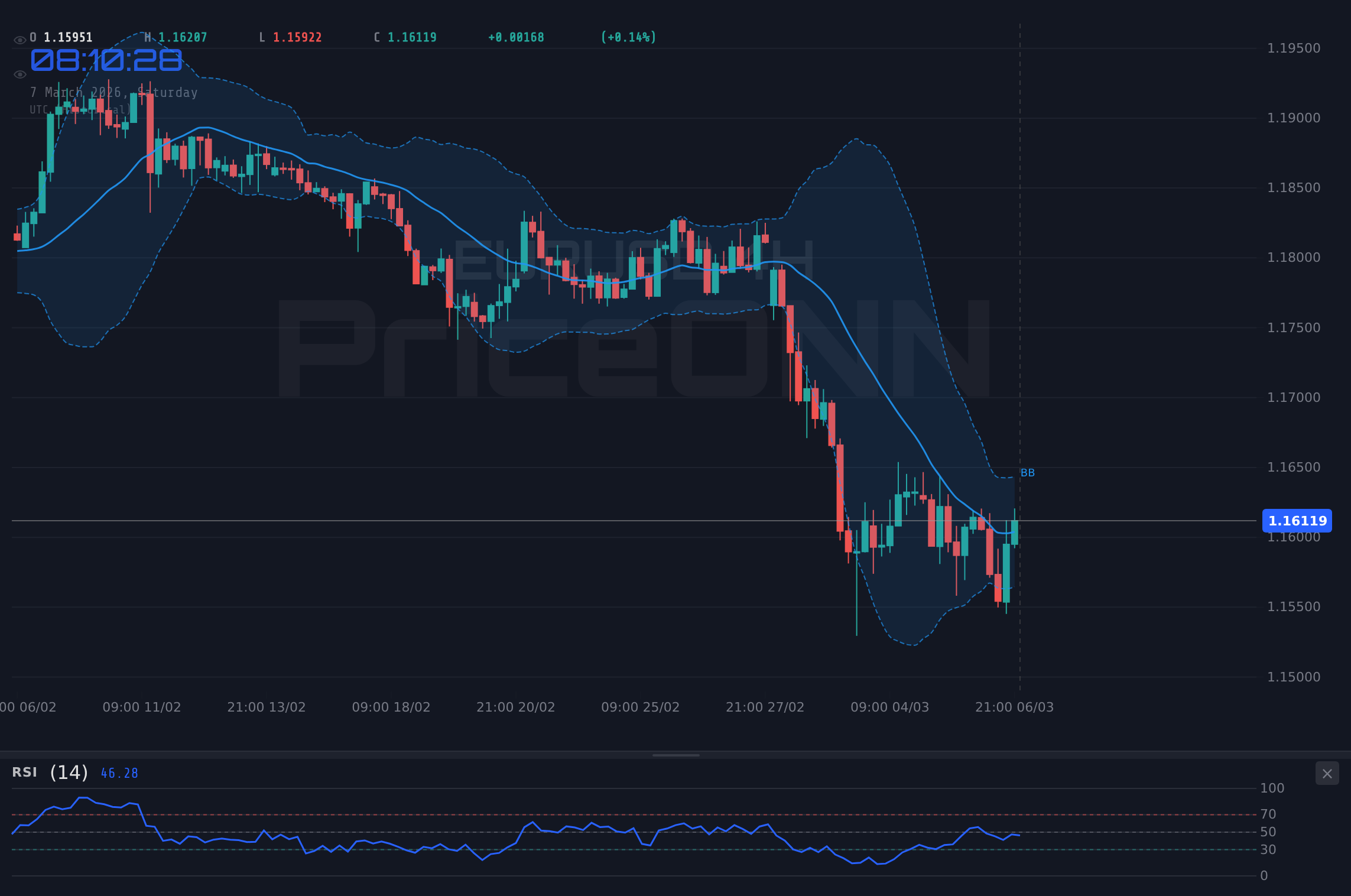
Zooming in to the 4-hour chart, we can see that the RSI is at 42.16, still in neutral territory. The Stochastic oscillator, with values of K=24.19 and D=38.82, indicates a potential oversold condition, but the %K line remains below the %D line, which is a bearish signal. The ADX on the 4-hour chart is at 41.86, indicating a strong downtrend. This conflicting signals suggest that the market is currently indecisive, and traders should exercise caution before entering new positions.
Looking at the hourly chart, the RSI is at 54.78, suggesting a slight bullish bias in the short term. The MACD is showing positive momentum, and the Stochastic oscillator (K=74.22, D=63.14) is signaling a bullish crossover. The ADX is weak at 17.06, suggesting that the short-term uptrend is not particularly strong. However, the Bollinger Bands indicate that the price is trading above the upper band, which could signal an overbought condition and a potential pullback.
Overall, the technical picture for EURUSD is mixed. While the short-term indicators suggest a potential bullish bounce, the medium- and long-term indicators remain bearish. This suggests that any upside moves may be limited, and the pair is likely to remain range-bound in the near term.
Key Levels to Watch: Support and Resistance
Identifying key support and resistance levels is crucial for determining potential entry and exit points. On the daily chart, immediate resistance lies at 1.16499, followed by 1.16925 and 1.17384. These levels represent potential areas where selling pressure could intensify, preventing further upside movement. On the downside, immediate support is at 1.15614, followed by 1.15155 and 1.14729. A break below the 1.15614 level could signal a continuation of the downtrend.
On the 4-hour chart, resistance is at 1.15809, 1.16074, and 1.1623. Support is at 1.15388, 1.15232, and 1.14967. These levels can be used for short-term trading strategies, such as buying near support and selling near resistance.
Traders should also pay attention to the 200-day moving average, which is currently acting as a dynamic resistance level. A break above this moving average could signal a more sustained bullish reversal.
From a risk management perspective, traders should always use stop-loss orders to limit potential losses. A stop-loss order placed just below the nearest support level can help protect against unexpected downside moves.
Key Levels
Support Levels
Resistance Levels
ECB Interest Rate Impact on Euro: Fundamental Factors
The ECB's monetary policy decisions play a crucial role in influencing the value of the euro. The ECB minutes, released earlier this week, revealed a cautious optimism among policymakers regarding the Eurozone's economic outlook. However, concerns remain about the impact of global economic uncertainty and geopolitical risks on the region's growth prospects. The minutes highlighted the need for a data-dependent approach to monetary policy, meaning that future interest rate decisions will be heavily influenced by incoming economic data. This is where next week's PMI data comes into play.
The upcoming PMI data will provide a snapshot of the Eurozone's manufacturing and services sectors. A strong reading would suggest that the Eurozone economy is holding up well despite global headwinds, which could embolden the ECB to consider further interest rate hikes. Conversely, a weak reading would raise concerns about a potential slowdown, potentially leading the ECB to adopt a more dovish stance. As Reuters reported, "Fed officials emphasized that inflation remains 'stubborn'." This reinforces the need for data dependency. The impact of ECB interest rate impact on euro will depend heavily on this release.
The strength of the US dollar is also a key factor influencing EURUSD. The DXY (Dollar Index) is currently at 98.71, a level that indicates continued dollar strength. A stronger dollar typically puts downward pressure on EURUSD, as it makes euro-denominated assets less attractive to international investors. Investors should closely monitor the DXY for potential breakouts or breakdowns, as these could have a significant impact on EURUSD.
Furthermore, geopolitical risks, particularly those in the Middle East, continue to weigh on market sentiment. Escalating tensions could lead to increased safe-haven demand, potentially benefiting the US dollar and putting further pressure on EURUSD. As noted in PriceONN's market news, "EUR/USD Under Pressure: Middle East Risks Outweigh All Else."
EURUSD Trade Plan: Waiting for Confirmation
Given the mixed technical picture and the upcoming economic data releases, a cautious approach is warranted. A potential trading strategy could involve waiting for a clear breakout or breakdown from the current range before entering a new position. A break above the 1.16499 resistance level could signal a bullish continuation, while a break below the 1.15614 support level could signal a bearish continuation.
Traders should also pay close attention to the economic calendar. The upcoming release of PMI data for the Eurozone and the United States could trigger significant volatility in EURUSD. As the economic calendar shows, several high-impact events are scheduled for next week, including PMI data on Wednesday, March 4th.
Considering the ADX value of 41.86 on the 4H chart, which indicates a strong downtrend, traders might consider a short position if the price breaks below the support level of 1.15614. However, due to the contradictory signals from other indicators, such as Stochastic being in the tradeable zone, this trade should be approached with caution.
A break above the 1.16499 resistance level, confirmed by strong volume, could signal a bullish continuation towards 1.16925 and 1.17384. This scenario is contingent on positive PMI data next week.
A break below the 1.15614 support level could signal a bearish continuation towards 1.15155 and 1.14729. This scenario is more likely if PMI data disappoints.
Risk Warning: Next Week's PMI Data
Considering the upcoming high-impact economic data releases, traders should be prepared for increased volatility. It is crucial to monitor the data closely and adjust trading strategies accordingly. The market's reaction to these releases will provide valuable insights into the future direction of EURUSD.
Frequently Asked Questions: EURUSD Analysis
Is EURUSD a good buy right now?
Given the mixed technical signals and upcoming economic data, EURUSD may not be a straightforward buy right now. A more conservative approach would be to wait for a breakout above 1.16499 or a breakdown below 1.15614 before considering a position.
What is the EURUSD price forecast for this week?
The EURUSD price forecast for this week is highly dependent on the PMI data. A positive surprise could push the pair towards 1.16925, while a negative surprise could lead to a test of 1.15155.
What are the key support and resistance levels for EURUSD?
Key support levels for EURUSD are 1.15614, 1.15155, and 1.14729. Key resistance levels are 1.16499, 1.16925, and 1.17384. These levels are derived from the daily chart and represent potential areas of price reversal.
Why is EURUSD moving today?
EURUSD is moving today due to a combination of factors, including dollar strength (DXY is at 98.71), geopolitical risks, and anticipation of next week's PMI data. The ECB minutes also played a role, revealing a cautious optimism among policymakers.
Technical Outlook Summary
| Indicator | Value | Signal |
|---|---|---|
| RSI (14) | 34.32 | Neutral |
| MACD Histogram | Negative | Bearish |
| Stochastic | 28.99/33.11 | Bearish |
| ADX | 24.76 | Trend strength |
| Bollinger | Mid Band | Watch |
Track markets in real-time
AI-powered analysis, technical indicators and real-time price data.
Join Our Telegram Channel
Breaking market news, AI analysis and trading signals instantly.
Join Channel