

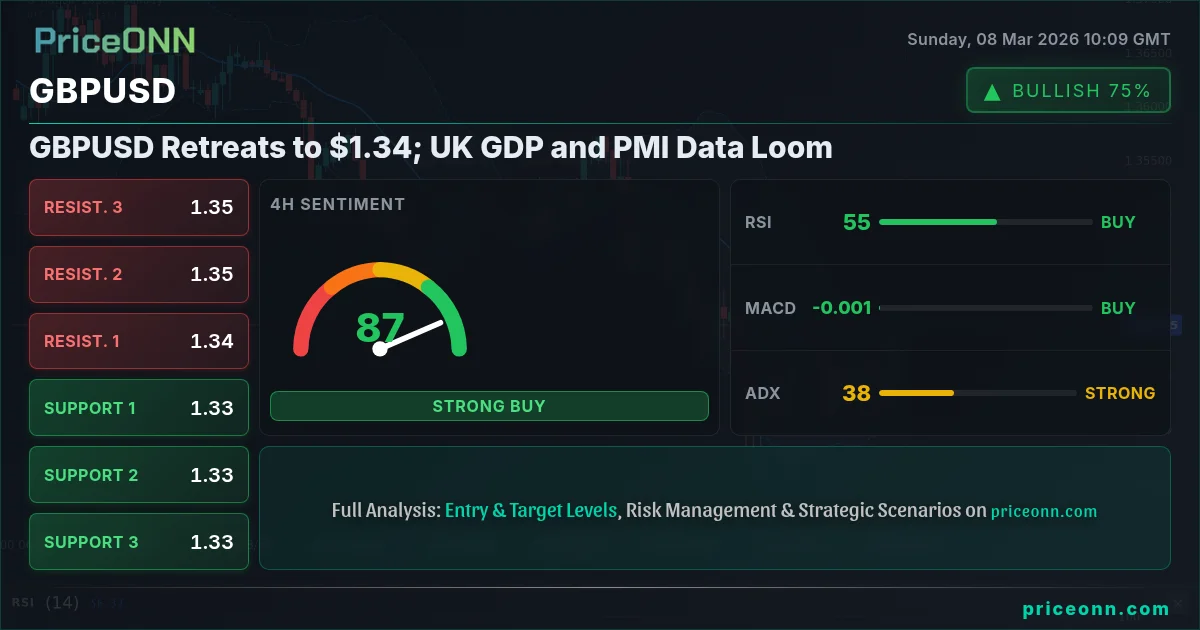
As the trading week concludes, GBPUSD finds itself hovering around $1.34, a level that has acted as a key pivot point in recent sessions. Amidst a backdrop of global economic uncertainty and shifting central bank expectations, the pound sterling faces a critical test. The question now is whether the bearish trend will persist, or if upcoming economic data will provide a catalyst for a reversal.
- GBPUSD currently trades near $1.34, a level acting as a key pivot point.
- Immediate resistance is observed at 1.33938, potentially capping further upside.
- Strong support lies at 1.33047, a breach of which could signal further downside pressure.
- UK GDP and PMI data next week could be the catalyst for a significant GBPUSD move.
Last week's price action saw GBPUSD struggle to maintain upward momentum, ultimately retreating to the $1.34 level. This comes as the dollar index, currently at 98.57, continues to exhibit strength, weighing on the pound. The recent U.S. Weekly Economic & Financial Commentary highlighted a weaker-than-expected jobs report, yet the dollar has remained resilient. This suggests that factors beyond U.S. domestic data, such as geopolitical risks and global risk sentiment, are playing a significant role in shaping currency valuations.
The escalating oil crisis, fueled by Middle East tensions, is sending ripples through forex markets, as highlighted in recent reports. While not directly impacting GBPUSD, the broader risk-off sentiment tends to favor the US Dollar as a safe haven, indirectly pressuring the pound. Concerns over stagflation in the UK, amid rising energy prices and supply chain disruptions, further contribute to the bearish outlook for GBPUSD. It is worth noting that Reuters recently reported on the resilience of the US economy despite some weak data points, solidifying the dollar strength.
Macroeconomic Factors Driving GBPUSD
Looking ahead, the key driver for GBPUSD will be the upcoming UK economic data releases. The market is particularly focused on the upcoming GDP and PMI data. Any signs of weakening economic momentum could reinforce expectations of a more dovish stance from the Bank of England (BoE). The current market sentiment, as revealed by analysis, suggests that a rate cut in March is unlikely, but this could quickly change if the data disappoints.
The broader macroeconomic environment remains challenging. The UK economy faces a unique set of headwinds, including the ongoing fallout from Brexit, rising energy costs, and persistent inflationary pressures. While the BoE has adopted a hawkish stance in recent months, the central bank's ability to continue raising interest rates is constrained by the fragile state of the UK economy. The market is pricing in a higher probability of a policy reversal, which is evident from the underperformance of the pound sterling as UK faces stagflation risks.
The geopolitical landscape also adds another layer of complexity. Escalating tensions in Eastern Europe and the Middle East have triggered a flight to safety, benefiting the US dollar as a safe-haven asset. Unless the geopolitical risks subside, the pound sterling will find it difficult to stage a sustained recovery. It's important to remember that the forex markets are inherently interconnected, and any major global event can have a ripple effect on currency valuations.
GBPUSD Technical Analysis: Key Levels to Watch
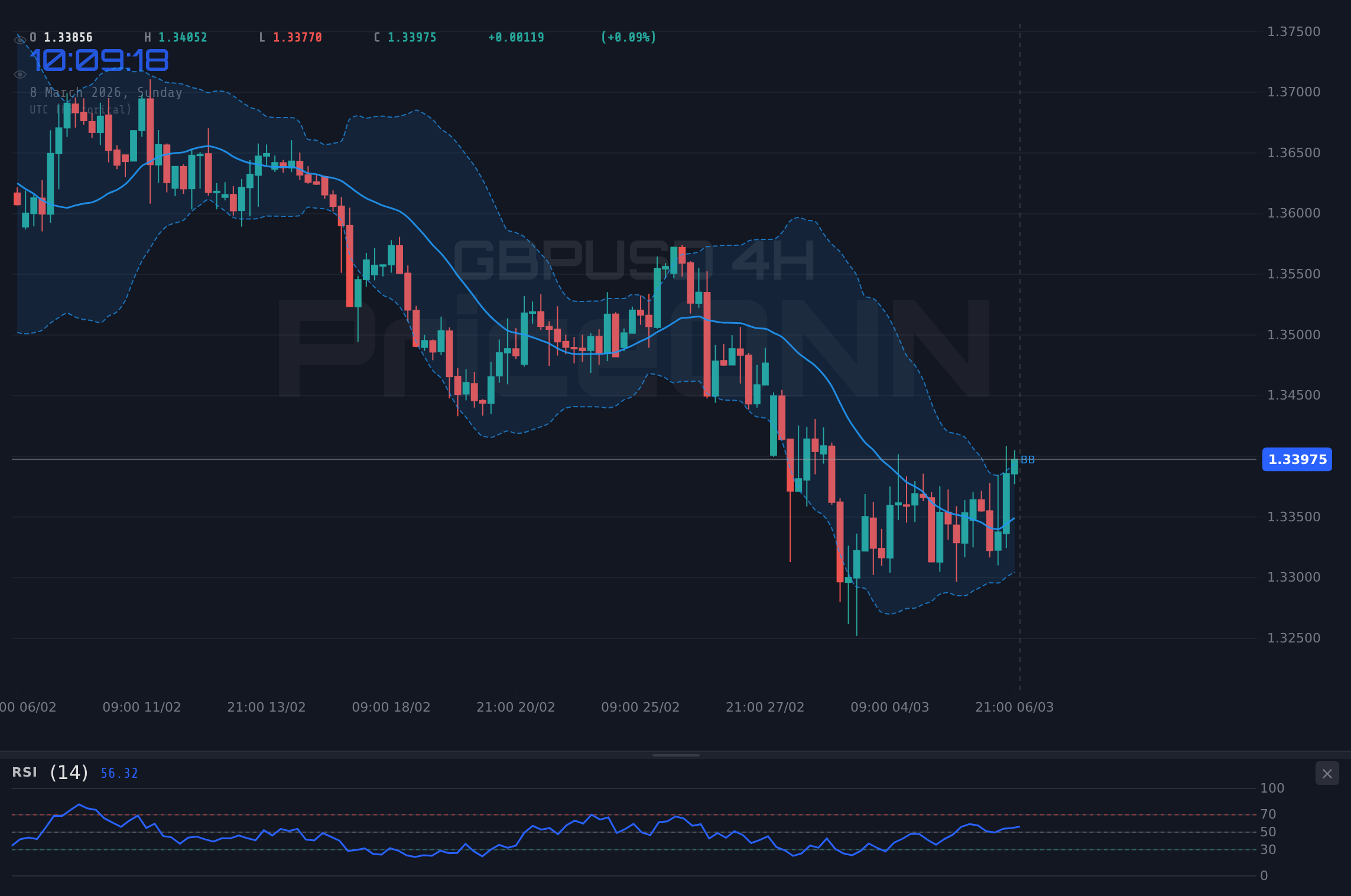
From a technical perspective, the 1-day timeframe paints a bearish picture for GBPUSD. The price action is below the middle band of the Bollinger Bands, indicating a potential downtrend. The RSI(14) sits at 41.38, suggesting that there is still room for further downside before the pair becomes oversold. The MACD histogram displays negative momentum, further confirming the bearish outlook.
On the 4-hour chart, the ADX registers at 38.77, signaling a strong downtrend. The Stochastic indicator, with K=51.76 and D=52.72, presents a mixed signal, but the overall trend remains bearish. The key support level to watch is 1.33047. A decisive break below this level could open the door for a move towards 1.32561 and potentially even lower towards 1.32156. These levels represent significant areas of demand that could provide a bounce.
On the upside, immediate resistance is observed at 1.33938. This level coincides with the daily high and represents a significant hurdle for the bulls to overcome. A successful break above this resistance could trigger a short-covering rally towards 1.34343 and 1.34829. However, given the prevailing bearish sentiment, a sustained move above these levels appears unlikely in the near term.
The 1H timeframe is showing a neutral trend, with RSI at 60.66. The Stochastic at K=78.41, D=70.53, signals a potential push to the upside. However, the ADX is only at 17.22, meaning any potential uptrend is weak. Key support is at 1.33791, while resistance is at 1.33936.
Assessing the Bull and Bear Cases for GBPUSD
The bear case for GBPUSD rests on several key factors: the strength of the US dollar, the fragile state of the UK economy, and the prevailing risk-off sentiment in the market. The technical indicators also support a bearish outlook, with the price action below key moving averages and the MACD histogram displaying negative momentum. A break below the 1.33047 support level could trigger a significant sell-off, potentially leading to further downside towards 1.32561 and 1.32156.
However, there is also a bull case to be made for GBPUSD. If the upcoming UK economic data releases surprise to the upside, it could provide a catalyst for a reversal. A dovish shift in the Fed, or easing of geopolitical tensions could also provide support for the pound sterling. From a technical perspective, a sustained break above the 1.33938 resistance level could trigger a short-covering rally, potentially leading to a test of higher resistance levels.
The ADX on the daily chart is at 28.32, showing a strong downtrend, so the overall outlook is bearish. However, the K=37.68, D=31.72 Stochastic is showing a potential push to the upside in the near term.
Trading Strategy: Waiting for Confirmation
Given the current market conditions, patience is key. The price action on GBPUSD is currently range-bound, and the direction is uncertain. The best approach is to wait for confirmation of a break above or below key support and resistance levels before initiating a trade.
If the price breaks below the 1.33047 support level, traders could consider entering a short position with a target of 1.32561 and a stop-loss order placed above the 1.33938 resistance level. Conversely, if the price breaks above the 1.33938 resistance level, traders could consider entering a long position with a target of 1.34343 and a stop-loss order placed below the 1.33047 support level.
It's important to remember that risk management is paramount. Always use a stop-loss order to limit your potential losses, and never risk more than a small percentage of your trading capital on any single trade. The market always gives a second chance. Manage your risk, wait for your setup.
Key Levels
Support Levels
Resistance Levels
Frequently Asked Questions: GBPUSD Analysis
Is GBPUSD a good buy right now?
Given the current bearish trend and upcoming economic data, GBPUSD is not necessarily a good buy right now. Traders should wait for a clear break above the 1.33938 resistance or a hold above the 1.33047 support before making a decision.
What is the GBPUSD price forecast for this week?
The GBPUSD price forecast for this week is highly dependent on the UK economic data releases. A bearish scenario could see the price test 1.32561, while a bullish scenario could see a move towards 1.34343.
What are the key support and resistance levels for GBPUSD?
Key support levels for GBPUSD are 1.33791, 1.33047, and 1.32561. Key resistance levels are 1.33938, 1.34343, and 1.34829. These levels should be watched closely for potential trading opportunities.
Why is GBPUSD moving today?
GBPUSD is moving today due to a combination of factors, including the strength of the US dollar and the uncertainty surrounding the UK economic outlook. The prevailing risk-off sentiment is also contributing to the bearish pressure on the pound.
Track markets in real-time
AI-powered analysis, technical indicators and real-time price data.
Join Our Telegram Channel
Breaking market news, AI analysis and trading signals instantly.
Join Channel