

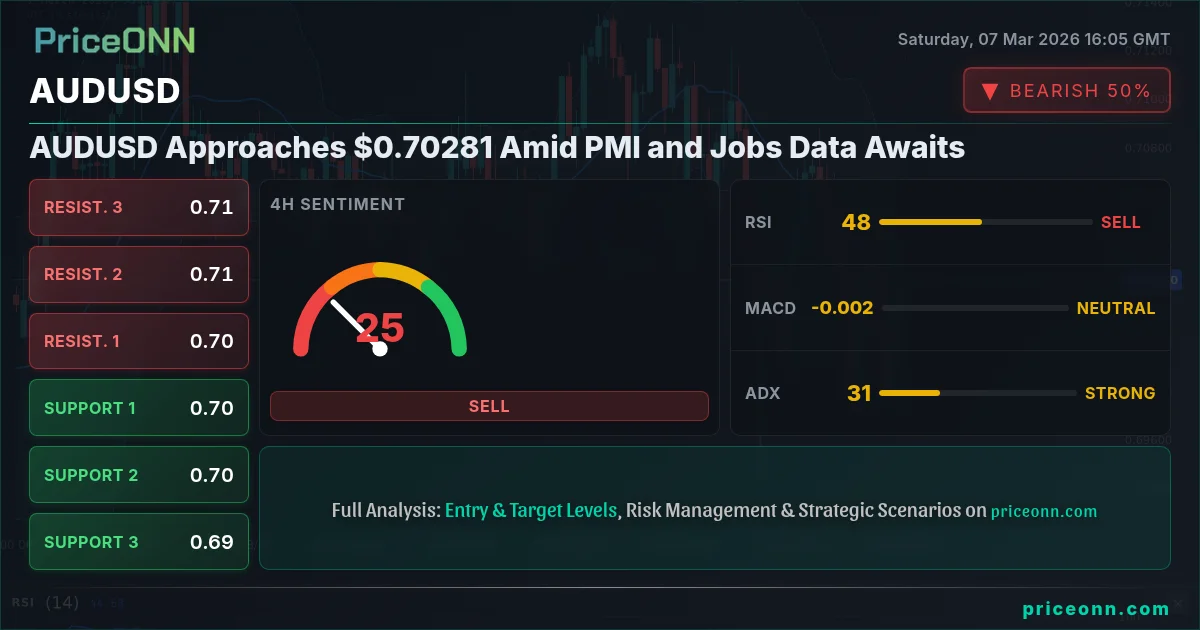
As global markets navigate a complex landscape of shifting economic indicators and geopolitical tensions, AUDUSD finds itself trading near $0.70281. The pair's trajectory is poised to be heavily influenced by upcoming PMI and jobs data, setting the stage for a potentially volatile week. The dollar index (DXY) currently sits at 98.71, a level that often exerts downward pressure on AUDUSD. The S&P 500, meanwhile, is experiencing a downturn, reflecting a broader risk-off sentiment that could further weigh on the Aussie.
Navigating the Week Ahead: Economic Data in Focus
The forex market is bracing for key economic data releases that are expected to inject volatility into AUDUSD. Traders are closely watching upcoming PMI and jobs data, which will provide insights into the health of both the Australian and US economies. These releases will serve as crucial indicators for central bank policies and market sentiment.
On the US side, market participants are awaiting new figures. According to the economic calendar, there are several high-impact USD events lined up, including PMI data. The market will be looking to see if the actual data confirms expectations. A stronger-than-expected jobs report could bolster the US dollar, putting downward pressure on AUDUSD. Conversely, weak data could weaken the dollar, providing a tailwind for the Aussie.
Australia's economic performance will also be under scrutiny. PMI data will offer insights into the country's manufacturing and services sectors. Positive figures could reinforce the Aussie's strength, while disappointing numbers could trigger a sell-off. The Reserve Bank of Australia's (RBA) policy outlook will be closely tied to these economic indicators.
Technical Indicators and Key Levels
From a technical perspective, AUDUSD's hourly chart paints a mixed picture. The RSI currently stands at 51.7, indicating a neutral stance with a slight upward bias. The MACD histogram is showing positive momentum, suggesting that buyers have some control. However, the ADX, at a low 14.88, signals a weak trend, indicating that the pair is trading in a sideways pattern. A breakout above the resistance level of 0.70296 or a breakdown below the support level of 0.7017 could determine the next direction.
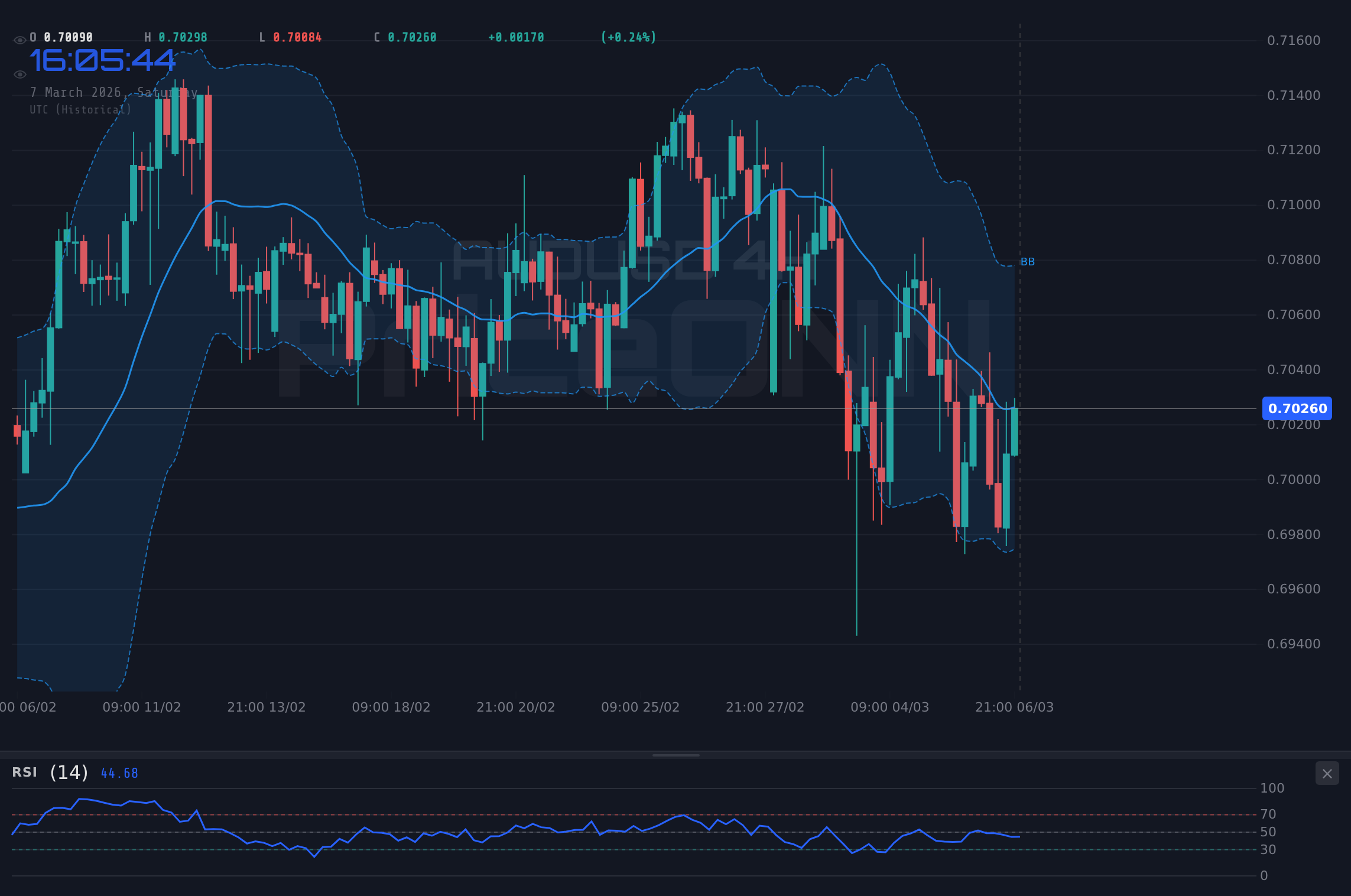
On the 4-hour chart, the technical outlook is leaning bearish. The RSI at 44.46 suggests a slight downward pressure. The MACD histogram is exhibiting negative momentum, indicating that sellers are gaining strength. The ADX is at 30.73, suggesting a strong downward trend. The key resistance level to watch is 0.70098, while support lies at 0.69682. A break below this support could lead to further declines.
The daily chart presents a more neutral picture. The RSI at 50.82 indicates a lack of clear direction. The MACD histogram is showing negative momentum, but the pair is trading above the Bollinger band's middle band. The ADX is at 31.48, signaling a strong downward trend. The key resistance level to watch is 0.7072, while support lies at 0.69566. A break below this support could lead to further declines.
Fundamental Drivers: Trade Data and Global Sentiment
AUDUSD's movements are also influenced by fundamental drivers, including trade data and global sentiment. As reported by PriceONN, recent Australian trade data has shown a narrowing surplus, which has weighed on the Aussie. Iron ore prices, a key export for Australia, are also closely watched for their impact on the currency. Furthermore, global risk sentiment plays a crucial role, with AUDUSD often serving as a proxy for risk appetite.
The US dollar's strength, as reflected in the DXY, exerts downward pressure on AUDUSD. The dollar's performance is influenced by factors such as US economic data, Federal Reserve policy, and geopolitical risks. Any positive developments for the US economy or hawkish signals from the Fed could strengthen the dollar and weaken AUDUSD.
Geopolitical tensions in the Middle East and elsewhere can also impact AUDUSD. Escalating conflicts often lead to a flight to safety, benefiting safe-haven currencies like the US dollar and putting pressure on riskier assets like the Australian dollar. The recent surge in crude oil prices, driven by Middle East tensions, has added another layer of complexity to the forex market.
AUDUSD: The Bull and Bear Cases
The bullish case for AUDUSD rests on several factors. First, a weaker-than-expected US jobs report on Wednesday could weaken the dollar, providing a boost to the Aussie. Second, positive Australian PMI data could reinforce the country's economic outlook and support the currency. Third, an easing of geopolitical tensions could improve global risk sentiment, benefiting AUDUSD.
The bearish case for AUDUSD is predicated on the following factors. First, strong US economic data could bolster the dollar, weighing on the Aussie. Second, disappointing Australian PMI data could trigger a sell-off in AUDUSD. Third, an escalation of geopolitical tensions could increase risk aversion, benefiting safe-haven currencies and pressuring AUDUSD.
From a technical standpoint, a decisive break above the resistance level of 0.70296 could signal a bullish breakout, while a break below the support level of 0.7017 could confirm a bearish breakdown.
Correlation Analysis: DXY and Risk Sentiment
AUDUSD's movements are closely correlated with the DXY and global risk sentiment. As the dollar index strengthens, AUDUSD typically weakens. With DXY currently at 98.71, AUDUSD is under pressure. Similarly, when risk appetite declines, AUDUSD tends to fall. The recent downturn in the S&P 500 reflects a risk-off environment, which could further weigh on the Aussie.
However, it's important to note that these correlations are not always perfect. At times, AUDUSD may decouple from its usual inverse relationship with the DXY or its positive correlation with risk sentiment. This can occur due to idiosyncratic factors specific to the Australian economy or currency.
Traders should closely monitor these correlations to gauge the potential impact of broader market developments on AUDUSD. A strengthening dollar or a decline in risk appetite could signal further downside for the pair, while a weakening dollar or an improvement in risk sentiment could provide a boost.
The Impact of Central Bank Policies
Central bank policies play a crucial role in shaping AUDUSD's trajectory. The Federal Reserve's (Fed) policy outlook is a key driver of the US dollar's performance, while the Reserve Bank of Australia's (RBA) policy stance influences the Aussie's strength. Any divergence in policy between the two central banks can lead to significant movements in AUDUSD.
Currently, the market is pricing in expectations for future Fed rate hikes. If the Fed adopts a more hawkish stance than expected, the dollar could strengthen, putting downward pressure on AUDUSD. Conversely, if the Fed turns dovish, the dollar could weaken, providing a tailwind for the Aussie.
The RBA's policy outlook is also closely watched by traders. If the RBA signals a willingness to raise interest rates, the Aussie could strengthen. However, if the RBA remains cautious due to concerns about economic growth, the Aussie could weaken.
Geopolitical Risks and Safe-Haven Flows
Geopolitical risks have emerged as a significant factor influencing financial markets, and AUDUSD is not immune to these pressures. Escalating tensions in the Middle East, particularly those involving Iran, have triggered a surge in crude oil prices and a flight to safety, benefiting safe-haven currencies like the US dollar and putting pressure on riskier assets like the Australian dollar.
According to Reuters, the recent surge in oil prices has raised concerns about inflation and global economic growth. This has led to increased risk aversion, benefiting safe-haven currencies and pressuring riskier assets. The Bloomberg data indicates a significant increase in demand for US Treasuries, reflecting a flight to safety.
Traders should closely monitor geopolitical developments and their potential impact on AUDUSD. An escalation of tensions could lead to further risk aversion, benefiting the US dollar and pressuring the Aussie. Conversely, a de-escalation of tensions could improve global risk sentiment, providing a boost to AUDUSD.
What Lies Ahead for AUDUSD?
AUDUSD's direction will be determined by a confluence of factors, including economic data releases, central bank policies, and geopolitical risks. The upcoming PMI and jobs data will provide crucial insights into the health of both the Australian and US economies, influencing central bank policies and market sentiment.
Traders should closely monitor these developments and adjust their strategies accordingly. A decisive break above the resistance level of 0.70296 could signal a bullish breakout, while a break below the support level of 0.7017 could confirm a bearish breakdown. Until the economic data resolves this, caution is warranted.
Frequently Asked Questions: AUDUSD Analysis
Is AUDUSD a good buy right now?
AUDUSD trading near $0.70281 presents a mixed picture. A buy is viable if it breaks above 0.70296 resistance, signaling bullish momentum, but traders should watch for a potential downside if it falls below 0.7017 support.
What is the AUDUSD price forecast for this week?
The AUDUSD price forecast for this week depends on upcoming PMI and jobs data. If the data is positive, AUDUSD could reach 0.7072 resistance; negative data could see it fall to 0.69566 support.
What are the key support and resistance levels for AUDUSD?
Key support for AUDUSD lies at 0.7017, 0.69682, and 0.69566. Key resistance levels are at 0.70296, 0.7072, and 0.70098, according to the latest market data.
Why is AUDUSD moving today?
AUDUSD is moving today due to a mix of factors, including global risk sentiment, and anticipation of upcoming PMI and jobs data. As well the DXY is impacting AUDUSD.
Track markets in real-time
AI-powered analysis, technical indicators and real-time price data.
Join Our Telegram Channel
Breaking market news, AI analysis and trading signals instantly.
Join Channel