SP500 Today Analysis: $6,669.85 Resistance Test Amidst Mixed Signals
SP500 faces resistance at $6,669.85. With ADX at 19.13 indicating a ranging market, bulls and bears battle it out. Technicals show conflicting signals.
Is the rally faltering, or is this just a pause before the next leg higher? The S&P 500 (SP500) is currently locked in a critical battleground, hovering around the $6,669.85 mark. This key resistance level is proving a tough nut to crack, with bulls and bears vying for control in a market that, by all technical accounts, appears to be ranging. The ADX reading of 19.13 on the 4-hour chart confirms this sentiment; a weak trend signal like this suggests a lack of directional conviction, making any breakout potentially deceptive. This is precisely where you need to pay attention. While the 1-hour chart offers some bullish signals, the daily and 4-hour indicators present a more cautious, even bearish, outlook. Understanding this divergence is crucial for navigating the choppy waters ahead.
- RSI at 43.89 on the 4-hour chart signals neutral-to-bearish pressure, not yet oversold.
- Critical resistance sits at $6,670.63, tested multiple times this week.
- MACD histogram shows negative momentum on daily charts, suggesting fading bullish conviction.
- The current ADX of 19.13 on the 4H timeframe indicates a ranging, not trending, market, increasing trade risk.
The Bull Case: Why $6,669.85 Might Be Broken
Let's be clear: the bulls have shown resilience. Despite the choppy price action, the S&P 500 has managed to hold its ground and even push higher in recent sessions, currently trading at $6,669.85. On the 1-hour timeframe, the picture is somewhat brighter for the bulls. The RSI(14) is hovering around 50.18, indicating a neutral stance but with a slight upward eğilim. More compellingly, the MACD is showing positive momentum, with the MACD line above its signal line. Furthermore, the Stochastic indicator on this timeframe is flashing a strong bullish signal, with %K at 92.44 and %D at 53.99, suggesting a potential upward momentum build. The Bollinger Bands on the 1-hour chart are also trading above the middle band, hinting at potential upside. If this short-term bullish momentum can hold, and if traders can push past the immediate resistance at $6,670.63, we could see a move towards the next resistance level at $6,683.67. This scenario often plays out when short-term sentiment overrides the broader trend, especially if there's a catalyst like positive news flow or a shift in Fed expectations that hasn't yet been fully priced in.
Another point in favor of the bulls is the general strength seen in some sectors, even if it's not broad-based. While the broader market analysis for the S&P 500 on the 4-hour and daily charts leans bearish, the 1-hour chart offers a glimmer of hope. This short-term optimism can sometimes be enough to trigger a short squeeze, especially if there are significant option expiries or futures rollovers looming. The fact that the index is still trading above psychological levels and has shown an ability to recover from dips suggests underlying buying interest. The question is whether this short-term strength is enough to overcome the headwinds from the longer-term technical picture and the broader market sentiment, which, as we'll discuss, is leaning towards caution.
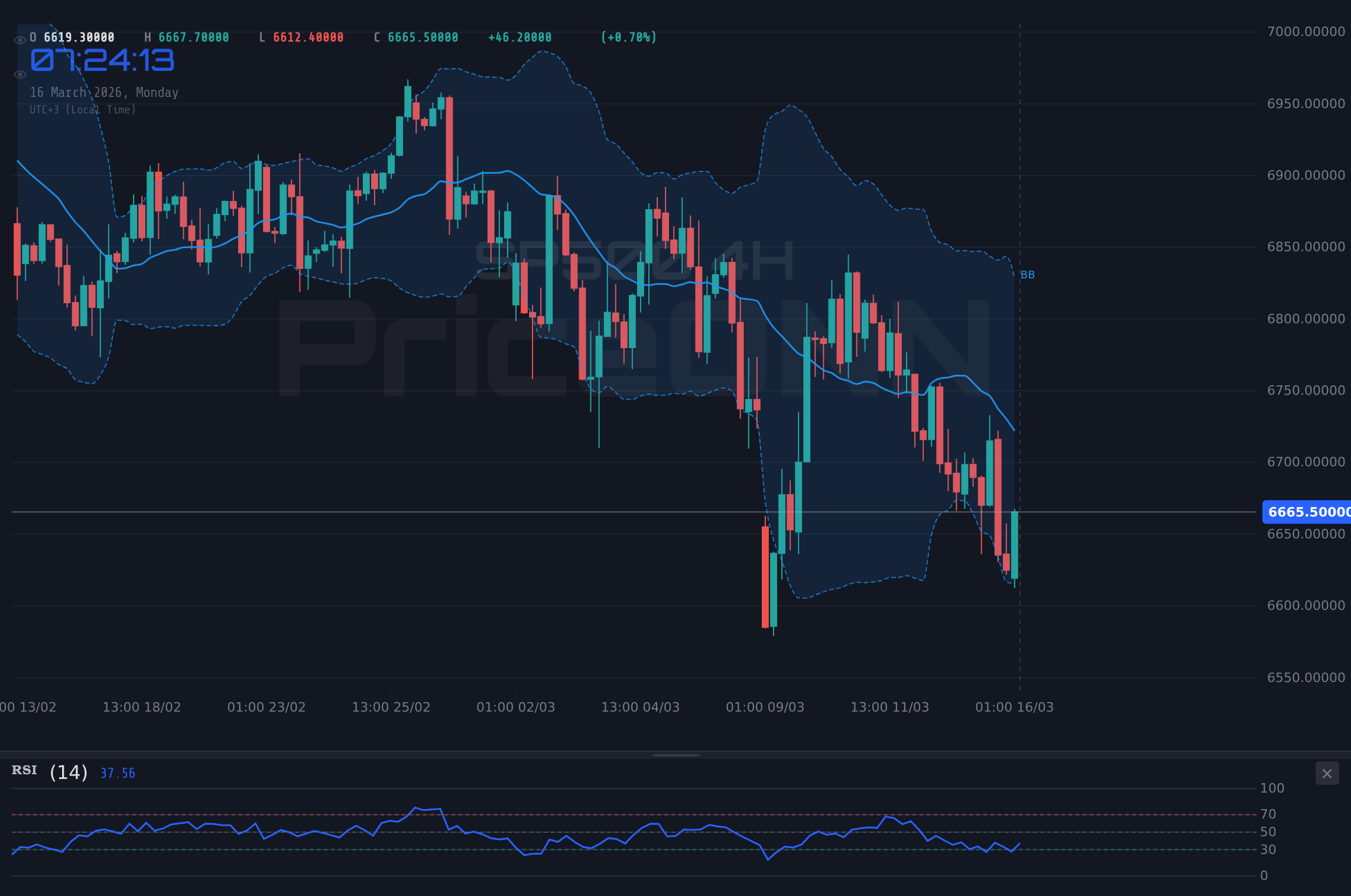
From a purely technical standpoint on the 1H chart, the Stochastic %K crossing above %D while in the upper zone, coupled with the MACD's positive momentum, presents a classic short-term bullish setup. However, the extremely weak ADX at 19.08 tempers expectations; this isn't a breakout in the making, but rather a potential range-bound bounce. Traders are likely looking for confirmation above $6,670.63 before committing to a longer-term bullish thesis.
The Bear Case: Why $6,669.85 Could Be a Wall
Now, let's switch gears and look at the bearish argument, which, frankly, carries more weight when we zoom out. The daily chart presents a starkly different picture. The trend is firmly bearish, with a 100% strength reading. The RSI(14) is at 38.17, well within the neutral zone but trending downwards, suggesting sellers are still in play. Crucially, the MACD is showing negative momentum, with the MACD line firmly below its signal line. This is a classic sell signal. The Stochastic indicator on the daily chart also favors the downside, with %K at 24.98 and %D at 39.7, indicating further room to fall. The Bollinger Bands are hugging the lower band, confirming the bearish pressure. Resistance levels at $6,670.63, $6,683.67, and $6,698.03 loom large, and given the overall bearish trend, breaking through them will be a significant challenge.
The 4-hour timeframe echoes this bearish sentiment. The trend is classified as bearish with 90% strength. The RSI(14) sits at 43.89, again pointing to a lack of bullish momentum. MACD continues to display negative momentum, and the Stochastic is in the oversold zone but trending downwards (%K at 18.01, %D at 25.59), which in a downtrend can signal further weakness. The ADX reading of 19.13 on this timeframe is particularly telling. While it signals a weak trend overall, in the context of a daily bearish trend, it suggests the market is consolidating before a potential further decline, rather than setting up for a reversal. This means that any rallies, including the current push towards $6,669.85, could be seen as opportunities for bears to enter or add to their positions, anticipating a move towards the support levels at $6,611.87, $6,598.83, and potentially even $6,575.97.
Correlation analysis adds another layer to the bearish argument. The Dollar Index (DXY) is currently at 99.96, showing a strong upward trend on the daily and 4-hour charts. A strengthening dollar typically puts pressure on US equities, as it makes dollar-denominated assets more expensive for foreign investors and can signal tighter global liquidity. While the S&P 500 has shown some resilience, this correlation cannot be ignored. If the DXY continues its ascent towards the 100.37 resistance level, it will likely act as a significant headwind for the S&P 500, reinforcing the bearish technical signals. Furthermore, the recent news about Saudi Arabia scaling back its ambitious Neom project, coupled with potential supply disruptions in energy markets, could inject a dose of geopolitical uncertainty, further dampening risk appetite and potentially driving investors away from equities and towards safer assets.
The conflicting signals between the 1-hour bullish momentum and the daily/4-hour bearish trends create a high-risk environment. Traders should be extremely cautious. A close below the key 1-hour support at $6,648 could trigger a rapid descent towards the 4-hour support levels. Conversely, a decisive close and hold above $6,670.63 might signal a temporary shift, but confirmation on higher timeframes is still needed.
The Technical Showdown at $6,669.85
When you look at the technical indicators across different timeframes, it's clear why this level is a battleground. On the 1-hour chart, we see a mix. The RSI at 50.18 is neutral, MACD is positive, and Stochastic is showing a bullish signal, but the ADX at 19.08 signifies a lack of trend strength. This suggests short-term traders might be looking for a quick scalp or a bounce, but the conviction isn't there for a sustained move. This is a classic setup for whipsaws – sharp moves in both directions that can trap unwary traders.
Now, shift your gaze to the 4-hour and daily charts, and the narrative changes dramatically. The bearish trend is dominant. Daily RSI at 38.17, MACD negative momentum, and Stochastic %K below %D all scream caution. The ADX on the daily chart at 39.23 indicates a strong downtrend. This means any short-term rallies, like the one currently testing $6,669.85, are likely to face significant selling pressure as participants on higher timeframes look to exit positions or initiate new shorts. The failure to break decisively above the $6,670.63 resistance on the 4-hour chart reinforces this bearish outlook. It's a divergence that demands respect: short-term traders might see a bounce, but long-term trend followers are likely watching for confirmation of the downtrend continuation.
The interplay between these timeframes is fascinating. The 1-hour chart is showing signs of potential upward momentum, driven by positive MACD and a bullish Stochastic reading. However, this is happening against the backdrop of a strong bearish trend on the daily chart, evidenced by negative MACD momentum and RSI below 40. This conflict is precisely why the ADX is so low on the 4-hour and 1-hour charts – the market is undecided. If the bulls are to gain control, they need to not only break $6,669.85 but hold above it, and crucially, start showing similar bullish signals on the daily chart. Until then, the bears remain in the driver's seat, looking for any sign of weakness to re-enter the market and push prices lower towards the support at $6,611.87.
The Verdict: Caution is the Watchword
So, where does this leave us? With the S&P 500 currently trading at $6,669.85, the technical signals are sending mixed messages, but the weight of evidence leans bearish. The short-term 1-hour chart shows some bullish potential, with positive MACD momentum and a bullish Stochastic reading. However, this is overshadowed by the bearish trend on the daily and 4-hour charts, characterized by negative MACD momentum, RSI below 40, and a strong ADX reading indicating a firm downtrend. The current price action at $6,669.85 represents a critical juncture – a test of resistance that, if it fails, could lead to a significant decline. The weak ADX readings across multiple timeframes suggest we are in a ranging or choppy market, increasing the risk of false breakouts and whipsaws. Therefore, the most prudent approach for traders right now is caution.
While a short-term bounce is possible, especially if driven by speculative buying or short-covering, the underlying trend and broader market conditions suggest that upside may be limited. The correlation with a strengthening DXY at 99.96 adds to the bearish case, potentially weighing on US equities. Geopolitical uncertainties, such as the news regarding Saudi Arabia's Neom project scaling back, can also contribute to a risk-off sentiment, further pressuring indices like the S&P 500. Until we see a clear, sustained break above the $6,670.63 resistance on higher timeframes, accompanied by stronger bullish signals across the board, the odds favor a continuation of the bearish trend or at least a period of consolidation before any significant upward move. Patience will be rewarded here; waiting for clearer signals and confirmation is key.
The current setup at $6,669.85 presents a high-risk, low-reward scenario for aggressive long positions. The probability of a failed breakout is significant given the bearish daily trend and weak ADX. Bears might find opportunities on a confirmed break below $6,648, targeting $6,611.87. For bulls, waiting for a decisive close above $6,670.63 on the daily chart, with corroborating bullish indicators, offers a much higher probability setup.
“The market is always in a transition. It’s never static. The best traders are the ones who can adapt to the changing conditions, not those who cling to old ideas.”
Frequently Asked Questions: SP500 Analysis
What happens if SP500 fails to break above the $6,670.63 resistance level?
If the S&P 500 fails to decisively break and hold above the $6,670.63 resistance, it is likely to face renewed selling pressure. Given the bearish trend on higher timeframes and the weak ADX, a failure here could lead to a decline towards the support level at $6,611.87, as indicated by the daily technicals.
Should I buy SP500 at current levels of $6,669.85 given the mixed signals?
Buying at $6,669.85 is a high-risk proposition due to conflicting signals between short-term bullish momentum and longer-term bearish trends. The probability of a successful breakout is currently low, with a higher chance of ranging or declining. It's advisable to wait for confirmation, such as a sustained close above $6,670.63 on the daily chart, before considering a long position.
Is the RSI at 43.89 a sell signal for SP500 right now?
An RSI reading of 43.89 on the 4-hour chart is not an immediate sell signal in isolation, but it does indicate a lack of bullish momentum and leans towards bearish pressure. Combined with other bearish indicators on higher timeframes like the daily MACD, it suggests that the market is not in a strong buying phase, reinforcing the caution around current levels.
How will the current DXY strength affect SP500 this week?
The DXY is showing a strong upward trend at 99.96, which typically acts as a headwind for US equities like the S&P 500. This inverse correlation suggests that continued dollar strength could put downward pressure on the SP500, potentially hindering any attempts to break through resistance levels and reinforcing the bearish outlook.
Volatility creates opportunity - those prepared will be rewarded. While the current technical picture for the S&P 500 at $6,669.85 presents a challenging environment with conflicting signals, the underlying bearish trend on higher timeframes suggests caution is warranted. The weak ADX readings highlight the ranging nature of the market, making decisive trades risky without further confirmation. Patient investors and traders who adhere to strict risk management principles, waiting for clearer signals and higher-probability setups, will be best positioned to navigate these choppy waters and capitalize on future market movements.
Track markets in real-time
AI-powered analysis, technical indicators and real-time price data.
Join Our Telegram Channel
Breaking market news, AI analysis and trading signals instantly.
Join Channel