
Gold Tumbles As Stocks Rebound Amid Easing Oil Prices
 PriceONN Editorial Desk
Multi-source verification
PriceONN Editorial Desk
Multi-source verification
Investor Sentiment Shifts as Equities Gain Traction
A notable retreat swept through the gold market on Monday, marking its fourth consecutive session of declines. This downturn coincided with a broad-based rebound in U.S. stock markets and a softening in crude oil prices. The shift in sentiment occurred even as significant geopolitical events, particularly the ongoing conflict in the Persian Gulf, continued to unfold with full intensity.
The front-month Comex gold contract for April delivery experienced a sharp fall, shedding $61.10, or 1.21%, to settle at $5,000.60 per troy ounce. Similarly, the April silver contract saw a modest decrease, losing $0.713, or 0.88%, to trade at $80.345 per troy ounce.
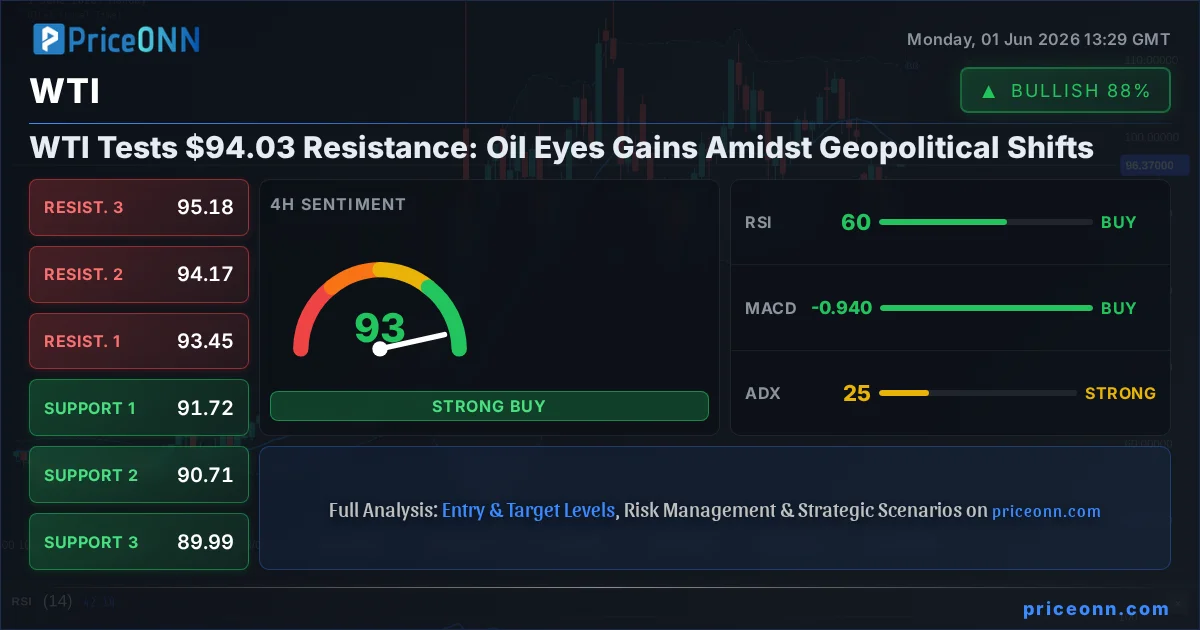
The resurgence in U.S. equities provided a direct counterweight to gold's decline. This market recovery was fueled by a cooling of oil prices, which experienced a significant drop largely driven by profit-taking activities from traders who had previously capitalized on recent price surges. West Texas Intermediate (WTI) crude oil for April delivery plummeted by $4.17, or 4.22%, closing the session at $94.54 per barrel.
Economic Data Offers Mixed Signals
Adding another layer to the market dynamics, recent economic data releases from Friday and Monday contributed to a renewed sense of investor confidence, further dampening safe-haven demand for gold. Official figures released by the U.S. Federal Reserve indicated that industrial production edged up by 0.20% month-over-month in February, representing a 1.40% increase year-on-year. The nation's capacity utilization rate held steady at 76.30% for the month.
Manufacturing output also showed positive movement, rising 0.20% from the previous month and 1.30% compared to the prior year. These figures, while showing modest growth, provided some reassurance amidst broader economic uncertainties.
Looking back at the final quarter of 2025, annualized GDP growth registered at 0.70%, falling short of the 1.40% forecast. The accompanying GDP Price Index stood at 3.80%. Notably, the core Personal Consumption Expenditures (PCE) price index, a key inflation gauge closely watched by the Federal Reserve, rose by 0.40% in January, aligning with expectations. On an annual basis, this index saw a 3.10% increase.
Other economic indicators presented a more varied picture. Real personal spending saw a slight uptick of 0.10% in January, surpassing the flat forecast. However, January's durable goods orders came in below estimates. The preliminary reading for the University of Michigan's consumer sentiment index in March dipped to 55.5 from 56.6 in February. Meanwhile, JOLTs job openings increased to 6,946,000 in January, up from 6,550,000 in December, signaling a potentially tightening labor market.
Geopolitical Developments and Central Bank Watch
On the geopolitical front, U.S. President Donald Trump intensified calls for international cooperation, urging seven unnamed countries to contribute naval assets to secure the Strait of Hormuz. He also applied pressure on European allies, warning of potential negative consequences for NATO if they do not align with U.S. objectives.
Earlier in March, Trump had indicated that the U.S. was seeking to form a coalition with major oil-dependent nations, including China, France, Japan, South Korea, and the U.K. to ensure stability in the Middle East's crude oil supply routes. However, no positive responses have been reported thus far.
The ongoing conflict has led to a shutdown of oil production in several Arab nations unable to export their output. Iran's Foreign Minister reiterated on Sunday that the nation was not seeking a ceasefire or negotiations. Amidst these developments, major central banks, including the U.S. Federal Reserve, European Central Bank, Bank of England, and Bank of Japan, are scheduled to convene for policy meetings this week. Analysts anticipate a potentially hawkish stance from these institutions as they grapple with the long-term inflationary pressures stemming from the extended regional conflict.
Market Ripple Effects
The confluence of retreating gold prices, a resurgent stock market, and moderating oil prices presents a complex environment for traders. The immediate impact sees a decline in demand for traditional safe-haven assets like gold, driven by improved risk appetite in equities and reduced immediate inflation fears from lower energy costs. However, the underlying geopolitical tensions and the looming central bank policy decisions introduce significant uncertainty.
Traders should closely monitor the upcoming central bank communications. A hawkish tone from the Fed, ECB, BoE, or BoJ could lead to increased volatility across bond markets and currency pairs, potentially strengthening the U.S. Dollar Index (DXY) and putting further pressure on commodities. The ongoing situation in the Middle East remains a critical wildcard; any escalation could swiftly reverse the recent market trends, reigniting demand for gold and potentially sending oil prices soaring once more. The interplay between inflation expectations, central bank policy, and geopolitical stability will dictate market direction in the coming weeks.
Track markets in real-time
Empower your investment decisions with AI-powered analysis, technical indicators and real-time price data.
Join Our Telegram Channel
Get breaking market news, AI analysis and trading signals delivered instantly to your Telegram.
Join Channel PriceONN News
Gold futures broke above $4,500 per ounce on Friday, driven by increasing optimism for a de-escalation in the U.S.-Iran conflict and the potential reopening of the Strait of Hormuz. Silver also saw significant gains, reflecting a broader shift towards precious metals as geopolitical tensions ease.
PriceONN News
(RTTNews) - After moving sharply lower earlier in the day, the price of gold has shown a significant turnaround over the course of the trading session on Thursday.
PriceONN News
Gold prices fell below the $4500 mark on Wednesday, extending previous losses as oil prices tumbled and geopolitical tensions between the US and Iran remained a key market driver. Investors are weighing inflation concerns against hopes of de-escalation.
PriceONN News
Gold prices surged by 1% to approximately $4,556 on Monday as market participants reacted to developing news of a potential US-Iran peace deal. The speculation weakened the US Dollar and sent oil prices tumbling.
PriceONN News
(RTTNews) - Gold prices traded higher on Monday, oil prices tumbled nearly 5 percent and the dollar hovered near a one-week low after U.S. President Donald Trump said on Saturday a peace deal with Iran had been "largely negotiated."
PriceONN News
Gold prices fell on Friday as concerns over crude oil inventories and the prolonged closure of the Strait of Hormuz fueled inflation anxieties, overshadowing U.S.-Iran peace talks. The June Comex Gold contract settled down 0.55% at $4,517.40.
PriceONN News
(RTTNews) - Gold prices have edged lower on Friday as crude oil inventory concerns and the extended delay in the reopening of the Strait of Hormuz increased inflation-related apprehensions, overshadowing the positive signals from the developments in the U.S.-Iran negotiations.
PriceONN News
(RTTNews) - Gold dipped toward $4,500 an ounce on Thursday, weighed down by a firm dollar and higher Treasury yields.
PriceONN News
(RTTNews) - Gold prices have soared on Friday amid rising optimism about an end to the Middle East war with the chances of reopening of the Strait of Hormuz and resumption of oil and energy trade growing stronger.
PriceONN News
(RTTNews) - Gold held firm above $4,500 an ounce on Friday, the dollar headed for a small weekly loss on improved risk sentiment in markets, and oil prices slipped to a one-month low amid investor optimism that the Middle East conflict is inching toward an end and that the reopen
PriceONN News
Gold prices experienced a significant decline on Wednesday, falling over 1% as diplomatic optimism surrounding U.S.-Iran talks grew, despite ongoing military actions. The June gold contract settled at $4,444.50.
PriceONN News
Gold prices experienced a significant downturn, shedding 2% this week to settle near $4,444.50 per ounce. This decline is attributed to evolving U.S.-Iran diplomatic efforts and concerns over potential central bank rate hikes.