
India Gold price today: Gold rises
 PriceONN Editorial Desk
Multi-source verification
PriceONN Editorial Desk
Multi-source verification
Gold Climbs in Indian Markets
Gold prices in India saw a rise on Tuesday, continuing its upward trajectory, according to recent market data. The price of gold reached INR 15,363.05 per gram, a notable increase from Monday's price of INR 15,293.97.
The cost of gold per tola also increased, settling at INR 179,192.50, compared to the previous day's INR 178,385.90. This upward movement reflects ongoing market dynamics influencing the precious metal's valuation.
Key Price Points
Here's a breakdown of gold prices in Indian Rupees (INR) for various units:
- 1 Gram: 15,363.05
- 10 Grams: 153,629.70
- Tola: 179,192.50
- Troy Ounce: 477,857.60
These figures are derived by converting international gold prices (denominated in USD/INR) into the local currency and standard measurement units used in India. These prices are updated daily to reflect current market conditions at the time of publication. While these figures offer a useful reference, local rates may exhibit slight variations due to regional market influences.
Decoding Gold's Enduring Appeal
Why does gold maintain its allure as an investment? Throughout history, gold has served as a reliable store of value and a medium for exchange. Beyond its aesthetic appeal and use in jewelry, gold is regarded as a safe-haven asset, particularly during times of economic uncertainty. It's also considered an effective hedge against both inflation and currency depreciation, as its value isn't tied to any specific issuer or government.
Central Banks' Role in the Gold Market
Central banks are among the largest holders of gold reserves. To bolster their currencies during volatile periods, these institutions often diversify their holdings by purchasing gold. This strategy aims to enhance the perceived stability and strength of their economies and currencies. Substantial gold reserves can instill confidence in a country's financial solvency. Data from the World Gold Council indicates that central banks added 1,136 tonnes of gold, valued at approximately $70 billion, to their reserves in 2022; this represents the highest annual purchase volume on record. Emerging economies, including China, India, and Turkey, are rapidly increasing their gold reserves.
Gold's Correlation with Other Assets
Gold typically exhibits an inverse correlation with the US Dollar and US Treasuries, both of which are considered major reserve and safe-haven assets. When the dollar weakens, gold prices tend to rise, providing investors and central banks with an opportunity to diversify their portfolios during turbulent times. Gold also shows an inverse correlation with risk assets; a stock market rally can depress gold prices, while sell-offs in riskier markets often boost the precious metal's appeal.
Factors Influencing Gold Prices
Numerous factors can influence gold prices. Geopolitical instability or fears of a significant recession can rapidly drive up gold prices due to its safe-haven status. As a yield-less asset, gold tends to benefit from lower interest rates, while higher interest rates can weigh on its price. However, most price movements are closely tied to the behavior of the US Dollar (USD), as gold is priced in dollars (XAU/USD). A strong dollar often keeps gold prices in check, while a weaker dollar is likely to push them higher.
Portfolio Impact: What This Means for Traders
The recent uptick in gold prices in India underscores the metal's sensitivity to both local and global economic factors. For traders, this presents a mixed bag of opportunities and risks. On one hand, rising prices offer potential for short-term gains, especially for those holding gold-backed assets or trading gold futures.
On the other hand, increased volatility necessitates careful risk management. Traders should closely monitor the USD/INR exchange rate, as fluctuations can significantly impact gold prices in local currency terms. Furthermore, keep an eye on global macroeconomic indicators, such as inflation rates and interest rate decisions by major central banks. These factors can influence investor sentiment and drive demand for gold as a safe-haven asset.
Assets to watch in relation to gold's performance include the Indian Rupee (INR), US Dollar Index (DXY), and gold mining stocks. A weaker Rupee could amplify the gains in gold prices for Indian investors, while a stronger Dollar could temper those gains. Monitoring the performance of gold mining companies can provide insights into the broader sentiment surrounding the gold market.
Track markets in real-time
Empower your investment decisions with AI-powered analysis, technical indicators and real-time price data.
Join Our Telegram Channel
Get breaking market news, AI analysis and trading signals delivered instantly to your Telegram.
Join Channel PriceONN News
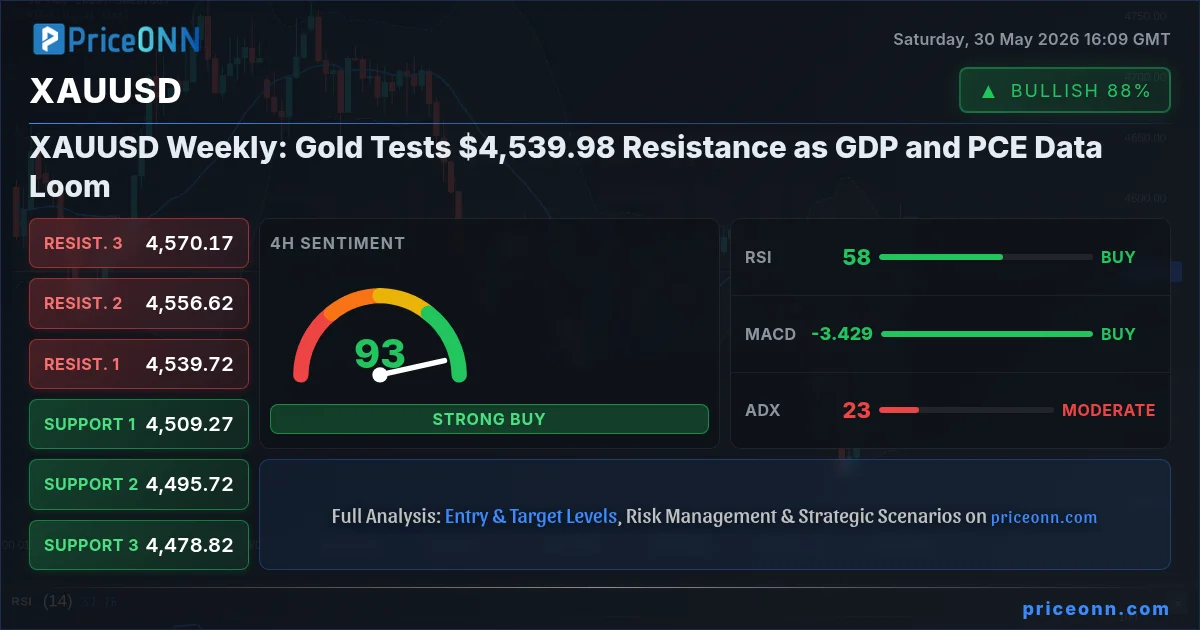
Gold futures broke above $4,500 per ounce on Friday, driven by increasing optimism for a de-escalation in the U.S.-Iran conflict and the potential reopening of the Strait of Hormuz. Silver also saw significant gains, reflecting a broader shift towards precious metals as geopolitical tensions ease.
PriceONN News
Gold prices experienced a significant decline on Wednesday, falling over 1% as diplomatic optimism surrounding U.S.-Iran talks grew, despite ongoing military actions. The June gold contract settled at $4,444.50.
PriceONN News
Gold prices experienced a significant downturn, shedding 2% this week to settle near $4,444.50 per ounce. This decline is attributed to evolving U.S.-Iran diplomatic efforts and concerns over potential central bank rate hikes.
PriceONN News
Gold prices retreated to $4,504.30 per troy ounce despite ongoing geopolitical tensions and the closure of the Strait of Hormuz, suggesting a complex market dynamic beyond typical safe-haven demand. Silver, however, managed a modest gain.
PriceONN News
Gold prices are facing intense scrutiny at the critical $4500 per ounce support level, even as industrial metals like copper surge and the US dollar softens amid renewed geopolitical optimism.
PriceONN News
Gold prices are under intense scrutiny as they hover around the critical $4500 per ounce support level. The precious metal faces pressure from a risk-on environment, despite a weaker dollar and strength in industrial commodities like copper.
PriceONN News
Gold prices fell on Friday as concerns over crude oil inventories and the prolonged closure of the Strait of Hormuz fueled inflation anxieties, overshadowing U.S.-Iran peace talks. The June Comex Gold contract settled down 0.55% at $4,517.40.
PriceONN News
(RTTNews) - Gold prices have soared on Friday amid rising optimism about an end to the Middle East war with the chances of reopening of the Strait of Hormuz and resumption of oil and energy trade growing stronger.
PriceONN News
(RTTNews) - After moving sharply lower earlier in the day, the price of gold has shown a significant turnaround over the course of the trading session on Thursday.
PriceONN News
Gold prices fell below the $4500 mark on Wednesday, extending previous losses as oil prices tumbled and geopolitical tensions between the US and Iran remained a key market driver. Investors are weighing inflation concerns against hopes of de-escalation.
PriceONN News
(RTTNews) - Extending the losses from yesterday's session, gold prices have slumped on Wednesday as traders watch the ongoing efforts to end the U.S.-Iran standoff with cautious optimism while the blockade on the Strait of Hormuz continues. The rising inflationary pressure weighe
PriceONN News
(RTTNews) - Gold prices traded lower on Wednesday, extending losses from the previous session as investors fretted about oil-driven inflation and the potential impact on interest rates.