
Why Did Silver Tumble 2% Despite a Weaker Dollar and Falling Yields?

Silver (XAG/USD) faced considerable selling pressure on Tuesday, plummeting by almost 2% to hover around the $79 mark. This sharp decline occurred despite a backdrop of a weakening US Dollar and falling US Treasury yields, factors that typically support precious metals. Market data indicates that the white metal has now retreated 1.81% on a weekly basis, as investor sentiment shifted towards riskier assets.
Market Context
The unexpected downturn in silver prices on Tuesday presents a puzzling scenario for market participants. Traditionally, a softer US Dollar makes dollar-denominated commodities like silver more attractive to foreign buyers, thereby boosting demand and prices. Concurrently, falling US Treasury yields reduce the opportunity cost of holding non-yielding assets such as silver, making them comparatively more appealing. However, this week, these conventional dynamics appeared to be overshadowed by other market forces. Industry reports suggest that rising crude oil prices may have exerted downward pressure on silver, potentially due to its industrial demand component. Furthermore, an observed improvement in overall market risk appetite saw investors gravitating away from safe-haven assets, including silver.
Analysis & Drivers
Several key drivers appear to be at play behind silver's recent slump. While the US Dollar Index (DXY) softened, indicating a less robust greenback, its impact on silver was seemingly negated. Analysts note that the industrial demand for silver, a critical factor often overlooked, might be facing headwinds. Silver's extensive use in sectors such as electronics and solar energy means that shifts in global manufacturing output and demand for these goods can significantly influence its price trajectory. The current market data suggests a potential slowdown or a shift in demand within these industrial applications, creating a headwind for the metal.
Moreover, the correlation between crude oil prices and silver, though not always direct, can be significant. When oil prices surge, it often signals broader inflationary pressures or increased industrial activity, but it can also divert capital that might otherwise flow into precious metals. In this instance, higher crude oil prices appear to have coincided with, and possibly contributed to, silver's decline. The broader market sentiment, characterized by an increased appetite for risk, also played a crucial role. As stock markets showed resilience and other riskier assets gained traction, investors reduced their exposure to perceived safe havens like silver, seeking higher returns elsewhere.
Trader Implications
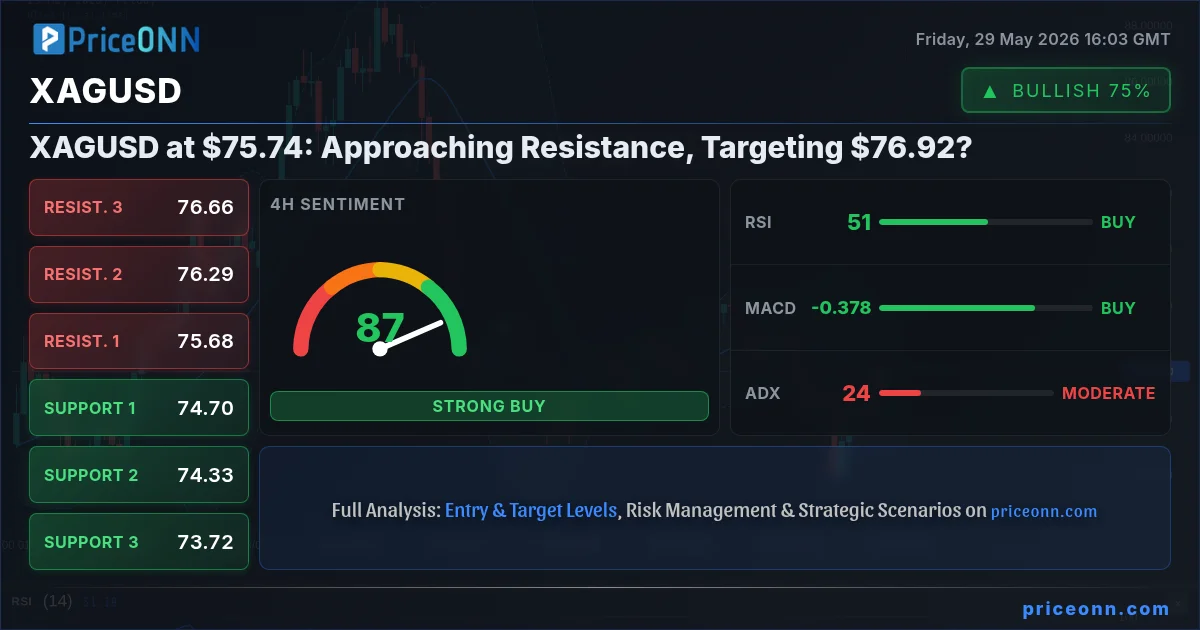
For traders, the recent price action in silver highlights the importance of monitoring a complex interplay of factors beyond just currency and interest rate movements. Key levels to watch include the recent low around $79, which may act as immediate support. A break below this level could signal further downside potential, with the next significant support possibly emerging around the $75 psychological mark. On the upside, resistance could be found near the $81 level, followed by the $83 area.
Traders should closely observe the US Dollar Index, US Treasury yields, and crude oil prices for short-term direction. However, the underlying industrial demand and shifts in global risk sentiment are crucial for determining the medium-to-long-term trend. A sustained improvement in global manufacturing output or a resurgence of safe-haven demand amid geopolitical uncertainty could reignite bullish sentiment for silver. Conversely, continued strength in risk assets and tepid industrial demand could keep prices capped.
Outlook
The immediate outlook for silver remains uncertain, caught between supportive macroeconomic indicators and potentially bearish industrial and risk sentiment factors. While the weaker dollar and lower yields offer a theoretical tailwind, the actual price action suggests that other forces are currently dominating the market. Investors and traders will be keenly watching upcoming economic data releases from major industrial economies, particularly China and the United States, for insights into manufacturing activity and demand for industrial metals. Any significant shift in global risk sentiment or a change in the trajectory of crude oil prices could also trigger a re-evaluation of silver's price forecast.
Frequently Asked Questions
What caused silver to fall by nearly 2% on Tuesday?
Silver prices tumbled by almost 2% on Tuesday, falling to around $79. This occurred despite a weaker US Dollar and lower US Treasury yields. Market data suggests that rising crude oil prices and an improved market appetite for riskier assets were key factors, drawing investors away from safe-haven metals.
What are the key technical support levels for XAG/USD?
The immediate support level for silver (XAG/USD) is near the recent low of $79. A decisive break below this point could lead to further declines, with the next significant psychological support level anticipated around $75. Traders should monitor these levels closely for potential trading opportunities.
What should traders watch for in the silver market moving forward?
Traders should closely monitor industrial demand indicators, especially from the electronics and solar energy sectors, as well as global manufacturing output data. Shifts in market risk sentiment and the price action of crude oil will also be critical. Upcoming economic data from the US and China will provide crucial insights into potential future price movements.
Track markets in real-time
Empower your investment decisions with AI-powered analysis, technical indicators and real-time price data.
Join Our Telegram Channel
Get breaking market news, AI analysis and trading signals delivered instantly to your Telegram.
Join Channel PriceONN News
Gold futures broke above $4,500 per ounce on Friday, driven by increasing optimism for a de-escalation in the U.S.-Iran conflict and the potential reopening of the Strait of Hormuz. Silver also saw significant gains, reflecting a broader shift towards precious metals as geopolitical tensions ease.
PriceONN News
Gold prices experienced a significant decline on Wednesday, falling over 1% as diplomatic optimism surrounding U.S.-Iran talks grew, despite ongoing military actions. The June gold contract settled at $4,444.50.
PriceONN News
Gold prices retreated to $4,504.30 per troy ounce despite ongoing geopolitical tensions and the closure of the Strait of Hormuz, suggesting a complex market dynamic beyond typical safe-haven demand. Silver, however, managed a modest gain.
PriceONN News
(RTTNews) - Gold prices have soared on Friday amid rising optimism about an end to the Middle East war with the chances of reopening of the Strait of Hormuz and resumption of oil and energy trade growing stronger.
PriceONN News
(RTTNews) - Gold held firm above $4,500 an ounce on Friday, the dollar headed for a small weekly loss on improved risk sentiment in markets, and oil prices slipped to a one-month low amid investor optimism that the Middle East conflict is inching toward an end and that the reopen
PriceONN News
Coeur Mining (CDE) shares surged past the critical 200-day moving average of $18.47, hitting $18.73 and marking a 4.5% daily gain. This technical breakout signals potential for further upward movement.
PriceONN News
(RTTNews) - After moving sharply lower earlier in the day, the price of gold has shown a significant turnaround over the course of the trading session on Thursday.
PriceONN News
Gold prices experienced a significant downturn, shedding 2% this week to settle near $4,444.50 per ounce. This decline is attributed to evolving U.S.-Iran diplomatic efforts and concerns over potential central bank rate hikes.
PriceONN News
(RTTNews) - Extending the losses from yesterday's session, gold prices have slumped on Wednesday as traders watch the ongoing efforts to end the U.S.-Iran standoff with cautious optimism while the blockade on the Strait of Hormuz continues. The rising inflationary pressure weighe
PriceONN News
(RTTNews) - Gold prices traded lower on Wednesday, extending losses from the previous session as investors fretted about oil-driven inflation and the potential impact on interest rates.
PriceONN News
(RTTNews) - Gold prices have edged lower on Tuesday amid renewed concerns of inflationary pressure following fresh U.S. military strikes on Iran yesterday while the Strait of Hormuz remains closed for oil and energy transit.
PriceONN News
Gold prices are facing intense scrutiny at the critical $4500 per ounce support level, even as industrial metals like copper surge and the US dollar softens amid renewed geopolitical optimism.