BRENT Crude Nears $113.5 Resistance at $110.88: Bull vs. Bear Showdown
BRENT crude oil trades at $110.88, hovering near resistance. Bulls eye $113.5, while bears watch key support levels. Geopolitical tensions and inflation remain in focus.
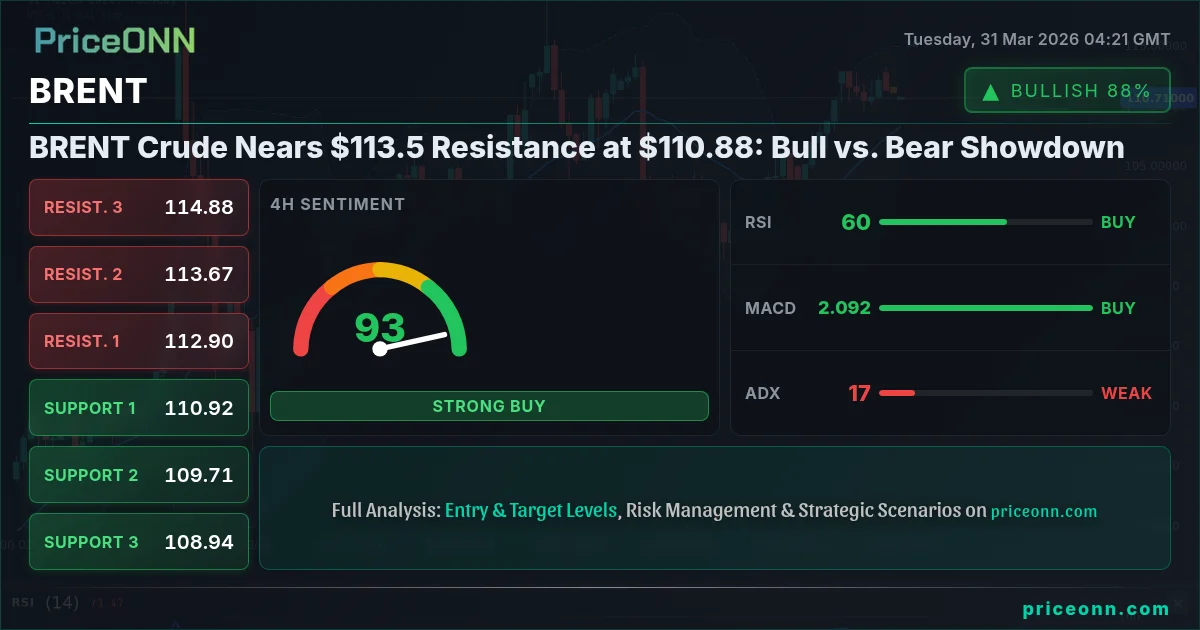
The tug-of-war for control of the oil market is intensifying as BRENT crude hovers around the critical $110.88 mark. This price point isn't just another number; it represents a significant battleground where bullish aspirations of reaching $113.5 clash with bearish sentiment, fueled by a complex interplay of geopolitical risks, inflation concerns, and shifting macroeconomic winds. The question on every trader's mind is whether the current upward momentum can overcome the resistance, or if a correction is on the horizon.
- BRENT crude oil is trading at $110.88, approaching a key resistance level.
- The 4H chart shows a strong bullish trend with a 'BUY' signal, while the 1D chart indicates a powerful downtrend with 'SELL' signals.
- Geopolitical tensions in the Middle East are a significant driver, pushing prices higher amid supply disruption fears.
- Inflationary pressures remain a concern, with Brent's price correlation to global energy costs being a primary focus for traders and policymakers alike.
The current market environment for BRENT is a complex tapestry woven with threads of geopolitical tension, inflationary pressures, and the ever-present dance between supply and demand. On one hand, the escalating conflict in the Middle East, with reports of Russian tankers entering Cuba's economic zone and ongoing instability, continues to be a potent catalyst for upward price action. These supply-side jitters create a palpable sense of urgency, pushing crude oil prices, including BRENT, towards higher ground. The fact that BRENT is trading at $110.88 right now, with its daily range extending from $107.96 to $113.39, underscores the volatility and the significant price swings we've witnessed recently. This upward trajectory, particularly on the 1-hour and 4-hour charts, is supported by positive momentum indicators and a generally bullish signal across these shorter timeframes, suggesting short-term buying interest remains strong.
However, a deeper dive into the longer-term technicals paints a more cautious picture. The daily chart for BRENT presents a formidable challenge, displaying a strong downtrend with a prevailing 'SELL' signal. This divergence between short-term bullishness and long-term bearish indicators is precisely where the market tension lies. While the intraday traders might be capitalizing on the immediate upward momentum, the daily indicators, such as RSI at 68.35 and a robust ADX of 62.25, suggest that the overall trend might be facing significant headwinds. This is the crux of the bull vs. bear debate: can the short-term buying pressure sustain itself against the weight of the daily trend, or is this merely a temporary reprieve before a more significant pullback?
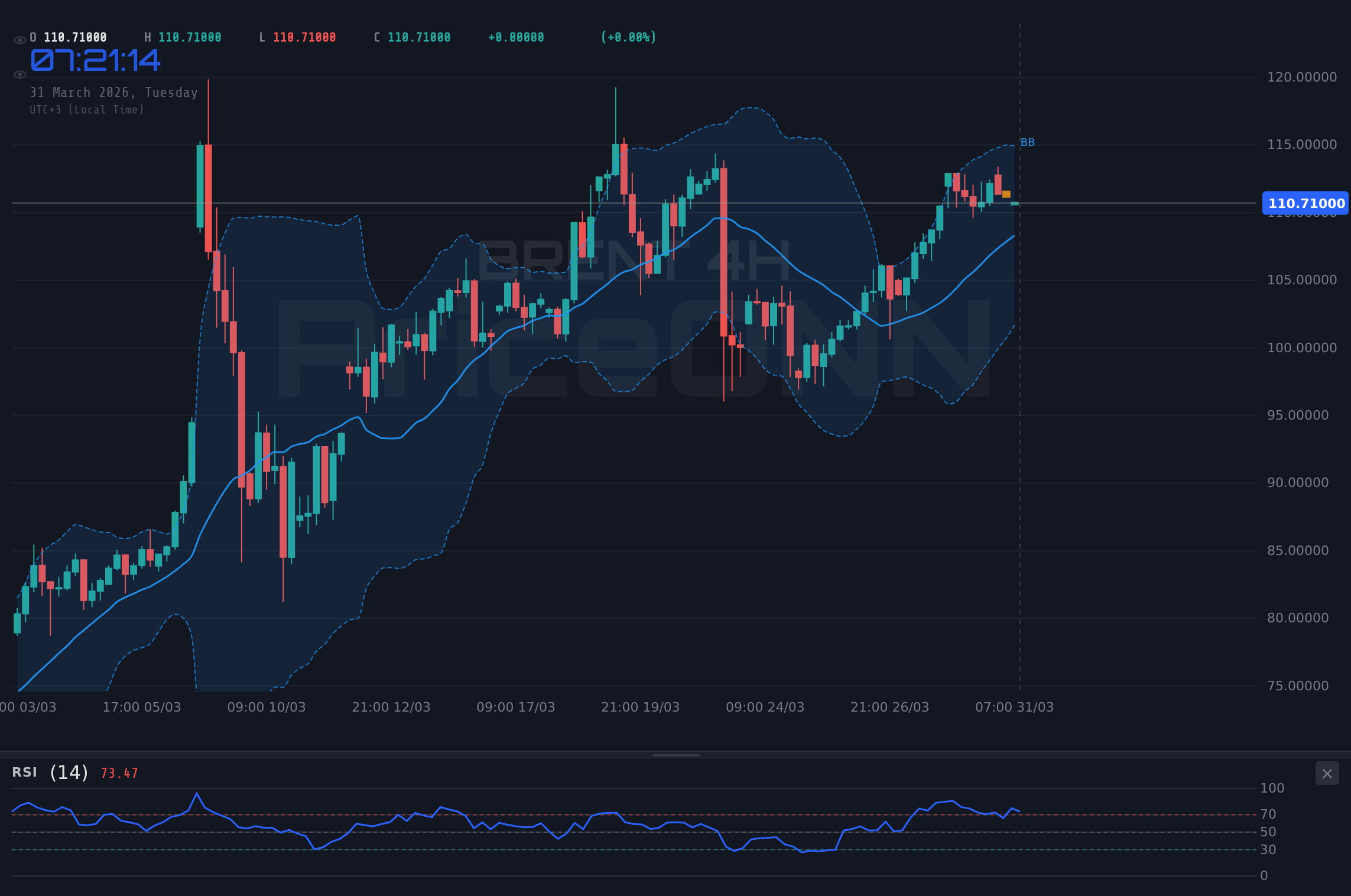
The bull case for BRENT hinges on several critical factors, primarily the persistent geopolitical instability and the perceived resilience of demand. The ongoing conflict in the Middle East, coupled with Europe's recurring energy crisis, creates a fundamental supply risk that cannot be ignored. When news emerges of Russia-Cuba fuel voyages testing U.S. policy or Europe grappling with supply shocks, the market immediately prices in potential disruptions. This narrative of tight supply, especially with OPEC+ production decisions often leaning towards maintaining current output levels, provides a strong underpinning for higher prices. Furthermore, the bullish sentiment is reflected in the technical indicators on the shorter timeframes. The 1-hour chart, for instance, shows a strong 'BUY' signal with an RSI of 52.77, MACD positive momentum, and Stochastic %K above %D at 32.5 vs 53.04 (though this last one is showing a slight caution, it's still within a bullish context when viewed with other indicators). The 4-hour chart echoes this, with a 'BUY' signal and RSI at 60.04, indicating a positive trend is in play on these intraday views.
Why $113.5 is the Next Hurdle
The immediate target for the bulls appears to be the resistance level around $113.5, a level that has been a significant pivot in recent price action. A decisive break above this mark, supported by increasing trading volumes and sustained buying pressure, could signal a continuation of the upward trend. The ADX on the 4-hour chart, though only 17.35, suggests that if momentum picks up, the trend could strengthen. Moreover, the daily chart, despite its overall bearish signal, does show a strong upward trend in terms of ADX (62.25), implying that when the trend does align, it does so with significant force. If the current bullish momentum manages to break through the $113.5 resistance, it could trigger a cascade of buying orders, potentially pushing prices towards the next resistance at $114.87 and even $116.81. This scenario is further bolstered by the fact that the daily Stochastic is showing a bullish crossover (%K > %D), which, if confirmed by other indicators, could signal a reversal or at least a significant upward correction.
However, the bears have a compelling argument rooted in the broader economic landscape and the longer-term technical outlook. The persistent inflation concerns, exacerbated by high energy prices, could lead to more aggressive monetary tightening by central banks. If the Federal Reserve, or indeed the ECB, signals a tougher stance on inflation, higher interest rates would typically dampen economic growth and, consequently, reduce demand for oil. This macroeconomic headwind is a significant threat to the bullish narrative. The daily chart's 'SELL' signal is a stark warning, with an RSI reading of 68.35 – while not yet in extreme overbought territory, it’s approaching a zone where pullbacks have historically occurred. The MACD on the daily chart is also below its signal line, indicating negative momentum. Furthermore, the ADX on the daily timeframe at 62.25 signifies a very strong trend – if that trend is indeed downwards, it implies substantial selling pressure could emerge.
The Case for Caution: Daily Chart Weakness
The bear case is significantly strengthened by the conflicting signals across different timeframes. While the 1-hour and 4-hour charts show buying interest, the daily perspective is undeniably bearish. A close below the current price of $110.88, and more importantly, a break below the support level at $110.19, would likely embolden sellers. The daily support levels at $108.25 and $106.88 become the next logical targets if the selling pressure intensifies. The Stochastic on the daily chart, despite a recent bullish crossover, is still in a position where a reversal could occur, especially if it fails to decisively move out of the lower ranges. The ADX, while indicating a strong trend, doesn't specify the direction; if the daily momentum shifts bearishly, this strong trend indicator would amplify the downside move. Traders focusing on the daily timeframe would likely be looking for confirmation of a sustained move below key intraday support levels before initiating short positions, but the overall bias from this longer timeframe is one of caution.
The correlation between BRENT prices and global economic health is undeniable. High oil prices, like the current $110.88, contribute to inflationary pressures, forcing central banks to consider tighter monetary policies. This creates a feedback loop: higher inflation leads to higher interest rates, which can slow economic growth, thereby reducing oil demand and potentially pushing prices down. This is the fundamental dilemma that policymakers and markets are grappling with. The recent news about Europe's recurring energy crisis and the U.S. considering policy shifts amid global energy scrambles highlights the delicate balance. While geopolitical events can cause short-term spikes, sustained high energy prices pose a significant macroeconomic risk that could ultimately cap the upside for BRENT.
From a technical standpoint, the confluence of indicators on the daily chart suggests that the current bullish momentum might be a temporary correction within a larger downtrend. The RSI at 68.35 is approaching overbought territory, and the MACD's position below its signal line on the daily chart cannot be ignored. The ADX at 62.25 indicates a strong trend, and if the market sentiment shifts, this strength could easily translate into a powerful bearish move. Support levels at $110.19, $108.25, and $106.88 become critical watchpoints. A failure to hold these levels could trigger significant liquidations and accelerate a downward move, potentially targeting much lower prices.
The narrative surrounding BRENT is further complicated by the broader market sentiment. While indices like the S&P 500 and Nasdaq are showing signs of resilience or potential retracement, their overall health is closely watched. A significant downturn in global equities, often triggered by inflation fears or geopolitical shocks, can spill over into commodity markets, reducing demand for risk assets like oil. Currently, the S&P 500 is showing a strong downtrend on the 4-hour and 1-day charts, which could signal a 'risk-off' environment, typically unfavorable for commodities like BRENT. This correlation analysis suggests that any major shift in equity markets could have a direct and immediate impact on oil prices.
Looking at the Forex market provides additional context. The Dollar Index (DXY) is showing strength, particularly on the 4-hour and 1-day charts, with RSI at 72.95 and 64.23 respectively. A stronger dollar generally puts downward pressure on dollar-denominated commodities like BRENT, as they become more expensive for holders of other currencies. This inverse relationship is a key factor to consider. While geopolitical events can sometimes override this correlation, the sustained strength in the DXY suggests that any significant upside move in BRENT might face headwinds from currency markets, unless the geopolitical risk premium becomes overwhelmingly dominant.
The market is currently at a crucial juncture. The bullish sentiment driving BRENT towards $110.88 and potentially higher is battling against the long-term bearish technicals and macroeconomic headwinds. The key takeaway is the divergence in signals across different timeframes. While short-term traders might find opportunities on the buy side, longer-term investors and swing traders need to pay close attention to the daily chart's bearish bias. The $113.5 resistance level is the immediate battleground. A decisive break above it, sustained by strong volume and confirmation from daily indicators, could open the door for further gains. Conversely, a failure to break higher and a subsequent move below support at $110.19 could signal a reversal, with bears aiming for lower levels.
Ultimately, the price action around $110.88 will be dictated by the interplay between ongoing geopolitical developments and the broader economic response. If supply disruptions remain the dominant narrative and demand proves resilient, BRENT could indeed push towards $113.5 and beyond. However, if inflation concerns lead to tighter monetary policy and slower global growth, the bearish signals on the daily chart could well materialize, leading to a significant correction. For now, the market is in a state of flux, with both bulls and bears having valid arguments. Patience and risk management will be paramount for any trader navigating these choppy waters.
The path forward for BRENT crude hinges on the market's ability to digest the current geopolitical risks against the backdrop of potential global economic slowdown. While the immediate technicals on shorter timeframes might suggest upward momentum, the persistent bearish signals on the daily chart, coupled with the DXY's strength and the specter of inflation-driven monetary tightening, present a significant challenge to sustained rallies. The $113.5 level stands as a critical psychological and technical barrier; its fate will likely determine the near-term direction. Traders must remain vigilant, closely monitoring both the headlines emanating from the Middle East and Europe, as well as the macroeconomic data that will shape central bank policy. The market is in a delicate balance, and the next move will depend on which narrative ultimately gains dominance.
The prevailing uncertainty means that while opportunities exist, they must be approached with disciplined risk management. The current price of $110.88 for BRENT crude is a pivotal point, and the battle between bullish momentum and bearish fundamentals will likely define the trading landscape in the coming days. Watching the key support at $110.19 and resistance at $113.5 will be crucial for understanding the market's next directional conviction. As the market digests these complex factors, adhering to a well-defined trading plan and respecting risk parameters will be the most effective strategy for navigating this volatile environment.
Bullish Scenario: Breaking Higher
35% ProbabilityConsolidation Scenario: Range-Bound Action
30% ProbabilityBearish Scenario: Pullback Incoming
35% ProbabilityFrequently Asked Questions: BRENT Analysis
What happens if BRENT breaks decisively above the $113.5 resistance level?
A sustained break above $113.5, confirmed by strong volume and positive daily indicators, could signal further upside potential. This scenario might target the next resistance at $114.87, fueled by bullish momentum and short-covering.
Should I consider selling BRENT at current levels around $110.88 given the daily chart's bearish signals?
Selling at current levels carries risk due to short-term bullish momentum. A more prudent approach might be to wait for a confirmed break below the $110.19 support level, aligning with the daily chart's bearish bias, before considering short positions with targets near $108.25.
How is the RSI at 68.35 on the daily chart interpreted for BRENT?
An RSI of 68.35 on the daily chart suggests that BRENT is approaching overbought territory but is not yet definitively there. While it indicates bullish momentum, it also warns of potential exhaustion and a possible pullback, especially if coupled with bearish divergences or a lack of follow-through buying.
How will continued Middle East tensions and potential Fed policy shifts impact BRENT prices this week?
Escalating geopolitical tensions could provide further upside impetus for BRENT, potentially pushing it towards $113.5 or higher. Conversely, any signs of more aggressive Fed tightening due to inflation fears could dampen demand and trigger a bearish reversal, despite the supply-side risks.
Track markets in real-time
AI-powered analysis, technical indicators and real-time price data.
Join Our Telegram Channel
Breaking market news, AI analysis and trading signals instantly.
Join Channel