EURUSD Dips to $1.15: Testing Key Support Amidst Global Uncertainty
EURUSD probes critical support at $1.14887 as a surge in oil prices and geopolitical tensions bolster the US Dollar, while German inflation data looms.
The EURUSD pair is currently navigating a crucial juncture, trading around the $1.15 mark. This level is more than just a psychological barrier; it represents a significant support zone that has historically provided a floor for the pair. However, the current market sentiment, heavily influenced by escalating geopolitical risks and a resurgent US Dollar, suggests that this support might be under severe pressure. We're seeing a confluence of factors – from rising oil prices to sticky inflation data in Europe – that are creating a complex and volatile environment for the Euro.
- EURUSD is trading near $1.15, testing the $1.14887 support level.
- The US Dollar Index (DXY) is strong, currently at 100.33, pressuring the Euro.
- Brent Crude oil is above $112, fueling inflation concerns and safe-haven demand for USD.
- German inflation data and ECB policy signals will be critical for the Euro's near-term direction.
Having closely monitored the Euro's trajectory, it’s clear that the current price action around $1.15 is more than just a technical pause; it's a battleground where fundamental forces are clashing. The Dollar Index (DXY) has climbed to 100.33, a level that historically correlates with headwinds for riskier assets and, by extension, the Euro. This strength in the dollar is not occurring in a vacuum; it's fueled by a global risk-off sentiment, partly driven by the surge in oil prices. Brent crude has breached $112.35, and WTI is pushing $105.11, reigniting inflation fears. For the European Central Bank (ECB), this presents a difficult dilemma: combatting inflation with potentially tighter monetary policy could stifle fragile economic growth, while inaction risks entrenched price pressures.
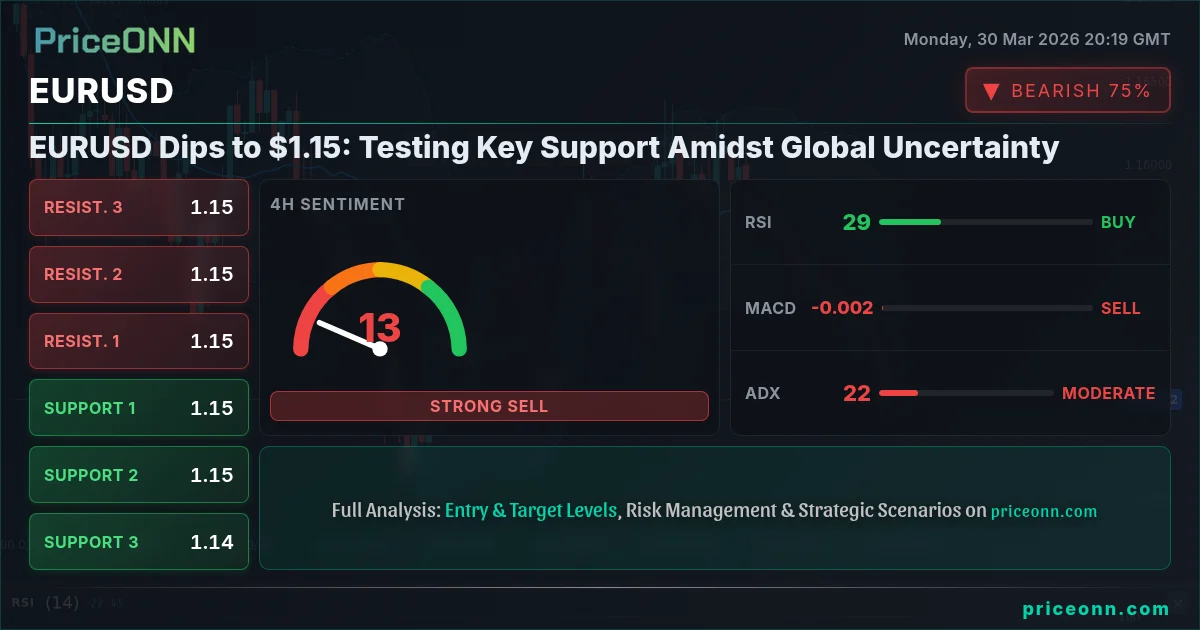
The technical indicators on the 1-hour chart for EURUSD paint a bearish picture, with the RSI at 30.08 indicating oversold conditions, but the trend is decidedly downwards, confirmed by a strong ADX of 31. The MACD is below its signal line, and Bollinger Bands are widening below the middle band, suggesting further downside potential in the short term. However, the 4-hour chart offers a slightly different perspective. While still showing a strong downtrend (ADX 21.85), the RSI at 29.02 is deep in oversold territory, and Stochastic is showing a potential buy signal with %K crossing above %D. This divergence between short-term bearish momentum and oversold conditions on the 4-hour chart suggests that a bounce from current levels is plausible, but it would require a significant shift in market sentiment or a dovish surprise from European economic data.
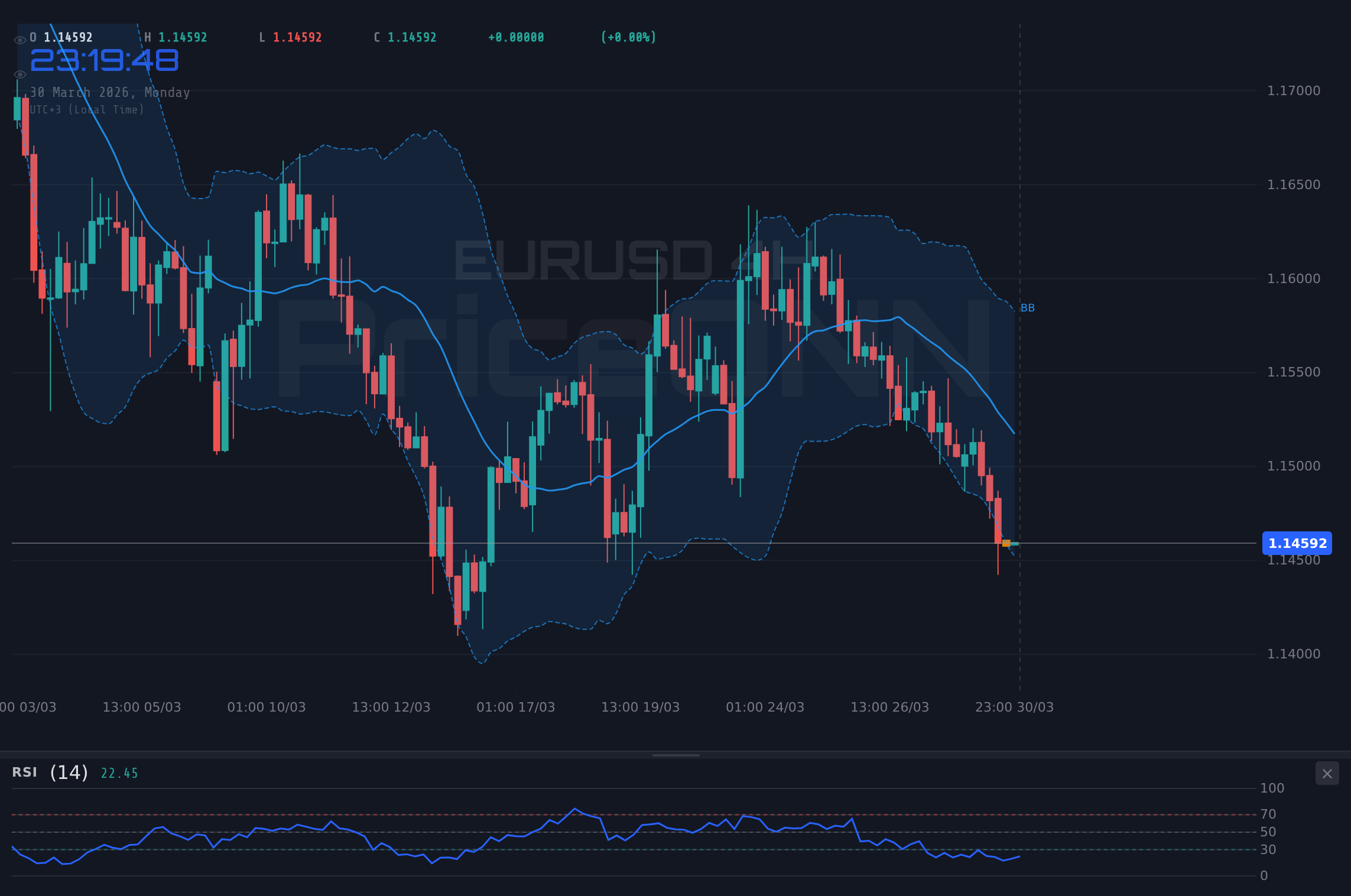
On the daily timeframe, the picture remains firmly bearish for EURUSD, with the trend strength at 100% and ADX at 34.13. The RSI at 40.73, while not oversold, indicates room for further decline before reaching the 30 level. The MACD has a positive momentum signal, but it's currently below the signal line, which is a bearish indication. The pair is trading below the middle Bollinger Band, reinforcing the bearish outlook. However, the Stochastic is showing a potential buy signal with %K above %D, although it's still in the lower range. This conflict between the strong daily downtrend and conflicting signals from oscillators like Stochastic suggests that while the overall bias is bearish, the probability of a short-term reversal or consolidation around the current support levels cannot be entirely dismissed. The key will be whether the pair can hold above the immediate support at $1.14887.
The Dollar's Dominance: A Multifaceted Strength
The US Dollar's resilience is a central theme in the current market. The DXY's ascent to 100.33 is not solely driven by a flight to safety. Several factors are at play. Firstly, the prospect of continued hawkishness from the Federal Reserve, or at least a prolonged period of higher-for-longer interest rates, continues to underpin the dollar. While market expectations for rate cuts have been pushed back, the Fed's resolve in tackling inflation, even amidst rising energy costs, provides a supportive backdrop. Secondly, the geopolitical landscape, with escalating tensions in the Middle East, naturally drives safe-haven flows towards the dollar, traditionally seen as the ultimate safe asset. This dual support – monetary policy divergence and geopolitical risk – creates a potent combination for dollar strength.
The correlation between the DXY and EURUSD is particularly noteworthy. With the DXY at 100.33, we see EURUSD pressured, currently trading at $1.15. This inverse relationship means that any further strength in the dollar, perhaps driven by stronger-than-expected US economic data or more aggressive Fed rhetoric, would likely push EURUSD lower. Conversely, a significant pullback in the DXY, perhaps triggered by a sudden de-escalation of geopolitical tensions or a dovish surprise from upcoming US employment figures, could provide much-needed relief for the Euro.
European Economic Crossroads: Inflation vs. Growth
The Eurozone faces a delicate balancing act. On one hand, rising energy prices, exacerbated by geopolitical conflicts, are pushing inflation higher. Reports indicate that German inflation could spike to 2.7% in March, a figure that will undoubtedly concern the ECB. This could create pressure for the central bank to adopt a more hawkish stance, potentially signaling a readiness to hike rates or at least maintain a tightening bias for longer. Such a move, if it materializes, could offer some support to the Euro by widening interest rate differentials with other major economies.
However, this inflation surge comes at a precarious time for the European economy. Growth prospects remain subdued, and the specter of recession looms large. A premature or overly aggressive tightening by the ECB, in response to energy-driven inflation, could choke off any nascent recovery, leading to stagflationary pressures. This is the tightrope the ECB walks: fighting inflation without tipping the economy into a deeper downturn. The market will be scrutinizing every word from ECB officials and every piece of economic data, particularly inflation and growth figures, for clues on the central bank's next move. The divergence between the Fed's current trajectory and the ECB's uncertain path is a key driver of the EURUSD's weakness.
The Oil Shock and its Ripple Effects
The surge in oil prices is a significant macroeconomic event with far-reaching consequences. For the Eurozone, which is heavily reliant on energy imports, higher oil prices directly translate into higher inflation and a widening trade deficit. This puts downward pressure on the Euro, as demand for the currency decreases to pay for more expensive imports. The conflict in the Middle East, as highlighted by recent news, is a primary driver, disrupting supply chains and creating supply shocks. This situation also benefits the US, a net energy exporter, further strengthening the dollar's relative appeal.
The impact of oil prices extends beyond direct inflation. Higher energy costs can dampen consumer spending and business investment, acting as a drag on economic growth. This could lead to reduced corporate earnings, potentially impacting equity markets. As seen with the Nasdaq plunging 12.5%, risk appetite is waning, which typically favors safe-haven assets like the US Dollar and can put pressure on riskier currencies like the Euro. The correlation between oil prices and inflation expectations means that sustained high oil prices could force central banks globally to maintain tighter monetary policies, further influencing currency dynamics.
Navigating the Support Levels: What Traders Should Watch
For traders focused on EURUSD, the immediate price action around $1.15 is critical. The first line of defense is the support level at $1.14887, followed by $1.14721 and $1.14429 on the daily chart. A decisive break below $1.14887, especially on increased volume, would signal a continuation of the bearish trend and could open the door for a move towards the lower support levels. The ADX at 34.13 on the daily chart indicates a strong existing trend, making a sustained bounce from these levels less likely without a significant catalyst.
However, we must also consider the potential for a short-term bounce. The oversold conditions indicated by the Stochastic oscillator on the 4-hour chart, coupled with the fact that the pair is trading near significant daily support, could lead to a technical rebound. A move back above $1.15345 (daily resistance) would be necessary to invalidate the immediate bearish outlook and suggest a potential test of higher levels. Traders will be closely watching the RSI on the 1-hour chart, currently at 30.08, for any signs of divergence or a move back into neutral territory. Confirmation would likely require breaking through immediate resistance levels and a concurrent weakening of the DXY.
EURUSD Trading Scenarios: A Path Forward
Bearish Continuation: Euro's Downward Spiral
65% ProbabilityConsolidation Around Support: A Brief Respite?
25% ProbabilityShort-Term Rebound: Technical Bounce from Oversold
10% ProbabilityThe current technical setup on EURUSD, particularly the oversold conditions on the 4-hour chart and the testing of significant daily support at $1.14887, suggests that a short-term bounce is a possibility, albeit a low-probability one given the prevailing bearish trends and dollar strength. However, the dominant narrative remains bearish. A break below $1.14887 would likely trigger further downside, driven by the strong dollar and persistent inflation concerns in Europe. Traders need to remain vigilant, manage risk effectively, and wait for clear confirmation before committing to a direction. The upcoming German inflation data and any further signals from the ECB or the Fed will be crucial in determining whether the Euro can find a more sustainable footing or if the current dip is just the precursor to further declines.
Frequently Asked Questions: EURUSD Analysis
What happens if EURUSD breaks below the $1.14887 support level?
A break below $1.14887 would reinforce the bearish trend, with the next significant support levels at $1.14721 and $1.14429. This scenario is supported by the strong daily downtrend (ADX 34.13) and the prevailing strength of the US Dollar Index (DXY) at 100.33.
Should I consider buying EURUSD at current levels around $1.15 given the oversold RSI on the 4-hour chart?
While the 4-hour RSI at 29.02 and Stochastic showing a buy signal suggest a potential for a technical bounce, the overall daily trend remains bearish (ADX 34.13). A cautious approach is advised; wait for confirmation such as a close above $1.15345 or a significant pullback in the DXY before considering long positions.
Is the RSI at 30.08 on the 1-hour chart a sell signal for EURUSD?
An RSI of 30.08 on the 1-hour chart indicates oversold conditions, which typically suggests a potential for a short-term reversal or consolidation rather than a direct sell signal. However, given the strong bearish trend (ADX 31), it's more indicative of downside momentum potentially exhausting temporarily, rather than a signal to buy.
How will upcoming German inflation data affect EURUSD this week?
If German inflation surges above expectations, currently forecast around 2.7%, it could pressure the ECB towards a more hawkish stance. This might initially support the Euro by widening rate differentials, but could also raise stagflation concerns, potentially capping gains and keeping EURUSD near current levels or even pressuring it lower if growth fears dominate.
Technical Outlook Summary
| Indicator | Value | Signal | Interpretation |
|---|---|---|---|
| RSI (14) | 40.73 | Neutral | Daily RSI is in neutral territory, leaning bearish. |
| MACD Histogram | -0.00453 | Bearish | Negative momentum on daily chart. |
| Stochastic | K=39.87, D=64.51 | Bearish | Bearish crossover on daily chart. |
| ADX | 34.13 | Bullish | Strong downtrend indicated on daily chart. |
| Bollinger Bands | Below Middle Band | Bearish | Price trading below the middle band on daily chart. |
Key Levels
Support Levels
Resistance Levels
The path forward for EURUSD hinges on the interplay between geopolitical developments, central bank policies, and crucial economic data. While the immediate technicals suggest bearish pressure, the oversold conditions on shorter timeframes hint at potential for a short-term bounce. However, without a clear shift in the macro narrative - such as a de-escalation in global tensions, a dovish pivot from the Fed, or surprisingly strong European growth data - the dominant trend is likely to remain under pressure. Traders must prioritize risk management, as volatility is set to continue. Patience and adherence to well-defined trading plans will be key to navigating these choppy waters. The market always presents opportunities, but they often come after periods of uncertainty and require disciplined execution.
Track markets in real-time
AI-powered analysis, technical indicators and real-time price data.
Join Our Telegram Channel
Breaking market news, AI analysis and trading signals instantly.
Join Channel