EURUSD Tests $1.15 Support: Bears Eyeing Key Levels Amidst Dollar Strength
EURUSD probes critical support at $1.15204 as the DXY strengthens. Bears target 1.15093, while bulls await confirmation for any upside potential.
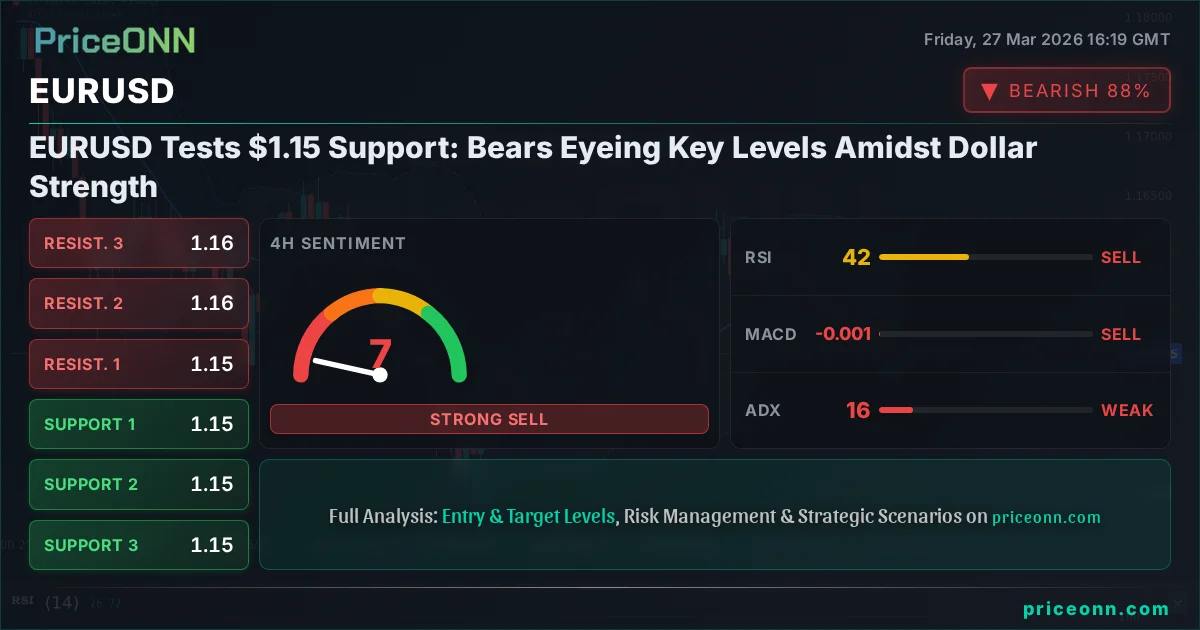
EURUSD is currently trading at $1.15204, testing a crucial support level that has captured the attention of traders and analysts alike. The pair has seen a modest daily decline of -0.09%, reflecting a broader market dynamic where the US Dollar Index (DXY) is exhibiting strength, currently at 99.86. This interplay between the euro and the dollar is central to understanding the immediate price action and potential future direction. The prevailing sentiment, as indicated by the 1-hour trend analysis, leans bearish with a strong conviction (93% power), suggesting that downside risks are currently more pronounced than upside opportunities. However, the longer-term daily chart presents a more nuanced picture, with a strong downtrend in place but mixed signals from shorter-term indicators, hinting at potential volatility around these key levels.
- EURUSD is currently testing support at $1.15204, with a strong bearish trend indicated on the 1-hour timeframe (93% power).
- The US Dollar Index (DXY) is at 99.86, showing upward momentum which typically pressures EURUSD downwards.
- Key support levels to watch are $1.15221, $1.15162, and $1.15098, with $1.15093 being a significant target for bears.
- Resistance is building around $1.15344, $1.15408, and $1.15467, levels that need to be cleared for any bullish reversal to gain traction.
- Upcoming economic data releases, particularly from the US, will be critical in shaping the outlook for EURUSD in the coming days.
The Euro Under Pressure: Why the Dollar is Gaining Traction
Dollar Strength and the EURUSD Correlation
The strength of the US Dollar, as measured by the DXY, is a pivotal factor influencing EURUSD's trajectory. With the DXY currently at 99.86 and showing a clear upward trend across multiple timeframes, the euro finds itself on the back foot. Historically, a rising dollar tends to exert downward pressure on major currency pairs like EURUSD, as it makes dollar-denominated assets more attractive and increases the cost of holding other currencies. This correlation is evident in the current market setup, where the dollar's upward momentum is coinciding with EURUSD's struggle to maintain higher ground. The 4-hour trend for DXY is strongly bullish (95% power), reinforcing the narrative of dollar outperformance.
Navigating Mixed Signals on the Daily Chart
While the short-term outlook for EURUSD appears bearish, the daily chart presents a more complex picture. The overall trend is decisively downwards (97% power), but the RSI(14) at 40.95 indicates it's not yet in oversold territory, suggesting room for further decline. However, the MACD is showing positive momentum, trading above its signal line, which can sometimes precede a shift in trend or a significant correction. The Stochastic oscillator, with %K at 52.05 and %D at 66.53, is flashing a bearish signal (%K < %D), aligning with the broader downtrend. Yet, the ADX at 34.07 confirms a strong trend, but the directionality of shorter-term indicators like MACD warrants close observation. This divergence between short-term bullish signals and the dominant long-term downtrend creates a degree of uncertainty, suggesting that the market might be consolidating before its next major move.
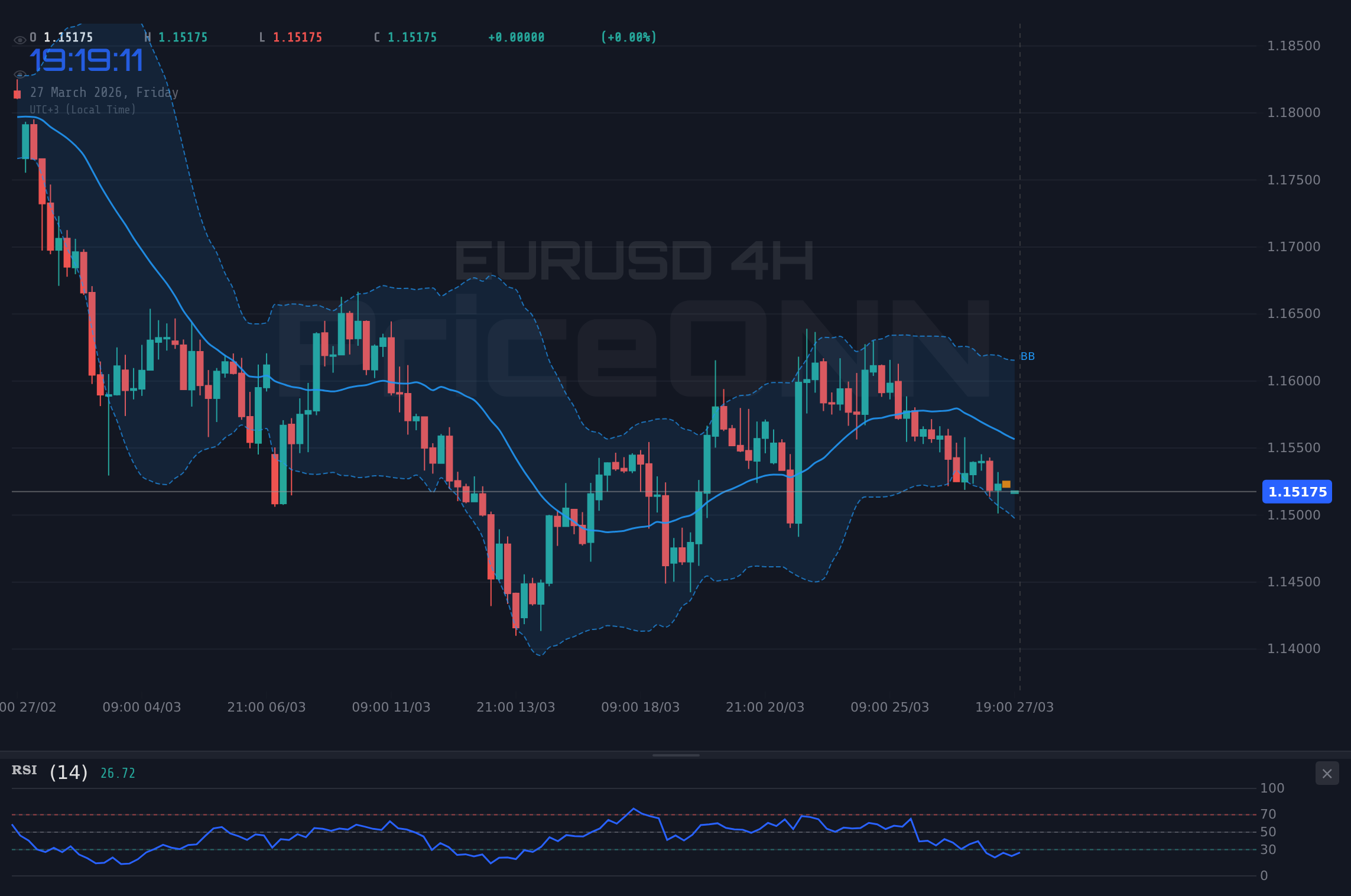
Bearish Scenario: The Path Towards 1.15093
Key Levels to Watch for Downside Confirmation
For the bearish sentiment to solidify and push EURUSD lower, bears will be looking to break through several critical support levels. The immediate support is found at $1.15221, followed by $1.15162. A decisive break and hold below these levels would likely pave the way for a test of the more significant support at $1.15098. This level is particularly noteworthy as it represents a key psychological barrier and a level where substantial buying interest has historically emerged. If this barrier is breached, the next logical target for sellers would be the $1.15093 mark, a level that aligns with the lower end of the daily trading range and offers a clear objective for a short-term bearish move. The strength of the downtrend on the 1-hour chart (93% power) lends credibility to this scenario, suggesting that sellers are in firm control in the immediate term.
What Economic Data Could Fuel the Sell-off?
Several upcoming economic data releases could provide the catalyst for a sustained bearish move in EURUSD. While the provided calendar data is sparse on specific dates for the USD releases, the actual figures released (52.4 for one indicator, 51.1 for another, and 6.926 for a third) suggest a mixed but potentially strengthening US economy. If future US data, particularly on employment and inflation, continues to surprise to the upside, it would reinforce the Federal Reserve's stance on monetary policy and likely boost the dollar further. Conversely, any signs of weakness in the Eurozone economy, such as a disappointing PMI or inflation figure, would exacerbate the downward pressure on EURUSD. The market is keenly watching for any indication that the Fed might be shifting its focus back to inflation concerns, as suggested by recent news headlines, which could further strengthen the dollar and push EURUSD towards lower support levels. The absence of specific dates for these high-impact events adds an element of uncertainty, but the general trend of potentially stronger US economic readings keeps the bearish bias intact.
Bullish Scenario: A Bounce from Support?
Conditions for a EURUSD Reversal
For the bulls to regain control, EURUSD must first demonstrate resilience around the current support levels. A failure to break below $1.15162 and especially $1.15098 would be the initial sign of strength. The pair would then need to reclaim the immediate resistance at $1.15344. A decisive move above this level, followed by a break of $1.15408, would start to paint a more constructive picture. Confirmation would come with a sustained push above the $1.15467 resistance. On the technical front, a bullish divergence on the RSI or MACD, or a bullish crossover on the Stochastic oscillator on the daily chart, would be needed to signal a potential bottom. The 4-hour chart offers some glimmer of hope, with a generally 'AL' (Buy) signal from its technical indicators, despite the overall bearish trend. However, this bullish scenario currently appears less probable given the dominant downtrend and dollar strength.
What Could Trigger a Euro Rally?
A significant shift in market sentiment or a dovish surprise from the Federal Reserve could potentially trigger a rally in EURUSD. If upcoming US economic data surprises to the downside, particularly on inflation or employment, it could lead to a reassessment of Fed rate hike expectations. This would likely weaken the dollar and provide a much-needed boost to the euro. Similarly, any positive news from the Eurozone, such as stronger-than-expected manufacturing or services PMIs, or a more hawkish tone from the European Central Bank, could support the single currency. The current risk-off sentiment, as reflected in the sharp declines in S&P 500 (-1.09%) and Nasdaq (-1.3%), generally favors safe-haven assets like the dollar, making a strong euro rally contingent on a significant reversal in global risk appetite or a clear shift in central bank policy divergence.
The Waiting Game: EURUSD in Consolidation
Range-Bound Trading Conditions
Should EURUSD fail to decisively break either support or resistance, the pair could enter a period of consolidation. This would likely occur if upcoming economic data from both the US and Eurozone proves to be mixed or largely in line with expectations, providing no clear direction. In such a scenario, the price action would be confined within the established range, likely between the immediate support at $1.15221 and resistance at $1.15344 in the short term, or a wider range defined by the daily support and resistance levels. The weak trend signals on the 1-hour ADX (16.38) and 4-hour ADX (16.02) support the idea of a range-bound market, where price swings are more influenced by technical levels than strong fundamental drivers. Traders would need to look for clear breakouts from this range, confirmed by increasing volume and momentum, to initiate new positions.
Factors Keeping EURUSD Stuck
Several factors could contribute to a period of consolidation for EURUSD. Firstly, the upcoming economic calendar, while featuring high-impact events, lacks specific dates in the provided data, creating uncertainty about when the market might receive definitive directional cues. Secondly, the conflicting signals from different timeframes and indicators can lead to indecision. While the 1-hour and 4-hour charts show bearish trends, the daily MACD suggests positive momentum, and the Stochastic is showing mixed signals across timeframes. This technical ambiguity can trap price action within a range. Furthermore, a balanced global risk sentiment, where neither risk-on nor risk-off dominates, can lead to currencies trading in lockstep with their respective economic fundamentals rather than reacting strongly to broad market sentiment. This equilibrium, if it occurs, would keep EURUSD pinned between its key support and resistance levels.
The Most Likely Scenario: A Bearish Bias Persists
Probability Assessment and Reasoning
Given the current market data and the prevailing macroeconomic environment, the bearish scenario appears to be the most probable outcome in the short to medium term. The strong bearish trend on the 1-hour (93% power) and daily (97% power) charts, coupled with the strengthening US Dollar (DXY at 99.86 and rising), provides a strong foundation for further downside. The immediate support at $1.15221 and $1.15162 are likely to be tested, with a potential break towards $1.15093. The recent sharp declines in major US indices like the S&P 500 (-1.09%) and Nasdaq (-1.3%) also indicate a risk-averse environment, which typically favors the dollar as a safe-haven asset. While some technical indicators on the daily chart show potential for a bounce, the overwhelming trend strength and dollar momentum suggest these are more likely to be temporary corrections within a larger downtrend. I would assign approximately a 65% probability to the bearish scenario playing out in the coming days to a week.
What's Next? Key Triggers to Watch
The key to navigating the current EURUSD landscape lies in monitoring specific triggers that could confirm or invalidate these scenarios. Firstly, watch for a decisive close below the $1.15093 support level on the 4-hour or daily chart. This would be a strong confirmation of the bearish outlook and could open the door to further declines. Secondly, keep an eye on the US Dollar Index (DXY). A sustained move above 100.00 would likely amplify the pressure on EURUSD. Conversely, a break below the immediate DXY support at 99.77 could signal a temporary dollar pullback, potentially offering a reprieve for the euro. Thirdly, upcoming economic data, especially from the US (PMI, employment figures), will be crucial. Any significant deviation from expectations, particularly negative surprises, could shift the narrative and challenge the prevailing dollar strength. Finally, monitor the price action around the $1.15344 resistance level; a failure to break above it on increased volume would reinforce the bearish bias.
Bearish Outlook: Downside Momentum Dominates
65% ProbabilityConsolidation Phase: Range-Bound Trading
25% ProbabilityBullish Reversal: A Fight for Higher Ground
10% ProbabilityFrequently Asked Questions: EURUSD Analysis
What happens if EURUSD breaks below the $1.15093 support level?
A confirmed break below $1.15093 on the daily chart would signal a strong bearish continuation, likely targeting the next support at $1.14956. This would be driven by persistent dollar strength and potentially weaker-than-expected Eurozone data.
Should I consider buying EURUSD at current levels around $1.15204 given the mixed daily signals?
Buying at current levels is not recommended due to the strong bearish trend on shorter timeframes and the rising DXY. A more prudent approach would be to wait for a clear break of resistance above $1.15467 or confirmation of a strong bounce from the $1.15093 support, with a probability estimate of at least 60% for the bearish scenario.
Is the RSI at 40.95 on the daily chart a sell signal for EURUSD?
An RSI of 40.95 is not an extreme sell signal in itself, as it falls within the neutral zone. However, it does indicate a downward eğilim and suggests that while there might be room for further downside, the pair is not yet oversold. This reading supports the prevailing bearish trend rather than signaling an immediate reversal.
How might upcoming US economic data impact EURUSD this week, given the DXY at 99.86?
Stronger-than-expected US data, especially on inflation or employment, would likely reinforce dollar strength, pushing EURUSD lower towards $1.15093. Conversely, any data surprises to the downside could weaken the dollar, potentially triggering a short-covering rally towards $1.15400.
Track markets in real-time
AI-powered analysis, technical indicators and real-time price data.
Join Our Telegram Channel
Breaking market news, AI analysis and trading signals instantly.
Join Channel