

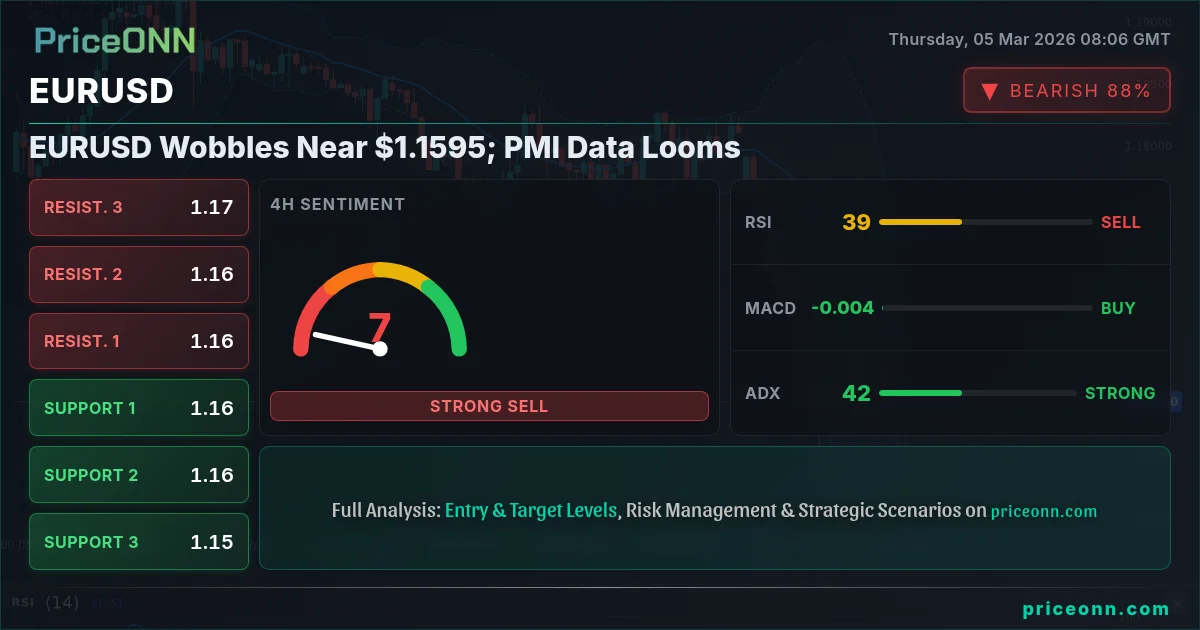
EURUSD is currently trading around $1.1595, struggling to maintain upward momentum as the dollar index strengthens. The pair is navigating a complex landscape of economic data releases and shifting market sentiment, with traders closely watching for signals from upcoming PMI figures.
The euro dollar trading strategy hinges significantly on the interplay between technical indicators and fundamental economic releases. Currently, the technical picture presents a mixed outlook, with the 1-hour chart showing a neutral trend but a bearish RSI reading of 42.21, suggesting potential for further downside. This bearish sentiment is echoed in the broader market, as the SP500 faces downward pressure, trading at 6846.05, indicating declining risk appetite that could further support the dollar.
Analyzing the technical indicators further, the ADX on the 4-hour chart shows a strong downtrend at 42.17. This suggests that the bearish momentum is not just a short-term phenomenon, but rather a sustained pressure that could drive EURUSD lower. However, the Stochastic indicator on the same timeframe shows a bullish signal with K=62.05 and D=59.15, creating a conflicting picture that requires careful interpretation.
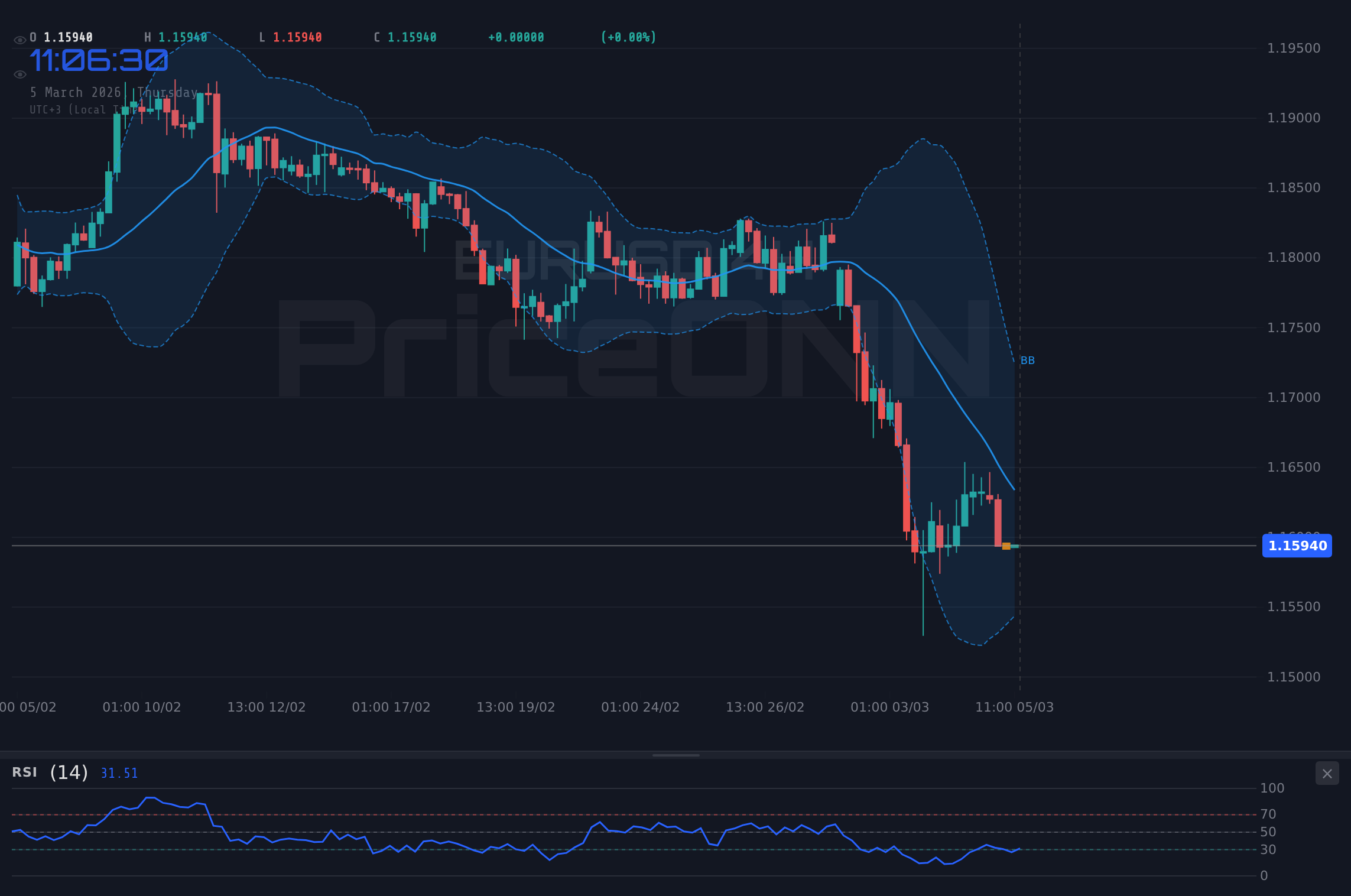
Key support levels to watch include 1.15908 on the 1-hour chart, followed by 1.15862 on the daily chart. A break below these levels could open the door for a test of lower support at 1.15401. On the upside, immediate resistance is found at 1.16188. A sustained move above this level would be needed to negate the current bearish bias. With the DXY currently at 98.81, any further strengthening of the dollar index will likely exacerbate the downward pressure on EURUSD.
The upcoming PMI data is a crucial factor to consider. As indicated in the economic calendar, key PMI figures are on the horizon, and any deviation from expectations could trigger significant volatility in EURUSD. Traders will be particularly focused on the Eurozone's manufacturing and services PMI readings, as these indicators provide valuable insights into the health of the Eurozone economy. Disappointing PMI numbers could reinforce concerns about a potential slowdown in economic growth, further weighing on the euro.
From a fundamental perspective, the recent weakness in EURUSD can be attributed to a combination of factors, including diverging monetary policies between the Federal Reserve and the European Central Bank (ECB). While the Fed has signaled a more hawkish stance, with expectations of further interest rate hikes, the ECB has maintained a more dovish approach, citing concerns about the impact of rising interest rates on economic growth. This divergence in monetary policy expectations has widened the interest rate differential between the US and the Eurozone, making the dollar more attractive to investors.
Geopolitical risks also play a significant role in shaping the EURUSD outlook. As highlighted in recent news, tensions in the Middle East and concerns about global trade relations continue to weigh on market sentiment, driving investors towards safe-haven assets like the US dollar. This safe-haven demand for the dollar further strengthens the DXY, putting additional pressure on EURUSD. The recent news about US-Japan nuclear deal talks amid trade war fears also adds to the uncertainty, as it could have implications for energy investors and global trade dynamics.
The current technical setup suggests a cautious approach is warranted. The bearish RSI and ADX readings indicate potential for further downside, but the conflicting signals from the Stochastic indicator highlight the need for confirmation. Traders should closely monitor the key support levels and watch for a break below 1.15908 to confirm the bearish bias. On the upside, a sustained move above 1.16188 would be needed to negate the current downward pressure.
Considering the prevailing market conditions, a euro dollar trading strategy should focus on risk management and patience. Given the conflicting signals and the potential for volatility surrounding the upcoming PMI data, traders should avoid making hasty decisions and instead wait for clear confirmation of the trend. A conservative approach would be to wait for a break below 1.15908 to consider short positions, with a stop-loss order placed above 1.16188 to limit potential losses. Alternatively, traders could look for opportunities to buy EURUSD on dips, targeting a rebound towards 1.16468, but only if the PMI data comes in better than expected.
Furthermore, correlation analysis reveals that EURUSD is highly sensitive to movements in the DXY. With the DXY currently at 98.81 and showing signs of further strength, EURUSD is likely to remain under pressure. Traders should therefore closely monitor the DXY and adjust their trading strategy accordingly. A break above 99.00 in the DXY could trigger a sharp decline in EURUSD, while a pullback in the DXY could provide some relief for the euro.
The EURUSD pair is navigating a complex landscape of technical and fundamental factors. The bearish RSI and ADX readings suggest potential for further downside, but the conflicting signals from the Stochastic indicator highlight the need for confirmation. The upcoming PMI data is a crucial catalyst to watch, and traders should exercise caution and patience, focusing on risk management and waiting for clear confirmation of the trend. With the DXY currently at 98.81 and showing signs of further strength, EURUSD is likely to remain under pressure in the near term.
Frequently Asked Questions: EURUSD Analysis
Is EURUSD a good buy right now?
Given the current price of $1.1595, bearish RSI, and strong DXY, EURUSD is not a strong buy right now. Waiting for confirmation of a reversal or a break above 1.16188 is advised before considering long positions.
What is the EURUSD price forecast for this week?
The EURUSD price forecast for this week is cautiously bearish, targeting support around 1.15862. A break below this level could lead to further declines towards 1.15401 if negative PMI data is released.
What are the key support and resistance levels for EURUSD?
Key support levels for EURUSD are at 1.15908 and 1.15862. Key resistance levels are at 1.16188 and 1.16468, both acting as barriers to upward price movement.
Why is EURUSD moving today?
EURUSD is moving lower today due to a strengthening dollar index (DXY at 98.81) and anticipation of upcoming PMI data. Bearish technical signals also contribute to the downward pressure.
Track markets in real-time
AI-powered analysis, technical indicators and real-time price data.
Join Our Telegram Channel
Breaking market news, AI analysis and trading signals instantly.
Join Channel