
Gold vs. Dollar: The Enduring Dilemma for Turkish Investors
A comprehensive analysis of the gold vs. dollar dilemma for Turkish investors, covering historical performance, hidden costs, digital alternatives, and diversification strategies. Learn how to make informed decisions based on your individual circumstances and risk tolerance.
Introduction: The Timeless Question
In Turkey, the question of whether to invest in gold or the dollar is pervasive. From family gatherings to workplace lunches, even casual conversations often revolve around this fundamental choice: "Should I buy gold, or dollars?" This question is deeply ingrained in the Turkish psyche, a response to decades of high inflation, currency volatility, and economic uncertainty. In this environment, the primary concern for the average citizen is simple: "How can I protect the value of my money?"
However, the answer isn't as straightforward as simply choosing "gold" or "dollar." The options within each asset class are diverse. With gold, one might consider physical gold from a jeweler, gold bullion from a bank, or trading XAUUSD on the stock exchange. Similarly, investing in the dollar presents complexities, from holding cash to opening a foreign currency deposit account or a term deposit.
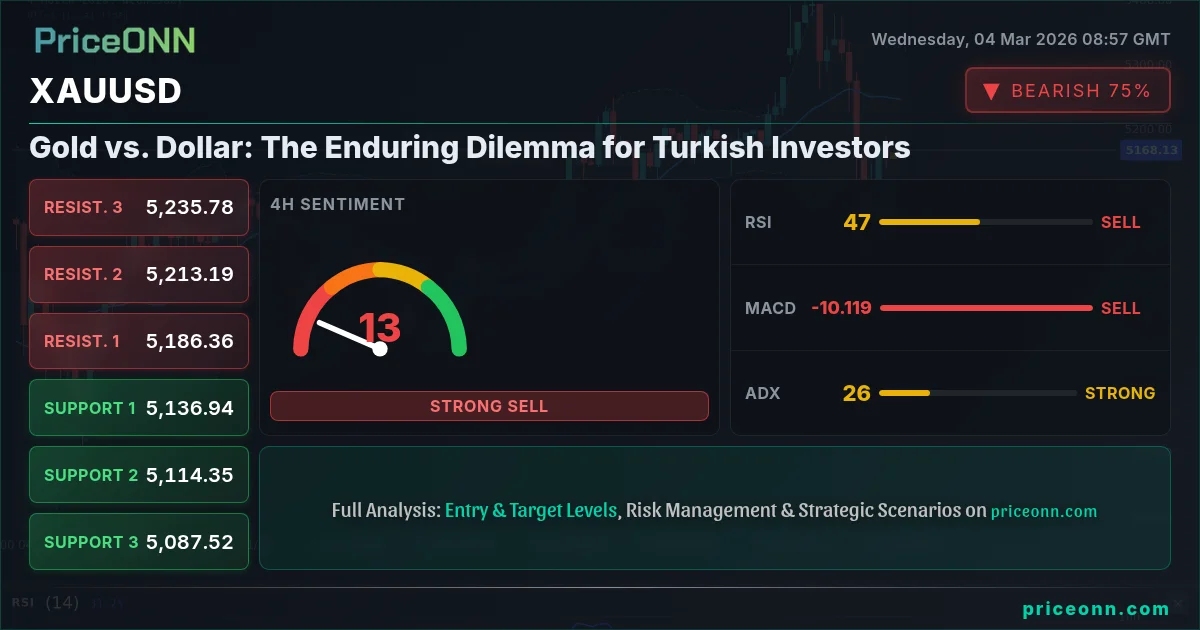
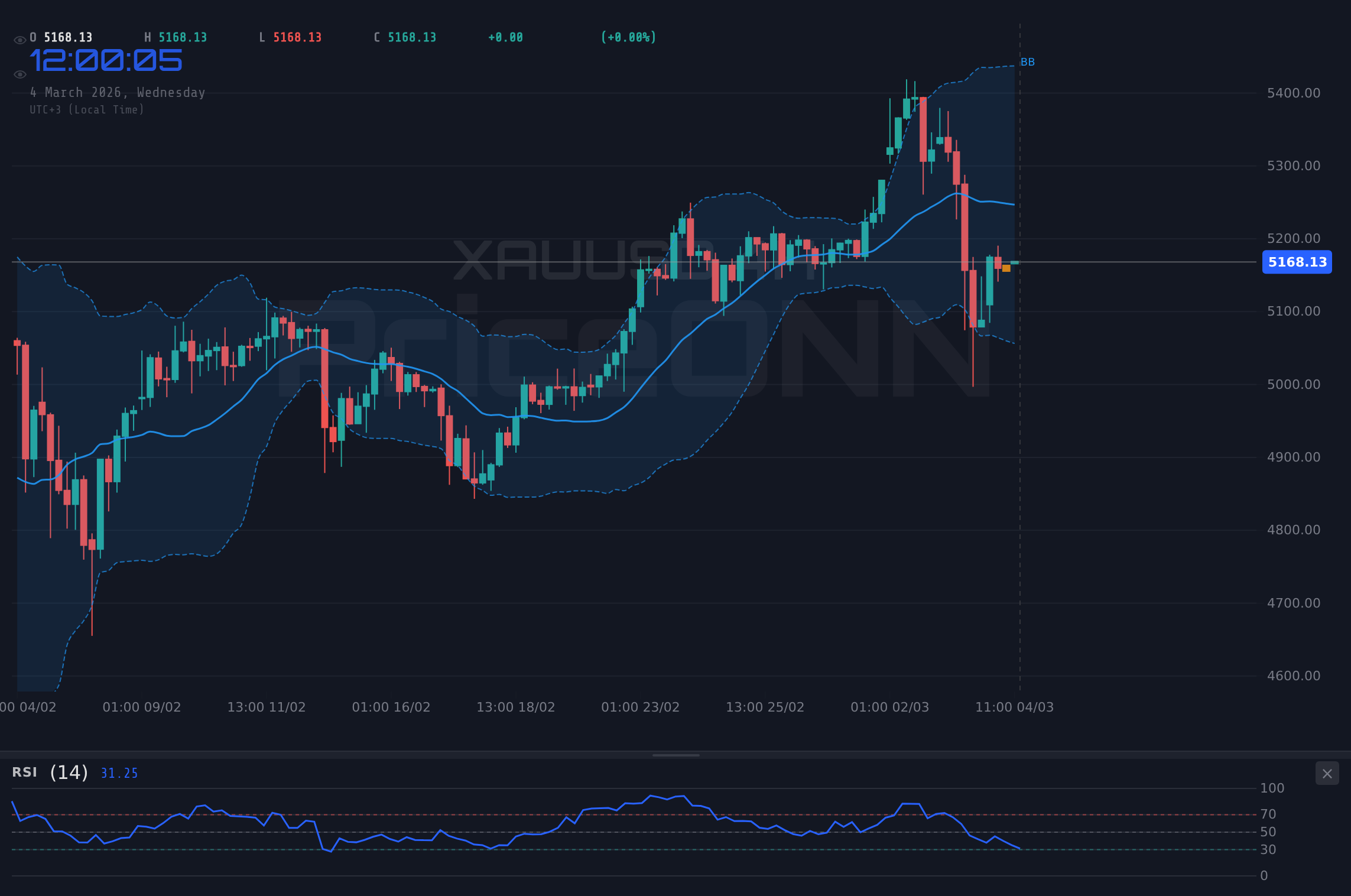
This article will explore the enduring dilemma faced by Turkish investors from every angle. We'll compare the historical performance of gold and the dollar, examine the differences between physical and digital gold, reveal the hidden costs of buying gold jewelry, and, most importantly, explain how to use these two investment vehicles not as competitors, but as complementary components of a diversified portfolio. We will also consider the current market data, including the XAUUSD price which currently sits at 5173.13, and the potential impacts of upcoming economic calendar events.
Two Reflexes in the DNA of the Turkish Investor
In Turkey, the words "investment" immediately conjure up images of gold and dollars. This isn't accidental. It's a survival reflex learned from decades of economic experience.
Gold: Trust Inherited from Grandmothers
In Turkish society, gold is more than just an investment vehicle. It's a cultural symbol. From bracelets gifted at weddings to gold coins placed under a newborn's pillow, gold represents the physical manifestation of a savings tradition passed down through generations. This cultural connection elevates trust in gold beyond purely financial calculations. For many Turkish investors, buying gold is not just a portfolio decision but also a connection to tradition and a sense of security. The thought, "At least I have my gold," has sustained families across Anatolia for centuries.
Dollar: A Shield Against Inflation
The dollar, especially since the 1990s, has become the most practical shield against inflation for the Turkish people. During periods of triple-digit inflation, people who converted their salaries into dollars on payday were able to maintain their purchasing power by the end of the month. The 2001 crisis, the 2018 currency shock, the pandemic era - in every major economic upheaval, those who held dollars fared much better than those who remained in Turkish Lira. This experience has left a deep mark on the collective memory. The belief that "the dollar always wins" is essentially a reversed observation: "the Turkish Lira always loses value."
What Do the Numbers Say? A Historical Comparison
Let's put aside emotional ties and cultural habits and look at the numbers objectively. How have gold and the dollar performed against the Turkish Lira over the past 10, 20, and 30 years?
Last 10 Years (2016-2026)
At the beginning of 2016, a gram of gold was around 115-120 TL. By 2026, this figure had multiplied significantly. The dollar, similarly, rose dramatically from approximately 2.90 TL during the same period. Both assets provided substantial returns in Turkish Lira terms. However, gold, especially after 2020, outperformed the dollar due to both the rise in global gold prices and the depreciation of the Turkish Lira. The reason is simple mathematics: gold operates with a dual engine. The price of gold increases both when the international gold price rises and when the Turkish Lira depreciates. The dollar, on the other hand, operates with only one engine - the depreciation of the Turkish Lira.
Long-Term Picture
From a 30-year perspective, both gold and the dollar have provided striking returns against the Turkish Lira. However, gold's long-term performance, especially when combined with the super cycle in the international gold market since the early 2000s, has surpassed the dollar. A crucial point here is that past performance does not guarantee future performance. Gold's superiority over the dollar largely depends on the long-term upward trend in global gold prices. If the international gold price falls, the price of gold in Turkish Lira terms may also decline, as happened between 2013 and 2015.
Jeweler's Gold: Hidden Costs
In Turkey, many people still think of jewelers when they think of gold. Gold coins, half gold coins, full gold coins, bracelets - these are tangible investments that can be held and stored in a safe. But beneath the seemingly simple structure of jeweler's gold lie significant hidden costs.
Labor Cost (Spread)
When you buy gold from a jeweler, you pay a labor (spread) fee on top of the gold's pure value. This fee varies depending on the product. It can be around 3-5% for a gold coin, but it can rise to 15-30% for an ornate bracelet or necklace chain. This means that if you bought a gold coin for 3,000 TL and the labor cost is 5%, the actual value of the gold is 2,850 TL. If you want to sell it back the same day, the jeweler will offer you 2,850 TL or less. So, you start with a 5-10% loss before even leaving the store. This cost may seem insignificant in small amounts, but for someone who regularly accumulates gold, it constitutes a significant loss over the years.
Purity and Carat Uncertainty
It is difficult to know whether a gold product you buy from a jeweler is really the carat declared. Is a bracelet sold as 22 carats really 22 carats? In most cases, it is, but cases of forgery are not unheard of. This risk increases especially in gold purchased from unreliable sources. Mint gold (republic, ata, quarter, half, full) is more reliable in this regard because it has standard weight and purity. But there is always a degree of uncertainty in processed jewelry gold.
Storage Risk
Since physical gold is a physical asset, it carries the risk of theft, loss, and damage. Storing it at home in a safe is a solution, but home safes provide limited protection against professional theft attempts. Renting a bank safe adds an additional cost and restricts your access to the gold.
Liquidity Problem
Who will you sell your gold coins to when you need urgent cash at 11:00 PM on a Saturday night? Jewelers are closed. Selling among acquaintances may not be reliable. One of the biggest disadvantages of physical gold is that it is not liquid 24/7.
Bank Gold: An Alternative to Jewelers
For investors who are aware of the disadvantages of jeweler's gold, banks offer a gold account option. In these accounts, you can buy and sell gold bullion, request physical delivery, or open a demand/term gold account.
Advantages
There is no labor cost in bank gold accounts. The buy-sell spread is usually lower than that of a jeweler. You can transact 24/7 in a digital environment, from mobile banking. There is no physical storage risk and it is subject to BRSA supervision.
Disadvantages
The biggest disadvantage of bank gold accounts is that they are not covered by deposit insurance. That is, if the bank goes bankrupt - even theoretically - the assets in your gold account are not under TMSF guarantee. This is an important risk factor, especially for investors working with large amounts.
In addition, the buy-sell spread applied by banks, although lower than that of jewelers, is high compared to spreads in international markets. And in the case of early redemption of term gold accounts, interest may be lost.
Digital Gold and XAUUSD: A New Generation Approach
With the advancement of technology, gold investment is no longer limited to buying physical metal. Buying and selling gold through digital platforms is rapidly spreading, especially among younger generation investors.
Borsa Istanbul (BIST) Gold Funds
Gold funds (ETFs) traded on Borsa Istanbul allow you to invest in physical gold. These funds hold real gold in their portfolios and their unit prices follow the price of gold bullion. Advantages include low costs, high liquidity, and instant trading within exchange hours.
XAUUSD: Direct Access to the Global Gold Market
XAUUSD expresses the price of gold in US dollars in the international market. Trading XAUUSD through Forex platforms is the most sophisticated and liquid form of gold investment. The current price of XAUUSD is 5173.13. Technical analysis of the 1-hour timeframe suggests a neutral trend, with support levels at 5134.96, 5109.72, and 5097.09, and resistance at 5172.83, 5185.46, and 5210.7. The 1-day timeframe shows an upward trend, with support at 4930.13, 4772.09, and 4547.33, and resistance at 5312.93, 5537.69, and 5695.73.
XAUUSD's unique advantages include:
- 24/7 access: The Forex market is open 24 hours a day during the week. You can instantly take or exit a position when there is a development in the market in the middle of the night. Even when the jeweler is closed or the bank application is under maintenance, the XAUUSD market is working.
- Two-way trading: You only profit when the price rises in physical gold. In XAUUSD, you also have the opportunity to profit when the price of gold falls (short position). This is a great advantage, especially in volatile periods.
- Leverage: By using leverage on Forex platforms, you can open positions above your capital. For example, with 1:100 leverage, you can manage a $100,000 position with $1,000 collateral. But this leverage comes with a warning: Leverage magnifies your profit as much as it magnifies your loss. Using leverage without risk management can quickly deplete your account.
- Minimum cost: There are no costs such as jeweler's labor or bank gold account spread in XAUUSD transactions. You only pay an extremely low spread (buy-sell difference) and commission, if any. The cost advantage is very obvious for investors trading with large amounts.
- Precise position sizing: When buying gold from a jeweler, the smallest unit is a quarter of gold. In a bank gold account, it is usually a minimum of 1 gram. In XAUUSD, you can open very small positions starting from 0.01 lot (approximately one percent of 1 ounce). This allows you to make risk management much more precise.
Disadvantages of XAUUSD
Like any investment vehicle, XAUUSD has disadvantages, and it is dangerous to trade without knowing them.
- Leverage risk: The leverage we mentioned above can be devastating if used uncontrolled. You can lose your entire account in an instant. This risk is definitely not present in physical gold - the value of a gold coin may fall, but it does not fall to zero.
- Platform and broker risk: You need a forex broker to trade XAUUSD. Choosing an unregulated or unreliable broker may cause you to lose your money completely. Brokers licensed by the CMB or supervised by international regulators (FCA, ASIC, CySEC) should be preferred.
- No physical asset: You do not have physical gold in your hand when you buy XAUUSD. This is a psychological disadvantage for some investors. The guarantee that "at least I have my gold" is not felt in a digital position.
- Requires knowledge and experience: You do not need technical knowledge to buy physical gold - you go to the jeweler, buy it, and come home. XAUUSD trading, on the other hand, requires a certain level of knowledge in technical analysis, fundamental analysis, risk management, and platform usage.
Dollar Investment: Not as Simple as You Think
When "buying dollars" is mentioned, most people think of buying cash dollars from an exchange office. But there are many different forms of dollar investment, and each has its own advantages and disadvantages.
Cash Dollar (Under the Pillow)
This is the most traditional method. You buy cash dollars from an exchange office or bank and keep them at home. The advantage is direct access and not being dependent on any institution. The disadvantages are obvious: risk of theft, no interest income against inflation, and risk of counterfeit money.
But the biggest disadvantage is usually overlooked: Cash dollars do not provide any return in dollar terms. That is, you get richer in Turkish Lira terms as the Turkish Lira depreciates, but your money stays the same in dollar terms. Even when US inflation is taken into account, your cash dollar actually loses value.
Foreign Currency Deposit
You can earn interest on your dollar by opening a foreign currency deposit account at a bank. This is a smarter strategy than holding cash because you at least get a return in dollar terms. However, the foreign currency deposit interest rates offered by banks in Turkey are usually below US inflation. So, real return is limited.
Also, foreign currency deposits are covered by TMSF guarantee, but there is a guarantee limit. There is bank risk for amounts above this limit.
Eurobonds and Dollar-Based Bonds
For more sophisticated investors, dollar-based bonds (Eurobonds) issued by Turkey or the private sector are an option. These provide a fixed interest income in dollar terms and you get your principal back at maturity. However, factors such as credit risk (the risk that the issuer will not be able to make payments) and interest rate risk should be considered.
Dollar Position in Forex (USDTRY)
You can invest in dollars by opening a long (buy) position in the USDTRY parity on Forex platforms. However, this is a method that should be approached with caution due to swap costs. The daily swap cost of carrying a long position in USDTRY stems from the interest rate difference between TL and USD, and this cost can be quite heavy, especially in periods of high interest rates. Forex is generally not a suitable tool for long-term dollar investment.
Gold vs. Dollar: Which Wins in Which Scenario?
To properly evaluate these two investment vehicles, it is necessary to understand how they perform in different economic scenarios.
Scenario 1: TL is Depreciating, Global Gold is Rising
This is the Turkish gold investor's favorite scenario. Both the depreciation of the Turkish Lira and the rise in international gold prices send the price of gold soaring like a rocket. In this scenario, gold clearly outperforms the dollar.
Winner: Gold
Scenario 2: TL is Depreciating, Global Gold is Falling
This scenario is more complex. The depreciation of the Turkish Lira pulls the price of gold up, while the fall in international prices pulls it down. The result depends on which of the two forces is stronger. The dollar, on the other hand, directly benefits from the depreciation of the Turkish Lira.
Winner: Usually the dollar, but it depends on the situation
Scenario 3: TL is Stable, Global Gold is Rising
If the Turkish Lira unexpectedly remains stable or appreciates (which is rare but not impossible), the dollar's return in Turkish Lira terms remains limited or may turn negative. However, the rise in global gold carries the price of gold upward in Turkish Lira terms as well.
Winner: Gold
Scenario 4: TL is Stable, Global Gold is Falling
This scenario can be a nightmare for the Turkish gold investor. There is no support from the depreciation of the Turkish Lira, and international gold prices are falling. The price of gold falls in Turkish Lira terms as well. During this period, the dollar also stays the same in Turkish Lira terms, but at least it can provide a return from deposit interest.
Winner: Dollar (with interest income)
Scenario 5: Global Crisis, Safe Haven Demand
In global financial crises, periods of uncertainty, and geopolitical tensions, gold has historically performed strongly. The dollar also has safe haven status, but gold usually provides stronger protection.
Winner: Gold (usually)
The Hidden Variable: Inflation
There is a highly critical variable that is often overlooked in the gold vs dollar discussion in Turkey: Turkey's high inflation.
When calculating returns in Turkish Lira terms, you have to deduct inflation. Let's say that gold gained 40% in Turkish Lira terms in one year. But if inflation in Turkey is 50% during the same period, you have actually lost 10% in real terms. The thought that "my gold has appreciated" is misleading when you do not take inflation into account.
The same is true for the dollar. If the dollar rose 30% but inflation is 50%, even the dollar could not fully protect you in real terms.
Making this calculation is vital, especially for long-term investment planning. You should focus on real return, not nominal return. And from this perspective, neither gold nor the dollar alone may be sufficient - the need for diversification becomes even more apparent.
Jeweler, Bank, or XAUUSD? Comparison Table
When we put these three gold investment methods side by side, the picture becomes clear.
- In terms of cost: Jeweler's gold is the most expensive option (3-30% labor). Bank gold is mid-level. XAUUSD is the lowest cost option.
- In terms of liquidity: Jeweler's gold has the lowest liquidity (limited to business hours). Bank gold is more liquid with mobile banking. XAUUSD offers 24/7 liquidity.
- In terms of risk: Jeweler's gold has physical storage risk. Bank gold does not have deposit insurance. XAUUSD has leverage risk and broker risk.
- In terms of information requirement: Jeweler's gold requires the least information. Bank gold requires a basic level of information. XAUUSD requires advanced level of knowledge and experience.
- In terms of minimum investment: The minimum is a quarter of gold at the jeweler. It is usually 1 gram at the bank. In XAUUSD, you can start with very small amounts with 0.01 lot.
- In terms of two-way trading: You only profit from the rise in jeweler and bank gold. In XAUUSD, there is the possibility of profiting from both the rise and the fall.
Each investor's level of knowledge, risk tolerance, and investment horizon is different. Therefore, there is no single "correct" option - there is the right option for you.
Not "Or," but "And": The Power of Diversification
Here is perhaps the most important message of the article: Seeing gold and the dollar as competitors is one of the biggest misconceptions in the investment world.
The famous saying of Harry Markowitz, the founder of modern portfolio theory, still applies: "Diversification is the only free lunch in investing." Putting all your money in a single asset - whether it is gold or the dollar - leaves you completely exposed to the risks of that asset.
Instead, distributing your portfolio across different asset classes reduces your total risk while optimizing your potential return.
An example distribution might be:
- You can create a tangible safety net by keeping a portion of your portfolio in physical gold (gold coins, gold bullion).
- You can earn interest income by keeping a portion in foreign currency deposits.
- You can increase real return potential by evaluating a portion in gold funds or stocks on the BIST.
- And if you have sufficient knowledge and experience, you can create alpha generation potential by evaluating a small portion in active trading tools such as XAUUSD.
The important thing is that this distribution is suitable for your circumstances. The portfolio of a 60-year-old person about to retire cannot and should not be the same as the portfolio of a 25-year-old at the beginning of his career.
Traps to Watch Out For
There are some common traps to fall into when investing in gold and the dollar.
The Fallacy of "Gold Always Rises"
Gold has a strong track record of preserving value in the long run. But it is wrong to say "it always rises." After seeing approximately $1,900 per ounce in 2011, the international gold price fell and dropped to $1,050 levels in 2015. This is a 45% drop and lasted for 4 years. An investor who bought gold in 2011 and had to sell it in 2015 suffered a serious loss.
The Sophistry of "Buying Dollars is Treason"
This statement, sometimes heard in economic discussions, is neither rational nor fair. Individuals have the right to use the tools they deem most appropriate to protect their savings. Foreign exchange demand is as much an individual preference as it is a barometer of economic confidence. It is not the citizen who should be blamed, but the conditions that drive the citizen to this choice.
Obsession with Timing
"Gold is expensive right now, let me buy it when it falls a bit." How many times have you said this sentence and gold has continued to rise instead of falling? Timing is a skill that even professional investors cannot consistently achieve. Instead, a strategy of investing a fixed amount at regular intervals (dollar-cost averaging) is a much healthier approach. If you regularly buy a certain amount of gold or dollars every month, you will soften the effect of price fluctuations over time.
Short-Term Thinking
Gold and dollar investment are fundamentally long-term asset protection tools. Using them for short-term speculation - "I will hold it for a week and sell it" - usually ends in disappointment. Spread costs, tax effects, and opportunity costs can seriously erode returns in short-term movements.
Dynamics Specific to Turkey
When evaluating the gold vs dollar discussion specifically in Turkey, it is necessary not to ignore some country-specific dynamics. It's also crucial to consider upcoming high-impact economic events, such as the US releases scheduled for today, March 4, 2026, including data related to construction spending, manufacturing PMIs, and factory orders. These events could significantly impact the dollar's value and, consequently, the dynamics of the gold vs. dollar equation.
Currency Protected Deposit (KKM) Effect
The KKM, which was put into practice in 2022, aimed to curb the tendency towards dollarization by providing additional returns on Turkish Lira deposits equal to the increase in the exchange rate. This mechanism has reduced the appeal of holding dollars in some periods. However, the sustainability of KKM and its burden on the treasury are a matter of debate. It is risky to tie your investment decisions to a single regulatory tool, because such tools can change overnight with policy changes.
Election Periods and Political Uncertainty
In Turkey, exchange rates and gold prices tend to increase in volatility during election periods. Sudden and large movements can occur during these periods. It may seem tempting to adjust your investment decisions according to the political calendar, but it is extremely risky. Predicting political outcomes is even more difficult than predicting market movements.
Central Bank Policies
The CBRT's interest rate decisions have a direct impact on the exchange rate and indirectly on the price of gold. Interest rate hikes usually support the Turkish Lira, slowing the rise of the dollar and gold in Turkish Lira terms. Interest rate cuts, on the other hand, weaken the Turkish Lira, pushing the Turkish Lira price of these assets upward. Following central bank policies is one of the basic requirements of being a conscious investor.
Final Word: The Right Question Brings the Right Answer
The question "Gold or dollar?" is actually the wrong question. Because this question assumes that you have to choose one side. Whereas the right question is: "What is the most appropriate portfolio distribution for me, according to my circumstances, risk tolerance, and investment goals?"
The answer to this question is different for everyone. And to find this answer, you need to be honest with yourself:
- How much risk can you take - really, can you sleep when your account balance drops 30%?
- How long is your investment horizon - 6 months, 5 years, 20 years?
- What is your level of investment knowledge - there is a huge knowledge gap between buying a gold coin from a jeweler and XAUUSD scalping.
- Do you have a regular income stream - or is this money your "last money"?
The answers you give to these questions will shape not your choice between gold and the dollar, but a much more comprehensive investment strategy.
And remember: The best investment strategy is the one that allows you to sleep comfortably at night. Neither gold nor the dollar should be held at the expense of sleepless nights.
Invest consciously. Diversify. Stick to your risk management. And above all - focus on your own circumstances, not what others are doing.
This article was prepared by the PriceONN editorial team to increase investor awareness. PriceONN does not provide investment advice; it helps investors make informed decisions by providing access to accurate information. Forex and CFD transactions involve high risk. Before investing, make sure you fully understand the risks and do not trade with money you cannot afford to lose.
Track markets in real-time
AI-powered analysis, technical indicators and real-time price data.
Join Our Telegram Channel
Breaking market news, AI analysis and trading signals instantly.
Join Channel