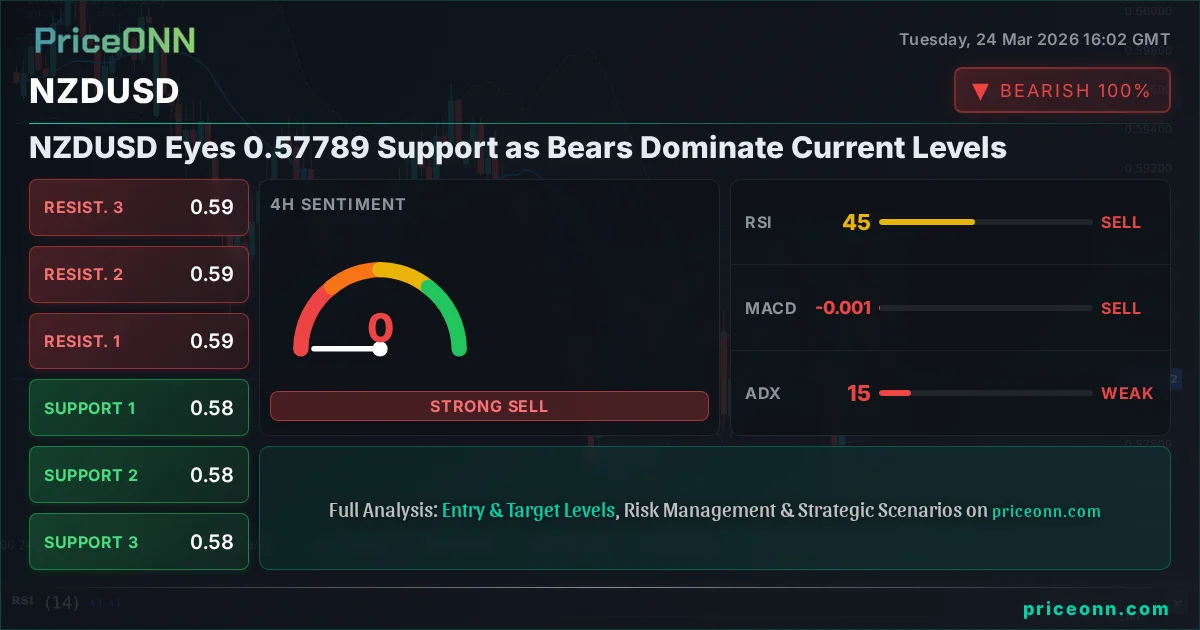
NZDUSD Eyes 0.57789 Support as Bears Dominate Current Levels
NZDUSD trading at $0.58155 sees bears eyeing the 0.57789 support level amid a weak trend and negative momentum. DXY strength adds pressure.
The relentless march of the US Dollar, currently standing firm at 99.24 on the DXY index, continues to cast a long shadow over riskier currencies. For the New Zealand Dollar against the US Dollar, or NZDUSD, this macro backdrop is proving particularly challenging. As of Tuesday, March 25, 2026, the pair is trading precariously close to a significant support level at $0.57789, a price point that traders are watching with bated breath. The current price of $0.58155 reflects a broader market sentiment that is currently favoring safe-haven assets and punishing riskier ones, a trend amplified by geopolitical uncertainties and shifting central bank expectations.
- RSI at 42.22 on the 1H chart signals bearish momentum, suggesting further downside is possible.
- Critical support sits at $0.57789, a level that has become a focal point for traders watching NZDUSD.
- The ADX reading of 11.2 on the 1H chart indicates a weak trend, highlighting potential for choppy price action but also susceptibility to directional moves.
- DXY strength at 99.24 is a key driver, correlating with the weakness seen in NZDUSD.
Navigating the Dollar's Strength: A Macro Perspective
The US Dollar Index (DXY), a measure of the dollar's strength against a basket of major currencies, is currently trading at 99.24. This level, coupled with a 0.48% daily gain, underscores the greenback's resilience. When the DXY strengthens, it typically exerts downward pressure on commodities and riskier currency pairs like NZDUSD, as global capital flows towards perceived safer assets. This dynamic is currently playing out, with the Dollar Index showing a strong daily upward trend on the 1D timeframe (ADX: 32.74), indicating conviction behind the dollar's move. This macro trend is a significant headwind for NZDUSD, suggesting that any attempts at recovery might face immediate selling pressure unless the broader market sentiment shifts dramatically or the Federal Reserve signals a dovish pivot, which seems unlikely given recent commentary from San Francisco Fed President Mary Daly about navigating inflationary headwinds without a clear rate path. The DXY's upward trajectory is a narrative that cannot be ignored when assessing the outlook for NZDUSD.Furthermore, the current market environment is characterized by a general aversion to risk. Major stock indices like the SP500 and Nasdaq are experiencing pullbacks, with SP500 trading at 6575.1 and Nasdaq at 24080.96. A declining risk appetite in equities often translates into reduced demand for higher-yielding, riskier currencies, further supporting the dollar's safe-haven appeal. This correlation is a critical piece of the puzzle for understanding NZDUSD's current predicament. The fact that both major US indices are in a confirmed downtrend on the daily charts (SP500 ADX 45.34, Nasdaq ADX 39.41) reinforces the narrative of caution and risk aversion, which is detrimental to the New Zealand Dollar.
Technical Breakdown: NZDUSD's Precarious Position
Delving into the technicals, the NZDUSD pair presents a concerning picture, particularly on the shorter timeframes. On the 1-hour chart, the RSI is hovering at 42.22, firmly in bearish territory and indicating that selling momentum is building. While not yet in oversold conditions, this reading suggests that any upward bounces are likely to be met with resistance. Adding to the bearish outlook, the MACD histogram is negative, and the MACD line is below the signal line, confirming the presence of downward pressure. The ADX at 11.2 on this timeframe points to a weak trend, meaning that while the current direction is down, the move might lack strong conviction and could be susceptible to sharp reversals. However, the overall picture is one of bearish bias, especially when considering the daily chart's signals.The 4-hour chart paints a slightly more mixed, yet still cautious, picture. Here, the RSI sits at 45.31, still in neutral territory but trending downwards, suggesting a potential continuation of the bearish sentiment. The Stochastic indicator shows %K at 37.35 and %D at 44.36, indicating a bearish crossover and reinforcing the downward bias. The ADX at 20.42 suggests a moderate trend strength, slightly more defined than the 1-hour chart. On the daily timeframe, the picture becomes clearer. The RSI is at 42.36, a level that, while not oversold, has historically preceded significant downside moves in NZDUSD. The MACD is negative, and the Bollinger Bands are showing the price trading below the middle band, a classic sign of bearish pressure. The ADX at 30.78 confirms a strong downtrend on the daily chart, indicating that the bears are in a dominant position over the longer term.
Key Levels and Potential Price Action
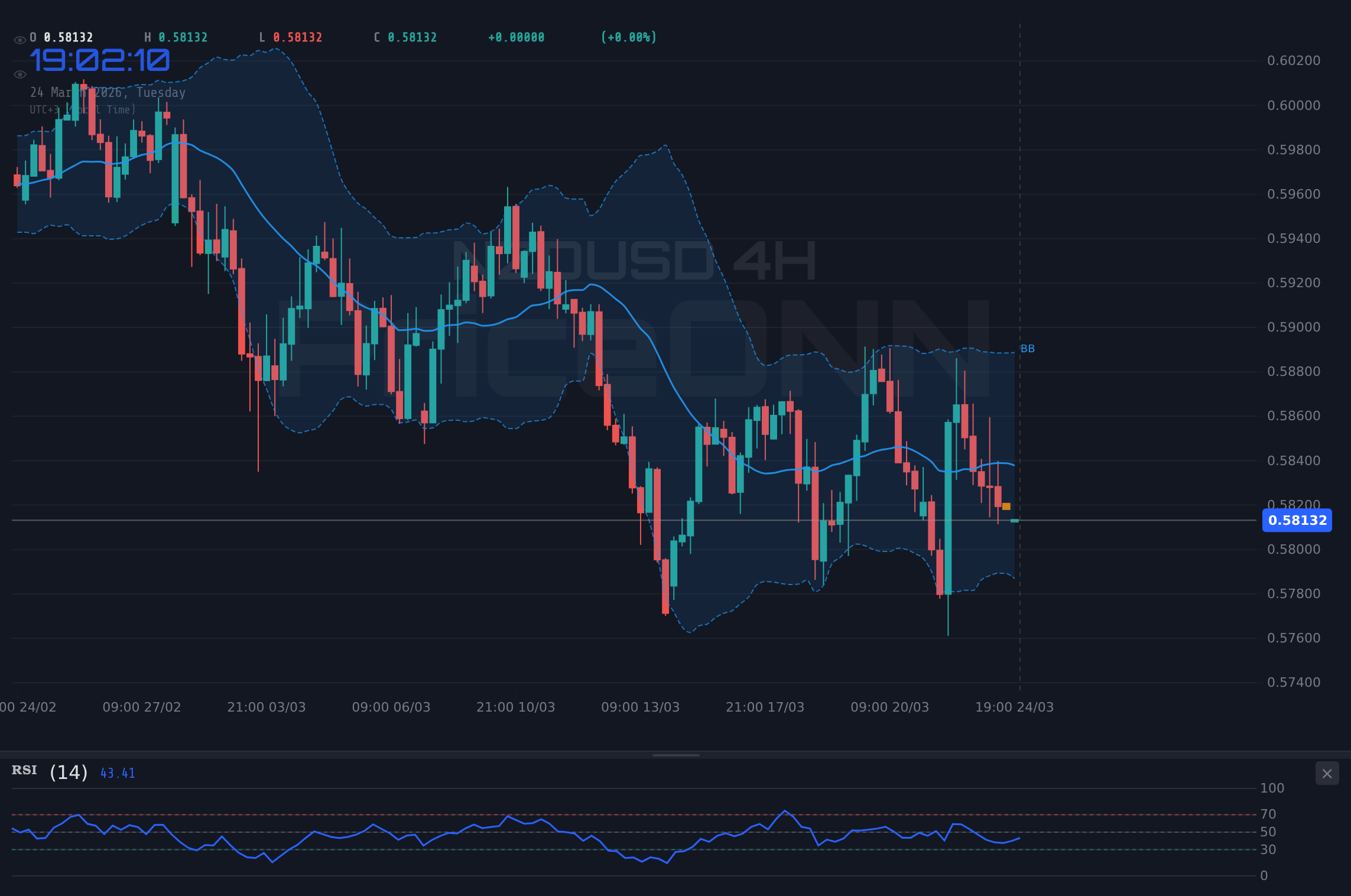
The immediate focus for NZDUSD traders is the support level at $0.57789. This is not just a random number; it represents a significant price point where buying interest has emerged in the past, and its breach could trigger a cascade of further selling. On the 1D chart, the next significant support level is $0.57075, followed by $0.56538. These levels are crucial for understanding the potential downside risk should the current bearish momentum continue. On the resistance side, the immediate hurdle is the 1-hour chart's upper Bollinger Band at $0.58366, followed by the 4-hour resistance at $0.58538 and the daily resistance at $0.5904. A sustained move above these resistance levels would be necessary to challenge the prevailing bearish narrative, but given the current confluence of negative technicals and a strong dollar, this seems unlikely in the short term without a significant shift in market sentiment or a major change in Fed policy expectations.The interplay between these levels and the current price of $0.58155 is critical. A break below $0.57789 would likely accelerate the move towards $0.57075, especially if the DXY continues its ascent. Conversely, a decisive break above the 1-hour resistance at $0.58366 could signal a short-term bounce, but the larger downtrend on the daily chart suggests that such moves would be opportunities for sellers to re-enter the market at better prices, unless significant new bullish catalysts emerge.
Geopolitical Undercurrents and Their Impact
The broader geopolitical landscape is also contributing to the current market dynamics, indirectly influencing NZDUSD. While the provided news feed doesn't offer direct NZDUSD-specific geopolitical impacts, general themes are evident. For instance, the mention of escalating geopolitical tensions in the USD/CHF analysis suggests a global appetite for safe-haven assets, which benefits the US Dollar. Similarly, news about foreign funds ditching Asian stocks due to oil shocks and dimming prospects indicates a global risk-off sentiment. This environment is generally unfavorable for commodity-linked currencies like the NZD, which often acts as a barometer for global economic health and risk appetite. When global tensions rise, investors tend to flee to perceived safe havens such as the USD, or even the JPY and CHF, while currencies like the NZD suffer.The volatility in crude oil prices, with WTI plunging from $100 to $85 after touching that brief high, also plays a role. Although New Zealand is not a major oil producer or consumer in the global sense, such price swings can signal broader economic instability or shifts in inflationary expectations. Higher oil prices can fuel inflation concerns, potentially leading central banks like the Fed to maintain a hawkish stance, which strengthens the dollar. Conversely, sharp oil price drops can sometimes be interpreted as signs of weakening global demand, which is also negative for riskier currencies. The current environment, with oil prices showing significant intraday volatility, adds another layer of uncertainty that favors the stability of the US Dollar over the New Zealand Dollar.
The Fed's Tightrope Walk and Its Implications
Central bank policy, particularly that of the US Federal Reserve, remains a paramount driver for currency markets. San Francisco Fed President Mary Daly's recent comments indicate that the Fed faces an uncertain path for monetary policy, grappling with inflationary headwinds. This uncertainty, coupled with the general resilience of the US Dollar, suggests that the Fed is unlikely to pivot towards aggressive rate cuts anytime soon. The CME FedWatch Tool, if available, would likely show probabilities leaning towards a steady-or-higher rate scenario for the near future. This hawkish-leaning stance from the Fed, or even a neutral stance when markets are looking for dovish signals, provides ongoing support for the US Dollar. For NZDUSD, this means that the burden of proof is on the bulls to find a reason for sustained upside, likely requiring a significant shift in New Zealand's own economic outlook or a clear change in global risk sentiment.The market's interpretation of Fed speak is crucial. Any hint of a more patient approach to rate cuts, or concerns about persistent inflation, tends to strengthen the dollar. This is exactly what we are seeing with NZDUSD trading near its support levels. The 'trust gap' dampening peace hopes, as mentioned in one of the forex news snippets, also contributes to a risk-off environment, which indirectly supports the dollar. In essence, the Fed's current policy path, or the market's perception of it, is a significant factor underpinning the strength of the USD against currencies like the NZD.
Trading Scenarios for NZDUSD
Given the confluence of bearish technical signals and a strong macroeconomic backdrop favoring the US Dollar, the outlook for NZDUSD remains cautious. The current price of $0.58155 is a critical juncture, with significant support just below at $0.57789.Bearish Scenario: Bears Eyeing Downside Breakout
75% ProbabilityNeutral Scenario: Range-Bound Consolidation
20% ProbabilityBullish Scenario: Short-Term Rebound Potential
5% ProbabilityThe Path Forward: Risk Management is Key
For traders watching NZDUSD, the current technical setup and the prevailing macroeconomic winds suggest a bias towards the downside. The key support level at $0.57789 is critical. A break below this level could initiate a more significant move lower, driven by the strong dollar and risk-off sentiment. However, as the ADX readings on shorter timeframes suggest, the market could experience choppy conditions before any decisive move. This highlights the importance of robust risk management. Sticking to stop-loss orders, managing position sizes according to risk tolerance, and waiting for clear setups are paramount. The market always offers opportunities, and forcing trades in uncertain conditions often leads to losses. Patience and discipline will be rewarded as the price action unfolds around these critical levels.Frequently Asked Questions: NZDUSD Analysis
What happens if NZDUSD breaks below the $0.57789 support level?
A break below $0.57789 on the daily chart would likely trigger further selling pressure, potentially accelerating the move towards the next support at $0.57075. This scenario is supported by the current bearish momentum and strong DXY.
Should I consider buying NZDUSD at current levels of $0.58155 given the oversold RSI on some timeframes?
Buying at current levels carries significant risk due to the prevailing downtrend and strong dollar. While shorter timeframes might show oversold conditions, the daily chart RSI at 42.36 and ADX at 30.78 indicate a strong bearish trend is in play. A confirmed bullish signal, like a break above $0.58366 with strong volume, would be needed before considering long positions.
Is the RSI at 42.22 on the 1H chart a sell signal for NZDUSD right now?
An RSI of 42.22 on the 1-hour chart indicates bearish momentum, aligning with the overall downtrend. While not an extreme oversold reading, it suggests that sellers are in control in the short term and further downside is possible before any significant bounce occurs.
How will the US Federal Reserve's policy outlook affect NZDUSD this week?
Continued hawkish rhetoric or uncertainty regarding rate cuts from the Fed would likely support the US Dollar, putting further downward pressure on NZDUSD. Any dovish surprises, though currently unlikely, could provide a temporary reprieve for the pair, but the broader trend needs to shift.
Track markets in real-time
AI-powered analysis, technical indicators and real-time price data.
Join Our Telegram Channel
Breaking market news, AI analysis and trading signals instantly.
Join Channel