

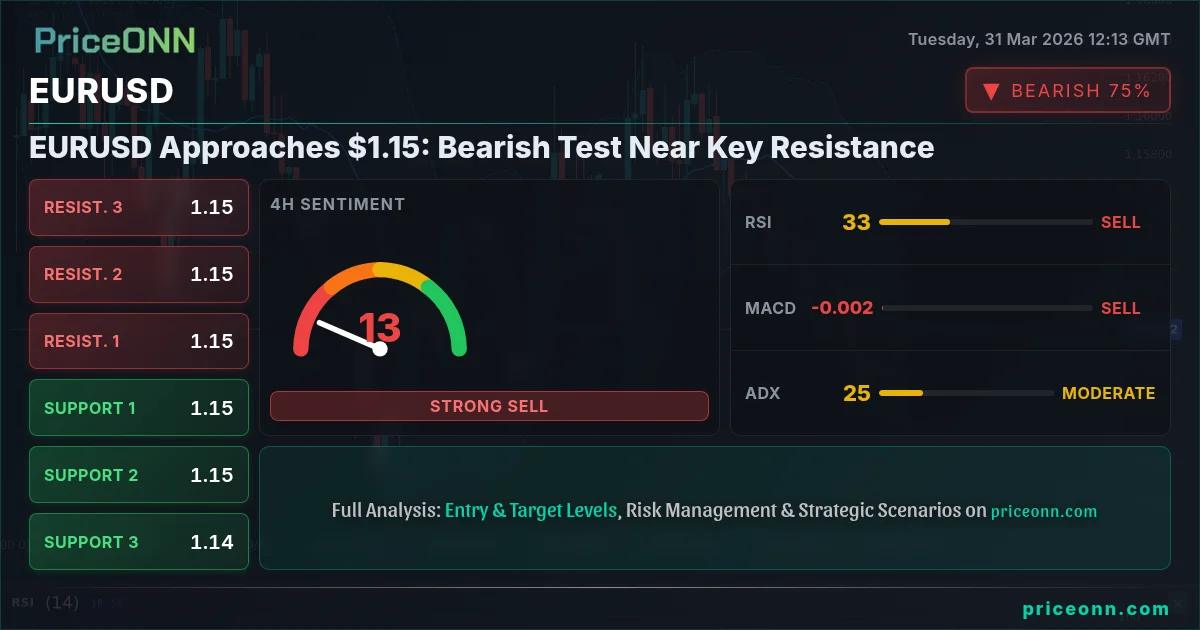
The EURUSD pair is currently navigating a critical juncture, hovering just shy of the $1.15 mark. This level is not just a psychological barrier but a significant resistance zone that, if tested and rejected, could signal a renewed bearish push. Having closely monitored the Euro's recent performance against the dollar, I see a complex interplay of fundamental and technical factors suggesting caution for bulls right now. The market sentiment is leaning towards a potential retracement, and understanding the nuances behind this positioning is key for any trader looking to navigate these choppy waters.
- EURUSD is testing resistance near $1.15, with the RSI at 67.3 indicating overbought pressure is building.
- Critical support for the pair sits at $1.14309, a level that has seen multiple tests this week.
- The MACD histogram shows bearish divergence, suggesting upward momentum is fading.
- Fed rate expectations, currently pricing in a hawkish stance, are driving EURUSD's correlation with the DXY.
The US Dollar Index (DXY) is currently trading around 100.08, showing a slight pullback but maintaining a strong upward trend on the daily and 4-hour charts. This strength in the dollar often exerts downward pressure on major currency pairs like EURUSD. Historically, when the DXY shows resilience, particularly with its ADX indicator at a robust 33.32, it creates a challenging environment for the Euro. The current DXY setup, with its daily trend strength at 100%, suggests that any weakness in the dollar might be temporary, making the $1.15 resistance level for EURUSD even more pivotal.
Looking at the technical indicators for EURUSD, the picture is decidedly mixed, leaning towards caution. On the 1-hour chart, the RSI is at 58.88, hovering in neutral territory but showing an upward eğilim, while the MACD exhibits positive momentum. However, the Stochastic oscillator is flashing a bearish signal with %K below %D, and the ADX at 18.93 indicates a weak trend. This suggests short-term chop rather than a clear direction. The 4-hour timeframe presents a more bearish outlook, with RSI at 33.44, MACD showing negative momentum, and ADX at 24.96 suggesting a moderate downtrend. The daily chart paints the clearest bearish picture, with RSI at 40.7, MACD negative, and ADX at a strong 35.09, indicating a well-established downtrend. This confluence of daily bearish signals, despite short-term noise, warrants close attention.
Navigating the Resistance at $1.15
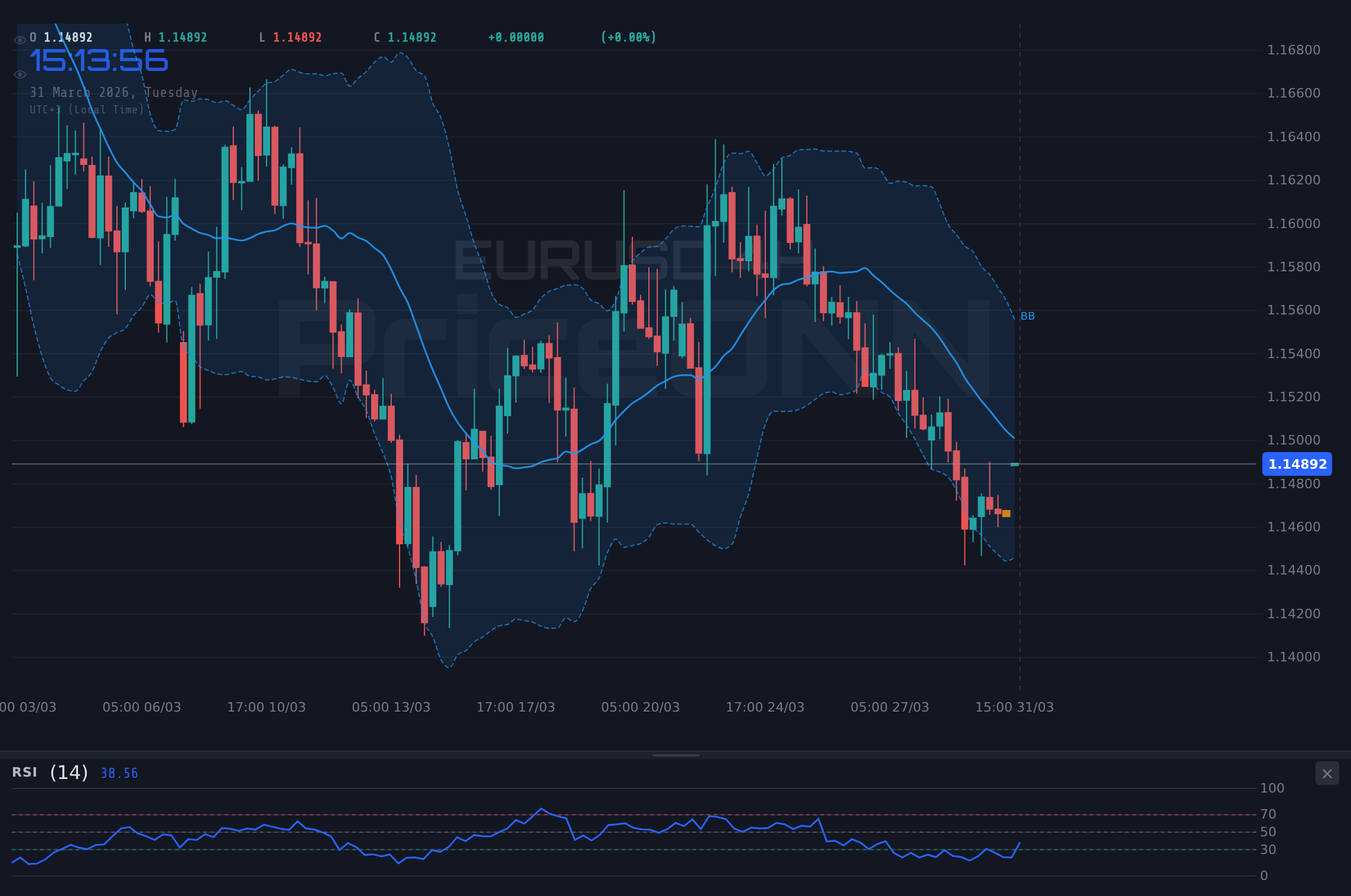
The immediate resistance for EURUSD is clearly defined around the $1.15089 mark on the daily chart, with further levels at $1.15536 and $1.15869. A sustained break above $1.15, particularly with strong conviction and volume, would challenge the prevailing bearish narrative. However, the current market data suggests this is less likely in the short term. The price action around $1.15 is crucial. A rejection here, coupled with a decisive close below the $1.14838 resistance level on the 4-hour chart, would reinforce the bearish sentiment. The 1-hour chart shows immediate resistance at $1.14776, which is already being tested, and a failure to break decisively above it could be the first sign of weakness.
On the flip side, support levels are clustered around $1.14309, $1.13976, and $1.13529. A break below the $1.14309 support would be a significant bearish development, potentially opening the door for a swift move towards the lower support levels. Traders are watching the $1.14500 area closely as a short-term inflection point. The strength of the downtrend on the daily chart, indicated by the ADX at 35.09, means that once a move below support begins, it can accelerate rapidly. This is especially true if it coincides with dollar strength, a correlation that has been particularly pronounced recently.
Fundamental Drivers: The Euro's Tightrope Walk
The Euro's fate remains intricately tied to the economic outlook for the Eurozone and the diverging monetary policy stances between the European Central Bank (ECB) and the US Federal Reserve. While specific economic data releases for EUR, USD, and GBP were not detailed with actual vs forecast figures in the provided calendar, the general context of US economic strength and Fed hawkishness is palpable. Recent news from March 31st indicates a continued focus on inflationary pressures, with oil prices surging towards $120 for Brent crude. This geopolitical tension, stemming from the Middle East conflict, is a significant driver. Higher oil prices typically fuel inflation, which can complicate central bank decisions – potentially forcing the ECB to maintain a more cautious stance than desired, while the Fed may feel compelled to remain hawkish.
The market is keenly awaiting upcoming economic data, particularly any high-impact releases that could shift the narrative. If inflation figures in the Eurozone were to surprise to the upside, it might offer some temporary support for the Euro. Conversely, any signs of economic slowdown, such as weaker PMI or GDP figures, would likely exacerbate the bearish pressure on EURUSD. The correlation between EURUSD and the DXY is a key factor to watch. With the DXY showing strong upward momentum (ADX 33.32 on daily), any positive US economic surprises or hawkish Fed commentary will likely weigh on the Europair, pushing it further away from the $1.15 resistance.
The Bank of Japan's recent hawkish meeting minutes, mentioned in relation to USD/JPY, also indirectly influence EURUSD. While not a direct driver, shifts in major central bank policies can create broader risk sentiment changes that spill over into other currency pairs. If the BoJ's hawkishness leads to a stronger Yen, it could signal a broader move by central banks to normalize policy, potentially benefiting some currencies but also increasing volatility across the board. For the Euro, the primary concern remains its own economic trajectory and the ECB's policy response to inflation and growth challenges.
Technical Signals: A Divergence of Opinions
Examining the technical indicators across different timeframes reveals a conflicting picture, which is typical near key resistance levels. The 1-hour chart offers some bullish signals, with positive MACD momentum and RSI showing an upward eğilim, but these are tempered by stochastic's bearish crossover and the overall weak trend indicated by the ADX. This suggests that short-term traders might be anticipating a minor bounce, but the underlying trend is not confirming it.
The 4-hour chart shifts the balance towards bearishness. The RSI at 33.44 clearly indicates a downtrend, and the MACD's negative momentum reinforces this. The ADX at 24.96 signals a moderate downtrend, suggesting that the selling pressure is more than just noise. The Stochastic oscillator is showing a potential for a short-term reversal upwards (%K > %D), but this is often seen in oversold conditions within a larger downtrend and requires confirmation.
The daily timeframe provides the most compelling bearish argument. The RSI at 40.7 is well within neutral-bearish territory, with a downward eğilim. The MACD is negative, and the ADX at 33.15 confirms a strong downtrend. The Stochastic oscillator, despite showing a recent upward signal (%K > %D), is coming from oversold conditions, which can sometimes precede a bounce but doesn't negate the overall bearish trend. This divergence between the shorter timeframes and the daily trend is where trading opportunities and risks lie. A failure to break above $1.15 resistance on the daily chart, while supported by these bearish daily indicators, strengthens the case for a downside move.
The Importance of the $1.15 Level
The $1.15 price point for EURUSD is more than just a number; it represents a significant psychological and technical barrier. For bulls, breaking and holding above $1.15 would signal a potential trend reversal and open the door for further upside towards $1.15536 and $1.15869. However, the current market data, particularly the daily bearish signals and the DXY's strength, suggests that such a breakout might be difficult to sustain without a significant shift in fundamentals or a clear catalyst. The fact that the RSI is around 40.7 on the daily chart, combined with the ADX at 33.15, indicates that sellers are still in control of the longer-term trend, even if short-term fluctuations occur.
Conversely, a rejection at $1.15 could lead to a rapid decline. The immediate support at $1.14309 is crucial. If this level breaks, the next targets would be $1.13976 and potentially down to $1.13529. The speed of such a move would depend heavily on the broader market sentiment and the direction of the US dollar. If geopolitical tensions escalate further, or if US economic data disappoints significantly, it could trigger safe-haven flows into assets other than the dollar, potentially weakening it and offering respite to EURUSD. However, given the current data, the path of least resistance appears to be lower if $1.15 holds as resistance.
Market Sentiment and Trader Positioning
Current market sentiment appears to be shifting, with a growing number of analysts and traders expressing caution about the Eurozone's economic outlook relative to the US. While specific COT data wasn't provided, the general trend of dollar strength and the hawkish Fed expectations suggest that speculative positioning might be starting to favor the greenback. The fact that the SP500 and Nasdaq 100 are showing bearish signals on the daily charts (ADX at 50.27 and 49.33 respectively) also points towards a potential decrease in risk appetite globally. When major equity indices turn bearish, it often correlates with a strengthening dollar and weakness in riskier currencies or assets, which could indirectly pressure EURUSD lower.
The energy markets are also playing a significant role. Brent crude is trading above $111, and WTI above $103, driven by geopolitical tensions. This provides an inflationary backdrop that central banks must contend with. For the Fed, higher oil prices reinforce the need to remain vigilant on inflation, potentially keeping interest rates higher for longer. This dynamic supports dollar strength. For the ECB, it presents a more complex challenge: higher inflation without necessarily the same robust economic growth that might justify aggressive rate hikes. This divergence in central bank challenges can create headwinds for the Euro.
What This Means for Traders Right Now
For traders, the current setup around $1.15 for EURUSD presents a classic risk-reward scenario. The resistance at $1.15, combined with the bearish signals on the daily chart and the strong DXY, suggests that shorting the pair on a rejection could offer a favorable risk-reward ratio, provided stops are managed strictly. The key would be to wait for confirmation: a decisive break below the $1.14309 support level on the 4-hour or daily chart. Scalpers might look for intraday opportunities around the $1.14500 pivot, but swing and position traders should focus on the daily trend confirmation.
Conversely, a strong, sustained breakout above $1.15 would invalidate the immediate bearish thesis. This would likely require a significant shift in market sentiment, perhaps driven by weaker-than-expected US economic data or a dovish pivot from the Fed. In such a scenario, the next targets would be the higher resistance levels, but the current technical picture does not strongly support this outcome. The ADX values across multiple timeframes suggest that the market is not yet in a strong breakout phase, but rather in a consolidation or a trend continuation phase, with the daily trend leaning bearish.
Actionable Insight: Patience at the Critical Juncture
The most prudent approach for traders right now is patience. Waiting for a clear signal at the $1.15 resistance or confirmation of a break below the $1.14309 support is crucial. The conflicting signals between short-term and long-term charts mean that entering prematurely could lead to whipsaws. The prevailing macroeconomic environment, characterized by geopolitical risks, inflationary pressures, and diverging central bank policies, suggests that volatility will remain elevated. Therefore, focusing on risk management and waiting for high-probability setups is paramount. The market always provides another opportunity, and forcing a trade in uncertain conditions often leads to losses. The $1.15 level is a battleground, and letting the price action dictate the next move is the wisest strategy.
Frequently Asked Questions: EURUSD Analysis
What happens if EURUSD fails to break above the $1.15 resistance level?
If EURUSD is rejected at the $1.15 resistance, it would likely confirm the bearish bias indicated by the daily chart's ADX of 35.09. A break below the immediate support at $1.14309 would then be expected, potentially targeting $1.13976.
Should I consider shorting EURUSD at current levels near $1.15 given the bearish daily trend?
Shorting EURUSD near $1.15 could be considered if a clear bearish signal or rejection forms, especially on the 4-hour or daily close. However, it's crucial to wait for confirmation, such as a break below $1.14309, and manage risk tightly with stops above the $1.15 resistance.
Is the RSI at 67.3 on the 1-hour chart a sell signal for EURUSD?
An RSI of 67.3 on the 1-hour chart is in the upper neutral zone, showing upward momentum but not yet definitively overbought. While it warrants attention, it's not a strong sell signal on its own and should be considered alongside other indicators and price action, especially the daily bearish trend.
How will ongoing geopolitical tensions and oil prices affect EURUSD this week?
Escalating geopolitical tensions and rising oil prices contribute to an inflationary environment, potentially keeping the Fed hawkish and supporting the USD. This dynamic could exert downward pressure on EURUSD, especially if the ECB struggles to combat inflation without hindering growth, making a rejection at $1.15 more probable.
Track markets in real-time
AI-powered analysis, technical indicators and real-time price data.
Join Our Telegram Channel
Breaking market news, AI analysis and trading signals instantly.
Join Channel