

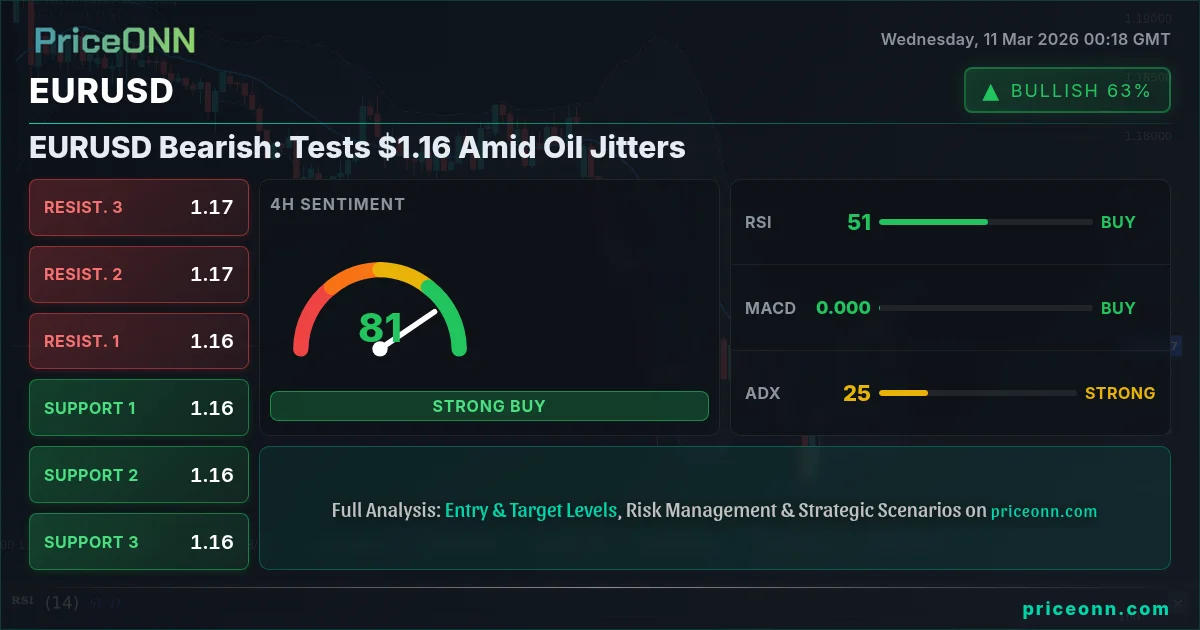
EURUSD is currently testing the $1.16 level, a critical juncture as oil price volatility and geopolitical tensions add to market uncertainty. The pair's direction in the coming days will likely hinge on how these factors play out and whether key economic data releases offer any respite or exacerbate the bearish pressure.
- EURUSD tests $1.16 amid Middle East tensions and fluctuating oil prices.
- Immediate support lies at 1.16002, with resistance at 1.16101.
- Stochastic in oversold territory suggests a potential short-term bounce, but the overall trend remains bearish.
- Traders should monitor upcoming USD data releases for potential catalysts.
Oil Jitters and EURUSD: A Complex Relationship
The recent surge and subsequent retreat in oil prices, driven by heightened tensions in the Middle East, have created a complex environment for EURUSD. Brent crude, currently trading around $65.73, experienced significant volatility after Iran threatened to halt oil exports, as reported by energy news outlets. This initial spike fueled concerns about inflation and energy costs, impacting the Eurozone more directly than the US. As a major importer of energy, the Eurozone's economy is particularly vulnerable to oil price shocks, potentially weakening the euro.
The "eurusd macroeconomic factors march 2026" are heavily influenced by this energy dynamic. A weaker euro, resulting from higher energy prices, makes Eurozone exports more competitive but also increases import costs, potentially leading to stagflation. The European Central Bank (ECB) faces a difficult balancing act: controlling inflation without stifling economic growth. This challenge is further complicated by the fact that different Eurozone countries have varying levels of exposure to energy price fluctuations, making a one-size-fits-all monetary policy approach less effective.
The Dollar's Safe-Haven Appeal
Amidst geopolitical uncertainty, the US Dollar often benefits from its safe-haven status. As risk appetite declines, investors tend to flock to the dollar, driving up its value. The DXY (Dollar Index) is currently trading at 98.59, reflecting this trend. With the DXY showing strength, EURUSD faces downward pressure. This inverse correlation between the dollar index and EURUSD is a key factor to watch. When the DXY rises, it typically signals increased demand for the dollar, making the euro relatively less attractive. This is a typical pattern that has played out many times over decades.
"EURUSD macroeconomic factors 2026" point to a scenario where the dollar's strength is further reinforced by expectations of continued monetary policy divergence between the Fed and the ECB. If the Fed remains hawkish, while the ECB adopts a more dovish stance due to concerns about the Eurozone economy, the dollar's appeal could increase further.
Technical Analysis: A Multi-Timeframe Perspective
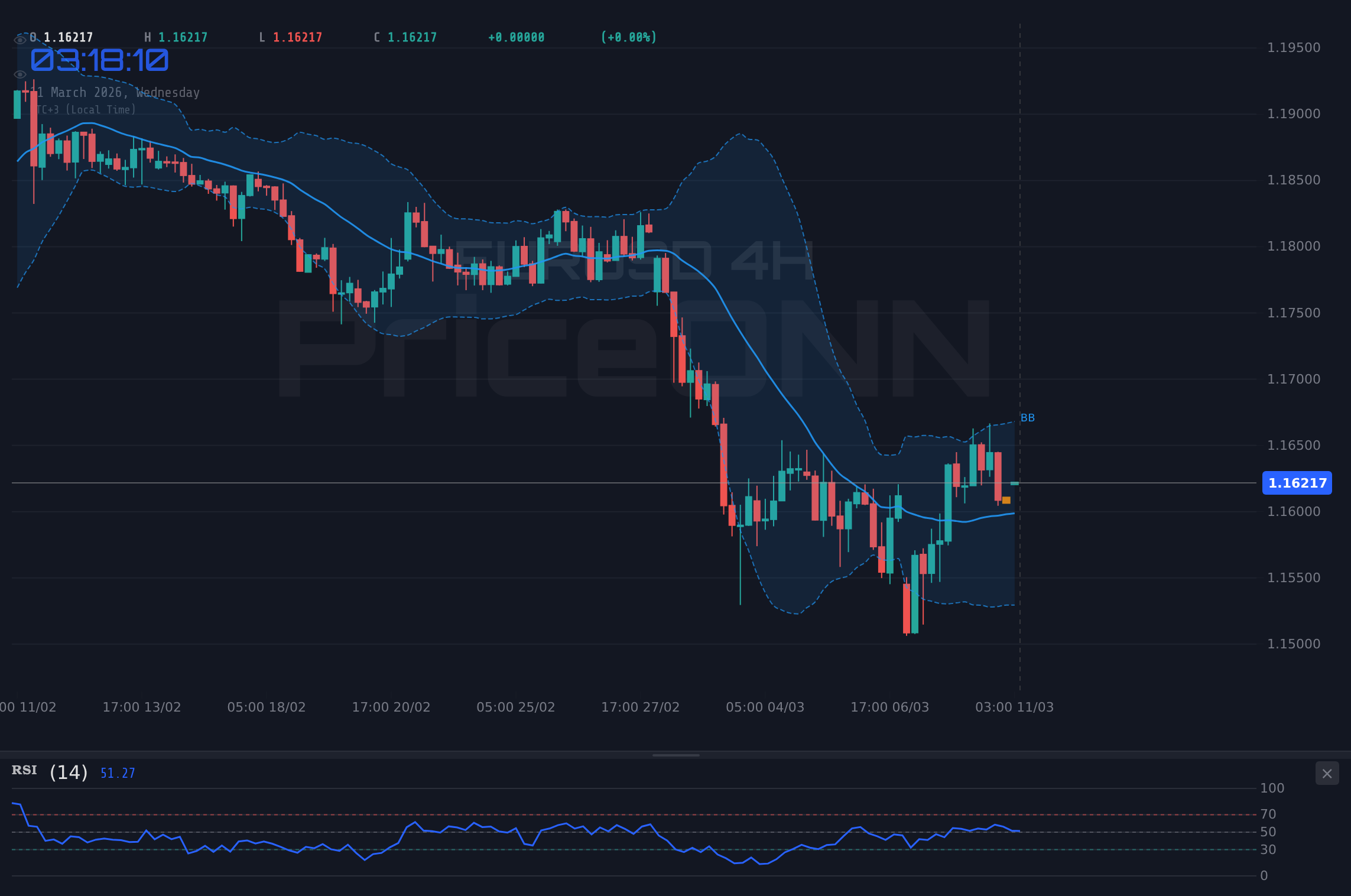
A multi-timeframe analysis of EURUSD reveals a mixed picture, but the overall bias leans bearish. On the daily chart, the trend is down (94% strength), with the price trading below the middle band of the Bollinger Bands. The ADX is at 27.88, indicating a strong downtrend. However, the Stochastic oscillator shows a potential bullish signal, with %K (50.2) above %D (37.91), suggesting a possible short-term bounce.
On the 4-hour chart, the trend is neutral, but the RSI is at 48.59, indicating further potential for downside movement. The MACD histogram shows positive momentum, but this could be a temporary pause in the downtrend. Key support levels to watch are 1.1625, 1.16055, and 1.15847. Resistance levels are at 1.16653, 1.16861, and 1.17056.
For scalpers, the 1-hour chart provides a more granular view. The trend is neutral, with RSI at 46.02. The Stochastic oscillator is in oversold territory (%K: 7.63, %D: 18.41), which could signal a short-term buying opportunity. However, the ADX is weak (18.63), suggesting a lack of strong conviction in either direction.
The Bear's Case: Why EURUSD Could Fall Further
The bearish scenario hinges on a continuation of the current risk-off environment and further strength in the US Dollar. If geopolitical tensions escalate, or if economic data releases from the Eurozone disappoint, EURUSD could break below the immediate support at 1.16002 and target the next support level at 1.15488. In this scenario, the ECB's response will be critical. If the ECB signals concerns about the Eurozone economy and hints at further easing measures, EURUSD could experience a more significant decline.
A break below 1.15488 could open the door for a test of 1.14624, a level not seen in several months. This bearish scenario is further supported by the fact that the daily chart shows a strong downtrend and negative momentum. Swing traders should watch for a confirmed break below 1.16002 to initiate short positions, with a stop-loss above 1.16653.
The Bull's Hope: A Potential Reversal
The bullish scenario depends on a stabilization of oil prices and a return of risk appetite to the markets. If tensions in the Middle East ease and oil prices retreat further, the Eurozone economy could receive a much-needed boost. In this scenario, EURUSD could find support at the current levels and attempt a rally towards 1.16653. A break above this resistance would be a positive sign for the bulls and could pave the way for a test of 1.17228.
However, the bullish scenario faces significant headwinds. The dollar's safe-haven appeal remains strong, and the ECB's cautious stance on monetary policy could limit the euro's upside potential. Long-term investors should remain cautious and wait for more clarity on the economic outlook before initiating long positions in EURUSD.
The Waiting Game: A Range-Bound Scenario
A third scenario is a continuation of the current range-bound trading, with EURUSD fluctuating between 1.16002 and 1.16653. In this scenario, neither the bulls nor the bears are able to gain a decisive advantage, and the pair remains stuck in a narrow trading range. This could occur if economic data releases from both the US and the Eurozone are mixed, providing no clear direction for the pair. In this scenario, scalpers could profit from short-term fluctuations within the range, but swing traders and long-term investors should remain on the sidelines.
Most Likely Scenario: Bearish Pressure Continues
Considering the current geopolitical tensions, oil price volatility, and the dollar's safe-haven appeal, the most likely scenario is a continuation of the bearish pressure on EURUSD. The strong downtrend on the daily chart, combined with the mixed signals on the shorter-term charts, suggests that the bears have the upper hand. A probability estimate of 60% is assigned to the bearish scenario, with 25% to the range-bound scenario and 15% to the bullish scenario.
Key Triggers to Watch This Week
Several key triggers could influence EURUSD this week. On the economic front, traders should pay close attention to the upcoming USD data releases. Any disappointing data could weaken the dollar and provide a boost to EURUSD. On the geopolitical front, developments in the Middle East will be crucial. An escalation of tensions could further fuel risk aversion and strengthen the dollar, while a de-escalation could lead to a rebound in EURUSD.
IF EURUSD breaks above 1.16653, THEN target 1.17228 this week. This requires easing geopolitical tensions and weaker USD data. A daily close above 1.17228 could signal a more significant reversal.
IF EURUSD closes below 1.16002, THEN target 1.15488 this week. This requires continued geopolitical tensions and stronger USD data. A daily close below 1.15488 could lead to a test of 1.14624.
Several high-impact USD data releases are scheduled for Friday, March 13th. These releases could trigger significant volatility in EURUSD. Manage your risk accordingly.
EURUSD: A Trade Plan
Given the bearish outlook, a potential trade plan could involve shorting EURUSD on a break below 1.16002. The first target would be 1.15488, with a second target at 1.14624. A stop-loss should be placed above 1.16653 to protect against unexpected upside movement. This trade plan is based on the assumption that the bearish factors currently weighing on EURUSD will continue to persist.
Technical Outlook Summary
| Indicator | Value | Signal |
|---|---|---|
| RSI (14) | 43.15 | Neutral |
| MACD Histogram | Negative | Bearish |
| Stochastic | 50.2/37.91 | Potential Reversal |
| ADX | 27.88 | Strong Downtrend |
| Bollinger | Middle Band | Below Band |
Key Levels
Support Levels
Resistance Levels
Frequently Asked Questions: EURUSD Analysis
What happens if EURUSD breaks below 1.16002?
If EURUSD breaks below 1.16002, the next support level to watch is 1.15488. A sustained break below this level could lead to a test of 1.14624, a level not seen in several months, potentially triggering further downside.
Should I short EURUSD at current $1.16 levels given the Stochastic?
While the Stochastic oscillator is oversold, suggesting a potential short-term bounce, the overall trend remains bearish. A more prudent approach would be to wait for a confirmed break below 1.16002 before initiating a short position, with a stop-loss above 1.16653.
Is RSI at 43.15 a buy signal for EURUSD right now?
An RSI of 43.15 is not necessarily a buy signal, as it indicates that EURUSD is not yet oversold on the daily timeframe. The overall downtrend and negative momentum suggest that further downside is possible before a significant reversal occurs.
How will the upcoming USD data releases on March 13th affect EURUSD this week?
The upcoming USD data releases on March 13th could have a significant impact on EURUSD. Stronger-than-expected data could strengthen the dollar and push EURUSD lower, while weaker-than-expected data could weaken the dollar and provide a boost to EURUSD. Traders should monitor these releases closely and adjust their positions accordingly.
Track markets in real-time
AI-powered analysis, technical indicators and real-time price data.
Join Our Telegram Channel
Breaking market news, AI analysis and trading signals instantly.
Join Channel