EURUSD Hovers at $1.15: Bearish Momentum Tests Key Support at $1.1484
EURUSD is trading at $1.15, facing downward pressure. Analysis suggests a potential test of support near $1.1484 as technical indicators flash bearish signals.
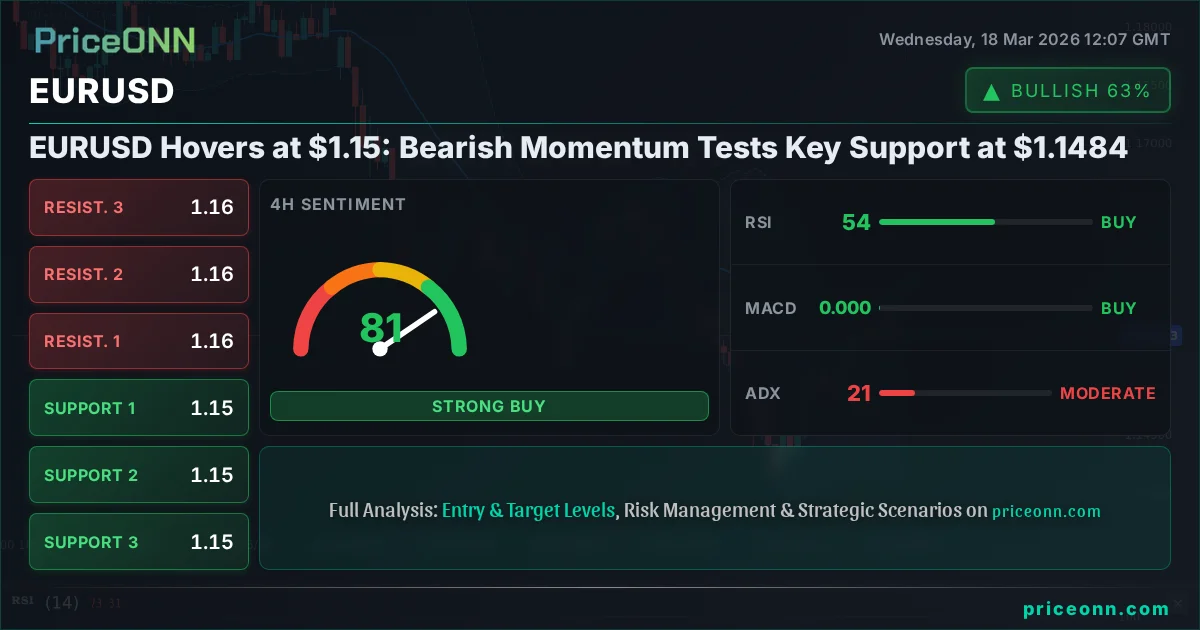
The EURUSD pair is currently locked in a critical battleground, trading precisely at the $1.15 mark. This level, while seemingly round, represents a pivotal point where short-term momentum clashes with the broader bearish undertone that has been building. For traders watching this pair, the action around the $1.1484 support level is currently the most compelling narrative, as multiple technical indicators and underlying macroeconomic factors converge to paint a potentially challenging picture for the Euro.
- EURUSD is trading at $1.15, with a slight bearish bias indicated by 1-hour and 1-day signals.
- Critical support is identified at $1.1484, a level that, if broken, could accelerate the downtrend.
- RSI at 39.49 on the daily chart suggests further downside potential, while ADX at 37.23 confirms a strong existing trend.
- The US Dollar Index (DXY) is showing strength, trading at 99.34, which typically exerts downward pressure on EURUSD.
The Dollar's Subtle Strength and its Impact on EURUSD
While the headline news often focuses on dramatic swings, the current market environment for EURUSD is characterized by a more nuanced interplay of forces. The US Dollar Index (DXY), currently trading at 99.34, is exhibiting a subtle but persistent strength. This upward movement, particularly evident on the 1-day timeframe where the trend is classified as 'Bullish (Strength: 92%)', tends to cast a shadow over major currency pairs like EURUSD. When the dollar strengthens, it naturally makes the Euro relatively more expensive for holders of USD, thereby increasing selling pressure on the EURUSD pair. The DXY's ability to hold above key levels, combined with positive momentum signals on its 1-hour chart, suggests that the greenback is not yet ready to cede ground, adding a foundational layer of bearish sentiment to EURUSD. This correlation is a cornerstone of forex analysis; understanding the DXY's trajectory is paramount to deciphering EURUSD's potential moves.
Technical Signals Pointing Downward: A Multi-Timeframe View
Diving into the technicals, the picture for EURUSD becomes clearer, and largely favors a bearish outlook in the short to medium term. On the 1-hour chart, the overall signal is 'SELL' (Buy: 1, Sell: 7, Neutral: 0), driven by a confluence of indicators. The Relative Strength Index (RSI) at 61.7, while in the neutral zone, shows a slight upward tendency, but this is overshadowed by other signals. More concerning for bulls is the MACD, which is showing negative momentum with the MACD line below its signal line. The Stochastic Oscillator, with K at 71.14 and D at 57.48, is in overbought territory but showing a bearish crossover (%K < %D on the 4H chart, K=89.52, D=89.09), indicating potential for a pullback or reversal. The ADX on the 1-hour chart, at 25.05, suggests a strong trend is in play, and given the overall 'SELL' signal, this points towards a downtrend. The 4-hour chart reinforces this bearish sentiment, with a 'SELL' signal (Buy: 0, Sell: 8, Neutral: 0) and a strong downtrend indicated by ADX at 47.78. Even the daily chart, often considered the most reliable for longer-term trends, leans bearish with a 'SAT' (Sell: 7, Buy: 1, Neutral: 0) signal, and an ADX of 37.23 confirming a strong existing trend, despite the RSI at 43.39 suggesting some room to fall further.
The Crucial $1.1484 Support Level
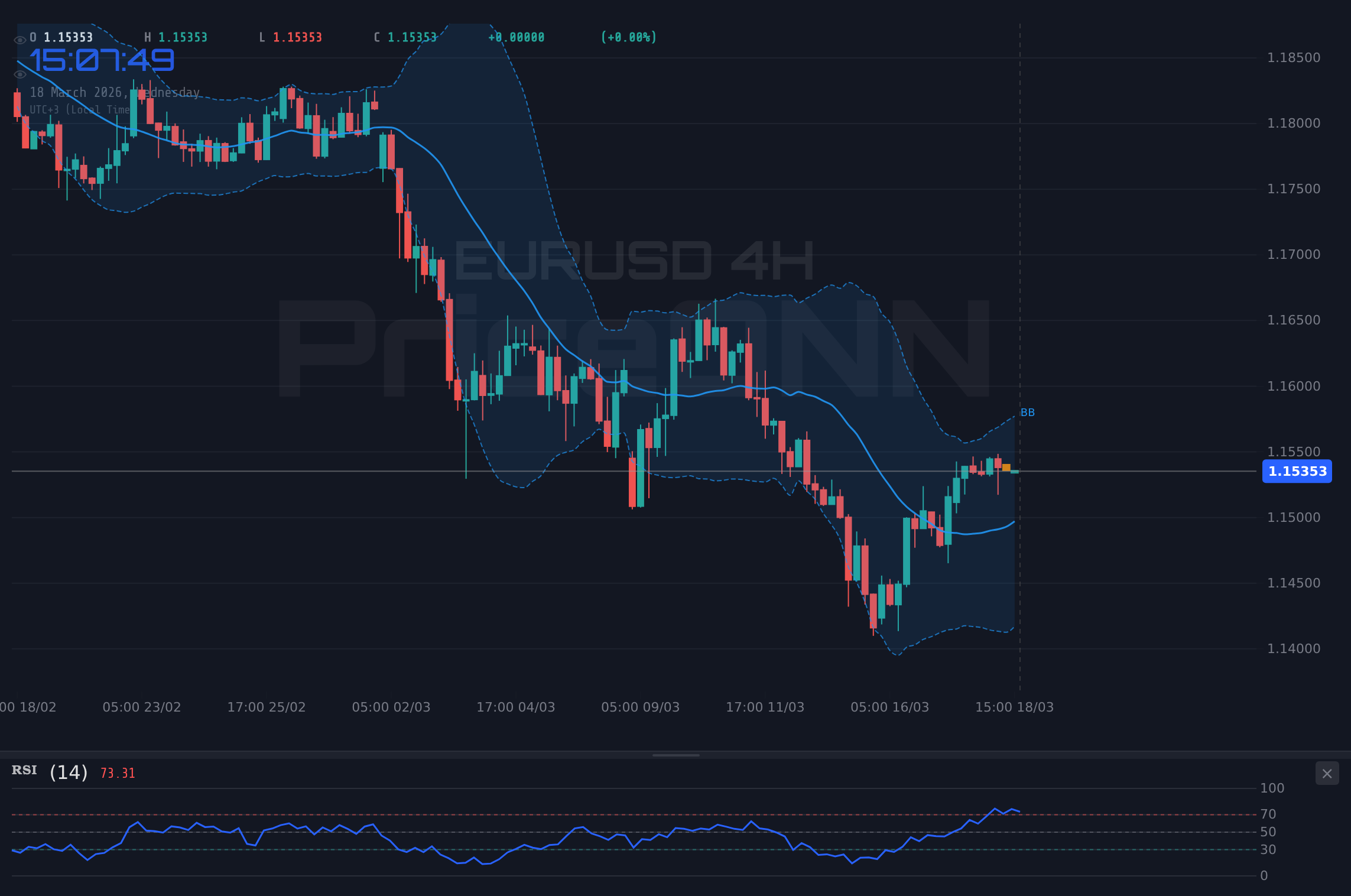
The immediate focus for any trader observing EURUSD must be the support level situated at $1.1484. This is not just an arbitrary number; it represents a price point where buying interest has historically emerged, providing a floor to price declines. However, the current market data indicates that this level is under significant pressure. The daily trend strength is noted as 'Düşüş (Güç: 94%)', and with the ADX at 37.23 signifying a strong trend, a break below $1.1484 could trigger a cascade of stop-loss orders, accelerating the downward move. The 1-day support levels are listed as 1.14843, 1.14341, and 1.1403. A decisive close below the primary support at $1.14843 would likely open the path towards the secondary support at $1.14341, and potentially even test the psychological $1.1400 handle if the bearish momentum intensifies. This is exactly where you need to pay attention; the market is telegraphing a potential move if this key level fails.
Navigating the Forex Landscape: EURUSD's Macroeconomic Drivers
Beyond the immediate technical signals, the fundamental backdrop provides critical context for EURUSD's current predicament. Recent economic data releases and central bank commentary are playing a significant role. The Federal Reserve's stance on interest rates remains a dominant theme. While markets are anticipating a pause in rate hikes, the forward guidance from Fed officials regarding inflation and the timing of potential rate cuts is crucial. Any hint of continued hawkishness or concern about persistent inflation could bolster the dollar, further pressuring EURUSD. Conversely, signals suggesting a more dovish pivot or a faster-than-expected path to rate cuts could offer some respite to the Euro. We are seeing this play out in the market's pricing of Fed Fund Futures, which are constantly being re-evaluated based on incoming data. The divergence in monetary policy expectations between the Federal Reserve and the European Central Bank (ECB) is a fundamental driver. If the Fed remains more resolute in its fight against inflation, or signals a slower pace of easing compared to the ECB, it would naturally support the dollar and weigh on EURUSD. This is where macroeconomic factors become paramount; they are the engine driving these price movements, not just random fluctuations.
The Role of Inflation and Growth Data
Inflationary pressures and economic growth figures are the lifeblood of central bank decisions, and consequently, currency valuations. Recent CPI and PMI data from both the Eurozone and the United States have painted a mixed but generally cautious picture. For the Eurozone, concerns about sticky inflation and subdued growth have been a persistent theme. If upcoming inflation reports (like the Harmonised Index of Consumer Prices - HICP) for the Eurozone show a faster-than-expected decline, it could embolden the ECB to consider easing monetary policy sooner rather than later. This would likely put downward pressure on the Euro. On the US side, while inflation has shown signs of moderation, the Fed remains vigilant. Stronger-than-expected employment data, such as Non-Farm Payrolls (NFP) or robust PMI figures, could be interpreted by the market as a sign that the US economy can withstand higher-for-longer interest rates, or at least delay rate cuts, thereby strengthening the dollar. The interplay between these data points creates a constant push and pull for EURUSD, making it essential to monitor upcoming releases like the German Ifo Business Climate survey and US Retail Sales figures.
Geopolitical Tensions and Safe-Haven Demand
In today's interconnected financial world, geopolitical events can inject significant volatility into currency markets. The ongoing tensions in the Middle East, and the broader implications for global energy supplies and inflation expectations, continue to be a background risk. While the immediate impact on EURUSD might be less direct than on oil prices, heightened geopolitical uncertainty often fuels demand for safe-haven assets. The US Dollar, despite its own set of challenges, often benefits from such risk-off sentiment due to its global reserve currency status. If geopolitical risks escalate, we could see a flight to safety that further bolsters the DXY and consequently pressures EURUSD lower. The news that European nations have rejected a U.S. request for military aid in securing the Strait of Hormuz, as reported by Reuters, highlights the complex geopolitical landscape. This, coupled with unexpected builds in US crude oil inventories, adds another layer of uncertainty that could indirectly support the dollar and weigh on riskier assets or currencies like the Euro.
What the Chart is Telling Us: A Deeper Dive
Looking at the EURUSD chart, the price action is painting a clear picture of bearish conviction, especially on the shorter timeframes. The 1-hour trend is strongly 'Düşüş' (Down), with an ADX of 25.05 indicating a robust trend. The RSI at 25.73 on this timeframe is deep in oversold territory, which might suggest a short-term bounce is possible, but it does not negate the overall bearish trend. The MACD is firmly negative, and Stochastic shows %K below %D, aligning with the 'SELL' signal. The 4-hour timeframe amplifies this, showing a 100% strength downtrend with an ADX of 47.78 – a very strong trend indicator. Here, RSI at 30.05 is still in oversold territory, and Stochastic is also showing a bearish crossover. The price is trading below the lower Bollinger Band, a sign of extreme bearish pressure. The daily chart offers a slightly less definitive picture, with a 'Neutral' trend strength (50%) and a lower ADX of 13.8, suggesting a consolidation phase might be forming. However, the RSI at 43.39 and the Stochastic's bearish crossover (%K=9.84, %D=22.35) still lean towards further weakness. The overwhelming 'SELL' signals across the 1-hour and 4-hour charts, despite the daily's neutrality, suggest that short-term traders should be looking for opportunities to the downside, especially if the $1.1484 support fails.
Interpreting the Indicators: A Trader's Perspective
From a trader's perspective, the current indicator readings present a compelling, albeit bearish, setup. The RSI, particularly on the 1-hour chart at 25.73, is screaming 'oversold'. However, in a strong downtrend, oversold conditions can persist for extended periods. It's not a buy signal in isolation; rather, it indicates that the selling pressure has been intense. The MACD's negative momentum and position below the signal line reinforce the bearish sentiment. The Stochastic oscillator, with its bearish crossover on the 4-hour chart, is another confirmation of downside potential. The ADX is the standout indicator here. On the 1-hour and 4-hour charts, it's showing strong trend strength (25.05 and 47.78 respectively). This means that if the price breaks through support, the move is likely to be significant and sustained. The daily ADX at 13.8, however, suggests that the longer-term trend might be losing steam or entering a consolidation phase. This conflict between short-term trend strength and the daily's weaker trend reading is precisely where careful analysis is needed. It implies that while a downtrend is likely to continue in the immediate future, the conviction might wane on longer timeframes, making the $1.1484 support level even more critical.
Connecting the Dots: EURUSD, DXY, and Equities
The correlation between EURUSD, the DXY, and major equity indices like the S&P 500 is a critical piece of the puzzle. Currently, the DXY is at 99.34 and showing upward momentum, which, as we've discussed, typically correlates inversely with EURUSD. Simultaneously, the S&P 500 is trading around 6728.9, showing a slight upward bias on the 1-hour chart but a bearish signal on the 1-day chart. This mixed picture in equities suggests that risk appetite is not overwhelmingly strong. In environments where risk appetite is waning, safe-haven assets and currencies tend to perform better. The US Dollar often benefits from this, further reinforcing the bearish outlook for EURUSD. If the S&P 500 were to experience a significant downturn, it would likely coincide with further dollar strength and a deeper slide in EURUSD, potentially pushing it decisively below $1.1484. The market is watching these correlations closely; any significant divergence could signal a shift in underlying sentiment.
The Road Ahead: What to Watch for EURUSD
Looking forward, the path for EURUSD appears fraught with potential downside. The confluence of bearish technical signals, a strengthening dollar, and a cautious macroeconomic outlook suggests that the pressure on the $1.15 level is likely to persist. The key event risk in the near term will be any new data releases or central bank commentary that could shift the monetary policy expectations for either the Fed or the ECB. For instance, if upcoming US inflation data comes in hotter than expected, it could reinforce the Fed's hawkish stance, bolstering the dollar and pushing EURUSD towards and potentially below $1.1484. Conversely, any significant weakness in US employment data or a surprisingly dovish tone from the Fed could offer some relief to the Euro. On the European side, any signs of stabilization in economic growth or a less hawkish ECB could provide a temporary reprieve, but the strong dollar and negative short-term technicals present formidable headwinds.
Scenario Analysis: Charting Potential Moves
Bearish Scenario: Momentum Tests $1.1434 Support
65% ProbabilityNeutral Scenario: Consolidation Around $1.15
25% ProbabilityBullish Scenario: Rebound from $1.1484 Support
10% ProbabilityFrequently Asked Questions: EURUSD Analysis
What happens if EURUSD breaks below the $1.1484 support level?
A break below $1.1484, confirmed by a daily close, would likely trigger further selling pressure. This could open the path towards the next daily support at $1.1434, and potentially even test the $1.1400 psychological level, especially if DXY continues its upward trend.
Should I consider buying EURUSD at current levels around $1.15 given the oversold RSI?
While the 1-hour RSI is oversold at 25.73, it's not a standalone buy signal in a strong downtrend. Traders should wait for confirmation, such as a decisive bounce from $1.1484 support or a bullish divergence on the MACD, before considering any long positions. A probability of only 10% is assigned to a bullish scenario currently.
Is the ADX at 37.23 on the daily chart a sell signal for EURUSD?
An ADX reading of 37.23 on the daily chart indicates a strong existing trend. Combined with other bearish signals like the MACD and Stochastic crossover, it confirms that the prevailing market direction is down. This suggests that any rallies are likely to be short-lived and that downside risks are elevated.
How will upcoming US inflation data affect EURUSD near the $1.15 level?
Higher-than-expected US inflation data would likely strengthen the US Dollar by reinforcing the Fed's potential to maintain higher interest rates for longer. This would put further downward pressure on EURUSD, potentially accelerating a move towards the $1.1484 support and below.
The path forward for EURUSD hinges significantly on the integrity of the $1.1484 support. While short-term oversold conditions might hint at a potential bounce, the prevailing bearish momentum, reinforced by a strong dollar and a firm trend on multiple timeframes, suggests that downside risks remain elevated. Patience and disciplined risk management will be key for any trader looking to navigate this currency pair in the coming sessions. Waiting for a clear break or a confirmed reversal pattern is crucial.
Track markets in real-time
AI-powered analysis, technical indicators and real-time price data.
Join Our Telegram Channel
Breaking market news, AI analysis and trading signals instantly.
Join Channel