AUD/USD Tests $0.70686 Resistance: Can Bullish Fundamentals Hold?
AUD/USD hovers near $0.70686 ahead of the RBA decision, with technicals showing mixed signals. Market sentiment hinges on inflation and rate outlook.
The Australian Dollar's dance around the $0.70686 mark presents a fascinating case study in currency trading. With the Reserve Bank of Australia (RBA) policy decision looming, traders are scrutinizing every tick, every correlation, and every piece of economic data. Is this current price level a mere pause before a significant move, or is it the calm before a storm? The interplay between fundamental drivers, such as inflation expectations and central bank policy, and the technical landscape is particularly compelling right now, offering a rich environment for deeper analysis.
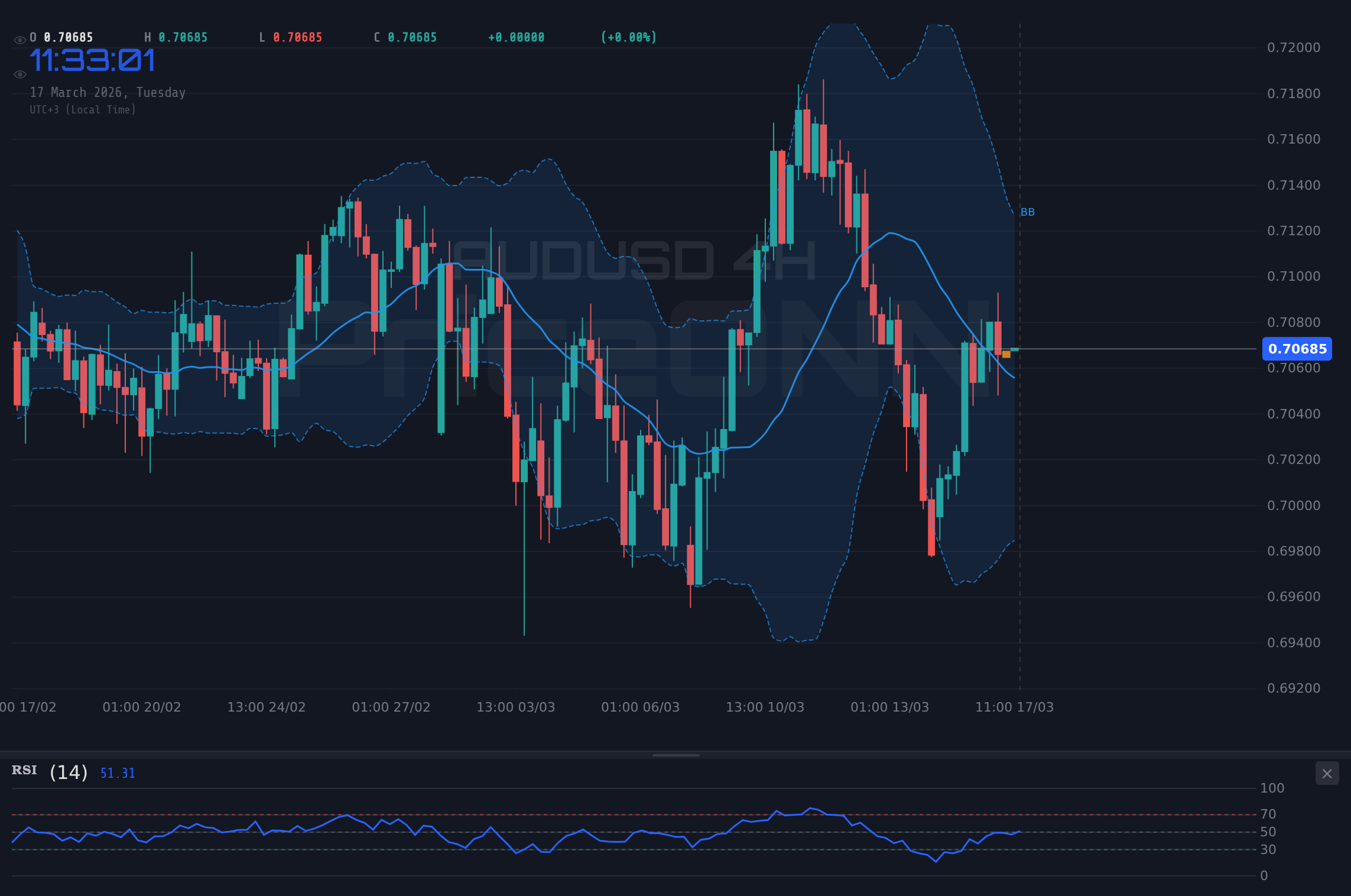
- AUD/USD is trading at $0.70686, with key resistance at $0.70946 and support at $0.70656 based on 4H data.
- The RBA policy decision is a critical upcoming event, with market sentiment split on potential rate actions.
- DXY strength at 99.62 is a headwind, while softer US equity futures (-0.35% for SP500) suggest cautious risk appetite.
- Technical indicators present a mixed picture: 4H RSI is 50.36 (neutral, slight uptrend), but 1D RSI is 45.95 (neutral, downtrend), indicating conflicting signals across timeframes.
The global economic backdrop is a complex tapestry, and AUD/USD's trajectory is inextricably linked to its threads. The US Dollar Index (DXY), currently trading at 99.62, remains a significant influence. A stronger dollar, as indicated by the DXY's upward momentum, typically exerts downward pressure on currency pairs like AUD/USD, as it makes the greenback more expensive for holders of other currencies. This correlation is not just theoretical; it's a constant factor shaping intraday and longer-term price action. Traders are watching closely to see if the DXY can maintain its strength, especially with the Federal Reserve's policy stance continuing to be a dominant theme in global markets.
Furthermore, the performance of major equity indices like the S&P 500 and Nasdaq provides crucial insights into risk sentiment. The S&P 500 trading down 0.35% at 6671.45 and the Nasdaq 100 down 0.45% at 24534.27 signal a degree of caution. When risk appetite wanes, investors often flock to perceived safe-haven assets, which can include the US dollar, further reinforcing the downward pressure on risk-sensitive currencies like the Australian Dollar. Conversely, a surge in equities would typically boost AUD/USD, reflecting a 'risk-on' environment.
Navigating the RBA's Next Move
The immediate catalyst for AUD/USD movement remains the Reserve Bank of Australia's upcoming policy decision. Market expectations are notably divided, creating a fertile ground for volatility. While some anticipate the RBA might hold rates steady, maintaining their current stance to observe the impact of previous tightening cycles and evolving inflation data, others are pricing in a potential rate hike. This divergence in expectations is key; if the RBA surprises the market with a more hawkish tone than anticipated, perhaps due to persistent inflation concerns or a stronger-than-expected employment report, the Australian Dollar could see a significant boost. Conversely, a dovish surprise or a signal of a prolonged pause could weigh heavily on AUD/USD.
The latest economic data from Australia will be crucial in shaping these expectations. Recent inflation figures, employment numbers, and consumer confidence surveys all play a role. If inflation remains stubbornly high, it strengthens the case for further rate hikes, providing a tailwind for the AUD. Similarly, a robust labor market, characterized by strong job creation and falling unemployment, often signals economic resilience and can support a central bank's decision to tighten policy. Traders are dissecting these reports for any hint of a shift in the RBA's outlook, understanding that policy divergence between the RBA and other major central banks, particularly the US Federal Reserve, can be a major driver of currency pair performance.
This uncertainty surrounding the RBA's next move is reflected in the technical indicators. On the 4-hour chart, the Relative Strength Index (RSI) hovers around 50.36, suggesting a neutral stance with a slight upward inclination. However, zooming out to the daily chart, the RSI sits at 45.95, indicating a more bearish sentiment and a prevailing downtrend. This conflict between short-term and long-term indicators highlights the indecision in the market. The ADX on the 4-hour chart at 39.23 suggests a strong downtrend, while the daily ADX at 15.87 points to a weaker, more horizontal trend. Such divergences mean that confirmation from price action will be paramount.
Technical Undercurrents at $0.70686
The current price of AUD/USD at $0.70686 sits precariously close to a significant resistance level. On the 4-hour timeframe, the immediate resistance is identified at $0.70946, with further hurdles at $0.70946 and $0.7109. These levels are critical. A sustained break and hold above $0.70946 would signal a bullish continuation, potentially attracting further buying interest and validating the 'risk-on' sentiment that could emerge if global markets stabilize. The Stochastics indicator on the 4-hour chart shows K=62.86 and D=40.14, indicating a potential for upward movement, contrasting with the daily Stochastic's K=26.17, D=37.28, which suggests further downside potential.
Conversely, support levels are currently positioned at $0.70656, $0.70512, and $0.70439 on the 4-hour chart. A decisive break below $0.70656 could trigger a move towards the lower support levels, especially if the RBA delivers a dovish surprise or if global risk aversion intensifies. The daily chart's RSI at 45.95, coupled with a negative MACD momentum and Bollinger bands indicating a downtrend, reinforces the bearish potential from a longer-term perspective. The market is essentially at a crossroads, with the immediate price action around $0.70686 being heavily influenced by the upcoming RBA announcement and broader macroeconomic trends.
The 1-hour timeframe shows a slightly more bullish inclination, with the RSI at 54.45 and a general buy signal across multiple indicators. This shorter-term optimism might be driven by traders anticipating a positive outcome from the RBA or simply positioning for intraday fluctuations. However, the longer-term signals on the 4-hour and daily charts suggest that any upside move might face significant headwinds. The ADX reading on the 1-hour chart is 21.97, indicating a moderately strong trend, which could support a move if the price can decisively break through the immediate resistance.
Correlation and Macroeconomic Ripples
The relationship between AUD/USD and commodity prices, particularly gold (XAUUSD), is often a key consideration. While gold is currently testing support near $5,000 amidst a pullback, its broader trend can influence the Australian Dollar, given Australia's significant role as a commodity exporter. The recent news highlighting gold's sharp downside 'fake-out' despite geopolitical tensions, and its subsequent consolidation near $5,000, suggests underlying demand remains, but the immediate pressure might be easing. If gold prices were to rebound strongly, it could provide a secondary boost to the AUD, assuming other factors remain supportive.
Oil prices, represented by Brent at $104.3 and WTI at $97.5, have seen a significant surge. This rise, driven by geopolitical concerns such as the Strait of Hormuz closure, generally signals increasing inflationary pressures and can indirectly support commodity-linked currencies like the AUD. However, the correlation is not always direct and can be overshadowed by specific central bank policies or risk sentiment shifts. The strong upward trend in oil prices is a factor that central banks, including the RBA, will be monitoring closely as it impacts their inflation targets and, consequently, their monetary policy decisions.
The interplay between the Australian Dollar and Japanese Yen (USD/JPY) is also noteworthy. With USD/JPY retreating from recent highs around 159.40 and trading near 159.00, potential intervention by Japanese authorities is on traders' minds. While not a direct correlation, shifts in major currency pairs can reflect broader risk sentiment that also impacts AUD/USD. A stabilization or reversal in USD/JPY could coincide with broader currency market adjustments, potentially affecting AUD/USD's path.
The recent news highlighting the potential for AUD/USD to break above 0.71 ahead of the RBA decision suggests that some market participants are already positioning for a bullish outcome. This anticipation, coupled with a rebound to around 0.7070, indicates a degree of optimism. However, the fundamental data needs to support this technical picture. If upcoming inflation data from Australia shows a significant deviation from expectations, either higher or lower, it could easily sway the narrative and lead to a decisive move away from the current $0.70686 level.
The analyst favor growing for AngloGold Ashanti (AU), as mentioned in recent news, could be a subtle indicator of positive sentiment towards Australian assets, though its direct impact on AUD/USD might be limited compared to monetary policy. Nevertheless, such positive sentiment in key sectors can contribute to an overall 'risk-on' mood, which benefits the Australian Dollar.
The Path Forward: Uncertainty and Opportunity
Looking ahead, the AUD/USD pair is at a critical juncture. The immediate focus remains squarely on the RBA's policy decision and any accompanying commentary regarding inflation and the economic outlook. Traders will be dissecting the statement for any hints about future rate movements, which will likely dictate the short-to-medium term direction. The current price of $0.70686 represents a key battleground between the bulls, hoping for a hawkish RBA surprise and a break above resistance, and the bears, who see potential downside if the RBA remains cautious or if global risk sentiment deteriorates.
From a technical standpoint, confirmation will be crucial. A sustained break above the 4-hour resistance at $0.70946 would be a bullish signal, targeting $0.7109 and beyond. Invalidation of this move would occur on a close below the 4-hour support at $0.70656, potentially opening the door for a test of lower levels. The divergence in RSI readings between the 1-hour, 4-hour, and daily charts underscores the need for caution. Traders should be looking for confluence across multiple timeframes and indicators before committing to a significant position.
The broader macroeconomic environment, particularly the path of US interest rates and global growth prospects, will continue to be a significant factor. Any signs of cooling inflation in the US or a more dovish stance from the Federal Reserve could provide relief to AUD/USD, even if the RBA maintains a steady course. Conversely, persistent US inflation or renewed geopolitical tensions could strengthen the DXY and weigh on the pair, regardless of the RBA's actions. The market is currently pricing in a complex set of variables, making disciplined risk management paramount.
Frequently Asked Questions: AUD/USD Analysis
What happens if AUD/USD breaks above the $0.70946 resistance level?
A sustained break above the 4-hour resistance at $0.70946 would signal bullish momentum, potentially targeting the next resistance level at $0.7109. This scenario would likely be supported by a hawkish RBA surprise or a significant improvement in global risk sentiment.
Should I consider buying AUD/USD at the current $0.70686 level given the mixed technical signals and upcoming RBA decision?
Caution is advised. While the 1-hour chart shows some bullish signs, the daily RSI at 45.95 and ADX at 15.87 suggest underlying weakness. A high-probability setup would require confirmation of a bullish RBA stance or a decisive break above $0.70946, with invalidation below $0.70656.
Is the RSI at 45.95 on the daily chart a strong sell signal for AUD/USD right now?
An RSI of 45.95 indicates a neutral-to-bearish bias on the daily timeframe, suggesting downward momentum is present but not yet extreme. It's not a definitive sell signal on its own; confirmation from price action breaking support levels like $0.70656 would be needed.
How might the RBA's policy decision impact AUD/USD this week, given current inflation data?
If the RBA signals a continued pause or potential easing due to cooling inflation, AUD/USD could fall below $0.70656. Conversely, a hawkish surprise, driven by persistent inflation, could push the pair above $0.70946, especially if accompanied by positive global risk sentiment.
Track markets in real-time
AI-powered analysis, technical indicators and real-time price data.
Join Our Telegram Channel
Breaking market news, AI analysis and trading signals instantly.
Join Channel