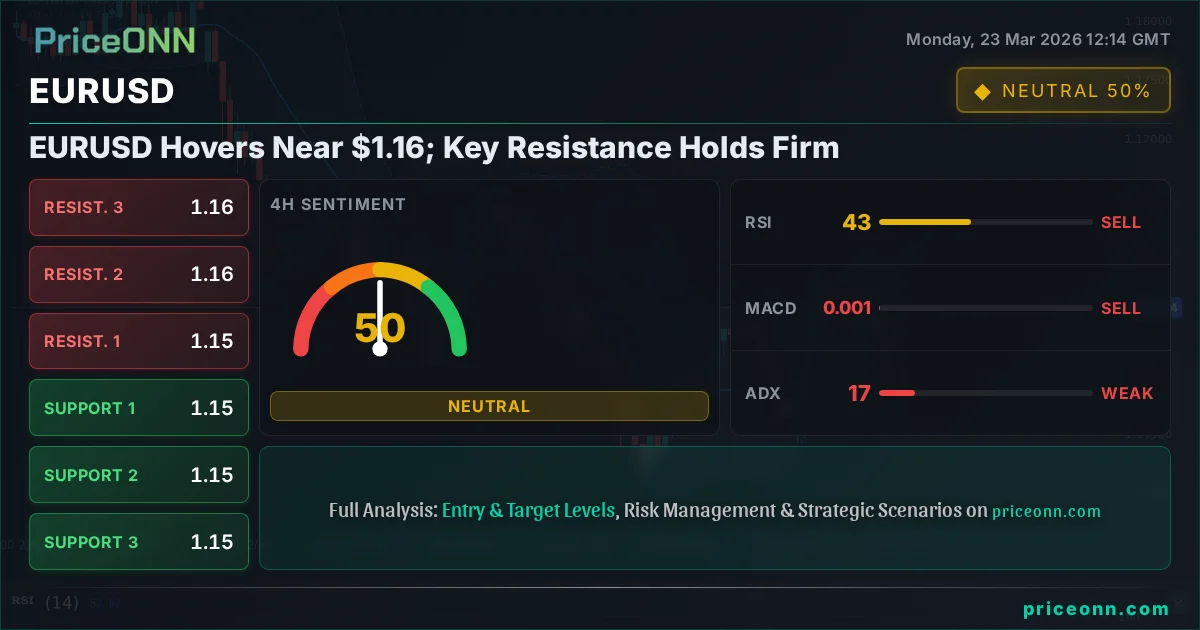
EURUSD Hovers Near $1.16; Key Resistance Holds Firm
EURUSD struggles near $1.1600 as the 1.15489 resistance level proves formidable. Technical indicators suggest a cautious outlook amid mixed market signals.
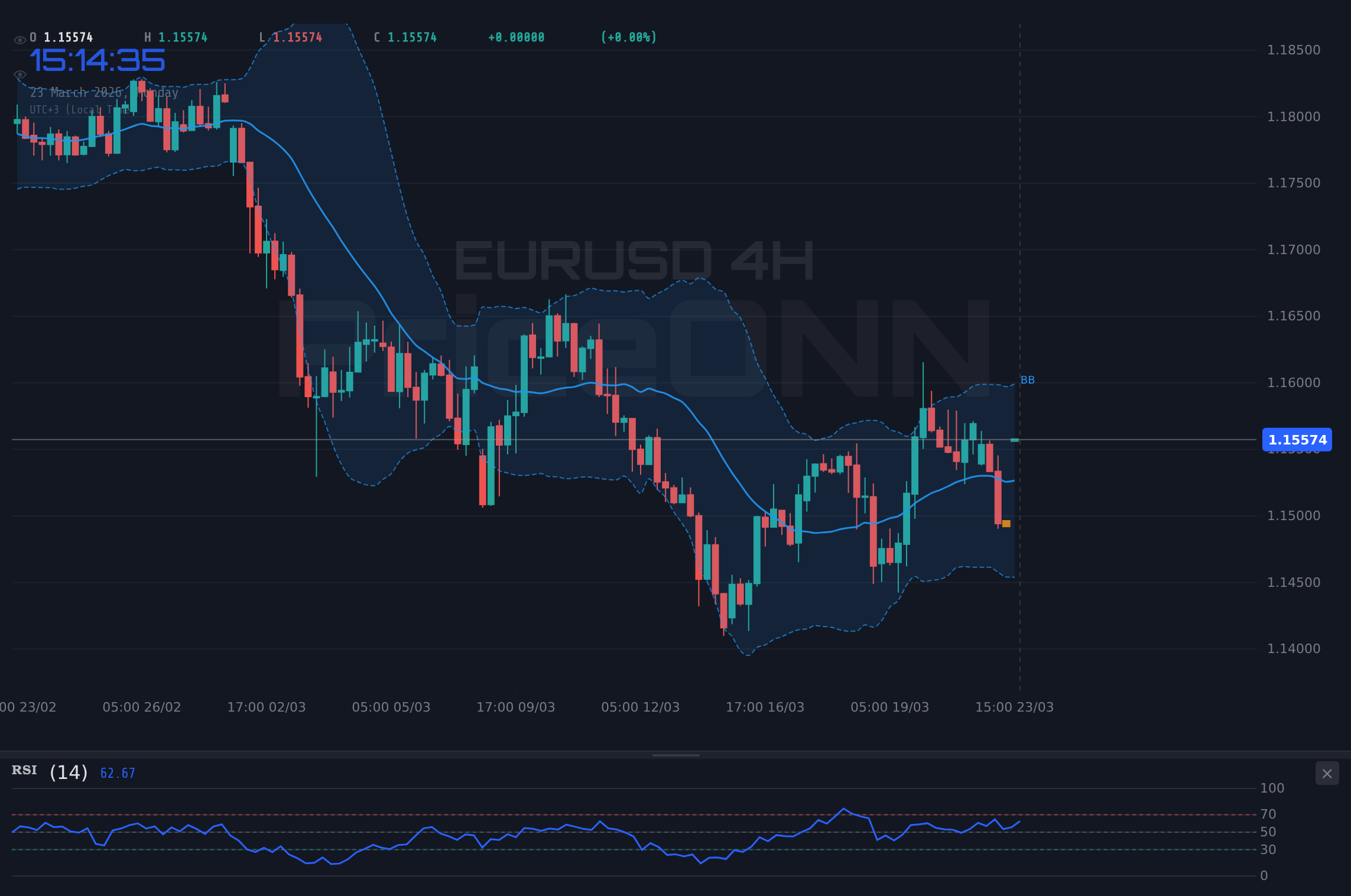
The Euro's attempt to gather momentum against the US Dollar has stalled near the crucial $1.1600 psychological mark, with the pair currently trading around $1.15617. This isn't just a minor pause; it's a critical juncture where the prevailing market sentiment, driven by a complex interplay of macroeconomic factors and geopolitical undercurrents, is being tested. The $1.15489 resistance level, a significant hurdle identified in our 4H analysis, has held firm, indicating that the bulls are struggling to gain sustained control. This price action demands close attention, as it could signal a potential continuation of the recent downward pressure or a prelude to a more decisive move. Understanding the forces at play is paramount for any trader navigating these choppy waters.
- EURUSD is trading near $1.15617, facing resistance at $1.15489.
- The Dollar Index (DXY) is at 99.33, showing a mixed but slightly upward trend, influencing EURUSD's direction.
- Gold prices have tumbled to $4,371.18, signaling potential risk-off sentiment that could support safe-haven currencies, though EURUSD's correlation is complex.
- Technical indicators present conflicting signals: RSI is neutral, but MACD and ADX suggest downward momentum on longer timeframes.
- A daily close above $1.16009 is needed for a bullish shift, while a break below $1.15308 would confirm further downside.
Navigating the Cross-Currents: DXY and Risk Appetite
The US Dollar Index (DXY), currently trading around 99.33, remains a pivotal force influencing EURUSD. While the 1-hour chart shows a neutral trend with mixed signals from MACD and Stochastic, the daily outlook paints a clearer picture of upward momentum. A DXY at 99.33, even with its current slight daily gain of 0.07%, suggests underlying strength that typically exerts pressure on major currency pairs like EURUSD. When the dollar strengthens, it makes Euro-denominated assets relatively more expensive for holders of other currencies, potentially dampening demand for the Euro. This inverse relationship is a cornerstone of forex analysis, and traders must constantly monitor the DXY's movements to gauge its impact on EURUSD. The market sentiment, as reflected by the DXY's trend, is crucial; a rising DXY often correlates with a 'risk-off' environment, where investors flock to perceived safe-haven assets like the US dollar, even as other safe havens like gold are experiencing their own volatility.
The current market environment is a fascinating study in contrasts. While the DXY shows signs of strength, other indicators paint a more complex picture. The SP500, trading at 6602.6, has seen a notable daily increase of 1.03%. This suggests a degree of risk appetite returning to equity markets, which typically would not favor a strong dollar. However, the Nasdaq100 also shows a similar upward trend. This divergence between equity market strength and dollar strength can create uncertainty. The Nasdaq100, at 24234.15, has also seen a significant rise. This suggests that the strength in US equities might be driven by specific sector performance rather than a broad-based risk-on sentiment that would typically weaken the dollar. This complex correlation means that EURUSD traders cannot simply rely on equity market direction alone; they must also consider the dollar's independent strength and its drivers.
Gold's Tumultuous Ride and its Implications for EURUSD
The recent sharp decline in gold prices, falling to $4,371.18 with a significant 2.81% daily drop, is a key development demanding our attention. Gold, often seen as a traditional safe-haven asset, has experienced considerable volatility. The breaking news indicates gold prices have tumbled to approximately $4,460 amid a stronger US Dollar, rising bond yields, and persistent inflation fears. This suggests that while the dollar is strengthening, the underlying drivers might be more complex than simple risk aversion. The drop in gold, especially when accompanied by rising bond yields, can signal a shift in investor sentiment away from traditional safe havens towards assets perceived to benefit from inflationary pressures or higher interest rates. For EURUSD, this gold price action adds another layer of complexity. If gold's fall is driven by expectations of aggressive central bank tightening (which would also strengthen the dollar), it could reinforce the downward pressure on EURUSD. Conversely, if the fall is seen as a correction after an overbought period, and if geopolitical tensions remain high, gold could still find buyers, potentially offering some support to currencies perceived as less risky.
The 1-day RSI for gold at 26.7 is deep in oversold territory, suggesting a potential for a bounce. However, the ADX at 22.26 indicates only a moderate downward trend, which, combined with the MACD being negative, suggests the downtrend is still in play. This conflicting technical picture for gold mirrors the uncertainty seen in EURUSD. The news highlights that gold prices have fallen below $5,000, driven by resurgent inflation fears and escalating Middle East tensions. This is a critical point: inflation fears are often a driver for gold as a hedge, but here they seem to be pushing investors towards the dollar and potentially away from gold as yields rise. This dynamic is crucial for EURUSD as it influences the broader risk sentiment and the relative attractiveness of the Euro versus the Dollar.
EURUSD Technicals: A Battle at the Key Levels
Turning our focus squarely onto EURUSD, the technical picture across different timeframes reveals a currency pair at a critical crossroads. On the 1-hour chart, the trend is neutral with a power of 50%, indicating a lack of strong directional conviction. However, the RSI at 54.58 is in neutral territory, leaning slightly bullish, while the MACD shows negative momentum. The Stochastic indicator, with K at 20.06 and D at 15.74, is flashing a bullish signal, suggesting a potential short-term upward move. Yet, the ADX at 23.14 points to a moderately strong uptrend, which seems to contradict the negative MACD. This presents a confusing short-term outlook, where traders might be looking for confirmation before committing to a direction.
The 4-hour timeframe offers a slightly clearer, though still challenging, perspective. The trend is neutral (50% power), but the RSI at 42.81 indicates a bearish bias, and the MACD is firmly negative, signaling weakening momentum. The Stochastic's K value (20.48) is below its D value (51.72), reinforcing the bearish signal. The ADX is at a low 16.85, suggesting a weak trend and potentially ranging conditions. This suggests that while there might be short-term fluctuations, the larger 4-hour trend is not strongly defined, making it difficult to establish a clear trading strategy based solely on this timeframe. The key takeaway here is consolidation, with price action likely to remain within defined boundaries until a significant catalyst emerges.
The daily chart provides the most significant context for the current EURUSD price action. The trend is classified as bearish with a high power of 94%. The RSI at 42.83 remains in neutral territory but shows a downward eğilim, and the MACD exhibits positive momentum, crossing above its signal line. However, the Bollinger Bands are below the middle band, indicating a bearish bias. The Stochastic indicator, with K at 62.49 and D at 39.23, shows a bullish signal, which contradicts the overall bearish trend and the ADX reading of 37.3, indicating a strong downward trend. This confluence of conflicting signals - a bearish daily trend with a bullish stochastic reading - highlights the indecision in the market. The key support level to watch on the daily chart is $1.15308, while the immediate resistance is at $1.15489, followed by the more significant $1.16009. A decisive break above $1.16009 would be needed to challenge the prevailing bearish sentiment.
Macroeconomic Factors: Inflation, Rates, and the Euro's Fate
The persistent narrative around inflation continues to be a dominant force shaping monetary policy expectations and, consequently, currency markets. While specific economic calendar data for the past 48 hours wasn't detailed in the provided context, the general market commentary points towards ongoing concerns about inflation, even as growth potentially slows. This creates a delicate balancing act for central banks, particularly the European Central Bank (ECB) and the US Federal Reserve. If inflation remains stubbornly high, it could force central banks to maintain a hawkish stance or even tighten policy further, which would typically support their respective currencies. For EURUSD, this means that upcoming inflation reports, employment figures, and central bank communications will be critical.
The rising bond yields, mentioned in the context of gold's decline, are a direct consequence of inflation concerns and expectations of higher interest rates. If US Treasury yields continue to climb, it makes dollar-denominated assets more attractive, potentially drawing capital away from other currencies, including the Euro. The 'stagflation' discussion, where high inflation coincides with slow economic growth, is a significant risk factor. If Europe faces a more pronounced stagflationary environment than the US, it could put additional downward pressure on EURUSD. Conversely, if the ECB signals a more aggressive stance on inflation than the Fed, or if US growth falters more significantly, it could provide support for the Euro. The market is constantly repricing these possibilities, leading to the volatility we are observing.
Geopolitical tensions, particularly in the Middle East, are adding another layer of uncertainty. The news about the IEA discussing potential oil stockpile releases due to escalating tensions underscores the fragility of the energy markets and their potential inflationary impact. Elevated oil prices can directly feed into inflation, forcing central banks' hands. For the Eurozone, which is heavily reliant on energy imports, sustained high oil prices can act as a significant drag on economic growth while simultaneously fueling inflation. This creates a challenging scenario for the ECB. The mention of GBP/USD facing downward pressure near 1.3320 due to Middle East tensions also highlights the broader risk sentiment. While EURUSD's correlation with GBPUSD is not always direct, a general move towards risk aversion driven by geopolitical events can weigh on both pairs against a strengthening dollar.
Trade Scenarios: What to Watch for EURUSD
Bearish Scenario: Testing Lower Supports
65% ProbabilityConsolidation Scenario: Range-Bound Action
25% ProbabilityBullish Scenario: Reclaiming Higher Ground
10% ProbabilityThe Path Forward: Patience and Risk Management
The current technical and fundamental landscape for EURUSD presents a scenario where patience is not just a virtue but a necessity. The conflicting signals across different timeframes and indicators suggest that the market is in a state of flux, awaiting a clearer catalyst. The resistance at $1.15489 is a clear line in the sand for the bulls, while the support at $1.15308 remains the immediate level to watch for bears. A daily close above $1.16009 would be a significant bullish development, potentially opening the door for a move towards $1.16325 and higher. However, given the current bearish bias on the daily chart and the strength of the DXY, the path of least resistance currently appears to be downwards. Traders should be looking for clear confirmation before entering positions. This might involve waiting for a confirmed breakout above resistance, a solid hold of support, or a clearer trend signal from oscillators like the RSI or MACD on higher timeframes.
The interplay between inflation fears, central bank policies, and geopolitical events will continue to be the primary drivers. Keep a close eye on upcoming economic data releases, particularly from the US and the Eurozone. The Federal Reserve's stance, as reflected in Fed Fund Futures and commentary from Fed officials, will be crucial in determining the dollar's trajectory. Similarly, any hints from the ECB about their inflation-fighting strategy or economic outlook could significantly impact the Euro. Remember, managing risk is paramount. With the ADX suggesting strong trends on some timeframes and weak trends on others, the market can be prone to sharp reversals or prolonged consolidation. Stick to your trading plan, manage your position size prudently, and never risk more than you can afford to lose. The market always provides opportunities; the key is to wait for the right setup and execute with discipline.
Frequently Asked Questions: EURUSD Analysis
What happens if EURUSD breaks below the $1.15308 support level?
A break below the $1.15308 support level, especially on a daily closing basis, would invalidate the current neutral-to-bullish short-term outlook and confirm further downside. This could open the door for a move towards the next significant support at $1.14607, as indicated by the daily chart analysis. Increased selling pressure would likely be confirmed by rising trading volumes and negative momentum signals across multiple timeframes.
Should I buy EURUSD at current levels near $1.15617 given the bullish Stochastic signal?
Buying solely based on the Stochastic signal near $1.15617 would be risky, as it conflicts with the overall bearish daily trend and the negative MACD momentum. A more prudent approach would be to wait for confirmation, such as a decisive break above the $1.15489 resistance or a clear bullish reversal pattern forming on the 4-hour chart. Risk management dictates waiting for higher probability setups rather than chasing short-term signals.
Is the RSI at 42.81 on the 4-hour chart a sell signal for EURUSD?
An RSI reading of 42.81 on the 4-hour chart indicates a bearish bias, suggesting that sellers have more control than buyers in that specific timeframe. While not yet in oversold territory, it aligns with the prevailing downward pressure. However, it should be considered alongside other indicators like MACD and ADX, which also show bearish momentum, reinforcing the idea that a 'sell' signal is present on this timeframe, but caution is advised due to the conflicting signals on other charts.
How will upcoming US inflation data affect EURUSD this week?
Stronger-than-expected US inflation data would likely reinforce expectations of a hawkish Federal Reserve, potentially leading to higher US Treasury yields and a stronger dollar. This scenario would put further downward pressure on EURUSD, potentially testing the $1.15308 support. Conversely, inflation data coming in cooler than expected could prompt a Fed pivot narrative, weaken the dollar, and offer support to EURUSD, possibly pushing it towards the $1.16009 resistance.
Track markets in real-time
AI-powered analysis, technical indicators and real-time price data.
Join Our Telegram Channel
Breaking market news, AI analysis and trading signals instantly.
Join Channel