

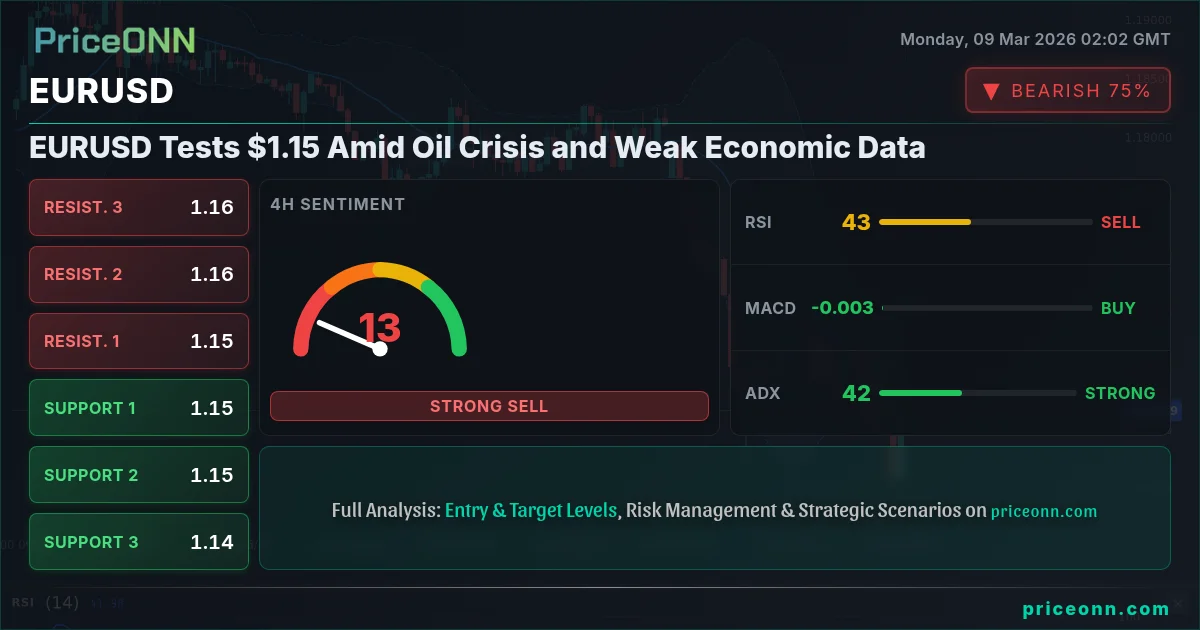
EURUSD is under pressure, currently testing $1.15, a level watched closely by traders as the pair grapples with a confluence of negative factors. The escalating oil crisis, stemming from heightened tensions in the Middle East, is sending shockwaves through forex markets, particularly impacting EUR/CAD. Simultaneously, weak economic data from the Eurozone is adding to the downward pressure, creating a challenging environment for the Euro.
- EURUSD is testing $1.15, a key level influenced by the oil crisis and weak Eurozone data.
- Immediate support lies at 1.15112, with resistance at 1.15264, according to 1H technical analysis.
- RSI at 29.12 on the 1H chart indicates oversold conditions, potentially signaling a short-term bounce.
- DXY's rise to 99.44 is exacerbating the downward pressure on EURUSD.
Oil Crisis and its Impact on EURUSD
The ongoing oil crisis, as highlighted by recent news reports, is significantly influencing forex markets. Crude oil prices have surged due to escalating tensions in the Middle East, disrupting global supply chains and impacting currency valuations. This crisis has particularly hit the EUR/CAD pair, as noted by reports of its plunge amidst dollar strength. The rise in Brent crude, now at $65.73, reflects the market's anxiety over potential supply disruptions and inflationary pressures.
The relationship between oil prices and currency valuations is complex but crucial. As an energy-importing region, the Eurozone is particularly vulnerable to oil price shocks. Higher oil prices can lead to increased import costs, potentially widening the trade deficit and putting downward pressure on the Euro. This scenario is further compounded by the European Central Bank's (ECB) monetary policy stance, which, in the face of economic uncertainty, may be perceived as less hawkish compared to other central banks.
Eurozone Economic Data Weighing on EURUSD
Adding to the woes of the Euro, recent economic data from the Eurozone has been less than encouraging. While specific figures are not provided in the immediate market data, the general trend of weak economic performance contributes to the bearish sentiment surrounding the Euro. Concerns over growth prospects, coupled with the uncertainty surrounding the oil crisis, create a perfect storm for the EURUSD pair.
The U.S. economy, on the other hand, is showing relative resilience, supported by robust employment figures and a hawkish Federal Reserve. This divergence in economic performance and monetary policy expectations further strengthens the U.S. dollar, exerting additional downward pressure on the EURUSD pair. The dollar index (DXY) at 99.44 reflects this strength, acting as a headwind for the Euro.
Technical Analysis of EURUSD
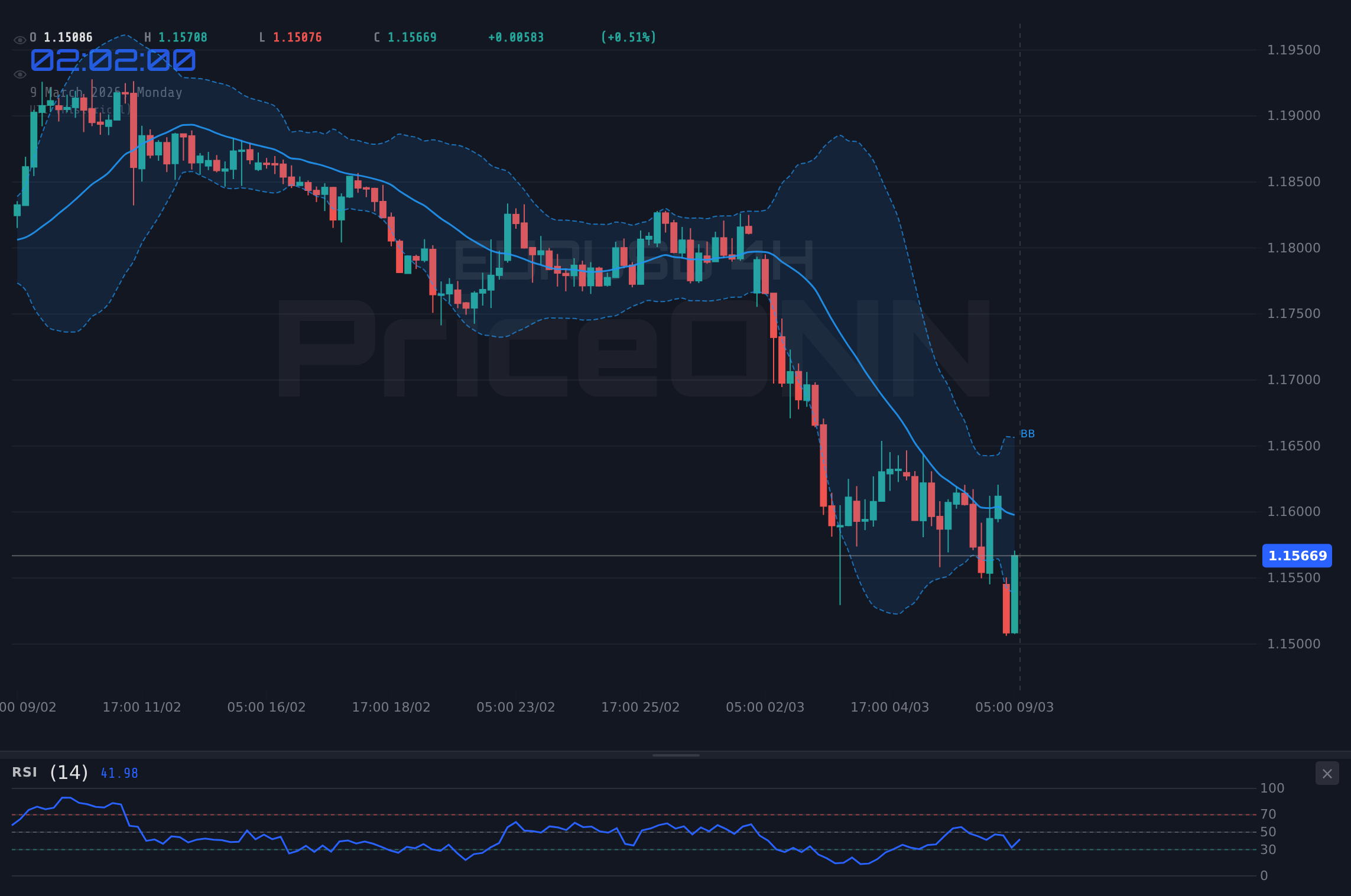
A technical overview of EURUSD reveals a bearish trend across multiple timeframes. On the 1H chart, the trend is strongly bearish with a strength of 91%. The RSI at 29.12 indicates oversold conditions, which may suggest a potential short-term bounce. However, the MACD remains in negative territory, signaling continued bearish momentum. The Stochastic oscillator, with K=2.18 and D=42.51, also supports the bearish outlook.
The 4H chart paints a similar picture, with the trend being neutral but with a strong bearish ADX of 42.01. The RSI at 32.23 is also in the oversold territory, while the MACD shows some signs of stabilization. The Stochastic oscillator, with K=43.45 and D=39.69, is showing a bullish crossover, which could indicate a potential short-term recovery.
On the daily timeframe, the trend is neutral, but the ADX at 25.04 indicates a strong bearish trend. The RSI at 27.89 is deeply in oversold territory, suggesting a potential for a more significant recovery. However, the MACD remains in negative territory, and the Stochastic oscillator, with K=19.79 and D=31.57, continues to signal bearish momentum.
Key Support and Resistance Levels for EURUSD
Identifying key support and resistance levels is crucial for traders navigating the EURUSD pair. According to the data, immediate support on the 1H chart lies at 1.15112, followed by 1.15057 and 1.1496. Resistance is observed at 1.15264, 1.15361, and 1.15416. These levels can act as potential entry and exit points for short-term trades.
On the 4H chart, support is found at 1.15958, 1.15798, and 1.15673, while resistance is at 1.16243, 1.16368, and 1.16528. These levels are relevant for medium-term traders looking to capitalize on potential swings in the EURUSD pair.
The daily chart reveals support at 1.15614, 1.15155, and 1.14729, with resistance at 1.16499, 1.16925, and 1.17384. These levels are significant for long-term investors assessing the overall trend and potential investment opportunities.
EURUSD Forecast and Trading Strategies
Given the confluence of negative factors impacting EURUSD, the short-term forecast leans towards continued downward pressure. A break below the immediate support at 1.15112 could open the door for a test of the lower support levels at 1.15057 and 1.1496. Conversely, a failure to break below 1.15112 could lead to a short-term bounce towards the resistance at 1.15264.
Medium-term, the outlook remains uncertain, contingent on the resolution of the oil crisis and the release of upcoming economic data. A sustained recovery in the Eurozone economy, coupled with a stabilization in oil prices, could provide support for the EURUSD pair. However, continued weakness in economic data and persistent tensions in the Middle East could exacerbate the downward pressure.
The Role of the Dollar Index (DXY)
The dollar index (DXY) plays a crucial role in the dynamics of the EURUSD pair. A rising DXY typically exerts downward pressure on EURUSD, as it reflects the relative strength of the U.S. dollar against a basket of currencies, including the Euro. The current DXY level of 99.44 indicates a strong dollar, which is contributing to the bearish sentiment surrounding EURUSD.
Traders should closely monitor the DXY for potential shifts in momentum. A weakening DXY could provide some relief for the EURUSD pair, while a continued rise in the DXY could further exacerbate the downward pressure. The relationship between the DXY and EURUSD is often inverse, but divergences can occur due to specific factors impacting either currency.
Risk Factors and Considerations
Investing in EURUSD involves inherent risks that traders should be aware of. The oil crisis, economic data releases, and central bank policies can all significantly impact the pair's movements. Geopolitical tensions, trade disputes, and unexpected events can also trigger volatility and disrupt established trends.
Effective risk management is crucial for navigating the complexities of the EURUSD market. Setting stop-loss orders, diversifying investments, and staying informed about market developments can help mitigate potential losses. Traders should also be mindful of their risk tolerance and avoid overleveraging their positions.
What Happens Next?
As EURUSD tests the $1.15 level, the immediate focus shifts to the upcoming economic data releases and the evolution of the oil crisis. Traders should closely monitor these developments for potential catalysts that could trigger significant movements in the pair. A decisive break below 1.15112 could signal further downside, while a sustained hold above this level could pave the way for a short-term recovery.
In the short-term, the forecast is cautiously bearish, with the potential for a bounce if oversold conditions persist. Medium-term, the outlook remains uncertain, contingent on the resolution of the oil crisis and the performance of the Eurozone economy. Until clarity emerges on these fronts, traders should exercise caution and manage their risk accordingly.
Frequently Asked Questions: EURUSD Analysis
Is EURUSD a good buy right now?
Currently, EURUSD at $1.15 is not a strong buy signal, as it is facing downward pressure from the oil crisis and weak Eurozone data. A potential buying opportunity could emerge if the RSI enters deeper oversold territory and the pair shows signs of stabilization above the 1.15112 support level.
What is the EURUSD price forecast for this week?
The EURUSD price forecast for this week leans towards continued downward pressure, with a potential test of the 1.15057 and 1.1496 support levels. A bullish scenario could unfold if the DXY weakens and the Eurozone economic data improves, potentially leading to a recovery towards the 1.15264 resistance level with a 30% probability.
What are the key support and resistance levels for EURUSD?
Key support levels for EURUSD are 1.15112, 1.15057, and 1.1496, while resistance levels are 1.15264, 1.15361, and 1.15416, according to the 1H chart analysis. These levels are crucial for identifying potential entry and exit points for short-term trades.
Why is EURUSD moving today?
EURUSD is moving lower today due to a combination of factors, including the escalating oil crisis, which is negatively impacting the Eurozone economy, and the strength of the U.S. dollar, as reflected in the rising DXY at 99.44. Weak Eurozone economic data is further contributing to the downward pressure.
Track markets in real-time
AI-powered analysis, technical indicators and real-time price data.
Join Our Telegram Channel
Breaking market news, AI analysis and trading signals instantly.
Join Channel