GBPUSD Dips to $1.335 Amid Easing Geopolitical Tensions
GBPUSD slides to $1.335 as geopolitical tensions ease and expectations shift for the Bank of England. Key economic data and central bank policy drive the pair's direction.
The pound dollar trading strategy is currently under pressure as GBPUSD has fallen to $1.33503 amid easing geopolitical tensions and shifting expectations for a Bank of England rate cut. This move reflects broader market dynamics influenced by both global events and domestic economic factors, making it crucial for traders to understand the underlying drivers.
- GBPUSD is currently trading at $1.33503, reflecting a daily change of -0.14%.
- Key support lies at 1.33136, with resistance at 1.34132, shaping near-term trading opportunities.
- The ADX at 27.3 indicates a strong downward trend on the 1D timeframe, signaling potential for further downside.
- Geopolitical tensions and shifting central bank expectations are key drivers of GBPUSD's current bearish momentum.
The recent dip in GBPUSD comes as geopolitical tensions between the US and Iran have eased, reducing the demand for safe-haven currencies. According to recent forex analysis, these geopolitical developments, coupled with key economic data releases, are shaping the market outlook. The shift in expectations for a Bank of England rate cut also plays a significant role, as traders are adjusting their positions based on the latest economic indicators. The GBP/USD pair has fallen to 1.3350 amid easing tensions between the US and Iran and shifting expectations for a Bank of England.
From a fundamental perspective, the UK economy is facing a mixed bag of signals. While employment data remains relatively robust, inflation figures have been stickier than expected, complicating the Bank of England's policy outlook. The upcoming economic events, particularly those relating to inflation and employment, will be crucial in determining the future direction of GBPUSD. These factors contribute to the overall pound dollar trading strategy, influencing decisions on entry and exit points.
Looking at the technical picture, the daily chart reveals a strong downward trend, as indicated by the ADX at 27.3. The RSI(14) is at 36.15, residing in neutral territory but trending downwards, suggesting further potential for bearish momentum. The MACD histogram is showing negative momentum, reinforcing the bearish outlook. The Stochastic indicator shows a potential bullish signal (%K > %D), but this needs confirmation from other indicators to be considered a reliable signal.
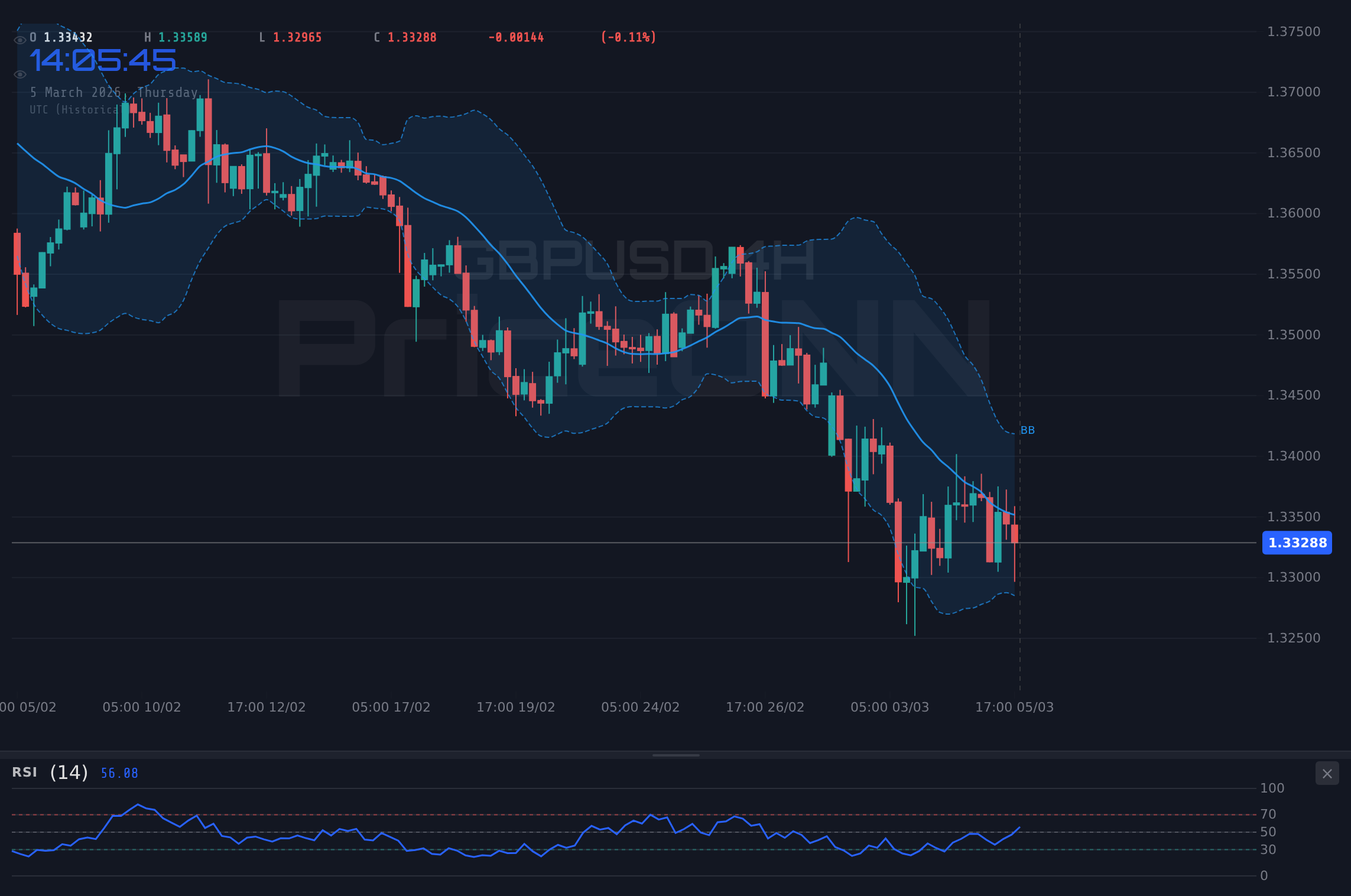
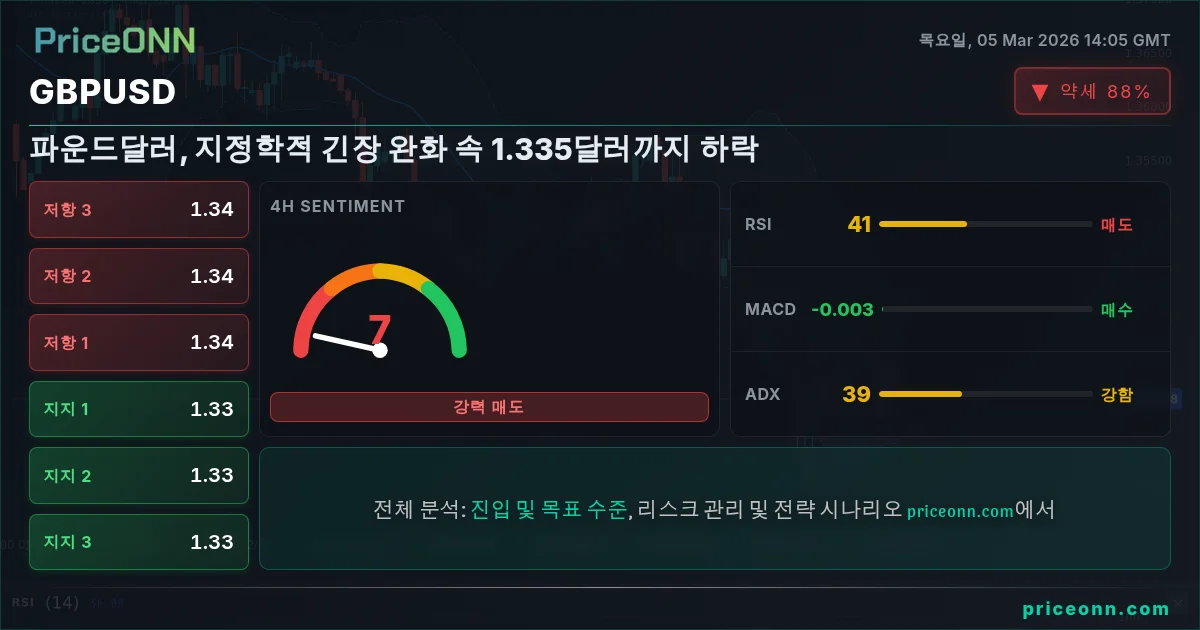
On the 4H timeframe, the ADX is at 38.17, signaling a strong downward trend. The RSI(14) is at 43.48, also in neutral territory but trending downwards. The MACD shows positive momentum, which might provide a temporary respite for the pair. However, the overall trend remains bearish, and traders should be cautious about initiating long positions. Key resistance levels to watch are 1.33843, 1.3415, and 1.34547. A break above these levels could signal a potential trend reversal, but until then, the bears remain in control.
Zooming into the 1H timeframe, the trend is neutral, with the ADX at a weak 12.62. The RSI(14) is at 47.97, showing neither overbought nor oversold conditions. The MACD momentum is balancing, indicating a potential consolidation phase. Support levels to monitor are 1.33545, 1.33428, and 1.33338. These levels could provide short-term buying opportunities, but the overall bearish trend suggests that any rallies might be short-lived.
The dollar index (DXY) is currently at 98.81, showing a daily increase of 0.3%. This strengthening dollar is putting downward pressure on GBPUSD. As the DXY continues to rise, GBPUSD is likely to face further headwinds. Traders should closely monitor the DXY's movements to gauge the potential impact on GBPUSD. Risk appetite, as indicated by the SP500, is declining, with the SP500 currently at 6838.25, down by 0.47%. This risk-off environment tends to favor safe-haven currencies like the US dollar, further contributing to the bearish outlook for GBPUSD.
The energy crisis and geopolitical tensions in the Middle East, as reported by various news outlets, are adding to the market's uncertainty. Disruptions in oil production and export halts are creating significant volatility in the energy markets, which indirectly impacts currency valuations. According to recent reports, the closure of the Strait of Hormuz and Qatari LNG production halts have sent European gas prices soaring, adding to the economic pressures in the region.
Considering the economic calendar, the upcoming high-impact events will be closely watched by traders. Any surprises in these data releases could trigger significant volatility in GBPUSD. Traders should prepare for potential price swings and adjust their strategies accordingly. The Actual data will be key to understanding the current economic trajectory and its impact on currency valuations.
Given the technical and fundamental outlook, several pound dollar trading strategy considerations emerge. Scalpers might look for short-term selling opportunities around resistance levels, while swing traders might wait for a confirmed break below support levels to initiate larger positions. Long-term investors should remain cautious, as the overall trend remains bearish, and any rallies might be temporary.
The current bearish trend in GBPUSD is driven by a combination of factors, including easing geopolitical tensions, shifting expectations for a Bank of England rate cut, a strengthening dollar, and a risk-off environment. Traders should carefully monitor key economic data releases, central bank policies, and geopolitical developments to make informed trading decisions. Although Stochastic indicator shows a potential bullish signal, this needs confirmation from other indicators to be considered a reliable signal.
Frequently Asked Questions: GBPUSD Analysis
Is GBPUSD a good buy right now?
No, given the current bearish trend and negative momentum, GBPUSD is not a good buy right now. The price is at $1.33503, with a strong downward trend indicated by the ADX at 27.3, suggesting that further downside is likely.
What is the GBPUSD price forecast for this week?
The GBPUSD price forecast for this week leans bearish, with potential targets around the support level of 1.33136. A break below this level could lead to further declines, but a rebound is possible if risk sentiment shifts.
What are the key support and resistance levels for GBPUSD?
Key support levels for GBPUSD are 1.33136, 1.32581, and 1.3214, while key resistance levels are 1.34132, 1.34573, and 1.35128. These levels are derived from the daily timeframe and can serve as potential entry and exit points.
Why is GBPUSD moving today?
GBPUSD is moving today due to a combination of factors, including easing geopolitical tensions and shifting expectations for a Bank of England rate cut. Additionally, a strengthening dollar and a risk-off environment are contributing to the bearish momentum.
Technical Outlook Summary
| Indicator | Value | Signal |
|---|---|---|
| RSI (14) | 36.15 | Bearish |
| MACD Histogram | Negative | Bearish |
| Stochastic | 31.97 | Bullish |
| ADX | 27.3 | Strong Trend |
| Bollinger | Middle Band | Bearish |
Key Levels
Support Levels
Resistance Levels
Track markets in real-time
Empower your investment decisions with AI-powered analysis, technical indicators and real-time price data.
Join Our Telegram Channel
Get breaking market news, AI analysis and trading signals delivered instantly to your Telegram.
Join Channel