
Is WTI Crude Oil Poised to Break $100 Amid Escalating Geopolitical Tensions?


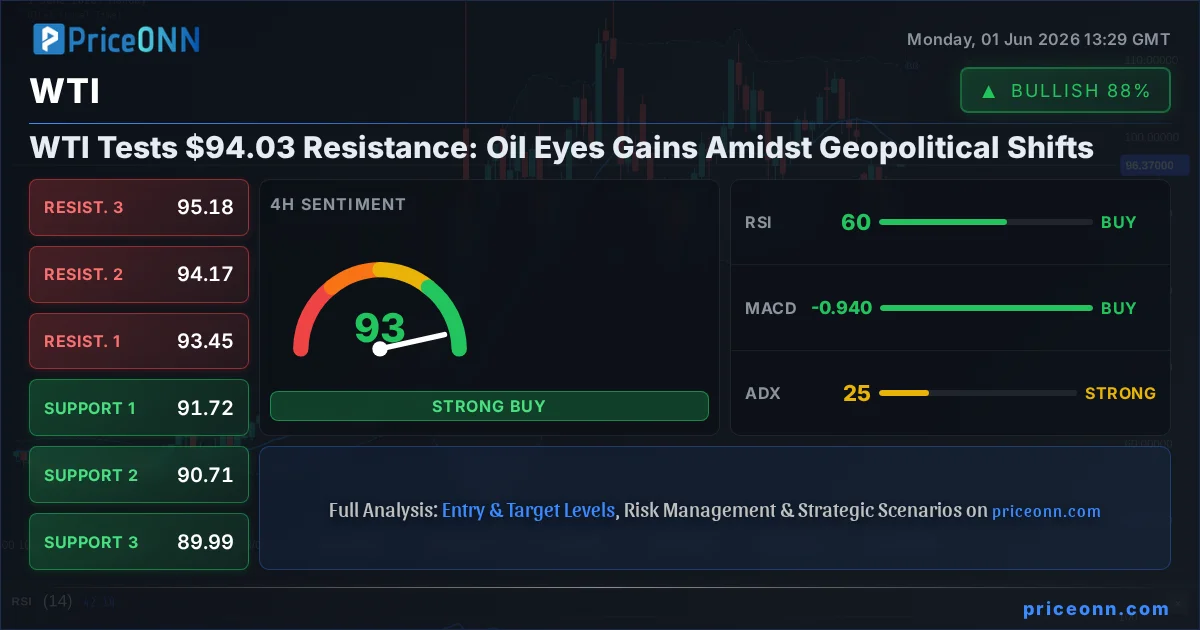
West Texas Intermediate (WTI) crude oil futures are testing the significant $100 per barrel psychological level, hovering just below it near $98.00 during Monday's European trading session. This price action is occurring against a backdrop of heightened geopolitical risks in the Middle East, specifically concerning the security of critical energy transit points.
Market Context
WTI, the benchmark for US crude, has been unable to decisively break above the $100 mark, reflecting a market that is sensitive to supply disruptions. Recent reports indicate that a vital port in Fujairah, United Arab Emirates, a key export route outside the Strait of Hormuz, has been targeted. This incident, the latest in a series of strikes, underscores the fragility of oil supply chains in the region and adds a significant risk premium to global oil prices.
WTI, known for its light and sweet characteristics, is a cornerstone of the global energy market. Sourced from the United States and distributed through the Cushing, Oklahoma hub, it serves as a critical price indicator. Despite its inherent value, the asset is currently grappling with external pressures that are capping its upward momentum.
Analysis & Drivers
The primary catalyst for current market sentiment appears to be escalating geopolitical tensions. Reports of attacks on energy infrastructure in the UAE, a nation crucial for maintaining oil flow, directly impact supply outlooks. The safety and openness of the Strait of Hormuz, a chokepoint through which a significant portion of global oil passes, remains a persistent concern. Any perceived threat to this waterway can cause immediate price spikes, though fears of wider conflict often lead to a more sustained risk premium.
Beyond immediate geopolitical events, broader market fundamentals continue to play a role. Global economic health is a key determinant of oil demand. A robust global economy typically translates to higher energy consumption, supporting prices. Conversely, signs of economic slowdown can dampen demand expectations, putting downward pressure on crude. Furthermore, the decisions made by OPEC and its allies (OPEC+) regarding production quotas remain a significant factor. Any indication of output adjustments to manage market supply can directly influence WTI's trajectory. The strength of the US Dollar also exerts influence; a weaker dollar generally makes oil more affordable for holders of other currencies, potentially boosting demand and prices.
Trader Implications
Traders should be closely monitoring the $100 per barrel level for WTI. A sustained break and hold above this mark could signal increased bullish sentiment, potentially leading to further price appreciation. Key resistance levels to watch include $101.50 and $103.00. On the downside, immediate support is observed around $97.50, followed by $96.00. The ongoing geopolitical developments in the Middle East present the most significant risk factor, capable of introducing rapid volatility.
Investors should also pay attention to upcoming US crude oil inventory reports from the API and EIA, typically released on Tuesdays and Wednesdays respectively. A larger-than-expected draw in inventories could support prices, while a build might exert downward pressure. The market's reaction to these reports, in conjunction with geopolitical news, will be crucial.
Outlook
The immediate outlook for WTI crude oil remains heavily influenced by geopolitical developments. Should tensions in the Middle East escalate further, the $100 mark could serve as a launching pad for higher prices. However, if diplomatic efforts prevail and supply fears subside, coupled with concerns over global demand, WTI could see a pullback. The market is at a critical juncture, with both supply-side risks and demand-side uncertainties at play.
Frequently Asked Questions
What is the current price of WTI crude oil?
As of the European trading session on Monday, West Texas Intermediate (WTI) crude oil futures were trading just below the $100 per barrel mark, hovering around $98.00.
What are the main drivers affecting WTI prices currently?
The primary drivers are escalating geopolitical tensions in the Middle East, particularly concerning supply routes like the Strait of Hormuz and recent attacks on infrastructure in the UAE. Broader factors include global economic health, OPEC+ production decisions, and the strength of the US Dollar.
What are the key levels traders should watch for WTI?
Traders should monitor the $100 per barrel level as a key psychological barrier. Upside resistance is seen around $101.50 and $103.00, while immediate downside support lies at $97.50 and $96.00.
Track markets in real-time
Empower your investment decisions with AI-powered analysis, technical indicators and real-time price data.
Join Our Telegram Channel
Get breaking market news, AI analysis and trading signals delivered instantly to your Telegram.
Join Channel PriceONN News
Gold futures broke above $4,500 per ounce on Friday, driven by increasing optimism for a de-escalation in the U.S.-Iran conflict and the potential reopening of the Strait of Hormuz. Silver also saw significant gains, reflecting a broader shift towards precious metals as geopolitical tensions ease.
PriceONN News
(RTTNews) - After moving sharply lower earlier in the day, the price of gold has shown a significant turnaround over the course of the trading session on Thursday.
PriceONN News
Gold prices fell on Friday as concerns over crude oil inventories and the prolonged closure of the Strait of Hormuz fueled inflation anxieties, overshadowing U.S.-Iran peace talks. The June Comex Gold contract settled down 0.55% at $4,517.40.
PriceONN News
(RTTNews) - Gold prices have soared on Friday amid rising optimism about an end to the Middle East war with the chances of reopening of the Strait of Hormuz and resumption of oil and energy trade growing stronger.
PriceONN News
Gold prices experienced a significant decline on Wednesday, falling over 1% as diplomatic optimism surrounding U.S.-Iran talks grew, despite ongoing military actions. The June gold contract settled at $4,444.50.
PriceONN News
Gold prices experienced a significant downturn, shedding 2% this week to settle near $4,444.50 per ounce. This decline is attributed to evolving U.S.-Iran diplomatic efforts and concerns over potential central bank rate hikes.
PriceONN News
Gold prices fell below the $4500 mark on Wednesday, extending previous losses as oil prices tumbled and geopolitical tensions between the US and Iran remained a key market driver. Investors are weighing inflation concerns against hopes of de-escalation.
PriceONN News
(RTTNews) - Extending the losses from yesterday's session, gold prices have slumped on Wednesday as traders watch the ongoing efforts to end the U.S.-Iran standoff with cautious optimism while the blockade on the Strait of Hormuz continues. The rising inflationary pressure weighe
PriceONN News
(RTTNews) - Gold prices traded lower on Wednesday, extending losses from the previous session as investors fretted about oil-driven inflation and the potential impact on interest rates.
PriceONN News
(RTTNews) - Oil prices traded sharply lower on Wednesday as U.S.-Iran talks continued despite new American attacks on missile sites and mine-laying ships in the Strait of Hormuz.
PriceONN News
Gold prices retreated to $4,504.30 per troy ounce despite ongoing geopolitical tensions and the closure of the Strait of Hormuz, suggesting a complex market dynamic beyond typical safe-haven demand. Silver, however, managed a modest gain.
PriceONN News
(RTTNews) - Gold prices have edged lower on Tuesday amid renewed concerns of inflationary pressure following fresh U.S. military strikes on Iran yesterday while the Strait of Hormuz remains closed for oil and energy transit.