AUDUSD Weekly: Down 0.85% to $0.70241 - Bears Eye Further Declines Amid Global Uncertainty
AUDUSD closed the week down 0.85% at $0.70241. With key support at $0.69102 tested, the outlook remains bearish as global risks and a strong DXY weigh on the Aussie.
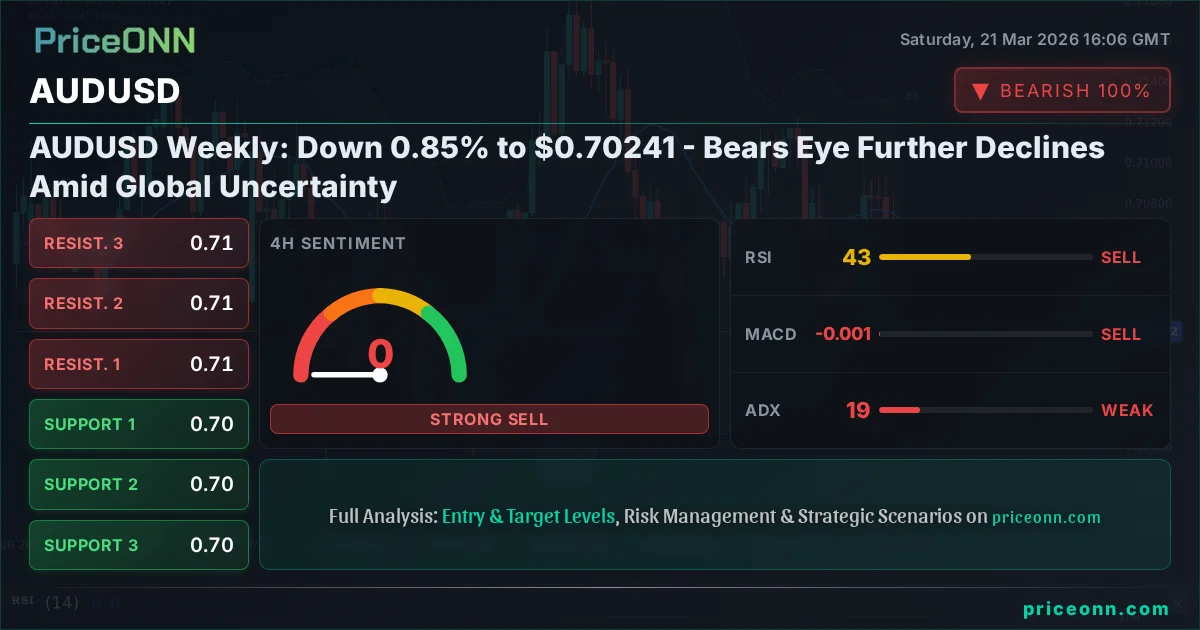
The Australian Dollar (AUD) has experienced a challenging week against its US counterpart, with AUDUSD closing down 0.85% at $0.70241. This marks a significant retreat from the week's highs and brings critical support levels into focus. The narrative driving this decline is multifaceted, encompassing a strengthening US Dollar Index (DXY), persistent global economic uncertainties, and a generally risk-averse market sentiment. As traders digest the week's events and look towards the next trading period, the question on many minds is whether the AUDUSD can find a footing or if further downside is imminent. This analysis delves into the fundamental and technical factors shaping the AUDUSD's trajectory, examining the key drivers behind its recent weakness and exploring potential scenarios for the week ahead.
- AUDUSD closed the week down 0.85% at $0.70241, driven by broad US Dollar strength and risk aversion.
- Key support at $0.69102 is now in play, with a decisive break below this level opening the door for further declines towards $0.67527.
- The DXY is showing strong upward momentum, currently trading at 99.39, exerting downward pressure on AUDUSD as per its inverse correlation.
- Technical indicators on the daily chart, such as RSI at 47.97 and a strong ADX of 20.48, suggest the bearish trend is consolidating but has room to extend.
- Upcoming economic events, including US inflation data and Australian employment figures, will be crucial in shaping the AUDUSD's direction.
The Bear Case Takes Hold: AUDUSD Under Pressure
Global Risk Aversion and the Dollar's Ascent
The prevailing mood across global financial markets over the past week has been one of caution, if not outright risk aversion. Escalating geopolitical tensions, particularly in the Middle East, have cast a long shadow, prompting investors to seek the perceived safety of the US Dollar. The US Dollar Index (DXY), a key barometer of the greenback's strength against a basket of major currencies, has reflected this sentiment, trading at 99.39 and showing a strong upward trend on the daily chart (ADX 34.64). This strengthening dollar acts as a significant headwind for risk-sensitive currencies like the Australian Dollar. Historically, a rising DXY has often coincided with a weakening AUDUSD, as capital flows out of perceived riskier assets and into the relative safety and higher yields (or yield expectations) offered by US assets. The fact that the DXY is showing a strong daily uptrend with RSI at 58.15 suggests that this dollar strength is not merely a fleeting reaction but potentially a more sustained move, putting further pressure on the AUDUSD.
This dynamic is particularly concerning for AUDUSD. The Australian Dollar is traditionally considered a 'risk-on' currency, meaning it tends to perform well when global investors are confident and willing to take on more risk. Conversely, during periods of heightened uncertainty or 'risk-off' sentiment, the AUD often weakens as capital retreats to safer havens. The current environment, marked by geopolitical flare-ups and concerns about global growth, clearly favors a risk-off environment. This is not just a narrative; it's reflected in the performance of other risk assets. Major equity indices like the SP500 and Nasdaq have seen significant pullbacks this week, with SP500 down 1.21% and Nasdaq 100 down 1.65% on the day. This synchronized decline in risk assets reinforces the demand for the US Dollar and simultaneously undermines the appeal of the Australian Dollar.
Furthermore, the correlation between the AUDUSD and the DXY is a well-established phenomenon that traders must respect. When the DXY rallies, it typically means the US Dollar is appreciating against a broad range of currencies, including the Euro, Yen, and Pound, and by extension, the Australian Dollar. The data shows the DXY is in a strong daily uptrend (ADX 34.64), and while its 1-hour trend is currently showing weakness, the daily and 4-hour charts indicate underlying strength. This persistent dollar strength provides a strong fundamental backdrop for AUDUSD's bearish move. The price action on AUDUSD, currently sitting at $0.70241, reflects this pressure, having fallen 0.85% for the week. The question now is how far this trend can extend, and what technical levels will act as crucial battlegrounds between the bulls and bears.
Australian Economic Weakness: Unemployment Data and RBA Watch
Beyond the global macro picture, domestic economic data from Australia has also played a pivotal role in the AUDUSD's recent slide. The latest Australian unemployment rate data surprised to the upside, showing an increase that has put pressure on the Reserve Bank of Australia's (RBA) policy outlook and, consequently, on the Australian Dollar. While the RBA has previously signaled a hawkish stance, aiming to combat inflation, a rising unemployment rate complicates this narrative. Higher unemployment suggests a potential softening in the domestic economy, which could temper the RBA's ability or willingness to continue with aggressive monetary tightening, or even prompt a shift towards a more neutral or dovish stance in the medium term.
The market's reaction to this data underscores its sensitivity to Australian economic health. When the unemployment rate rises unexpectedly, it often signals cooling labor market conditions, which can translate into lower wage growth and reduced consumer spending – all factors that can dampen inflationary pressures. For the RBA, this presents a delicate balancing act. They need to bring inflation under control without tipping the economy into a significant downturn. The surprise increase in unemployment suggests that the balance might be tilting towards the latter, leading traders to reassilize their expectations for future RBA rate hikes. This reassessment directly impacts the interest rate differential between Australia and other major economies, particularly the US, which can influence currency flows.
Looking at the AUDUSD price action, the impact of this domestic data cannot be understated. The pair has been trading around the $0.70241 mark, and the negative surprise in the unemployment figures provided a catalyst for further selling pressure. This data point is crucial because it directly challenges the 'higher-for-longer' interest rate narrative that had previously supported the Australian Dollar. If the RBA is forced to pause or even reverse its tightening cycle due to economic weakness, the yield advantage that the AUD might have enjoyed will diminish, making it less attractive to investors. Therefore, all eyes remain on upcoming Australian economic releases, including inflation figures and retail sales, to gauge the true health of the economy and the RBA's likely path forward. The current technical setup, with AUDUSD trading below key moving averages and showing bearish momentum on the 1-hour and 4-hour charts, seems to be pricing in this potential economic slowdown and a less hawkish RBA.
Technical Breakdown: Key Levels and Bearish Signals
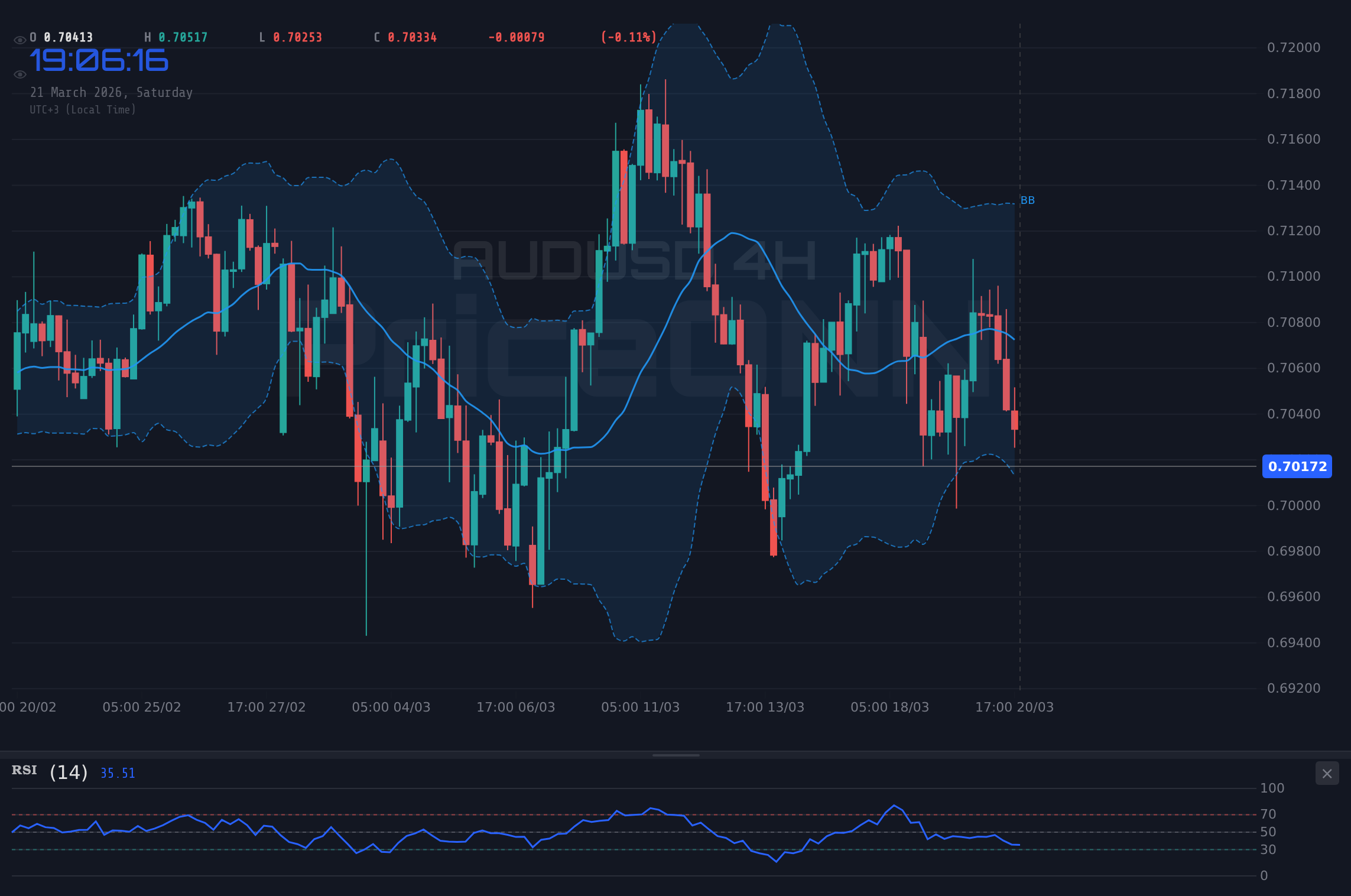
From a technical perspective, the AUDUSD's chart paints a decidedly bearish picture, especially when looking at the 4-hour and daily timeframes. The pair has decisively broken below several key short-term support levels, and the momentum indicators are flashing warning signs for the bulls. The current price of $0.70241 sits precariously close to the 1-hour support level of $0.70193. More critically, the daily support levels at $0.69545 and $0.69102 are now firmly in the crosshairs. A break below $0.69102, in particular, would be a significant technical event, potentially opening the floodgates for a move towards the next major support at $0.67527.
The indicators are largely aligned with this bearish outlook. On the daily timeframe, the Relative Strength Index (RSI) is hovering at 47.97, indicating a lack of bullish momentum and suggesting room for further downside before reaching oversold territory (typically below 30). The MACD (Moving Average Convergence Divergence) is also showing negative momentum, with the MACD line below its signal line and the histogram in negative territory. This suggests that selling pressure is dominant. The ADX (Average Directional Index) on the daily chart is at 20.48, which, while indicating a less forceful trend compared to the 4-hour's 19.14, still points towards a developing downtrend. On the 4-hour chart, the picture is even starker: ADX is at 19.14, suggesting a weak trend, but the RSI at 42.76 and Stochastic (K=43.72, D=61.32) showing a bearish cross reinforce the downward bias. The fact that the price is trading below the middle Bollinger Band on multiple timeframes further confirms the bearish sentiment.
The 1-hour chart, while showing some signs of consolidation with an ADX of 22.47, is still heavily influenced by the bearish signals from the higher timeframes. The RSI at 34.27 and Stochastic in oversold territory (K=9.76, D=12.46) might suggest a temporary bounce or consolidation is possible. However, without a clear bullish divergence or a strong fundamental catalyst to reverse the trend, any such bounce is likely to be met with selling pressure, especially as it approaches the daily resistance levels. The immediate resistance on the 1-hour chart is at $0.70449 and $0.70545. A failure to decisively break above these levels, especially in the context of the broader bearish trend, would likely see the AUDUSD resume its downward trajectory.
The Bull Case: Lingering Hopes and Potential Reversals
Dollar's Momentum vs. Overstretched Indicators
Despite the overwhelmingly bearish technical and fundamental picture, there are always arguments to be made for a bullish reversal, however slim they may seem. One such argument centers on the possibility that the US Dollar's recent rally may be overextended, and that current indicators are flashing oversold signals that could precede a correction. On the 1-hour Stochastic for AUDUSD, we see %K at 9.76 and %D at 12.46, both deep in oversold territory. Similarly, on the 4-hour chart, while not as extreme, the Stochastic is also showing signs of potentially bottoming out. These readings, particularly when they occur near key support levels like $0.69102, can sometimes precede a short-term bounce.
The logic here is that markets don't move in straight lines. Even strong trends experience pullbacks and consolidations. If the DXY, currently at 99.39, were to experience a significant profit-taking move or face a strong fundamental headwind (perhaps unexpected positive news from the Australian economy or a dovish shift in Fed commentary), the AUDUSD could find relief. The daily RSI at 47.97, while not oversold, is also not in extreme territory, suggesting that the market is not yet fully 'priced in' for a deep downturn. A bounce from current levels could target the 1-hour resistance at $0.70449 and then the more significant 4-hour resistance at $0.70715. Such a move would require a clear catalyst to dislodge the current bearish sentiment.
Furthermore, while global risk aversion is a powerful driver, it can also be a double-edged sword. If the geopolitical situation stabilizes or if economic data starts to show resilience in key global economies outside the US, risk appetite could return. This would naturally benefit commodity-linked currencies like the Australian Dollar. The Brent crude oil price, currently at $112.79, and WTI at $98.50, remain elevated, reflecting ongoing supply concerns. While high oil prices can contribute to inflation and global economic worries, they also represent a significant export income for Australia, which could provide some underlying support for the AUD if other factors align favorably. The challenge for bulls is to identify a scenario where these positive factors for Australia outweigh the dominant dollar strength and global risk-off sentiment.
Potential Catalysts for an Aussie Rebound
For the AUDUSD to stage a meaningful recovery, several factors would need to align. Firstly, a significant shift in the US Dollar's momentum would be paramount. This could be triggered by a less hawkish-than-expected tone from the Federal Reserve in upcoming communications, or perhaps a surprise dovish pivot if US economic data begins to show more pronounced weakness. While Fed futures are not pricing in a specific probability of a rate cut in the immediate term, any hint of a softening stance could send the DXY lower and provide a reprieve for the AUD.
Secondly, domestic Australian data would need to surprise to the upside. Stronger-than-expected inflation figures, a robust employment report, or positive manufacturing and services PMIs would challenge the narrative of economic slowdown and bolster the RBA's hawkish credentials. Such data would likely lead to a reassessment of interest rate expectations, potentially widening the interest rate differential in favor of the AUD and attracting capital inflows. For instance, if upcoming Australian inflation data comes in significantly above forecasts, it could prompt markets to price in more RBA hikes, creating a strong tailwind for AUDUSD.
Thirdly, a de-escalation of geopolitical tensions or a significant improvement in global risk sentiment could also spark a recovery. If markets perceive that the immediate threats have subsided, investors might rotate back into riskier assets, boosting currencies like the AUD. This would be a broader market move, but AUDUSD would likely be a direct beneficiary. The current technical setup, with the daily RSI at 47.97 and daily Stochastic showing a potential bottoming at 35.85/44.21, suggests that the pair is not yet deeply oversold, meaning there is room for a rally if the right catalysts emerge. However, without these catalysts, the path of least resistance remains to the downside, given the prevailing market conditions.
The Verdict: Caution Prevails, Bears in Control
Weighing the Evidence: Why Bears Have the Edge
After carefully weighing the available fundamental and technical evidence, the outlook for AUDUSD remains predominantly bearish in the short to medium term. The confluence of a strong US Dollar, driven by global risk aversion and a robust US economic outlook relative to other major economies, presents a formidable challenge for the Australian Dollar. The DXY's upward trend on the daily chart (ADX 34.64, RSI 58.15) is a persistent headwind that cannot be ignored. Coupled with this is the disappointing domestic economic data from Australia, particularly the surprise rise in unemployment, which casts doubt on the RBA's ability to maintain a hawkish policy stance indefinitely.
Technically, the AUDUSD has broken key support levels, and the momentum indicators across multiple timeframes (4-hour and daily) are flashing bearish signals. The RSI is not yet oversold, and the MACD continues to show negative momentum. The ADX readings on the 4-hour (19.14) and daily (20.48) charts, while not indicating extremely strong trends, are sufficient to suggest that the path of least resistance is downwards, especially when supported by fundamental factors. The immediate support at $0.70193 on the 1-hour chart is being tested, and a close below it would likely accelerate the move towards the more significant daily support at $0.69545 and ultimately $0.69102. A decisive break below $0.69102 would be a strong bearish signal, targeting the $0.67527 level.
While oversold conditions on the 1-hour Stochastic (K=9.76, D=12.46) might hint at a potential short-term bounce, this is unlikely to alter the broader bearish trend without a significant shift in either global sentiment or domestic Australian fundamentals. Scalpers and short-term traders might look for tactical long opportunities on bounces towards resistance levels like $0.70449 or $0.70715, but these would be counter-trend trades with clear invalidation points. For swing traders and long-term investors, the current setup favors a bearish bias, looking for opportunities to enter short positions on rallies or on clear breaks of key support levels. The risk/reward ratio for long positions appears unfavorable given the strong headwinds.
Navigating the Week Ahead: Key Levels and Events to Watch
Looking ahead to the next trading week, several key factors will dictate the direction of AUDUSD. Firstly, investors will be closely monitoring upcoming US economic data, particularly inflation figures (CPI, PCE) and employment reports (NFP, jobless claims). Any signs of persistent inflation or a cooling labor market could lead to a reassessment of Fed policy expectations, potentially weakening the DXY and offering some respite to AUDUSD. Conversely, stronger-than-expected US data would likely reinforce the DXY's strength and add to the bearish pressure on AUDUSD.
Secondly, Australian economic data will remain crucial. Any further surprises in employment, inflation, or consumer spending data could significantly impact the RBA's policy outlook and, by extension, the AUD. Traders will be looking for any hints from RBA officials regarding their assessment of the economic situation and their future policy path. The market's reaction to the recent unemployment data suggests a sensitivity to any signs of economic weakness.
Technically, the key levels to watch remain the same. On the downside, immediate support is at $0.70193 (1H), followed by the more significant daily supports at $0.69545 and $0.69102. A break below $0.69102 is a strong bearish signal, targeting $0.67527. On the upside, resistance is found at $0.70449 and $0.70545 (1H), with the more critical resistance area around $0.70715 (4H) and subsequently $0.71162. A sustained move above $0.71162 would be needed to challenge the broader bearish narrative, but this seems unlikely in the current environment.
For scalpers, watching the intraday price action around the $0.70193 support and $0.70449 resistance will be key for short-term trades, looking for quick bounces or breakdowns. Swing traders should remain patient, waiting for a decisive break of either the support at $0.69102 or a confirmed move above the resistance cluster near $0.70715-$0.71162 before committing to larger positions. Long-term investors should focus on the broader macroeconomic trends – the DXY's trajectory, global risk sentiment, and the divergence in central bank policies – using technical levels as confirmation points for their fundamental thesis. The current data strongly suggests a bearish bias, making any rallies opportunities to potentially enter short positions, rather than signs of a sustained trend reversal.
Historical Context: Past Weakness and Resilience
Examining historical price action for AUDUSD during periods of dollar strength and global uncertainty can offer valuable insights. In previous cycles where the DXY has strengthened significantly, such as during the 2014-2016 period or parts of 2018-2019, the Australian Dollar has often experienced substantial declines. For instance, between mid-2014 and early 2016, the DXY rallied considerably, and AUDUSD fell from above 0.9000 to lows around 0.6800. This historical precedent underscores the potent impact of dollar strength on the Aussie.
During these past periods of dollar rallies, the AUDUSD often exhibited similar technical patterns: breaking below key moving averages, struggling at resistance levels on any attempted bounces, and showing sustained bearish momentum on daily and weekly charts. The RSI would frequently remain suppressed in the 30-50 zone during downtrends, only moving higher during significant counter-trend rallies. The MACD would also typically remain negative for extended periods, indicating sustained selling pressure. The current situation, with AUDUSD trading at $0.70241 and showing similar technical characteristics, echoes these past bearish phases.
However, history also shows that the AUDUSD has a capacity for resilience, often driven by specific domestic factors or sharp shifts in global sentiment. For example, periods of strong commodity prices, particularly for iron ore and coal (key Australian exports), have provided support to the AUD even when the dollar was generally strong. The current elevated oil prices are a positive for commodity exporters, but this hasn't been enough to offset the headwinds from dollar strength and domestic economic concerns this week. Understanding these historical cycles helps put the current price action into perspective. While the current environment shares similarities with past bearish phases, the specific interplay of central bank policies, inflation dynamics, and geopolitical risks creates a unique landscape that traders must continuously analyze.
Trader Perspectives: Scalpers, Swing Traders, and Long-Term Investors
The current market environment for AUDUSD presents different opportunities and challenges for various trading horizons. For scalpers, the immediate price action around the $0.70193 support and $0.70449 resistance on the 1-hour chart offers potential for quick, short-term trades. A bounce off $0.70193 could be traded towards $0.70449, with tight stop-losses below the support. Conversely, a failure to hold $0.70193 could offer a quick scalp trade towards $0.69997. The key is rapid execution and strict risk management, as these short-term moves can reverse quickly.
Swing traders, who typically hold positions for days to weeks, should adopt a more cautious approach. The current bearish bias suggests looking for opportunities to enter short positions. A potential setup could involve a rally towards the $0.70715-$0.71162 resistance zone, followed by bearish confirmation (e.g., a bearish candle pattern, or failure to break higher with conviction). An entry on such a pullback, targeting the daily support at $0.69545 or $0.69102, would offer a favorable risk/reward profile. Alternatively, waiting for a decisive break below $0.69102 and then trading the subsequent retest of that level as resistance could also provide a strong bearish setup. Long positions would only be considered on a strong, confirmed break above the $0.71162 resistance, suggesting a significant shift in market dynamics.
For long-term investors, the focus remains on the overarching macroeconomic themes. The strength of the DXY, the trajectory of US interest rates versus other major central banks (particularly the RBA), global growth prospects, and geopolitical stability are the primary drivers. While the current price of $0.70241 might seem attractive for a long-term buy, the prevailing headwinds suggest caution. Investors might consider waiting for a more significant pullback towards the $0.67527 level, or for clear signs of a fundamental shift (e.g., a dovish Fed pivot, sustained improvement in Australian data, or de-escalation of global risks), before establishing or adding to long-term positions. The current environment favors a defensive stance, prioritizing capital preservation while keeping an eye on developing opportunities.
Key Economic Events on the Horizon
The coming week will feature several critical economic data releases that could significantly influence AUDUSD. In the United States, key inflation indicators such as the Consumer Price Index (CPI) and Personal Consumption Expenditures (PCE) price index will be closely watched. These reports will provide crucial insights into the persistent inflationary pressures and will heavily influence the Federal Reserve's monetary policy decisions. Higher-than-expected inflation could reinforce hawkish Fed expectations, strengthening the DXY and pressuring AUDUSD. Conversely, signs of cooling inflation might lead to a reassessment of Fed policy, potentially weakening the dollar.
Employment data from both the US and Australia will also be in focus. US Non-Farm Payrolls (NFP) and weekly jobless claims will offer a snapshot of the labor market's health. A strong NFP report would support a hawkish Fed stance, while a weak one could signal economic softening. For Australia, ongoing monitoring of the unemployment rate and wage growth figures will be vital. Following the recent surprise increase in unemployment, any further signs of labor market weakness could amplify concerns about the Australian economy and weigh further on the AUD. Additionally, Purchasing Managers' Index (PMI) data from both regions will provide insights into manufacturing and services sector activity, offering a real-time gauge of economic momentum.
The market will also be sensitive to any commentary from central bank officials. Statements from Federal Reserve members regarding inflation, economic growth, and the future path of interest rates will be scrutinized for clues about monetary policy direction. Similarly, any remarks from RBA officials will be crucial for understanding their reaction to the recent economic data and their forward guidance. The interplay between these global and domestic economic factors, coupled with ongoing geopolitical developments, will create a dynamic trading environment for AUDUSD, making it imperative for traders to stay informed and adaptable.
Frequently Asked Questions: AUDUSD Analysis
What happens if AUDUSD breaks below the critical $0.69102 support level?
A decisive break below $0.69102 would signal a significant strengthening of the bearish trend. This would likely trigger further selling pressure, with the next major support level targeted around $0.67527. Such a move would indicate that the global risk-off sentiment and US Dollar strength are overwhelming any underlying support for the Australian Dollar.
Should I consider buying AUDUSD at current levels near $0.70241 given the oversold Stochastic on the 1-hour chart?
While the 1-hour Stochastic is in oversold territory, the broader daily and 4-hour technicals remain bearish, and fundamental headwinds persist. Buying at current levels carries significant risk. A more prudent approach would be to wait for confirmation of a trend reversal or a bounce towards resistance levels like $0.70715, with strict stop-losses in place, or to wait for a break below key support for potential bearish entries.
Is the RSI at 47.97 on the daily chart a sell signal for AUDUSD right now?
An RSI of 47.97 is not a direct sell signal, as it sits in the neutral zone. However, it indicates a lack of strong bullish momentum and room for further downside before reaching oversold conditions. In the context of a bearish trend, this RSI level suggests that sellers are in control and further declines are more probable than significant rallies without a clear catalyst.
How will upcoming US inflation data affect AUDUSD this week?
Higher-than-expected US inflation would likely reinforce hawkish Federal Reserve expectations, strengthening the US Dollar (DXY) and putting downward pressure on AUDUSD, potentially pushing it towards $0.69102. Conversely, lower-than-expected inflation could lead to a weaker dollar and a relief rally in AUDUSD, possibly targeting resistance around $0.70715.
The market is a dynamic interplay of global forces and domestic specifics. While the AUDUSD currently faces significant headwinds, characterized by a strong dollar and cautious risk sentiment, the potential for shifts in economic data or geopolitical landscapes always exists. For traders, disciplined risk management and a clear understanding of the key levels and catalysts are paramount. Patience in waiting for confirmed setups, whether for a bearish continuation or a potential reversal, will be crucial in navigating the upcoming trading week.
Track markets in real-time
AI-powered analysis, technical indicators and real-time price data.
Join Our Telegram Channel
Breaking market news, AI analysis and trading signals instantly.
Join Channel