EURUSD Weekly Outlook: $1.16 Slide Continues Amid Stronger Dollar and Risk-Off Sentiment
EURUSD struggles at $1.16 as the DXY strengthens and risk appetite fades. Key support at $1.15239 tested, with eyes on upcoming Fed commentary and inflation data.
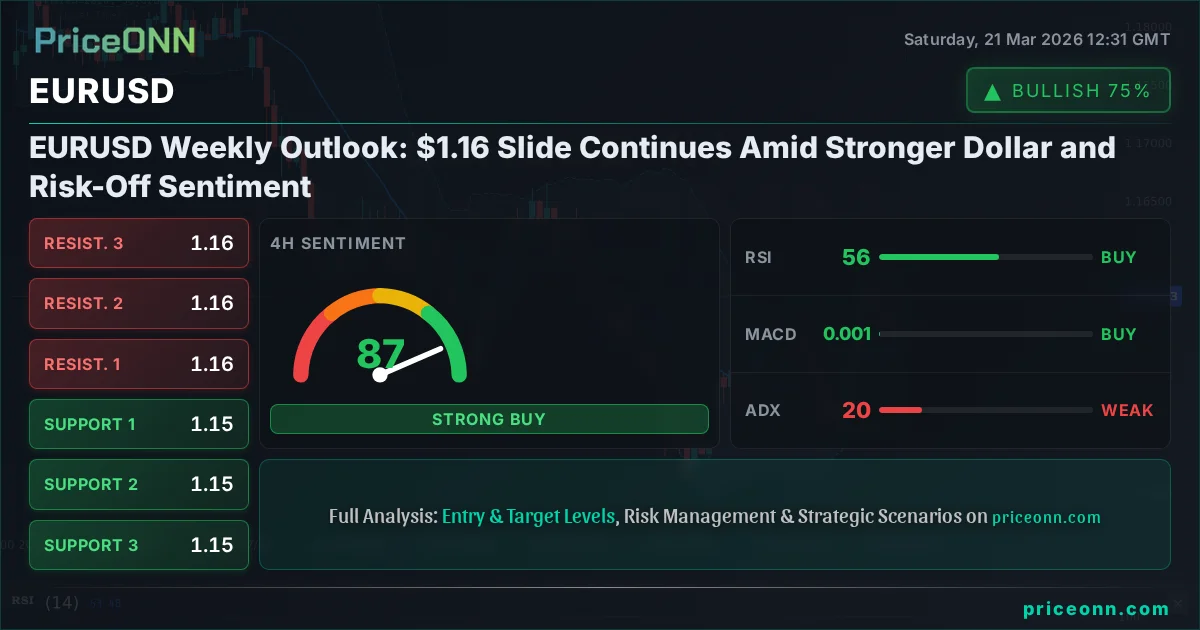
The EURUSD pair finds itself at a critical juncture, trading around the $1.16 mark as the week draws to a close. Last Friday's close saw the pair languishing near this level, reflecting a broader trend of US dollar strength and a noticeable dip in global risk appetite. This confluence of factors has put significant pressure on the Euro, challenging its recent gains and prompting a closer look at the underlying technical and fundamental drivers. As we navigate the current market landscape, understanding the interplay between central bank policies, macroeconomic data, and geopolitical undercurrents is paramount for discerning the potential direction of this major currency pair.
- EURUSD is trading around $1.16, with the latest 1-hour chart showing a neutral trend (50% strength) but a strong bearish signal (Sat: 7, Al: 1).
- The daily chart indicates a bearish trend (94% strength) with RSI at 44.34, suggesting further downside potential.
- Key support for EURUSD is identified at $1.15239, while resistance looms at $1.15647 on the 1-hour timeframe.
- The strengthening DXY (99.39) and falling S&P 500 (6536.05) point towards a risk-off environment, typically favoring the US dollar.
Navigating the Dollar's Resurgence: DXY Strength Takes Center Stage
The US Dollar Index (DXY) has been a dominant force in the currency markets this past week, and its current standing at 99.39 underscores its resurgence. The data reveals a strengthening trend across multiple timeframes, particularly on the daily chart where its strength is rated at 92%. This upward momentum in the dollar is not occurring in a vacuum; it's intrinsically linked to a broader de-risking sentiment across global markets, as evidenced by the S&P 500's fall to 6536.05 and the Nasdaq's slide to 23992.13. When the greenback strengthens, it typically exerts downward pressure on assets priced in dollars, including major currency pairs like EURUSD. For EURUSD, a rising DXY often translates to falling prices, as the Euro becomes relatively cheaper against the dollar. The DXY's ability to hold above key levels, bolstered by expectations of a more hawkish stance from the Federal Reserve compared to the ECB, creates a challenging environment for the Euro.
The technical indicators for the DXY further support this narrative. On the 1-hour chart, while the trend strength is neutral at 50%, the overall signal leans towards buying, with an RSI of 56.78 indicating room for further upside. The MACD is positive, and the Bollinger Bands are showing price above the middle band, suggesting an upward bias. Even on the 4-hour chart, where the trend is confirmed as bullish (85% strength), the DXY is finding support. This persistent dollar strength is a primary headwind for EURUSD, forcing traders to reassess their positions and risk exposure. The market is keenly watching for any shifts in Federal Reserve policy or unexpected economic data that could alter this dollar-centric narrative.
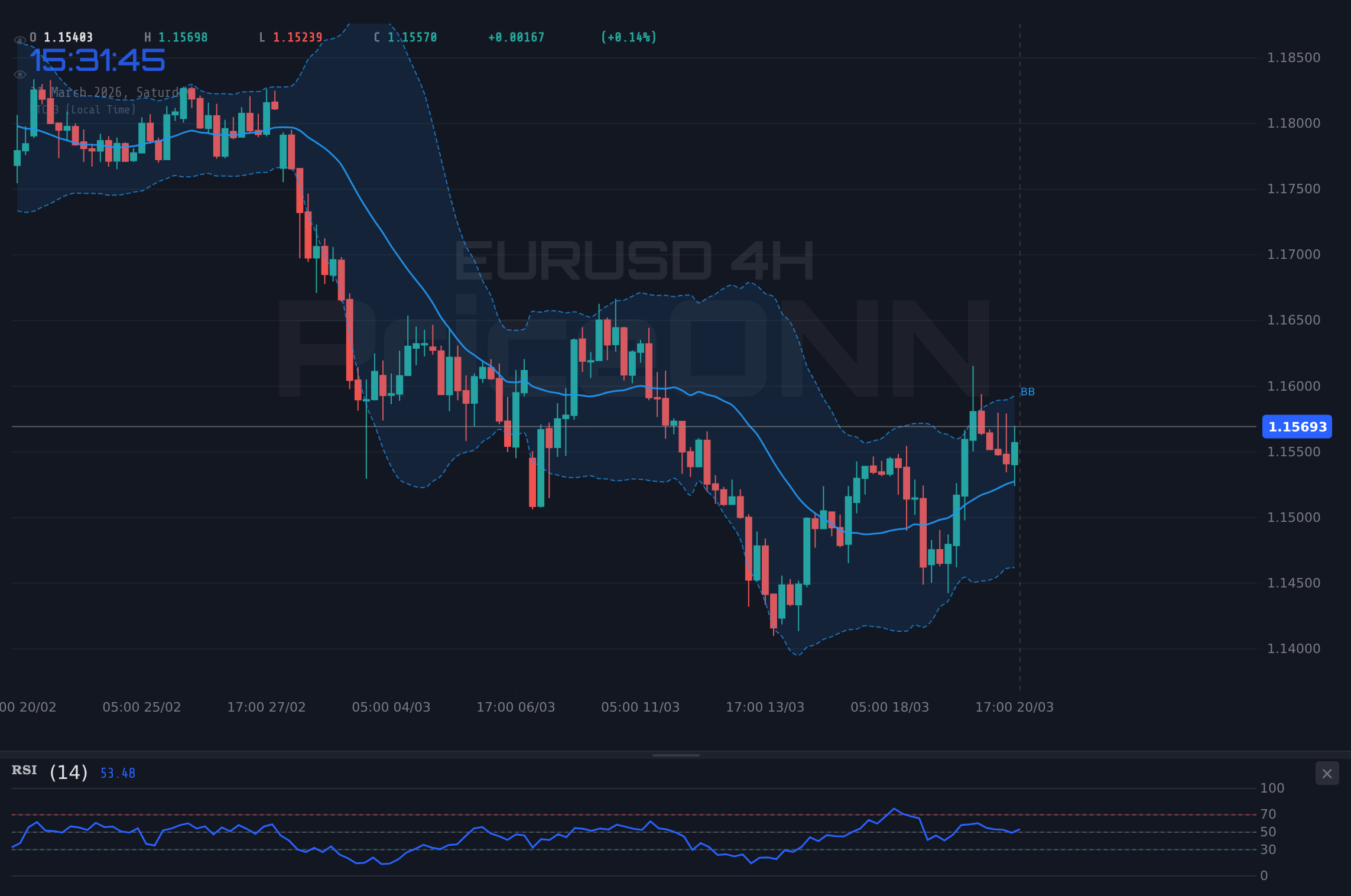
The correlation is clear: as the DXY climbs, EURUSD faces headwinds. The current reading of the DXY at 99.39 signifies a robust dollar, which directly impacts the Euro's valuation. This dynamic is crucial for understanding the recent price action in EURUSD, which has seen a bearish slide despite various economic nuances. The market's perception of interest rate differentials, inflation outlooks, and geopolitical stability all contribute to the dollar's appeal as a safe-haven asset, further reinforcing its upward trajectory and, consequently, pressuring the single currency.
EURUSD Technicals: Bears Tighten Grip Below $1.16
Turning our attention to EURUSD, the technical picture painted by the provided data is predominantly bearish, especially when viewed through the lens of the daily and 1-hour timeframes. The daily chart clearly shows a bearish trend with 94% strength, and the RSI(14) at 44.34 suggests there is ample room for further decline before hitting oversold territory. This indicator reading, coupled with a negative MACD momentum and price trading below the middle Bollinger Band, reinforces the prevailing downtrend. The Stochastic Oscillator, with %K at 49.67 and %D at 30.17, provides a conflicting bullish signal, but this is often a lagging indicator in a strong trend and should be viewed with caution.
The 1-hour timeframe offers a more granular view, revealing a neutral trend (50% strength) but a strong bearish signal with 7 out of 8 indicators suggesting a 'Sell'. The RSI here is at 53.72, hovering in neutral territory, which doesn't offer immediate oversold relief. However, the MACD is showing negative momentum, below its signal line, and the price is below the middle Bollinger Band, aligning with the broader bearish sentiment. The ADX at 23.85 indicates a moderately strong trend, further supporting the idea that the bears are currently in control. The key support level to watch on this timeframe is $1.15409, followed by $1.15321. A break below these levels could accelerate the downward move.
The 4-hour chart presents a neutral trend (50% strength), but the overall signal leans towards 'Buy' (6 out of 8 indicators). This divergence across timeframes highlights the complexity of the current market. The RSI is at 56.39, and the MACD shows positive momentum. However, the Stochastic oscillator (%K: 61.37, %D: 69.89) is flashing a bearish signal, and the ADX at 19.77 points to a weak trend. While some indicators suggest a potential for a short-term bounce, the dominant daily and 1-hour signals lean bearish. This means that any upward retracements might be opportunities for sellers to re-enter the market at better prices, rather than the start of a sustained recovery. The critical support at $1.15239 remains the focal point for short-term price action.
The overall technical consensus, heavily weighted by the daily and 1-hour signals, points towards continued downside pressure for EURUSD. While the 4-hour chart offers a glimmer of hope for bulls with a neutral trend and a 'Buy' signal, the prevailing bearish sentiment across shorter and longer-term daily charts cannot be ignored. Traders should be wary of buying into strength and look for potential pullbacks towards resistance levels as opportunities for bearish positions, always with strict risk management in place.
Fundamental Undercurrents: Fed vs. ECB and Inflationary Pressures
The fundamental landscape for EURUSD remains a tug-of-war between the monetary policies of the Federal Reserve and the European Central Bank (ECB), exacerbated by persistent inflationary pressures and evolving geopolitical risks. The recent market news highlights a key theme: the Fed's stance on interest rates versus the ECB's. While the Fed has maintained its interest rate stance, the market sentiment, as reflected in Fed Fund Futures, often anticipates a more cautious approach to rate cuts compared to what was previously priced in. This is often driven by sticky inflation data and a resilient US economy. In contrast, the ECB faces its own set of challenges, including varying economic performance across Eurozone member states and the ongoing impact of energy price volatility, as highlighted by recent energy shock reports.
The data from the provided market context shows the DXY at 99.39, a testament to the dollar's strength, partly fueled by these interest rate expectations. Traders are constantly evaluating the relative hawkishness or dovishness of central banks. If the Fed signals a longer path of higher rates due to persistent inflation, it generally strengthens the dollar, creating headwinds for EURUSD. Conversely, any indication from the ECB that they might be more aggressive in easing policy, perhaps due to weaker economic growth or inflation falling faster than expected, would further pressure the Euro. Upcoming economic data releases, such as CPI and employment figures from both the US and the Eurozone, will be critical in shaping these expectations.
Geopolitical tensions, particularly those in the Middle East, continue to add a layer of complexity. As noted in recent market news, escalating Gulf tensions have impacted crude oil prices, with WTI reaching $97.82. Higher energy prices can fuel inflation globally, complicating the task for central banks. For the Eurozone, heavily reliant on energy imports, sustained high oil prices can dampen economic growth and put additional pressure on the Euro. This dynamic forces a delicate balancing act for the ECB: combating inflation without stifling economic recovery. The recent news about gold prices tumbling 8.50% this week as oil prices soared is a fascinating, albeit complex, indicator of market sentiment and the interplay between safe-haven assets, inflation hedges, and risk-on/risk-off environments.
Furthermore, the recent market commentary suggests that the US Dollar Index (DXY) dipped below 100.00 to 99.60 as the Federal Reserve maintained its interest rate stance, while geopolitical tensions escalated. This indicates that despite the Fed's current position, geopolitical risks are also playing a significant role in dollar strength, potentially reinforcing its safe-haven appeal. The interplay of these fundamental factors - monetary policy divergence, inflation persistence, energy market volatility, and geopolitical uncertainty - creates a complex backdrop for EURUSD. The ability of the pair to find sustained upward momentum will largely depend on a clear shift in either Fed or ECB policy, or a significant de-escalation of global tensions.
The Fed's Balancing Act: Rate Cuts on Hold?
The Federal Reserve's monetary policy remains a central theme influencing the US dollar and, by extension, EURUSD. While the latest market data doesn't explicitly provide Fed Fund Futures probabilities, the narrative often points to a cautious approach regarding rate cuts. The Fed is likely weighing the dual mandate of price stability and maximum employment against a backdrop of persistent inflation and a dynamic geopolitical environment. If inflation proves more stubborn than anticipated, or if economic growth remains robust, the Fed might delay or scale back the number of expected rate cuts throughout 2026. This scenario would typically support a stronger dollar, as higher interest rates for longer attract capital and increase the currency's yield appeal.
Conversely, any signs of economic cooling or a significant drop in inflation could prompt the Fed to reassess its stance. However, given the current strength of the DXY and the prevailing risk-off sentiment, the market seems to be pricing in a higher probability of the Fed remaining patient. This contrasts with potential easing cycles elsewhere, creating a yield differential that favors the dollar. The upcoming economic calendar, particularly any speeches from Fed officials or key inflation reports, will be crucial for gauging the Fed's immediate intentions and their potential impact on EURUSD. The market's interpretation of these signals will dictate whether the dollar continues its upward march or faces a correction.
ECB's Tightrope Walk: Growth vs. Inflation in the Eurozone
The European Central Bank (ECB) is navigating its own complex path, balancing the need to control inflation with the imperative to support a potentially fragile economic recovery across the Eurozone. Unlike the Fed, the ECB's decision-making is often influenced by a more diverse economic landscape within the bloc. Recent market news and analysis suggest a focus on whether the ECB's calm stance might fuel EURUSD below certain technical levels, implying a potential for further downside if inflation doesn't cooperate or if growth falters significantly. The Eurozone's reliance on energy imports makes it particularly susceptible to geopolitical shocks and oil price fluctuations, as seen with WTI crude oil trading around $98.50.
If inflation in the Eurozone remains elevated, the ECB might be compelled to maintain a hawkish bias for longer than anticipated, which could theoretically support the Euro. However, if economic growth falters significantly, or if inflation shows signs of a rapid decline, the ECB might be pressured to consider easing monetary policy sooner rather than later. This delicate balancing act creates uncertainty and can lead to volatility in EURUSD. Traders will be closely monitoring Eurozone inflation data (CPI) and Purchasing Managers' Index (PMI) reports in the coming weeks for clues about the ECB's next move and its potential impact on the single currency.
Key Levels and Price Action: The Battle for $1.15
The EURUSD pair is currently hovering around the $1.16 level, but the underlying technical structure suggests a strong bearish bias, particularly on the daily and 1-hour charts. The critical support level to monitor on the 1-hour chart is $1.15409, with further downside potential towards $1.15321 and $1.15171. These levels represent areas where buying interest might emerge, potentially leading to a short-term bounce or consolidation. However, given the overall bearish sentiment and the strength of the DXY, a decisive break below $1.15239 on the 4-hour chart could trigger a more significant sell-off, targeting lower levels.
On the resistance side, the 1-hour chart presents immediate hurdles at $1.15647, $1.15797, and $1.15885. A sustained move above these levels would be necessary to challenge the prevailing bearish narrative, but this seems unlikely without a significant shift in market sentiment or central bank policy. The daily chart offers much wider levels, with resistance at $4844.03, $5037.87, and $5208.77 for XAUUSD, and $1.16499, $1.17193, and $1.1823 for EURUSD. The immediate focus, however, remains on the lower timeframes and the ability of price to hold or break the key support zone around $1.15239-$1.15409. A failure to hold these levels could open the door for a move towards the next significant daily support at $1.14768.
The historical context of EURUSD trading around these levels also matters. Periods of strong dollar appreciation, often driven by interest rate differentials or safe-haven demand, have historically led to significant pullbacks in the pair. The current setup, with the DXY showing strength and risk aversion in play, aligns with such historical patterns. Traders are therefore watching closely to see if the current price action represents a continuation of a larger downtrend or a temporary consolidation before a potential reversal. The outcome will likely be dictated by upcoming economic data and central bank communications.
Scenario Analysis: Charting the Week Ahead for EURUSD
Bearish Outlook: Downside Momentum Persists
65% ProbabilityNeutral Consolidation: Range-Bound Trading
25% ProbabilityBullish Reversal: Dollar Weakness Emerges
10% ProbabilityKey Economic Catalysts on the Horizon
Looking ahead, the economic calendar is packed with crucial data releases that could significantly influence EURUSD's trajectory. Investors will be keenly watching inflation figures from both sides of the Atlantic. For the Eurozone, upcoming CPI data will provide vital insights into whether inflationary pressures are subsiding, which could influence the ECB's monetary policy outlook. Similarly, US inflation reports, including CPI and PCE, will be critical for the Federal Reserve's assessment of the economic landscape and its future rate decisions. The market's reaction to these figures could either reinforce the current dollar strength or spark a reversal.
Employment data also remains a key focus. Non-Farm Payrolls (NFP) and unemployment rate figures from the US will offer a snapshot of the labor market's health. Stronger-than-expected employment numbers could bolster the case for the Fed to maintain a hawkish stance, potentially pushing the DXY higher and EURUSD lower. Conversely, weaker data might fuel expectations of earlier rate cuts, leading to dollar weakness. For the Eurozone, PMI data will offer insights into manufacturing and services sector activity, providing a gauge of economic momentum. Any significant deviations from expectations in these reports could trigger sharp moves in EURUSD.
Furthermore, central bank communications will be paramount. Speeches from Fed and ECB officials will be scrutinized for any hints regarding future monetary policy direction. The market's interpretation of these statements, especially concerning inflation and growth outlooks, can significantly sway currency valuations. Given the current sensitivity of markets to interest rate differentials and inflation concerns, any shift in forward guidance from either central bank could provide the necessary catalyst for a decisive move in EURUSD, potentially breaking it out of its current range or reinforcing the prevailing bearish trend below $1.16.
Risk Management is Key: Given the conflicting signals across different timeframes and the sensitivity to upcoming economic data, extreme caution is advised. Always employ strict stop-loss orders and position sizing to manage risk effectively. Focus on clear setups defined by the technical levels and fundamental catalysts discussed. Do not chase the market; wait for confirmation.
Concluding Thoughts: Navigating the Currents
The EURUSD pair stands at a critical juncture, trading near $1.16 with a predominantly bearish technical outlook, reinforced by a strengthening US dollar and prevailing risk-off market sentiment. While short-term fluctuations and potential bounces are possible, the overarching trend appears to favor the downside, particularly if key support levels like $1.15239 fail to hold. The interplay between the Federal Reserve's cautious approach to rate cuts, persistent inflationary pressures, and geopolitical uncertainties continues to underpin dollar strength. Upcoming economic data releases, especially inflation and employment figures from both the US and the Eurozone, along with central bank commentary, will be crucial in determining the pair's direction in the coming week.
Traders should remain vigilant, monitoring the key support at $1.15239 and resistance at $1.15647. A decisive break below the former could accelerate the bearish slide, while a sustained move above the latter might signal a temporary reprieve or a potential reversal. The current environment demands a disciplined approach, focusing on risk management and waiting for clear confirmation before committing to positions. The market is dynamic, and while the current data suggests caution, opportunities will undoubtedly arise for those patient enough to identify them.
Frequently Asked Questions: EURUSD Analysis
What happens if EURUSD breaks below the $1.15239 support level?
If EURUSD breaks decisively below the $1.15239 support level, the bearish scenario gains significant traction. This could trigger a move towards the next daily chart support at $1.14768, driven by continued dollar strength and risk-off sentiment. Confirmation would be a clear daily close below $1.15239.
Should I consider buying EURUSD at current levels near $1.16 given the neutral 4-hour signal?
Buying at current levels near $1.16 is a high-risk proposition given the dominant bearish signals on the daily and 1-hour charts, despite a neutral 4-hour signal. A more prudent approach would be to wait for confirmation of a bullish reversal, perhaps a break above $1.15797 resistance, or to look for selling opportunities on pullbacks towards resistance levels.
Is the RSI at 44.34 on the daily chart a sell signal for EURUSD?
An RSI of 44.34 on the daily chart is not an oversold or overbought signal, placing it in neutral territory but leaning towards bearish momentum. While it doesn't indicate an immediate sell, it suggests ample room for further downside before the pair becomes technically oversold, supporting the prevailing bearish trend.
How will upcoming US inflation data impact EURUSD this week?
Upcoming US inflation data will be a critical catalyst. If inflation comes in hotter than expected, it could reinforce Fed hawkishness, strengthen the DXY, and push EURUSD lower towards $1.14768. Conversely, cooler inflation might lead to dollar weakness and a potential test of resistance near $1.15797.
Track markets in real-time
AI-powered analysis, technical indicators and real-time price data.
Join Our Telegram Channel
Breaking market news, AI analysis and trading signals instantly.
Join Channel