Dow Jones Tests Resistance at $45,787: Powell and Oil Prices Loom
The Dow Jones Industrial Average hovers around $45,787, facing resistance as traders eye Fed policy and surging oil prices. Technical indicators suggest caution.
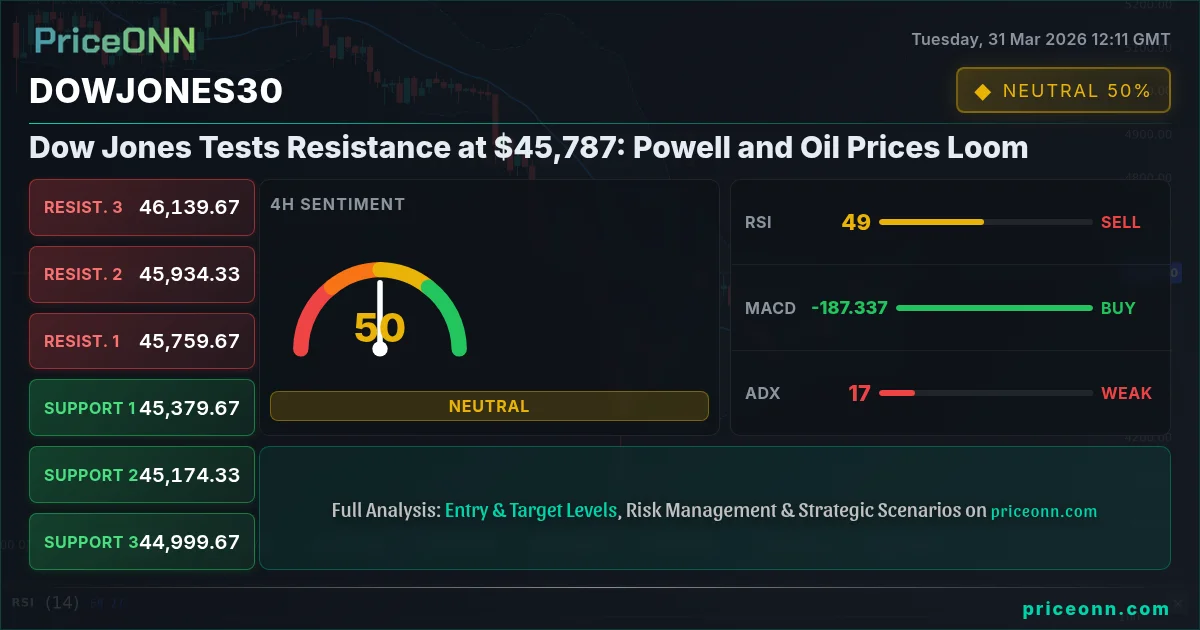
The Dow Jones Industrial Average is currently navigating a critical juncture, hovering just below key resistance levels as it trades at exactly $45,787.00. This pivotal moment arrives with a backdrop of significant market forces, including persistent inflation concerns, a strengthening US Dollar, and the ever-present shadow of Federal Reserve policy under Chair Powell. The index's ability to hold its ground and push higher hinges on a delicate balance of technical signals and macroeconomic drivers, making its next move a closely watched event for traders worldwide.
- The Dow Jones Industrial Average is trading at $45,787, testing immediate resistance.
- ADX at 16.58 indicates a weak trend, suggesting a lack of strong directional commitment.
- RSI at 61.97 on the 1H chart shows upward momentum but is not yet in overbought territory, while the 1D RSI at 37.15 signals a bearish undertone.
- A daily close above $45,826.33 resistance is needed for a bullish continuation signal.
- Surging oil prices above $110 and a strong DXY at 100.27 present conflicting pressures on the index.
The technical landscape for the Dow Jones Industrial Average presents a complex picture, characterized by mixed signals across different timeframes. On the 1-hour chart, the trend is described as neutral with a power of 50%, showing an ADX of 17.59. This suggests a lack of strong directional conviction in the short term. However, the RSI(14) at 61.97 indicates a degree of upward momentum, though it remains comfortably outside overbought territory. The MACD is positive, with its signal line above the histogram, and Bollinger Bands are trading above the middle band, all pointing towards a cautiously optimistic short-term outlook. Stochastic K (65.24) is above D (76.71), which typically signals a bearish divergence, adding a layer of complexity to the immediate intraday outlook. The general signal on this timeframe leans towards 'BUY' (Al: 6, Sat: 2, Nötr: 0), but the conflicting Stochastic reading warrants careful observation.
Moving to the 4-hour timeframe, the picture becomes slightly more nuanced. The trend is also neutral, again with 50% power, but the ADX drops to 16.58, reinforcing the idea of a ranging or choppy market environment. This is a key observation for traders; a weak trend reading like this implies that any breakout might lack sustained follow-through. The RSI(14) sits at 51.22, suggesting a neutral stance, neither pushing towards overbought nor oversold conditions. The MACD remains positive, and Bollinger Bands are holding above the middle band, indicating that the recent upward move has some technical backing. However, the Stochastic oscillator shows K at 84.33 and D at 53.06, a clear bullish crossover, suggesting potential further upside in this timeframe. The overall signal on the 4H chart is 'BUY' (Al: 6, Sat: 2, Nötr: 0), but the overall weak trend indicated by the ADX means traders should be wary of chasing price.
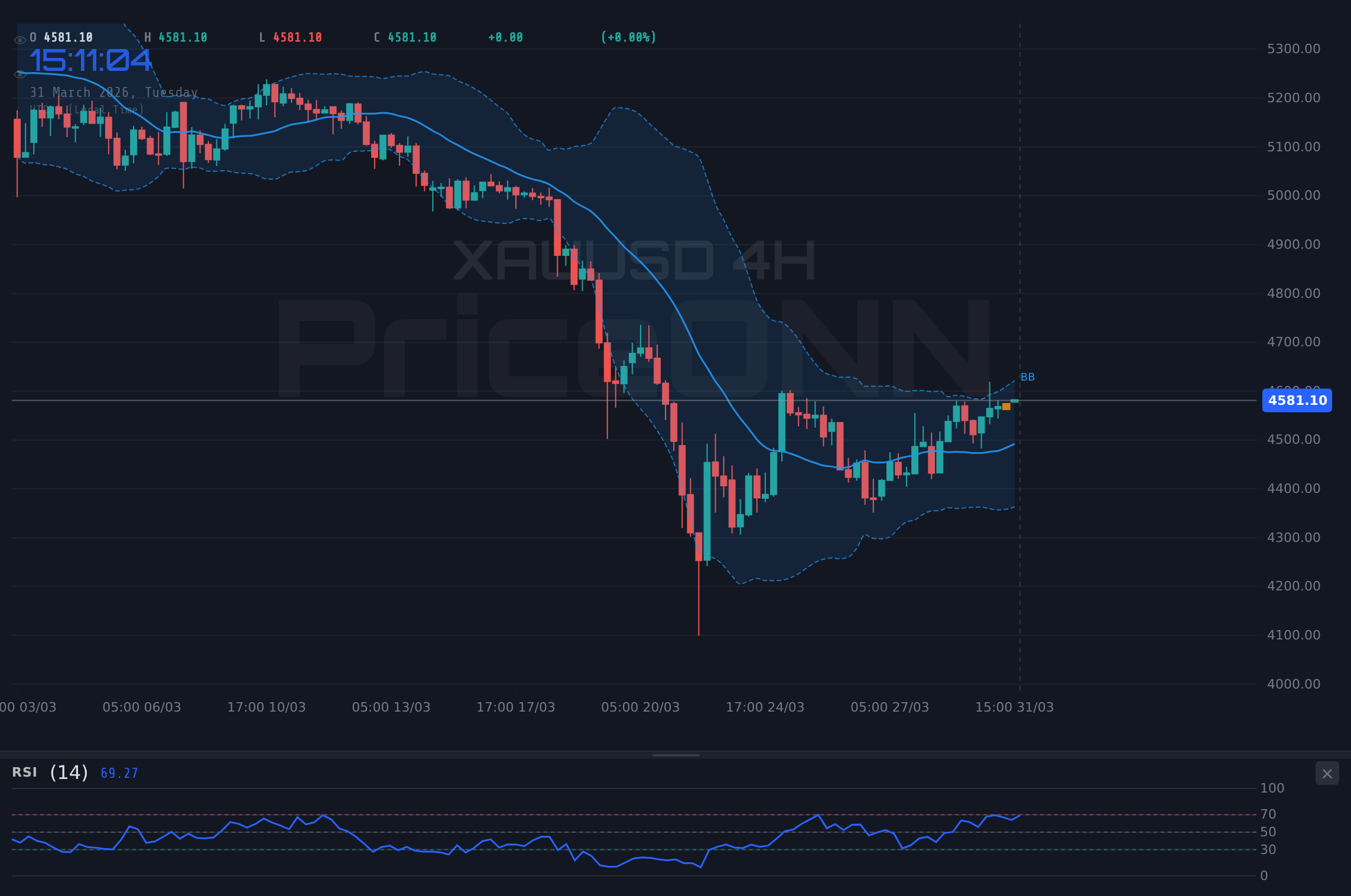
The daily chart presents a more bearish outlook, which contrasts sharply with the shorter timeframes. Here, the trend is definitively described as downwards, with 100% power, and the ADX at a strong 43.18. This signifies a robust downtrend is in play. The RSI(14) is at 37.15, firmly in neutral territory but with a downward trajectory, indicating selling pressure is present. The MACD is negative, with the histogram below the signal line, confirming bearish momentum. Bollinger Bands are trading below the middle band, further supporting the bearish sentiment. The Stochastic oscillator's K line (21.53) is below the D line (34.62), showing a bearish signal and suggesting that the index is approaching oversold conditions, though not yet there. The overall signal on the daily chart is 'SELL' (Al: 0, Sat: 8, Nötr: 0), highlighting a significant divergence between the short-term optimism and the longer-term bearish trend.
Navigating the Resistance Zone at $45,787
The immediate price action around $45,787.00 is crucial. This level represents a significant area of resistance on the daily chart, as evidenced by the data provided. The nearest resistance level is precisely at $45,736.67, followed by $45,826.33, and then a more significant hurdle at $45,934.33. For the bulls to gain sustained control, a decisive break and hold above $45,826.33 would be necessary. This would not only negate the immediate bearish pressure seen on the daily chart but also signal a potential shift in market sentiment. Such a move would likely require strong volume and a clear catalyst, potentially stemming from positive economic news or a dovish tilt from the Federal Reserve.
Conversely, failure to overcome this resistance zone could see the index retreating. The immediate support level to watch is $45,656.33, followed by $45,486.33, and then a more substantial floor at $45,379.67. A close below $45,656.33 on the 1-hour chart would signal a potential short-term reversal, aligning with the broader bearish trend indicated by the daily timeframe. Traders will be closely monitoring the price action around these levels, looking for confirmation of a breakout or breakdown. The current weak trend indicated by the ADX suggests that a decisive move might be building, but the direction remains uncertain until price action provides a clearer signal.
The Powell Factor and Oil's Inflammatory Influence
The looming presence of Federal Reserve Chair Powell and the ongoing surge in oil prices add significant layers of complexity to the Dow Jones's outlook. Recent economic data, while mixed, has kept inflation concerns alive. Any hint from Powell or other Fed officials about maintaining a hawkish stance on interest rates could dampen market sentiment, especially if the market is already pricing in rate cuts. The current Fed Fund Futures data, although not explicitly provided here, generally indicates market expectations, and any deviation from those expectations can cause significant volatility. The US Dollar Index (DXY) is currently trading at 100.27, showing a rising trend on the daily chart, which typically adds pressure to risk assets like equities, including the Dow Jones.
Simultaneously, oil prices, both Brent and WTI, are experiencing significant upward pressure. Brent crude is trading at $110.52, and WTI at $103.11, both showing strong upward trends on their daily charts with high ADX values (62.25 for Brent, 58.34 for WTI). Surging oil prices directly translate to higher energy costs, which can fuel inflation and potentially force central banks to maintain tighter monetary policies for longer. This creates a challenging environment for equities, as higher inflation can erode corporate profit margins and reduce consumer spending power. The correlation between oil prices and inflation expectations is well-established, and the current price levels suggest that inflationary pressures remain a significant concern for policymakers and market participants alike.
Technical Setups: Watching for the Breakout
Given the conflicting signals across timeframes and the macroeconomic crosswinds, the current market environment for the Dow Jones Industrial Average suggests a 'WATCH_ZONE' approach. The ADX on the 4-hour chart at 16.58 clearly indicates a lack of strong trend, meaning that while price might be pushing towards resistance, it lacks the underlying conviction for a sustained breakout without further confirmation. A daily close above the critical resistance level of $45,826.33 would be the primary trigger for a bullish scenario. This would suggest that the index is overcoming the short-term selling pressure and aligning with the more optimistic intraday technicals. Such a move would need to be supported by increasing volume and potentially a shift in sentiment regarding Fed policy or inflation.
Conversely, a failure to break this resistance, coupled with a close below the immediate support at $45,656.33, would likely signal a bearish continuation, aligning with the daily chart's downtrend. This scenario would be invalidated if price decisively breaks above $45,826.33. The market is currently in a state of flux, where short-term optimism clashes with longer-term bearish indicators and significant macroeconomic headwinds. Therefore, patience is paramount. Waiting for a clear directional signal, rather than trying to anticipate the move, is the prudent strategy in such a choppy market. The key is to let the price action confirm the direction before committing significant capital.
Bearish Continuation: Facing the Downtrend
60% ProbabilityConsolidation: Choppy Waters Ahead
30% ProbabilityBullish Breakout: Climbing the Resistance
10% ProbabilityConnecting the Dots: Correlation and Macroeconomic Threads
Understanding the Dow Jones's potential moves requires looking beyond its own chart. The DXY, or US Dollar Index, currently at 100.27, is showing a strong upward trend on its daily chart (ADX 33.32), which historically acts as a headwind for US equities. A stronger dollar makes US exports more expensive and can signal global economic uncertainty, prompting a risk-off sentiment that often weighs on indices like the Dow Jones. However, the S&P 500 is showing a conflicting signal, with a daily chart showing a strong downtrend (ADX 50.27) but a 1-hour chart indicating a bullish move. This divergence suggests that while broad market sentiment might be cautious, there's short-term buying interest in US equities. This complex interplay means that the DXY's strength might not be as potent a downward force as usual, or that other factors are currently overpowering it.
The surge in oil prices, with Brent at $110.52 and WTI at $103.11, is another critical factor. These high energy costs contribute to inflationary pressures, which could influence the Federal Reserve's monetary policy decisions. If inflation remains stubbornly high, the Fed might be compelled to keep interest rates elevated for longer, or even consider further hikes, which would typically be bearish for stocks. Market participants will be scrutinizing upcoming economic data, particularly any releases related to inflation or employment, for clues about the Fed's next move. The current pricing in Fed Fund Futures, if available, would offer insights into market expectations, but without that specific data point, we must rely on the general direction of oil prices and the DXY as leading indicators of potential policy shifts. The rising oil prices, coupled with a strong dollar, create a challenging environment, suggesting that any upward move in the Dow Jones might face significant headwinds.
The correlation between the Dow Jones and other major indices like the S&P 500 and Nasdaq 100 is also noteworthy. The S&P 500 is showing a strong downtrend on its daily chart (ADX 50.27), and the Nasdaq 100 mirrors this with its own powerful daily downtrend (ADX 49.33). This suggests that the weakness in the broader stock market might be influencing the Dow Jones, even if its own short-term charts show some resilience. The fact that the Dow Jones is testing resistance while other major indices are in clear downtrends on their daily charts highlights the current indecision and potential vulnerability. A sustained move higher in the Dow Jones would likely require a broader market turnaround or significant positive news that specifically benefits blue-chip industrial stocks.
The Path Forward: Patience and Risk Management
The current technical setup for the Dow Jones Industrial Average, trading at $45,787.00, demands a cautious and disciplined approach. The confluence of resistance levels, mixed signals across different timeframes, and significant macroeconomic pressures from oil prices and potential Fed policy shifts creates a volatile environment. The ADX readings across the board, particularly the weak trend signals on the 1-hour and 4-hour charts, indicate that the market is currently lacking a strong directional bias. This means that while price might fluctuate, substantial commitment to a trend is absent, increasing the risk of whipsaws for traders attempting to enter positions prematurely.
For traders looking for a clear entry, the most prudent strategy is to wait for confirmation. A decisive daily close above the key resistance at $45,826.33 would provide a strong bullish signal, suggesting that the index is breaking out of its consolidation pattern and could target higher levels. Conversely, a breakdown below the support at $45,656.33 would align with the bearish sentiment seen on the daily chart and could lead to further downside. In either scenario, waiting for price to confirm the move before entering a trade is crucial for managing risk effectively. The market is currently presenting a 'watch and wait' scenario, where observing price action and waiting for clearer signals will likely yield better trading opportunities.
The interplay between technical indicators and fundamental drivers paints a picture of uncertainty. While shorter-term charts show some buying interest, the longer-term daily trend and macroeconomic headwinds cannot be ignored. The surge in oil prices, potentially fueling inflation and influencing Fed policy, adds a significant layer of risk. Therefore, any trading decisions should be made with a strong emphasis on risk management. This includes using appropriate stop-loss orders, managing position sizes carefully, and avoiding overly aggressive entries until a clearer trend emerges. The market is cyclical, and while current conditions might be choppy, opportunities will arise for those who remain patient and disciplined.
Frequently Asked Questions: DowJones30 Analysis
What happens if the Dow Jones breaks above the $45,826.33 resistance level?
A confirmed daily close above $45,826.33 would signal a bullish breakout, potentially invalidating the current bearish trend on the daily chart. This could open the door for price targets towards the next resistance at $45,934.33 and potentially higher levels around $46,139.67, depending on market momentum.
Is the current RSI of 61.97 on the 1H chart a buy signal for the Dow Jones at $45,787?
An RSI of 61.97 on the 1-hour chart indicates upward momentum but is not yet in overbought territory. While it supports a short-term bullish bias, it should not be considered a standalone buy signal, especially given the conflicting daily RSI of 37.15 and the weak trend indicated by the ADX.
How will the surging oil prices above $110 impact the Dow Jones trend analysis?
High oil prices contribute to inflationary pressures, which could lead the Federal Reserve to maintain a hawkish stance on interest rates. This macro environment typically acts as a headwind for equities like the Dow Jones, potentially reinforcing the bearish signals seen on the daily chart and limiting upside potential.
Should traders consider buying the Dow Jones at $45,787 given the mixed signals and weak trend?
Given the weak trend (ADX 16.58) and conflicting signals across timeframes, it is advisable to adopt a 'watch and wait' strategy. A confirmed breakout above $45,826.33 or a breakdown below $45,656.33 would provide a clearer trading setup with higher probability.
Track markets in real-time
AI-powered analysis, technical indicators and real-time price data.
Join Our Telegram Channel
Breaking market news, AI analysis and trading signals instantly.
Join Channel