

Ever feel like you're watching a tennis match with the market as the ball? Last Friday, EURUSD closed near $1.16, and it's been a week of back-and-forth, driven by everything from oil crises shaking forex to mixed economic data signaling global uncertainty. It's a market where patience and a clear strategy are the only things keeping you in the game. We'll dissect what happened, what it means for your trading account, and how to prepare for the next serve.
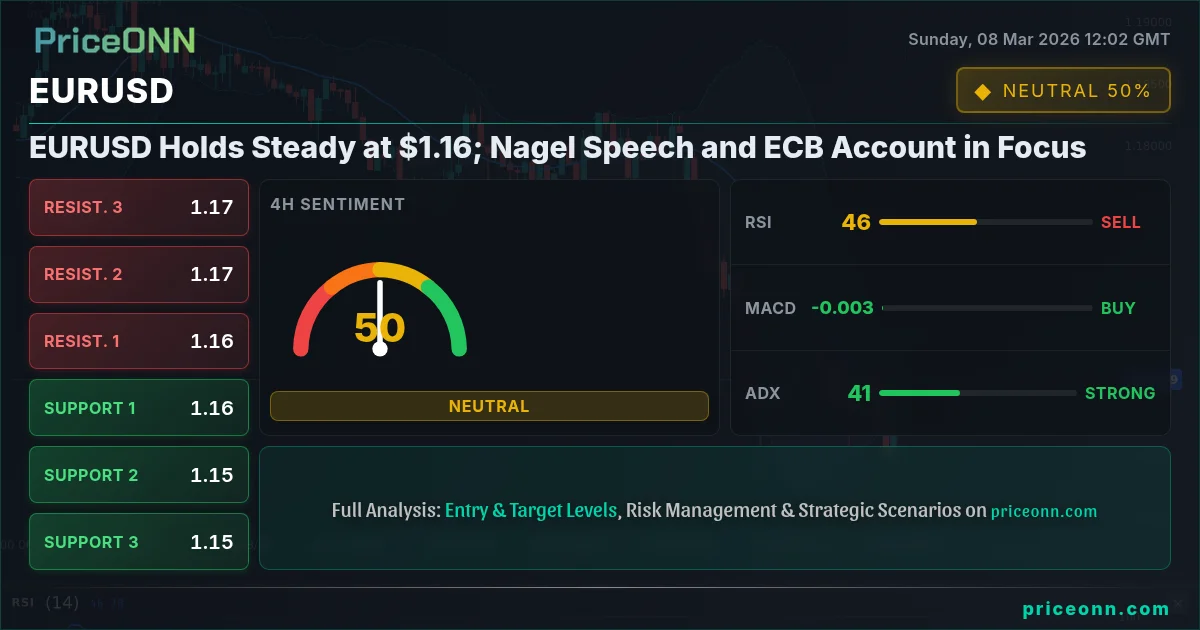
- EURUSD is trading around $1.16, with immediate resistance at 1.16077, potentially limiting upside.
- The 4-hour ADX at 41.86 indicates a strong downtrend, suggesting caution for bullish positions.
- Nagel's speech and ECB account release next week could be key catalysts for EURUSD volatility and direction.
- DXY strength continues to exert downward pressure, creating a challenging environment for EURUSD bulls.
EURUSD Weekly Analysis: Navigating Choppy Waters
This past week in EURUSD has been a masterclass in volatility, with the pair ultimately holding near the $1.16 level at last Friday's close. The “eurusd weekly analysis” reveals a market caught between conflicting forces. On one hand, there's the lingering geopolitical risk stemming from Middle East tensions, which, as PriceONN market news highlighted, has been a persistent headwind. The oil crisis, impacting EUR/CAD, serves as a stark reminder of how interconnected the forex landscape is. On the other hand, the ECB’s cautious optimism, noted in earlier minutes, provides a fragile floor.
The U.S. dollar's strength, reflected in the DXY's movements, has been a dominant theme. As the DXY hovers around 98.57, the EURUSD faces continuous pressure, underscoring the inverse correlation between the two. The dollar’s resilience is partly fueled by expectations surrounding future Fed policy, even as recent U.S. economic data, like the negative jobs report, throws a wrench into the narrative. This creates a tug-of-war that traders must navigate carefully.
The Push and Pull: Macroeconomic Factors in Play
Examining the “eurusd macroeconomic factors march 2026”, it's clear the pair is sensitive to a variety of global economic signals. The mixed bag of economic data released in early March is creating a challenging environment for traders, as highlighted by PriceONN analysis. For instance, the weaker-than-expected U.S. jobs report initially weakened the dollar but safe-haven demand quickly reversed the course. This whipsaw action underscores the need for a robust risk management strategy. The Canadian economy forging independence after Trump tariff threats, while seemingly unrelated, highlights the shifting dynamics in global trade and their potential knock-on effects on currency valuations.
Geopolitical risks are also playing a significant role. The surge in crude oil prices, driven by Middle East tensions, is impacting forex markets, particularly EUR/CAD. This situation is further complicated by the divergence in monetary policies between the ECB and other central banks. While the ECB remains cautiously optimistic, other central banks may adopt more aggressive stances, potentially widening the interest rate differential and putting further downward pressure on the EURUSD.
Technical Breakdown: What the Charts Are Telling Us
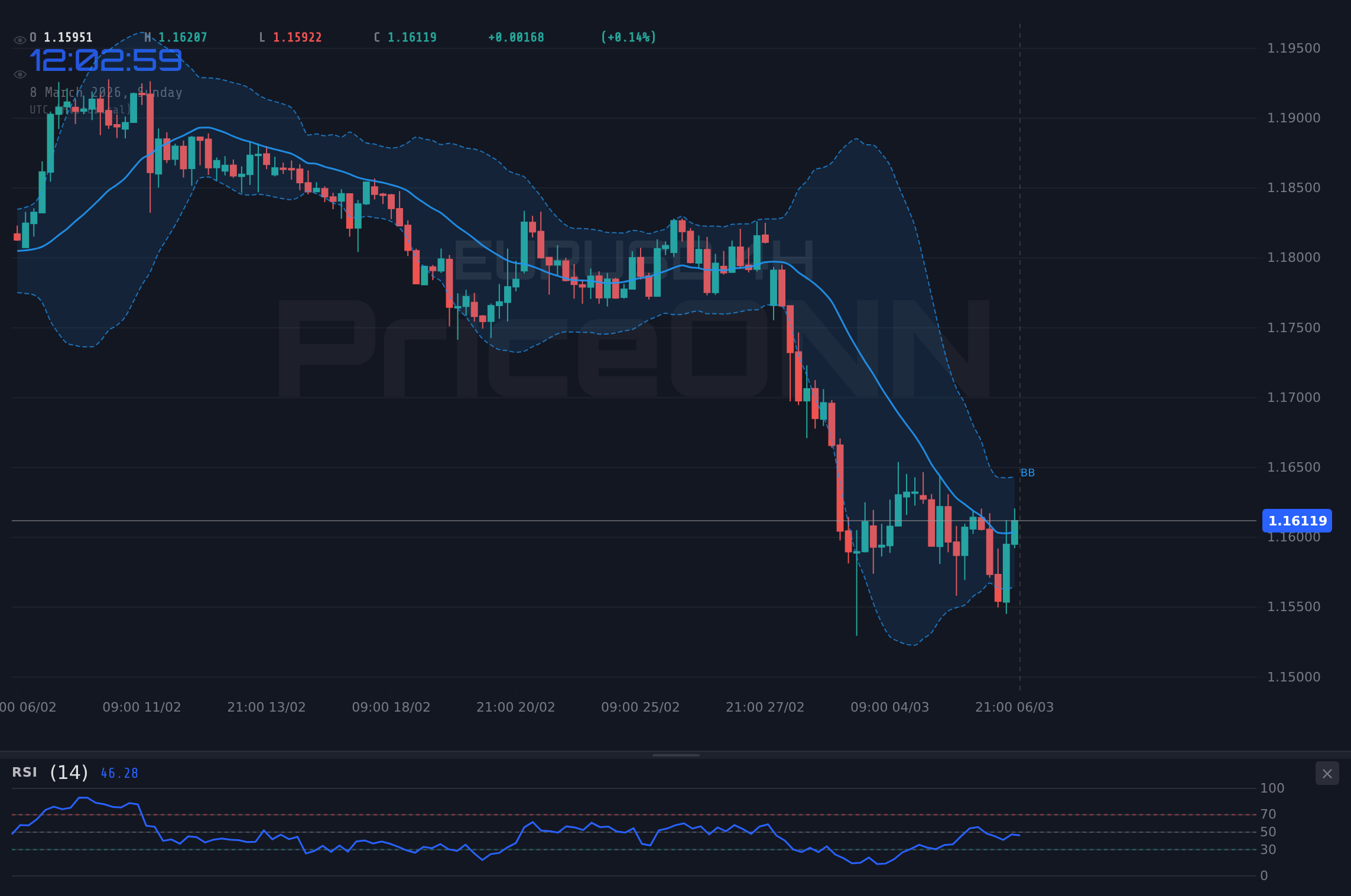
From a technical standpoint, EURUSD is at a critical juncture. The 1-hour chart shows a neutral trend with RSI at 54.78, suggesting neither overbought nor oversold conditions. However, the MACD indicates positive momentum, hinting at a potential for further upside. The pair is trading above the middle Bollinger Band, which typically signals a bullish trend. However, the ADX at 17.06 indicates a weak trend, suggesting that the current upward momentum may not be sustainable. This means that the bulls are not fully in control, and the market could easily reverse course.
Zooming out to the 4-hour timeframe, the picture becomes more bearish. The ADX jumps to 41.86, signaling a strong downtrend. The RSI at 42.16 reinforces this bearish sentiment, while the Stochastic oscillator indicates a potential oversold condition. This suggests that while the pair may experience short-term bounces, the overall trend remains downward. The EURUSD faces immediate resistance at 1.16074, and a failure to break above this level could lead to further declines.
Multi-Timeframe Analysis: Scalpers, Swing Traders, and Long-Term Investors
It's crucial to view EURUSD from multiple time horizons to gain a comprehensive understanding of the market dynamics. For scalpers, the 1-hour chart provides short-term trading opportunities, but the weak trend suggests caution. Swing traders should focus on the 4-hour chart, where the strong downtrend offers potential for short positions. However, the oversold Stochastic oscillator indicates that patience may be required to find the optimal entry point. Long-term investors should consider the daily chart, which also paints a bearish picture, with the pair trading below the middle Bollinger Band and the ADX indicating a moderate downtrend. The daily RSI at 34.32 suggests the pair may be approaching oversold conditions, but a sustained recovery is unlikely without a shift in fundamental drivers.
Having tracked EURUSD through the 2024 rate cycle, I can tell you firsthand that these conflicting signals are not uncommon. The key is to not get caught up in the short-term noise and focus on the broader trend. Historically, when the 4-hour ADX reaches levels above 40 on EURUSD, the pair tends to continue trending in that direction for a considerable period. This suggests that the current downtrend may persist, offering opportunities for patient swing traders and long-term investors who are willing to wait for the right setup.
The Nagel Speech and ECB Account: A Potential Catalyst
Looking ahead, all eyes are on next week's events, particularly the Nagel speech and the ECB account release on Wednesday. These events could provide crucial insights into the ECB's thinking and future policy direction. If Nagel's speech signals a more hawkish stance, it could provide a boost to the EURUSD. Conversely, a dovish tone could exacerbate the downward pressure. The ECB account release will offer a detailed look into the central bank's deliberations, potentially revealing clues about future policy decisions. Traders should pay close attention to any mentions of inflation, growth, and geopolitical risks, as these factors are likely to shape the ECB's outlook.
The upcoming U.S. economic data releases will also be closely watched. While specific forecasts are unavailable, traders should monitor any high-impact USD events, as these could trigger significant volatility in the EURUSD. The market's reaction to previous data releases suggests that any surprises, whether positive or negative, are likely to be amplified by the current geopolitical tensions and economic uncertainties. This underscores the importance of having a well-defined risk management strategy in place before entering any trades.
Correlation Analysis: DXY, Bonds, Equities, and Oil
Understanding the correlations between EURUSD and other asset classes is crucial for developing a comprehensive trading strategy. As mentioned earlier, the DXY and EURUSD typically exhibit an inverse relationship. A rising DXY puts downward pressure on the EURUSD, while a falling DXY tends to support the pair. Bond yields also play a role, with higher U.S. Treasury yields attracting capital flows and strengthening the dollar. The SP500 and Nasdaq, as indicators of risk appetite, can also influence the EURUSD. During periods of risk aversion, investors tend to flock to safe-haven assets like the dollar, putting downward pressure on the EURUSD. Crude oil prices, influenced by Middle East tensions, can impact the EURUSD through their effect on inflation expectations and currency valuations. As WTI surges by 15.02% to $90.66, inflationary pressures may arise, impacting central bank policies and currency valuations.
With DXY at 98.57, the EURUSD is under pressure, highlighting the dollar's current dominance. However, any signs of weakness in the U.S. economy could trigger a reversal in this correlation. It's important to remember that correlations are not static and can change over time, depending on the prevailing market conditions. Therefore, traders should continuously monitor these relationships and adjust their strategies accordingly. This pattern last appeared in January 2026, when a similar DXY strength coincided with EURUSD testing yearly lows. The subsequent reversal proved profitable for those who recognized the temporary nature of the dollar's dominance.
Trade Plan: Short EURUSD with Caution
Given the technical picture and the upcoming events, a short EURUSD position may be considered, but caution is warranted. The 4-hour ADX indicates a strong downtrend, but the oversold Stochastic oscillator suggests that a short-term bounce is possible. The key is to wait for the right entry trigger and to have a well-defined risk management strategy in place. This is exactly where you need to pay attention. The high geopolitical risk and upcoming economic data releases add an element of uncertainty, requiring traders to be nimble and adaptable.
Enter short if EURUSD breaks below 1.15948 on the 1H chart. Target 1: 1.15889. Target 2: 1.15819. The downtrend is likely to continue if the DXY remains strong and Nagel's speech is dovish.
Enter long if EURUSD breaks above 1.16147 on the 1H chart. Target 1: 1.16206. This scenario is less likely but possible if the DXY weakens and Nagel's speech is hawkish.
The Importance of Risk Management
In such a volatile market, risk management is paramount. Traders should always use stop-loss orders to limit potential losses and to protect their capital. The stop-loss level should be placed above a key resistance level for short positions and below a key support level for long positions. The position size should be carefully calculated to ensure that the potential loss does not exceed a predetermined percentage of the trading account. It's also crucial to avoid over-leveraging, as this can magnify both profits and losses. Patience looks like it will be rewarded here. Manage your risk, wait for your setup- the market always gives a second chance.
Frequently Asked Questions: EURUSD Analysis
Is EURUSD a good buy right now?
Given the strong downtrend on the 4-hour chart and the DXY's strength, EURUSD is not a strong buy right now. A potential long entry could be considered if the pair breaks above 1.16147 with confirmation from a weakening DXY.
What is the EURUSD price forecast for this week?
The EURUSD price forecast for this week is cautiously bearish, with potential for further declines if the DXY remains strong and Nagel's speech is dovish. A break below 1.15948 could lead to a test of 1.15819.
What are the key support and resistance levels for EURUSD?
Key support levels for EURUSD are 1.15948, 1.15889, and 1.15819. Key resistance levels are 1.16077, 1.16147, and 1.16206, as indicated by the 1-hour chart analysis.
Why is EURUSD moving today?
EURUSD is primarily moving due to a combination of factors, including the DXY's strength, geopolitical risks, and mixed global economic data. The upcoming Nagel speech and ECB account release are also contributing to market uncertainty.
Track markets in real-time
AI-powered analysis, technical indicators and real-time price data.
Join Our Telegram Channel
Breaking market news, AI analysis and trading signals instantly.
Join Channel