EURUSD Tests $1.15 Support Amidst DXY Surge: What's Next?
EURUSD is hovering around $1.15032, facing pressure as the DXY index climbs. Technicals show mixed signals with a strong downtrend on the daily chart.
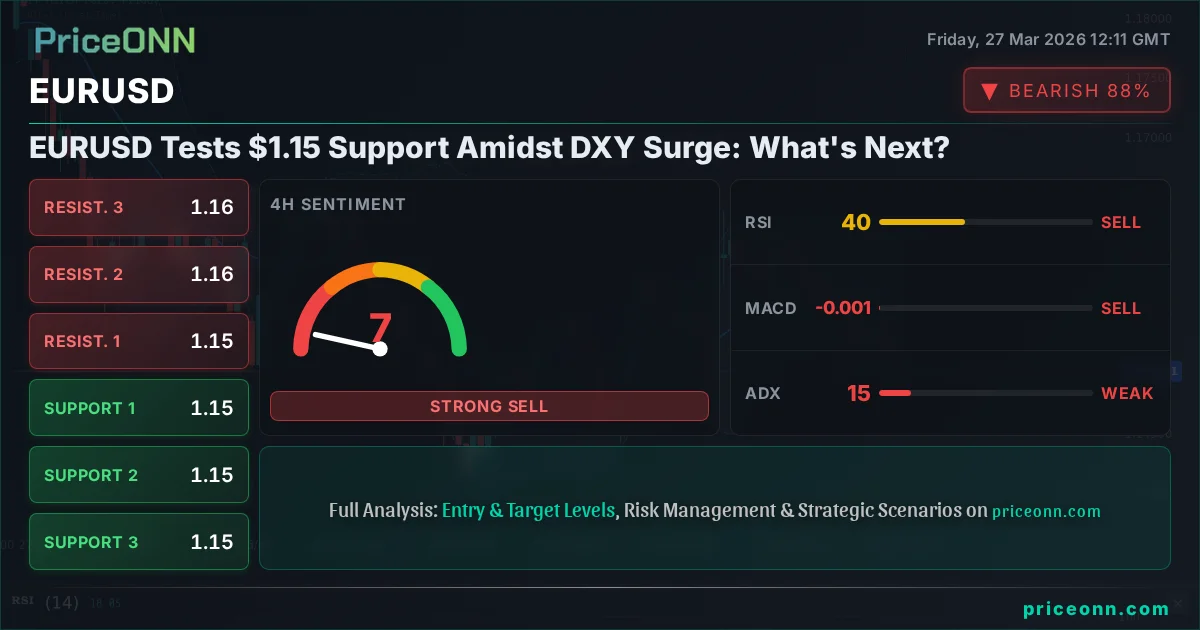
The EURUSD pair is currently navigating a critical juncture, trading just above the $1.15032 mark. This level is drawing attention as the US Dollar Index (DXY) continues its ascent, nearing the significant 99.92 level. This interplay between the Euro and the Dollar is being closely watched by traders and analysts alike, as it often sets the tone for broader market sentiment and risk appetite across global financial markets. The current price action, while seemingly tight, is unfolding against a backdrop of significant macroeconomic shifts and geopolitical undercurrents that could dictate the pair's trajectory in the coming days and weeks.
- EURUSD is trading at $1.15032, with the DXY index at 99.92, indicating dollar strength.
- Daily chart analysis for EURUSD shows a strong downtrend (97% power), with RSI at 39.77 and ADX at 34.07.
- Key support for EURUSD is identified at $1.15093, while resistance lies at $1.15621.
- Geopolitical tensions and a hawkish Fed stance are driving safe-haven demand for the USD, impacting EURUSD.
The daily chart for EURUSD paints a picture of persistent downward pressure. With a formidable 97% trend power indicating a strong bearish sentiment, the pair is firmly entrenched in a downtrend. The Relative Strength Index (RSI) at 39.77 suggests that while not yet oversold, the Euro is certainly losing ground against the dollar, with room to fall before hitting extreme levels. Complementing this, the Average Directional Index (ADX) at 34.07 confirms a robust trend is in play, reinforcing the bearish outlook. This confluence of technical indicators on the daily timeframe underscores the challenges facing the Euro and highlights the strength of the US Dollar in the current market environment. Traders are closely monitoring how these factors will play out as the market digests recent economic data and geopolitical developments.
Navigating the Dollar's Ascent
The US Dollar Index (DXY) has been on a steady climb, currently hovering around 99.92. This strength is not occurring in a vacuum; it's a response to a complex mix of global economic uncertainty and shifting central bank expectations. The DXY's upward trajectory is a significant factor for EURUSD, as a stronger dollar typically exerts downward pressure on the Euro. Investors are gravitating towards the perceived safety of the greenback amidst escalating geopolitical tensions, particularly concerning energy security and broader global instability. This flight to safety, often amplified by concerns over inflation and potential economic slowdowns, provides a strong tailwind for the dollar, making it an attractive currency for those seeking to preserve capital in volatile times. The sustained rise in the DXY suggests that these underlying concerns are weighing heavily on market sentiment, and the dollar's strength is likely to remain a dominant theme in the near term.
The Fed's Stance and Inflation Fears
Recent commentary from Federal Reserve officials suggests a renewed focus on inflation risks, a shift that could have significant implications for the EURUSD pair. Comments hinting at the possibility of a more hawkish stance, or at least a prolonged period of higher interest rates, are underpinning dollar strength. This is particularly relevant given the recent spikes in oil prices, which can re-igncite inflation concerns. If the Fed signals a greater willingness to combat inflation through aggressive monetary policy, it would likely widen the interest rate differential between the US and the Eurozone, further supporting the dollar. This scenario could exacerbate the downward pressure on EURUSD, especially if the European Central Bank (ECB) maintains a more dovish outlook or faces domestic economic headwinds that limit its policy options. The market will be scrutinizing upcoming economic data and Fed speeches for any further clues on their policy direction.
Geopolitical Tensions and Energy Shocks
The current geopolitical landscape is adding another layer of complexity to the currency markets, directly influencing EURUSD. Escalating tensions in key global regions, coupled with cyber threats targeting critical infrastructure, are contributing to a 'risk-off' sentiment. This environment naturally boosts demand for safe-haven assets, with the US dollar often being a primary beneficiary. Furthermore, the surge in oil prices, partly driven by these geopolitical events, has direct implications for inflation expectations on both sides of the Atlantic. Higher energy costs can put pressure on economies that are net energy importers, such as many in the Eurozone, potentially widening the economic divergence between the US and Europe. This divergence, if sustained, could translate into further weakness for the Euro against the Dollar, reinforcing the bearish trend observed in EURUSD.
Technical Breakdown: What the Charts Reveal
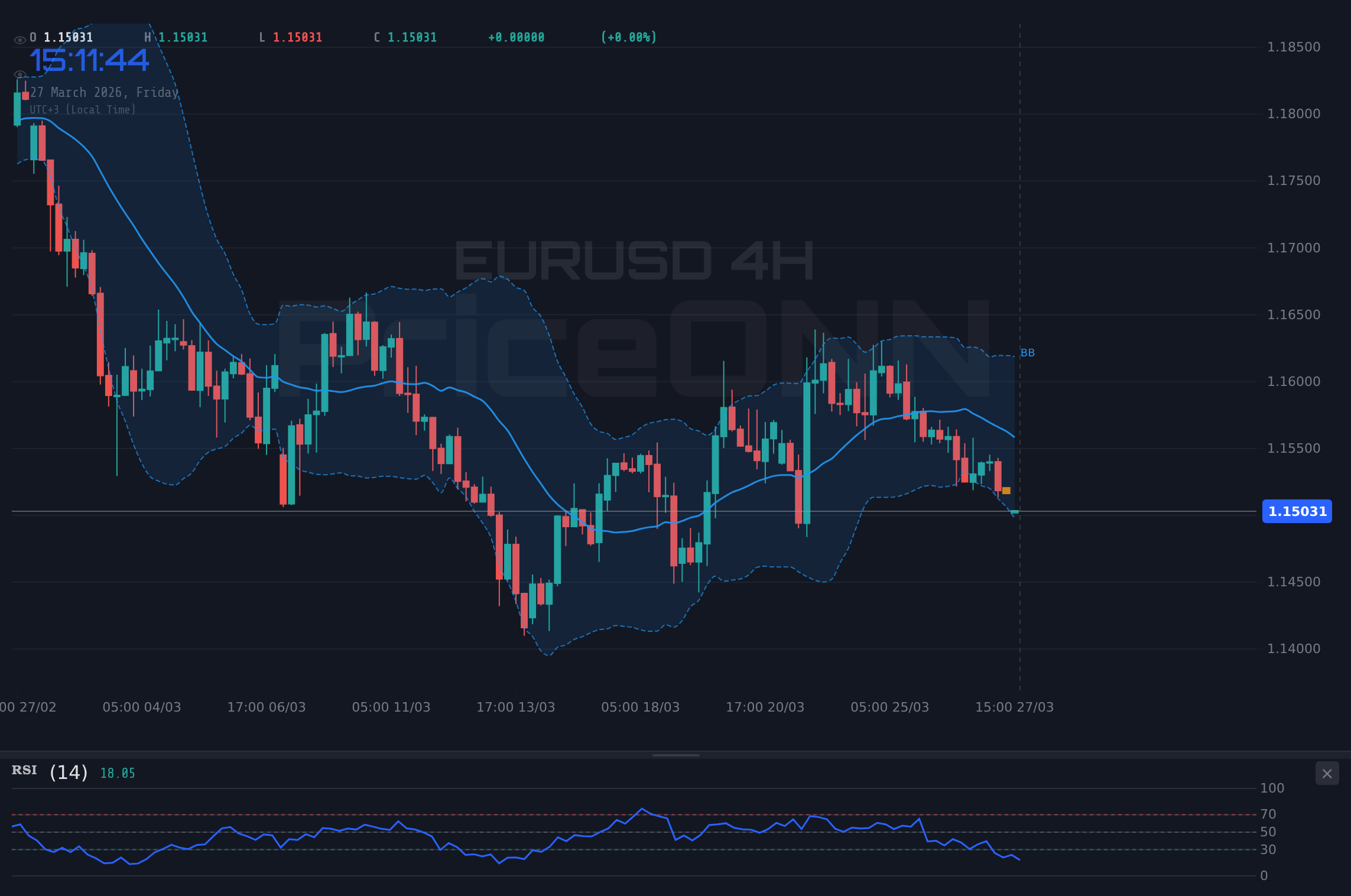
Diving deeper into the technicals, the 1-hour chart for EURUSD, while showing some signs of consolidation, largely reflects the dominant downtrend. The RSI is sitting at 32.64, firmly in neutral territory but trending downwards, indicating a lack of buying momentum. The MACD is below its signal line, confirming negative momentum, while the Stochastic Oscillator shows %K below %D, suggesting further downside potential. The ADX at 18.19 indicates a weak trend on this shorter timeframe, suggesting that while the direction is down, the conviction isn't exceptionally strong intraday, perhaps leading to choppy price action. The Bollinger Bands are also showing the price trading below the middle band, reinforcing the bearish bias.
However, the 4-hour timeframe presents a slightly more nuanced picture. Here, the trend is classified as 'Neutral' with 50% power, indicating a potential pause or consolidation phase. The RSI at 40.11 is still in neutral territory but trending lower. The MACD is negative, but the Stochastic shows %K above %D, hinting at a potential short-term bounce or at least a slowing of the downward momentum. The ADX here is weaker still at 14.74, confirming the choppy, less-directional nature of price action on this timeframe. This suggests that while the overall daily trend is bearish, intraday or even 4-hour swings might offer opportunities for short-term traders, though the lack of strong trend confirmation warrants caution. The Bollinger Bands on the 4-hour chart are also below the middle band, but the Stochastic's upward signal provides a hint of potential short-term relief.
The daily chart, as mentioned, is where the strongest bearish conviction lies. The overall signal for EURUSD is overwhelmingly 'SELL' across multiple timeframes, but it's crucial to interpret these signals within the broader market context. The fact that the 4-hour Stochastic is showing a potential upward signal while the daily RSI is still trending down creates a conflict that traders need to navigate carefully. This divergence might suggest a potential pullback or consolidation before the next leg down, or it could be a sign of weakening bearish momentum. The ADX readings across different timeframes also paint a picture of a market that is trending strongly on the daily, but showing less conviction on shorter intervals, implying that intraday volatility could be significant.
Key Levels to Watch
The immediate support level for EURUSD is identified at $1.15093. This is a critical point where the price is currently testing. A decisive break below this level, especially on increased volume, would likely trigger further selling pressure, potentially targeting the next support at $1.14876 and then $1.14565. On the upside, resistance is forming around $1.15621. For the bearish trend to be challenged, EURUSD would need to convincingly break and hold above this resistance level, followed by a push towards the subsequent resistance at $1.15932. The current price action suggests a battle is underway around the $1.15093 support. A failure to hold here could accelerate the downtrend, while a bounce might offer a temporary reprieve, though the broader daily trend still favors the downside.
Intermarket Correlations and Risk Sentiment
The performance of EURUSD cannot be viewed in isolation. Its movements are intrinsically linked to the DXY, which is currently showing significant strength. With the DXY at 99.92, the pressure on EURUSD is palpable. This correlation is a cornerstone of forex analysis; a rising dollar often implies a 'risk-off' environment, which tends to weigh on currencies like the Euro. Simultaneously, major stock indices like the S&P 500 and Nasdaq are experiencing declines, currently trading at 6446.95 and 23425.43 respectively. This broad market selloff further reinforces the demand for safe-haven assets, benefiting the dollar and putting additional strain on riskier currencies or those in economies perceived as less stable. The decline in equities suggests that investors are becoming more risk-averse, a sentiment that typically favors the US dollar over the Euro.
Oil prices, both Brent and WTI, are showing significant upward momentum, trading at $108.04 and $97.01 respectively. This surge in energy costs is a double-edged sword. On one hand, it can fuel inflation expectations, potentially prompting central banks like the Federal Reserve to adopt a more hawkish stance, which is dollar-positive. On the other hand, sustained high energy prices can act as a drag on global economic growth, particularly for energy-importing nations and regions like the Eurozone. This could create a scenario where the dollar benefits from both safe-haven flows and the prospect of higher US interest rates, while the Euro suffers from both its correlation with risk assets and the direct impact of higher energy costs. The conflicting signals from oil prices - inflationary pressure versus growth concerns - add to the overall market uncertainty.
Economic Calendar Insights
Looking at the economic calendar, recent data releases have provided mixed signals but have generally supported the dollar's strength. For instance, recent USD figures showed Manufacturing PMI at 52.4 (actual) versus a forecast of 51.5, indicating stronger-than-expected industrial activity. Another USD release for ISM Services PMI came in at 51.1, slightly below the forecast of 52, but still indicating expansion. These figures, while not overwhelmingly bullish, suggest a resilient US economy compared to some other major economies. Upcoming data, such as the US Non-Farm Payrolls (NFP) report, will be crucial. A strong NFP reading could further cement expectations of a hawkish Fed, potentially driving EURUSD lower. Conversely, a weaker-than-expected report might offer some respite to the Euro, although the prevailing risk-off sentiment and DXY strength could limit any significant upside.
Trade Scenarios and Outlook
Bearish Scenario: Downside Momentum Continues
70% ProbabilityNeutral Scenario: Consolidation Around $1.15
20% ProbabilityBullish Scenario: Short-Term Rebound
10% ProbabilityThe prevailing market sentiment, driven by a strengthening DXY and geopolitical uncertainties, strongly favors a bearish outlook for EURUSD. The technical indicators on the daily chart align with this view, showing a robust downtrend. While shorter timeframes might exhibit some choppiness or potential for short-term bounces, the overarching trend suggests that any upward movements could be opportunities for sellers to re-enter the market. The critical support at $1.15093 is the immediate level to watch. A break below this could signal the continuation of the sharp downtrend, with targets extending lower. Conversely, a sustained hold and subsequent break above resistance levels would be needed to challenge the current bearish thesis, but this appears less likely given the current macro environment.
Conclusion: A Dollar-Driven Market
In essence, the EURUSD currency pair is currently navigating a challenging environment characterized by a strong US dollar, persistent inflation concerns, and heightened geopolitical risks. The DXY's ascent to near 99.92, coupled with a bearish technical setup on the daily EURUSD chart, points towards continued downward pressure. While short-term fluctuations and potential consolidation may occur, the broader market narrative favors the dollar. Traders should remain vigilant, paying close attention to key support and resistance levels, particularly the $1.15093 mark. The Federal Reserve's stance on inflation and upcoming economic data releases, such as Non-Farm Payrolls, will be pivotal in shaping the near-term direction. For now, the path of least resistance appears to be lower for EURUSD, as the global search for safe havens continues to bolster the greenback.
Frequently Asked Questions: EURUSD Analysis
What happens if EURUSD breaks below the $1.15093 support level?
A break below $1.15093 on EURUSD would likely confirm the continuation of the strong daily downtrend, potentially accelerating declines towards $1.14876 and then $1.14565. This scenario is favored by the current DXY strength and bearish technicals.
Should I consider buying EURUSD at current levels around $1.15032 given the oversold RSI on the 1H chart?
While the 1-hour RSI is low, the daily chart shows a strong downtrend with RSI at 39.77, not yet oversold. A bounce is possible but risky; wait for confirmation like a break above $1.15621 resistance or a clear bullish divergence on higher timeframes before considering long positions.
Is the RSI at 39.77 on the daily chart a sell signal for EURUSD?
An RSI of 39.77 on the daily chart for EURUSD is not an extreme oversold or overbought signal, but it is trending downwards, reinforcing the bearish sentiment. It indicates a lack of buying pressure rather than an immediate sell signal in itself, supporting the prevailing downtrend.
How will upcoming Non-Farm Payrolls data affect EURUSD, given the current DXY strength?
A strong NFP release could bolster the DXY further by reinforcing hawkish Fed expectations, likely pushing EURUSD lower. Conversely, a weak NFP might offer temporary relief to EURUSD, but the strong dollar trend and risk-off sentiment could limit significant gains.
Track markets in real-time
AI-powered analysis, technical indicators and real-time price data.
Join Our Telegram Channel
Breaking market news, AI analysis and trading signals instantly.
Join Channel