


USD/JPY closed last Friday at $159.74, a level unseen since July 2024, setting the stage for a week filled with anticipation. Bulls and bears are locked in a tight contest as the pair approaches the psychologically significant 160.00 level. The question now is: can the bulls maintain control, or will the bears seize the opportunity to push the pair lower?
- USD/JPY closed at $159.74 last Friday, fueling speculation of Bank of Japan intervention near 160.00.
- RSI on the daily chart stands at 70.07, signaling overbought conditions that could trigger a pullback.
- Key support level to watch is 158.77; a break below could lead to further downside.
- DXY strength, currently at 100.2, is a primary driver supporting USD/JPY's bullish momentum.
The Bull Case for USD/JPY
The bullish momentum behind USD/JPY is undeniable. Several factors have contributed to the pair's ascent, making a compelling case for further upside. One of the primary drivers is the strength of the U.S. dollar, as reflected in the Dollar Index (DXY), which currently sits at 100.2. A rising DXY generally puts pressure on other currencies, and the Japanese Yen is no exception. As reported by PriceONN Market News, USD/JPY eyes 160.00 as geopolitical risks fuel dollar demand. This highlights the safe-haven appeal of the dollar in times of global uncertainty, further bolstering its value against the Yen.
Furthermore, the divergence in monetary policy between the U.S. Federal Reserve and the Bank of Japan (BoJ) continues to play a significant role. While the Fed has signaled a potential slowdown in its rate-hiking cycle, the BoJ remains committed to its ultra-loose monetary policy. This disparity in interest rate expectations makes the dollar more attractive to investors seeking higher yields, further fueling the bullish trend in USD/JPY. The 1H chart shows a bullish trend (83%) with RSI at 64.78, indicating continued upward momentum. Scalpers might see this as an opportunity to ride the short-term trend, targeting the 159.73 resistance level.
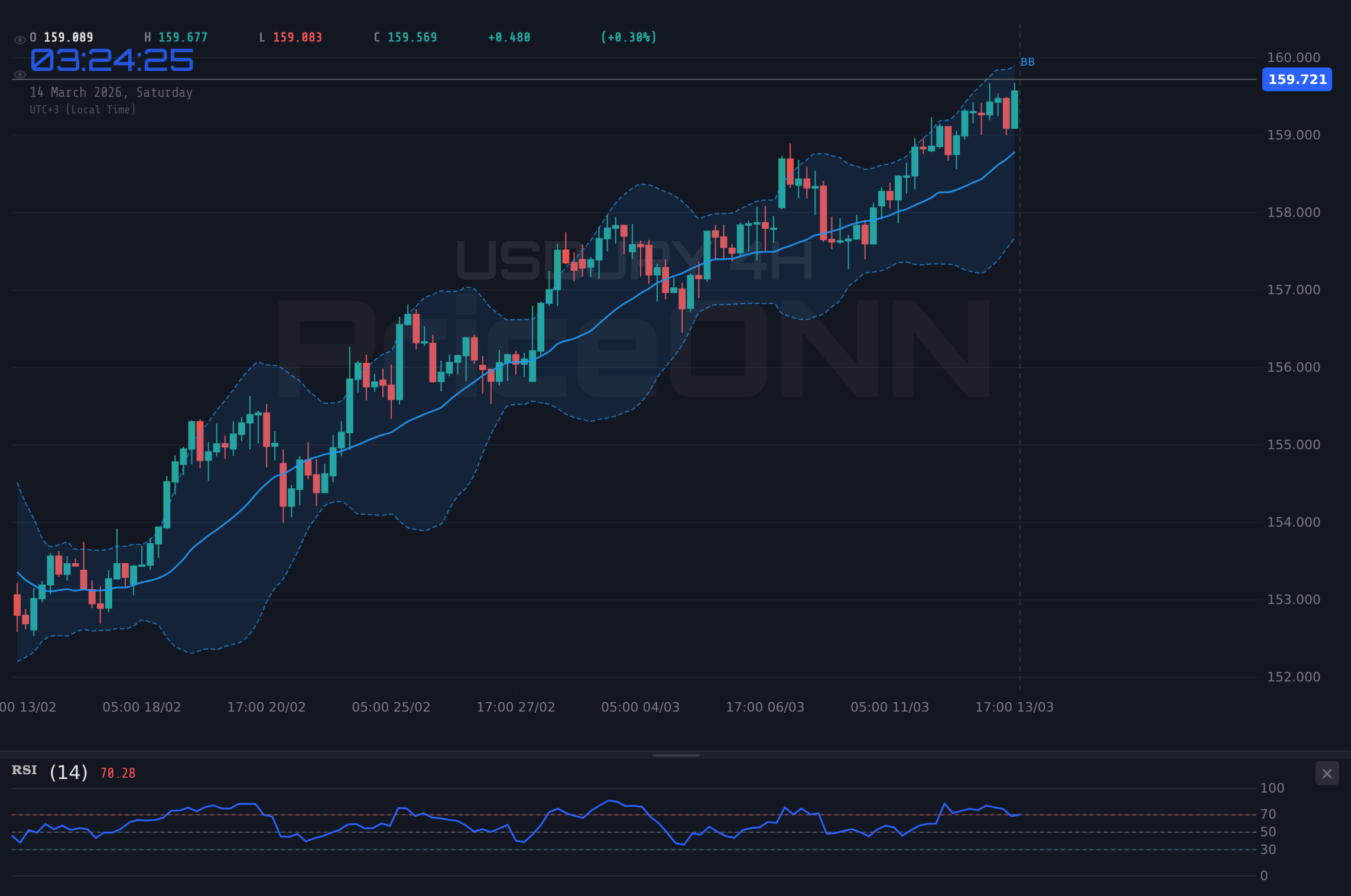
From a technical perspective, USD/JPY has been exhibiting a clear uptrend on the daily chart. The pair has consistently made higher highs and higher lows, indicating strong buying pressure. The MACD on the daily timeframe is also in positive territory, further supporting the bullish outlook. The 1D chart shows the MACD with positive momentum. Swing traders might look for a break above the 159.79 resistance on the 1H chart, targeting 160.00 as the next psychological resistance level. Given the current momentum and fundamental backdrop, the path of least resistance appears to be to the upside for USD/JPY.
The Bear Case for USD/JPY
Despite the compelling bullish arguments, there are also valid reasons to believe that USD/JPY could be due for a correction. One of the primary concerns is the overbought condition of the pair, as indicated by the Relative Strength Index (RSI). On the daily chart, the RSI currently sits at 70.07, signaling that USD/JPY may be overextended and ripe for a pullback. The fact that the Stochastic K is at 92.33 on the 1H chart further reinforces this view. This overbought condition could lead to profit-taking by investors, putting downward pressure on the pair.
Another factor weighing on USD/JPY is the potential for intervention by the Bank of Japan. As the pair approaches the 160.00 level, speculation about BoJ intervention has intensified. The BoJ has a history of intervening in the currency market to defend the Yen, and it may be tempted to do so again if USD/JPY continues to climb. Such intervention could trigger a sharp reversal in the pair, catching many bulls off guard. Long-term investors should be wary of this risk, as BoJ intervention could significantly alter the trajectory of USD/JPY.
Geopolitical risks also pose a threat to the bullish trend in USD/JPY. Escalating tensions in the Middle East, as highlighted by recent news reports, could lead to a flight to safety, benefiting the Japanese Yen. As a safe-haven currency, the Yen tends to appreciate during times of global uncertainty. The 1D chart shows a weak ADX at 21, suggesting that the bullish trend may be losing steam. This, combined with the overall "sell" signal from the 1H chart, indicates that a potential shift in market sentiment might be on the horizon. Even though the trend is bullish (83%) on the 1H chart, the RSI is nearing overbought territory, suggesting caution.
Technicals as the Tiebreaker
To determine which scenario is more likely to play out, it is crucial to analyze the technical picture in more detail. A multi-timeframe analysis reveals a mixed bag of signals. On the hourly chart, USD/JPY is exhibiting a strong bullish trend, with the price trading above its 200-period moving average. However, the RSI is nearing overbought territory, suggesting that the pair may be due for a short-term pullback. The Stochastic is also in overbought territory, further reinforcing this view.
On the four-hour chart, the technical outlook is more neutral. The price is trading above its 200-period moving average, but the RSI is hovering around the 50 level, indicating a lack of clear momentum. The MACD is also close to the zero line, suggesting indecision in the market. The 4H chart shows the RSI at 68.1, nearing overbought levels, while the ADX is at 22.13, signaling a moderate uptrend. This suggests that the market might be consolidating before making its next move.
The daily chart provides a longer-term perspective. USD/JPY is clearly in an uptrend, with the price trading well above its 200-day moving average. However, the RSI is in overbought territory, suggesting that the pair may be overextended. The MACD is also showing signs of divergence, which could be an early warning signal of a potential reversal. The daily chart shows the RSI at 70.07, confirming overbought conditions. The ADX at 21 indicates a moderate uptrend, but the Stochastic K is at 97.53, reinforcing the overbought signal.
Looking at the support and resistance levels, immediate support can be found at 159.568 on the 1H chart, followed by 158.768 on the daily chart. Key resistance lies at the 160.00 psychological level, followed by 160.498 on the daily chart. A break above 160.00 would likely trigger further upside, while a break below 158.768 could lead to a deeper correction. The 1H chart indicates resistance at 159.681 and 159.733, while the 4H chart shows resistance at 159.39 and 159.691.
Correlation Analysis
A comprehensive correlation analysis provides additional insights into USD/JPY's potential trajectory. The Dollar Index (DXY) is a critical factor to consider, as it often moves inversely to USD/JPY. Currently, the DXY is at 100.2, showing a strong bullish trend. This DXY strength is putting downward pressure on the Japanese Yen, contributing to the upward momentum in USD/JPY. If the DXY continues to rise, it will likely further support USD/JPY's bullish trend. With the DXY at 100.2, USD/JPY is likely to face continued upward pressure, potentially testing the 160.00 resistance level.
Equity markets, as represented by the SP500 and Nasdaq100, also play a role. A risk-off environment, characterized by falling equity prices, typically leads to increased demand for safe-haven currencies like the Japanese Yen. However, despite the recent declines in the SP500 (currently at 6625.3) and Nasdaq100 (currently at 24337.41), USD/JPY has continued to climb. This suggests that other factors, such as DXY strength and BoJ policy, are currently outweighing the impact of risk aversion. If the SP500 and Nasdaq100 continue to fall, it could eventually trigger a more significant correction in USD/JPY, but for now, the bullish momentum remains intact.
Oil prices, as represented by Brent Crude (currently at $103.82) and WTI Crude (currently at $99.18), also have an indirect impact on USD/JPY. Rising oil prices tend to fuel inflation expectations, which can lead to higher interest rates and a stronger dollar. This, in turn, can put downward pressure on the Japanese Yen. The recent spike in oil prices, driven by geopolitical tensions in the Middle East, has likely contributed to the bullish trend in USD/JPY. If oil prices continue to rise, it will likely further support USD/JPY's upward momentum.
The Verdict: Cautious Optimism
Considering all the factors, a cautious optimism seems warranted for USD/JPY. The bullish momentum is strong, supported by DXY strength, BoJ policy divergence, and rising oil prices. However, the overbought conditions, potential for BoJ intervention, and geopolitical risks cannot be ignored. Traders should remain vigilant and monitor key technical levels for potential entry and exit points. Scalpers should watch the 159.73 resistance, while swing traders should keep an eye on the 158.768 support. Long-term investors should be wary of BoJ intervention and geopolitical risks.
The overall signal from the 1H chart is "Sell", with RSI at 23.05 indicating oversold conditions. The 4H chart also signals "Sell", with RSI at 31.08. The 1D chart signals "Sell" as well, with RSI at 23.59. These mixed signals suggest that while the overall trend is bullish, short-term pullbacks are possible. The key to successful trading will be managing risk effectively and waiting for the right setup.
Frequently Asked Questions: USDJPY Analysis
What happens if USDJPY breaks above 160.00 resistance?
A break above the 160.00 psychological resistance level would likely trigger further upside momentum in USDJPY. The next resistance level to watch would be 160.498 on the daily chart. This breakout scenario could be supported by continued DXY strength and rising oil prices.
Should I buy USDJPY at current levels of $159.74 given the RSI at 70.07?
Given the overbought conditions indicated by the RSI at 70.07 on the daily chart, it may be prudent to wait for a pullback before entering a long position. A potential entry point could be near the 158.768 support level, which represents a more favorable risk-reward ratio. However, aggressive traders might still consider a long position with a tight stop-loss order.
Is the potential for BoJ intervention a major risk for USDJPY bulls?
Yes, the potential for Bank of Japan intervention is a significant risk for USDJPY bulls. The BoJ has a history of intervening in the currency market to defend the Yen, and it may be tempted to do so again if USDJPY continues to climb. Such intervention could trigger a sharp reversal in the pair, catching many bulls off guard.
How will the upcoming CPI data affect USDJPY this week?
The upcoming CPI data will be a key catalyst for USDJPY this week. Stronger-than-expected CPI data could lead to increased expectations for Fed rate hikes, further supporting the dollar and pushing USDJPY higher. Conversely, weaker-than-expected CPI data could lead to a pullback in the dollar and a correction in USDJPY.
Track markets in real-time
AI-powered analysis, technical indicators and real-time price data.
Join Our Telegram Channel
Breaking market news, AI analysis and trading signals instantly.
Join Channel