

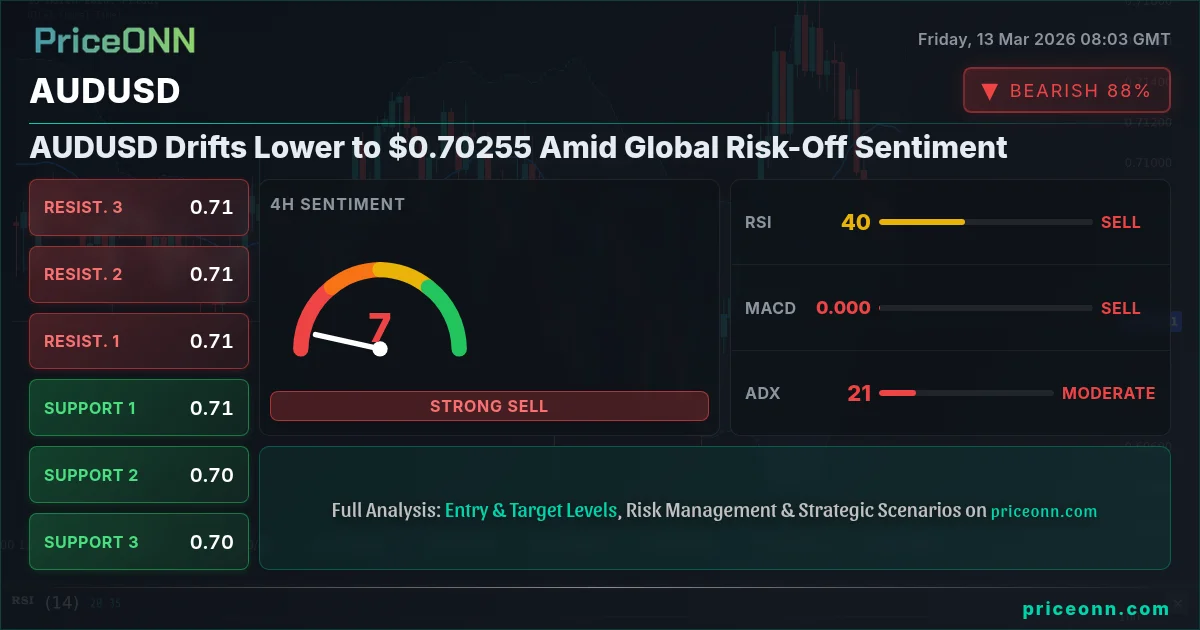
AUDUSD is under pressure, currently trading at $0.70255, as escalating geopolitical tensions and a robust US Dollar Index (DXY) create a challenging environment for the Aussie. WTI crude oil soaring above $95 a barrel due to Strait of Hormuz tensions, as reported by recent news, adds another layer of complexity, influencing risk sentiment and currency valuations.
- AUDUSD is currently trading at $0.70255, pressured by a strong US Dollar and risk-off sentiment.
- Immediate support lies at $0.70275, a break below which could accelerate losses.
- RSI at 18.73 indicates oversold conditions on the 1-hour chart, but downtrend momentum remains strong.
- Upcoming Home Sales data from the US on Friday could introduce volatility and impact AUDUSD direction.
The strength in the DXY, currently at 99.91, is weighing heavily on AUDUSD. The dollar index has gained 0.51% today, driven by expectations of continued hawkish monetary policy from the Federal Reserve. This is compounded by risk aversion stemming from escalating tensions in the Middle East. The surge in oil prices, with Brent crude at $102.28 and WTI at $97.18, is also adding to inflationary pressures, potentially forcing central banks to maintain tighter monetary policies for longer.
From a technical perspective, AUDUSD is exhibiting a clear downtrend across multiple timeframes. On the 1-hour chart, the trend is classified as a strong sell, with the ADX at 32.28 confirming the strength of the bearish momentum. The RSI at 18.73 indicates oversold conditions, suggesting a potential for a short-term bounce. However, the MACD remains in negative territory, reinforcing the prevailing bearish sentiment. Key support on the 1-hour chart lies at $0.70275, a break below which could lead to further declines towards $0.7018 and $0.7000.
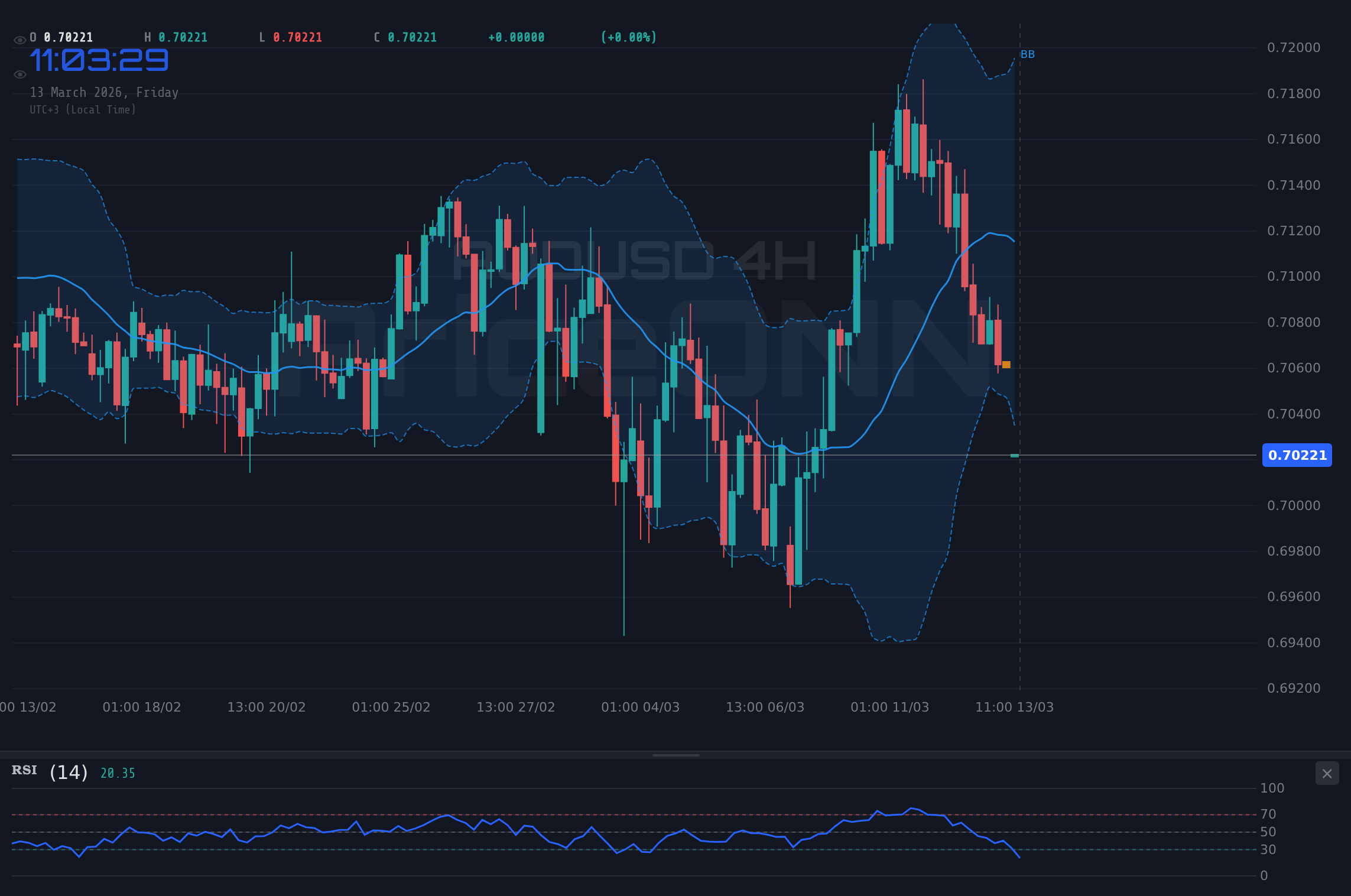
The 4-hour chart paints a similar picture, with AUDUSD trading below its moving averages and exhibiting negative momentum. The RSI at 43.66 remains in neutral territory, indicating further downside potential. Key resistance on the 4-hour chart sits at $0.70912, with a break above this level needed to negate the bearish outlook. The Stochastic oscillator is in oversold territory with K=4.32, D=13.57, signaling a potential for a reversal, but confirmation is still needed.
Looking at the daily timeframe, AUDUSD is trading below its 200-day moving average, confirming the long-term bearish trend. The daily RSI at 48.54 is in neutral territory, suggesting further downside potential. Key support on the daily chart lies at $0.70409, $0.7011 and $0.69516, while resistance is at $0.71302, $0.71896 and $0.72195. The ADX at 25.38 indicates a strong trend. The Stochastic oscillator shows K=57, D=60.8, a bearish signal, %K
The upcoming US Home Sales data on Friday is a key event to watch. A stronger-than-expected reading could further boost the US Dollar, exacerbating the downward pressure on AUDUSD. Conversely, a weaker-than-expected reading could provide some relief for the Aussie. The market consensus is for a modest increase in home sales, but any significant deviation from this expectation could trigger a sharp move in AUDUSD.
The Reserve Bank of Australia's (RBA) monetary policy stance is also playing a role in AUDUSD dynamics. While markets are pricing in a higher probability of future rate hikes by the RBA, the central bank remains cautious about tightening policy too aggressively, given the risks to economic growth. This divergence in monetary policy expectations between the Fed and the RBA is contributing to the strength of the US Dollar against the Australian Dollar.
Furthermore, escalating tensions in the Middle East are driving safe-haven demand, benefiting the US Dollar and putting pressure on riskier assets like the Australian Dollar. As reported by various news sources, the threat of disruptions to global energy supplies is also fueling inflationary concerns, adding to the uncertainty in financial markets. This risk-off environment is likely to persist in the near term, keeping AUDUSD under pressure.
Given the prevailing bearish sentiment and the confluence of negative factors, AUDUSD is likely to remain under pressure in the near term. A break below the immediate support at $0.70275 could trigger a further decline towards $0.7018 and $0.7000. Traders should closely monitor the DXY, oil prices, and upcoming economic data releases for further clues about the direction of AUDUSD.
AUDUSD breaks below $0.70275 support, accelerating decline towards $0.7018 and $0.7000. Strong DXY and risk-off sentiment persist, driven by geopolitical tensions and hawkish Fed expectations.
AUDUSD bounces off $0.70275 support, driven by a weaker-than-expected US Home Sales data release and a temporary easing of geopolitical tensions. Resistance at $0.7055 is the initial target.
Technical Outlook Summary
| Indicator | Value | Signal |
|---|---|---|
| RSI (14) - 1H | 31.23 | Neutral |
| MACD Histogram - 1H | Negative | Bearish |
| Stochastic - 1H | K=24.23, D=48.72 | Bearish |
| ADX - 1H | 37.39 | Strong Downtrend |
| Bollinger - 1H | Below Lower Band | Watch |
Key Levels
Support Levels
Resistance Levels
Frequently Asked Questions: AUDUSD Analysis
What happens if AUDUSD breaks below $0.70275 support?
A break below the $0.70275 support level could trigger a further decline in AUDUSD, potentially leading to tests of $0.7018 and $0.7000, driven by continued US Dollar strength and risk-off sentiment.
Should I sell AUDUSD at current levels of $0.70255 given the oversold RSI?
While the RSI at 18.73 suggests oversold conditions on the 1-hour chart, the strong downtrend momentum indicated by the ADX of 32.28 warrants caution. Selling AUDUSD at current levels carries risk, and confirmation of a reversal is needed before considering a long position.
Is the current MACD signal a reliable indicator for AUDUSD's future direction?
The negative MACD histogram confirms the prevailing bearish momentum, but it should be used in conjunction with other indicators and price action analysis to make informed trading decisions. A bullish divergence on the MACD could signal a potential reversal.
How will the upcoming US Home Sales data affect AUDUSD this week?
Stronger-than-expected US Home Sales data could further boost the US Dollar, exacerbating the downward pressure on AUDUSD. Conversely, weaker-than-expected data could provide some relief for the Aussie, but the overall bearish trend is likely to persist.
Disclaimer: Trading foreign exchange on margin carries a high level of risk, and may not be suitable for all investors. Past performance is not indicative of future results. The high degree of leverage can work against you as well as for you. Before deciding to trade foreign exchange you should carefully consider your investment objectives, level of experience, and risk appetite. The possibility exists that you could sustain a loss of some or all of your initial investment and therefore you should not invest money that you cannot afford to lose. You should be aware of all the risks associated with foreign exchange trading, and seek advice from an independent financial advisor if you have any doubts.
Track markets in real-time
AI-powered analysis, technical indicators and real-time price data.
Join Our Telegram Channel
Breaking market news, AI analysis and trading signals instantly.
Join Channel