AUDUSD Hovers Near $0.70188: Neutral Outlook Amidst Shifting Macro Winds
AUDUSD is trading near $0.70188, showing a neutral technical bias. Key levels to watch include support at $0.69102 and resistance at $0.72375, as market participants assess upcoming economic data and central bank policies.
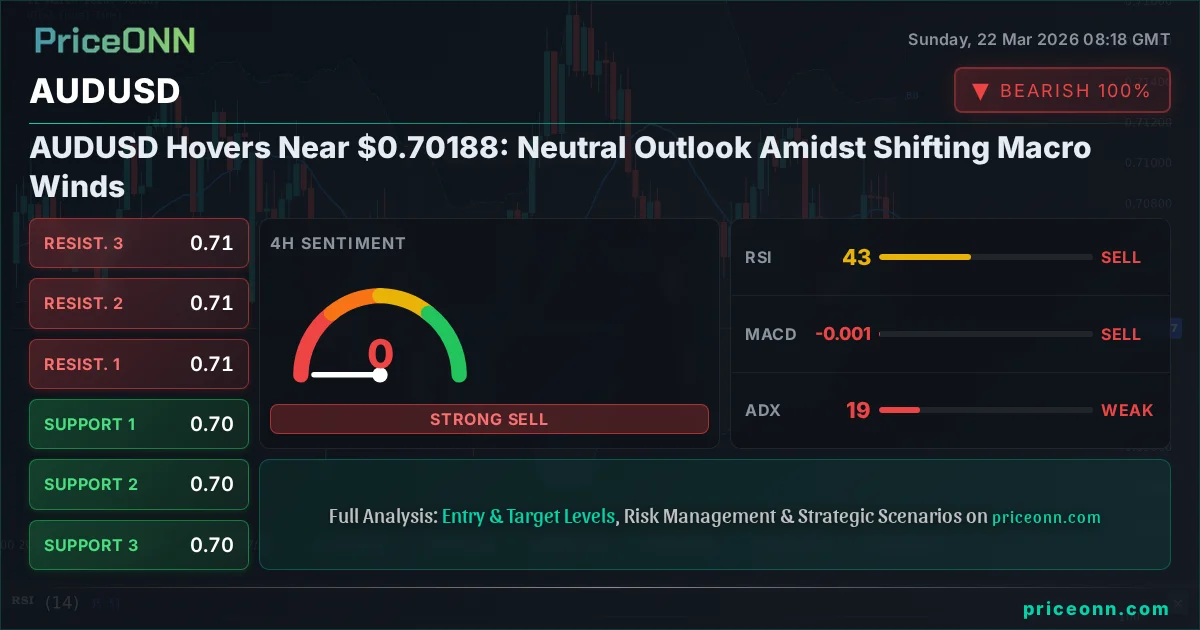
The Australian Dollar versus the US Dollar (AUDUSD) finds itself at a critical juncture, currently trading at $0.70188. This level represents a delicate balance, reflecting a neutral technical outlook shaped by a confluence of shifting macroeconomic winds and ongoing market uncertainty. Last week saw the pair experience a notable downturn, closing down 0.92% at $0.70188 following a high of $0.70961 and a low of $0.70043. This price action occurred within a broader context of a strengthening US Dollar, evidenced by the DXY index rising to 99.25, and a general risk-off sentiment permeating global markets, pushing major indices like the S&P 500 down by 1.2% to 6536.67 and the Nasdaq 100 by 1.67% to 23986.8. Analyzing this complex interplay is crucial for traders looking to navigate the potential opportunities and risks that lie ahead. The coming week promises to be pivotal, with key economic data releases and central bank commentary poised to influence AUDUSD's trajectory. Understanding the technical underpinnings, supported by fundamental drivers, will be paramount for formulating a robust trading strategy. This analysis delves into the multi-timeframe technical picture, explores the macroeconomic forces at play, and outlines potential scenarios for AUDUSD, offering a comprehensive outlook for the week ahead.
- The AUDUSD is currently trading at $0.70188, with a neutral technical bias across multiple timeframes.
- Key support for AUDUSD is identified at $0.69102, while resistance looms at $0.72375.
- RSI readings across different timeframes suggest a lack of strong directional momentum, hovering in neutral territory (1H: 34.27, 4H: 42.76, 1D: 47.97).
- The strengthening US Dollar Index (DXY) at 99.25 presents a headwind for AUDUSD, indicating potential downward pressure.
Navigating the Neutral Zone: AUDUSD Technical Landscape
The technical picture for AUDUSD on the 1-hour chart paints a cautious, neutral-to-bearish short-term trend, with the pair currently trading at $0.70188. The ADX at 22.47 suggests a moderate trend strength, but the RSI(14) reading of 34.27 indicates a leaning towards bearish momentum, although it remains shy of oversold conditions. This is further corroborated by the MACD, which is showing negative momentum with the MACD line below the signal line. Bollinger Bands are positioned below the middle band, reinforcing the bearish inclination in this timeframe. Stochastic Oscillator values of K=9.76 and D=12.46 firmly place the pair in oversold territory, hinting at a potential short-term bounce, though not a sustained trend reversal. The immediate support level to monitor is $0.69997, followed by $0.69901. Resistance is currently faced around $0.70271 and $0.70449. For scalpers and intraday traders, these levels are critical. A break below $0.69997 could invite further selling pressure towards $0.69723, while a sustained push above $0.70449 might signal a temporary reprieve, potentially targeting $0.70545. The overall signal on the 1H is strongly bearish (Al: 1, Sat: 7, Nötr: 0), reflecting the immediate downward pressure, but the oversold Stochastic warrants attention for any potential short-covering rallies.
Diving into the 4-hour timeframe, the trend remains decidedly neutral, but with a subtle bearish bias, as indicated by the ADX at 19.14, suggesting a weak trend environment. The RSI(14) at 42.76 reinforces this, sitting comfortably in neutral territory and showing no strong directional conviction. The MACD maintains negative momentum, with the MACD line below its signal line, aligning with the bearish sentiment. Bollinger Bands are also below the middle band, indicating that the price action is currently favoring sellers. Stochastic Oscillator values (K=43.72, D=61.32) show a downward signal, with the %K line below the %D line, suggesting further downside potential, though not in extreme oversold conditions. The support levels here are $0.70268, $0.70116, and $0.69821. Resistance is seen at $0.70715, $0.7101, and $0.71162. For swing traders looking at a slightly longer horizon, the inability of the price to decisively break above the middle Bollinger Band suggests that the upward momentum is lacking. The bearish signal from Stochastic, despite the neutral RSI, points towards caution. The general signal is bearish (Al: 0, Sat: 8, Nötr: 0), highlighting the prevailing selling pressure on this timeframe.
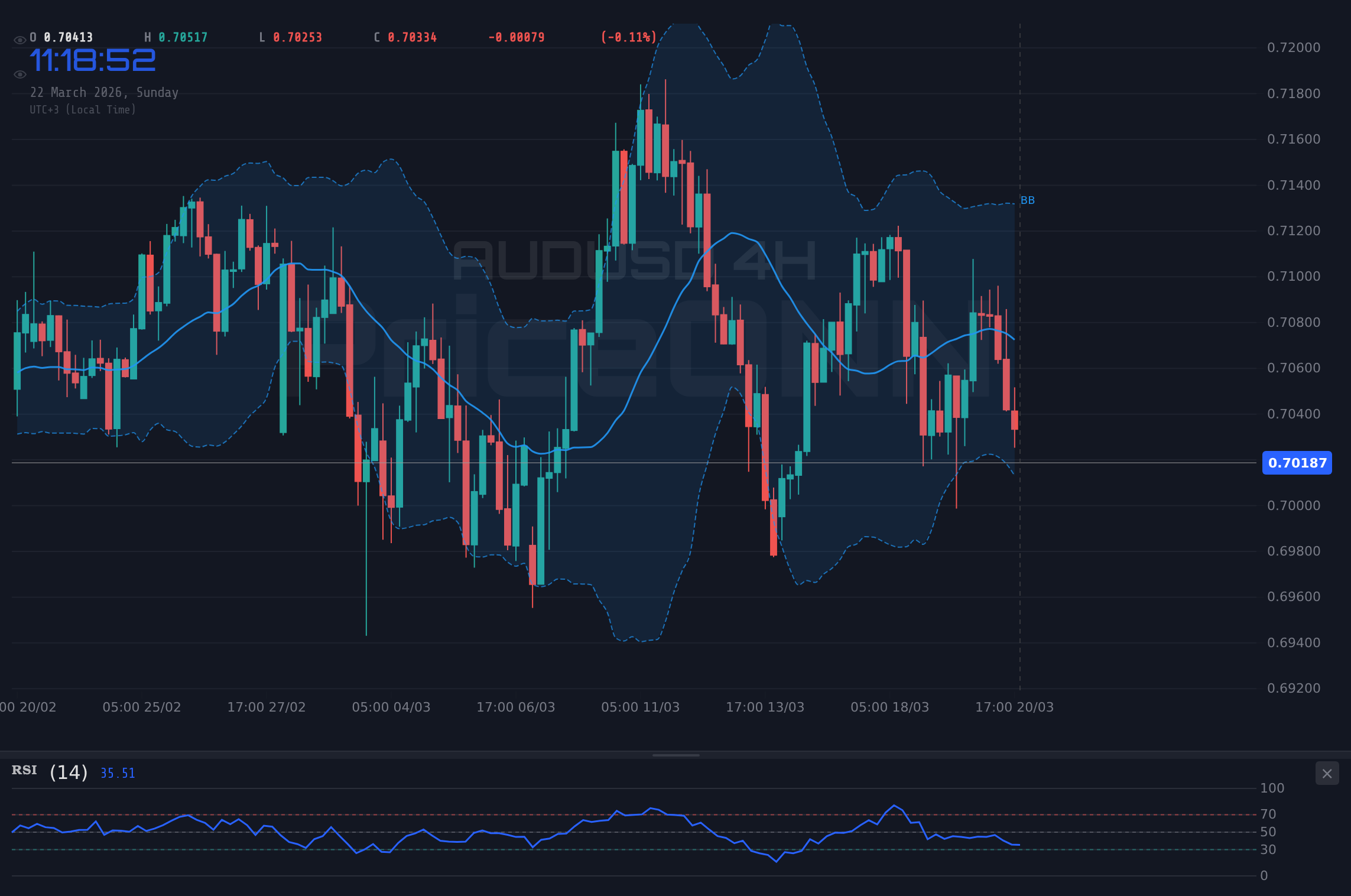
On the daily chart, the picture for AUDUSD becomes even more neutral, yet the prevailing trend is still slightly bearish, with an ADX reading of 20.48 indicating a moderately weak trend. This suggests that while a downtrend might be in place, it lacks strong conviction, potentially leading to range-bound price action. The RSI(14) at 47.97 is firmly in neutral territory, reflecting the indecision in the market. It's neither overbought nor oversold, meaning there's significant room for price to move in either direction before extreme conditions are met. The MACD is displaying negative momentum, with the MACD line below its signal line, but the histogram is narrow, suggesting that the bearish momentum is not accelerating. Bollinger Bands are positioned below the middle band, indicating a bearish bias on the daily close, but the price is hovering near the lower half of the bands, not aggressively breaking down. The Stochastic Oscillator (K=35.85, D=44.21) shows a bearish signal, with %K below %D, suggesting further downside might be possible, but it's far from oversold levels. The major support levels are critical: $0.70193, $0.69545, and the significant psychological level at $0.69102. Resistance is observed at $0.71284, $0.71727, and a more distant $0.72375. The overall signal here is bearish (Al: 2, Sat: 6, Nötr: 0), but the neutral RSI and weak ADX suggest that any moves might be choppy rather than part of a strong trend. This daily timeframe perspective is crucial for long-term investors and position traders evaluating the overall health of the trend.
The interplay between AUDUSD and its correlated assets paints a clearer picture of the underlying market sentiment. The US Dollar Index (DXY) is currently at 99.25, showing a positive daily change of 0.35%. This strengthening dollar acts as a significant headwind for AUDUSD. Historically, a rising DXY often correlates with a falling AUDUSD, as the 'Aussie' is a risk-sensitive currency, and a strong dollar reflects increased demand for safe-haven assets or a hawkish stance from the Federal Reserve. The S&P 500 (SP500) is down 1.2% at 6536.67, and the Nasdaq 100 (NDX) has fallen 1.67% to 23986.8. This broad market weakness suggests a decline in risk appetite globally. When risk appetite wanes, investors tend to move away from perceived riskier assets like the Australian Dollar and towards safer havens like the US Dollar. The negative correlation between AUDUSD and the S&P 500 is often observed; a sell-off in equities typically weighs on AUDUSD. Furthermore, oil prices, represented by Brent crude at $112.54 and WTI at $98.39, have seen significant gains, up 4.58% and 3.76% respectively. While higher oil prices can sometimes boost commodity-linked currencies like the AUD, the dominant factor currently appears to be the broad-based strength of the US Dollar and the risk-off sentiment, overshadowing any commodity-led support. The rising oil prices, however, do contribute to inflation concerns, which could influence central bank policies and, by extension, currency valuations.
The recent market news flow also provides essential context. PriceONN's market news from the past week highlights significant developments. On March 20th, reports indicated that AUD/USD dipped as Australia's unemployment rate surprised higher. This fundamental data point is critical: a rising unemployment rate suggests potential weakness in the Australian economy, which could deter investment and put downward pressure on the AUD. PriceONN's news specifically mentioned, "Will AUD/USD Fall to 0.7000 Amid Rising Unemployment and Dollar Strength?" This question directly addresses the current situation, linking the economic data to the pair's price action and the prevailing dollar strength. Further news on March 18th noted, "AUD/USD Climbs 0.48% After RBA Rate Hike Signals Hawkish Stance." This indicates that while economic data can pressure the currency, central bank actions, like a hawkish Reserve Bank of Australia (RBA) stance, can provide significant support. However, the current price action suggests that the negative economic data and overall dollar strength are currently outweighing the hawkish RBA sentiment. The continued rise in oil prices, while potentially supportive of commodity currencies, is also fueling inflation concerns globally. This complicates the picture for central banks, potentially leading to higher-for-longer interest rate scenarios, which would typically favor the US Dollar over the Australian Dollar. The ongoing geopolitical tensions, such as the reported attacks on energy hubs, add another layer of complexity, increasing demand for safe-haven assets and generally supporting the USD.
Looking at the longer-term implications, the AUDUSD's performance is intrinsically linked to the broader economic outlook and monetary policy divergence between Australia and the United States. The RBA's recent hawkish surprise, hiking rates, initially provided a boost to the Australian Dollar. However, this positive sentiment appears to be fading as fundamental economic data, such as the rising unemployment rate, takes center stage. The market is now grappling with whether the RBA's action was a preemptive measure against inflation or a sign of underlying economic fragility. On the US side, the Federal Reserve's stance remains a key driver. While market expectations for rate cuts have fluctuated, the Fed's commitment to combating inflation, coupled with a resilient US economy and the strength of the US Dollar, continues to exert pressure on AUDUSD. The correlation with bond yields is also noteworthy. Rising US Treasury yields tend to strengthen the dollar, making AUDUSD less attractive. Conversely, falling yields could offer some respite. For long-term investors, the current neutral stance on the daily chart suggests a period of consolidation or range-bound trading is possible. However, the underlying bearish signals from the ADX and RSI on lower timeframes warrant caution. The ability of AUDUSD to hold above the critical $0.70102 support level will be a key determinant of whether the pair can consolidate or if further downside is inevitable. The historical context shows that AUDUSD often experiences significant volatility around RBA and Federal Reserve policy meetings, and the current lack of clear directional conviction suggests that the market is waiting for definitive catalysts.
The question of what different types of traders should watch becomes paramount given this neutral yet potentially volatile setup. For **scalpers** operating on the 1-hour timeframe, the immediate focus will be on the tight intraday support at $0.69997 and resistance at $0.70271. The oversold Stochastic suggests a potential for short-term bounces, but the negative MACD and RSI indicate that any rallies might be capped. Scalpers should look for quick entries and exits, managing risk tightly, as the 1H trend is bearish. For **swing traders** who focus on the 4-hour and daily charts, the key is the behavior around the $0.70193 daily support and $0.71284 daily resistance. The neutral RSI on the daily chart and weak ADX readings suggest that a sustained trend move might be difficult to initiate without a clear catalyst. Swing traders should be patient, waiting for a decisive break above resistance or a solid bounce from support, possibly confirmed by a change in momentum indicators. Long-term investors, observing the daily chart, should be mindful of the broader trend. While the daily trend is technically neutral to slightly bearish, the lack of strong momentum and the proximity to major support at $0.69102 suggest a potential consolidation phase. They should focus on fundamental developments, such as upcoming inflation data, employment figures from both Australia and the US, and any further commentary from the RBA or the Fed. A decisive break below $0.69102 could signal a more significant downtrend, while a sustained move above $0.71284 might indicate a shift towards a more bullish outlook.
The correlation analysis extends beyond just the DXY and equities. Examining Treasury yields, the benchmark 10-year yield provides insight into interest rate expectations. If yields are rising, it generally supports a stronger dollar and can pressure AUDUSD. Conversely, falling yields might offer some relief. Currently, without specific yield data, we infer from the DXY's strength that yields might be stable or trending upwards, contributing to USD strength. The relationship with oil prices is also complex. While Australia is a commodity exporter and benefits from higher commodity prices, the current risk-off environment and USD strength seem to be the dominant factors. The positive correlation between oil prices and AUDUSD is usually present, but it can be overshadowed. For instance, if oil prices surge due to geopolitical risk, it might increase demand for the USD as a safe haven, simultaneously pressuring AUDUSD despite the commodity boost. The recent news regarding attacks on energy hubs could exemplify this. The market is weighing the inflationary impact of higher oil prices against the safe-haven appeal of the USD. Therefore, while Brent crude is at $112.54 and WTI at $98.39, their direct positive impact on AUDUSD might be muted by the overarching strength of the greenback and the global risk sentiment reflected in the falling stock markets.
The upcoming week holds several crucial economic events that could significantly impact AUDUSD. From Australia, traders will be closely monitoring any further economic data releases that could shed light on the health of the economy and the RBA's future policy path. Given the recent surprise in the unemployment rate, any updates on inflation or retail sales will be closely scrutinized. On the US side, key data releases such as Core PCE Price Index and the University of Michigan Consumer Sentiment will be critical. The Core PCE is the Fed's preferred inflation gauge, and any deviation from expectations could heavily influence Fed policy expectations and, consequently, the DXY and AUDUSD. Consumer sentiment figures will provide insights into the US consumer's economic outlook, impacting spending and overall economic growth. Furthermore, any speeches or meeting minutes from Federal Reserve officials will be closely watched for clues regarding the future direction of monetary policy. Traders will be looking for any hints about the timing and pace of potential interest rate adjustments. The market's reaction to these data points and central bank communications will likely determine whether AUDUSD can break out of its current neutral range or if it will continue to be dominated by the prevailing dollar strength and risk-off sentiment.
Considering the current technical and fundamental landscape, the most probable scenario for AUDUSD in the short to medium term appears to be a continuation of its neutral to slightly bearish trend, heavily influenced by the US Dollar's strength and broader market sentiment. The confluence of weak Australian economic data, a strong DXY, and declining risk appetite suggests that upward momentum will likely be limited. The key resistance level at $0.71284 remains a formidable barrier, and breaking above it would require a significant shift in market dynamics, such as a sharp decline in the DXY or a major positive surprise in Australian economic data. Conversely, the support at $0.69102 represents a critical line in the sand. A decisive breach below this level would likely confirm a bearish trend continuation, potentially opening the door for further declines towards $0.6538. The neutral RSI readings across timeframes, coupled with weak ADX values, support the idea of consolidation or choppy price action rather than a strong trending move. Therefore, while a strong bearish trend is not yet confirmed, the path of least resistance seems to be downwards, contingent on the sustained strength of the US Dollar and risk aversion. The probability of a sustained bullish move appears lower in the immediate term, given the headwinds. The neutral scenario, characterized by range-bound trading between the immediate support and resistance levels, is also plausible, especially if upcoming economic data proves inconclusive.
From a historical perspective, periods of neutral trading in AUDUSD often precede significant trend changes. Looking back at similar consolidation phases, particularly when the DXY has been strong and global risk sentiment has been subdued, the pair has tended to eventually break lower. For instance, during periods of Fed tightening cycles, AUDUSD has historically struggled to maintain upward momentum, often succumbing to dollar strength. The RBA's hawkish surprise last week was a temporary anomaly, and the market seems to be digesting it against the backdrop of a stronger dollar and concerning domestic economic data. The price action around the $0.70188 level is crucial. A failure to hold this level could trigger stop-loss orders, accelerating declines towards the next major support. Conversely, a strong bounce from this area, perhaps fueled by a weaker DXY or a surprisingly positive Australian data release, could lead to a retest of higher resistance levels. The volatility seen in oil prices, while significant, adds a layer of complexity by contributing to inflation fears, which in turn can lead to hawkish central bank rhetoric, further supporting currencies like the USD. This intricate web of correlations means that traders must maintain a holistic view, integrating technical signals with fundamental drivers and geopolitical developments.
For traders employing different strategies, the current environment demands specific approaches. Scalpers will be looking for short-term opportunities around the immediate intraday support and resistance levels, focusing on quick entries and exits as the price action dictates. The oversold Stochastic on the 1H chart might offer short-covering opportunities, but the overall bearish momentum needs to be respected. Swing traders should exercise patience, waiting for clearer signals on the 4H and daily charts. A decisive break of the $0.70193 daily support or a convincing move above the $0.71284 daily resistance would be necessary to initiate a more directional trade. The neutral ADX and RSI on the daily chart suggest that chasing moves within the current range might be fraught with risk. Long-term investors should focus on the fundamental narrative. The sustainability of the US Dollar's strength, the path of inflation, and the future policy decisions of the Fed and RBA are the key drivers. A clear break below $0.69102 could signal a more significant downtrend, while a sustained move above $0.71284 might be the first indication of a potential bottoming process. Risk management remains paramount across all timeframes, with strict adherence to stop-loss levels and position sizing being essential in this choppy market environment.
The macroeconomic backdrop continues to heavily influence AUDUSD. The Federal Reserve's monetary policy remains a dominant theme. While market participants have been pricing in potential rate cuts, the Fed's cautious stance, driven by persistent inflation and a resilient labor market, has supported the US Dollar. Any hints from Fed officials regarding the timing or extent of future rate adjustments will be closely monitored. The upcoming Core PCE Price Index data will be particularly crucial in this regard. For Australia, the RBA's recent hawkish move, while initially supportive, is now being viewed against the backdrop of rising unemployment. This creates a policy dilemma for the RBA: combat inflation aggressively, potentially risking economic slowdown, or prioritize growth, risking higher inflation. This uncertainty adds to the neutral bias seen in AUDUSD. Geopolitical risks, such as the energy sector tensions highlighted in recent news, continue to support the safe-haven appeal of the USD. The ongoing conflict in energy markets could lead to sustained supply disruptions and inflationary pressures, further complicating the global economic outlook and reinforcing the demand for the greenback. These factors collectively create a challenging environment for AUDUSD, where positive news for the Australian economy might struggle to gain traction against the prevailing strength of the US Dollar and global risk aversion.
The technical indicators, while providing a snapshot of current momentum, must be interpreted within this broader context. The RSI readings across timeframes (1H: 34.27, 4H: 42.76, 1D: 47.97) generally suggest a lack of strong buying pressure, hovering in neutral to slightly bearish territory. This implies that any upward moves might face resistance without significant underlying strength. The MACD indicator, consistently showing negative momentum on lower timeframes (1H, 4H) and on the daily chart, reinforces the view that selling pressure is dominant, even if it's not accelerating rapidly. The Stochastic Oscillator's position in oversold territory on the 1H chart (K=9.76, D=12.46) offers a glimmer of hope for a short-term bounce, but this signal alone is insufficient to warrant a bullish outlook, especially given the bearish MACD and RSI. The ADX, ranging from 19.14 (4H) to 22.47 (1H) and 20.48 (1D), indicates weak to moderate trend strength, suggesting that the market is not yet committed to a strong directional move. This aligns with the neutral outlook, implying that price action could be characterized by choppiness and ranging behavior until a clearer trend emerges. The confluence of these indicators suggests caution and a focus on risk management rather than aggressive directional bets.
The 'aud usd 0.7200 target' mentioned in emerging queries points to a potential upside level that the market might be looking towards, although current technicals do not strongly support this in the immediate term. For such a target to be reached, a significant shift in fundamentals would be required, likely involving a weakening of the US Dollar and a strong positive catalyst for the Australian economy. Currently, the 'audusd fundamentals' are mixed at best, with the rising unemployment rate posing a significant challenge. The market sentiment analysis clearly indicates a risk-off environment, which typically favors the US Dollar. Therefore, while $0.7200 remains a psychological level, it appears distant under current conditions. The focus remains on the immediate support at $0.69102 and resistance at $0.71284. Price action around these levels will be more indicative of the near-term direction than speculative upside targets.
Ultimately, the AUDUSD's path forward will be dictated by the ongoing tug-of-war between the strength of the US Dollar, the economic health of Australia, and the broader global risk sentiment. While the technical indicators suggest a neutral to slightly bearish bias, the lack of strong conviction across all timeframes points towards a period of consolidation. The key levels to watch remain $0.69102 for support and $0.71284 for resistance. Traders should remain vigilant for shifts in DXY, major equity market movements, and crucial economic data releases from both countries. The possibility of a 'stop hunt' around key psychological levels like $0.70000 cannot be ruled out, especially in a choppy market. Patience and a disciplined approach to risk management will be crucial for navigating the week ahead.
The Bears' Grip: Downside Risks Loom
65% ProbabilityThe Waiting Game: Range-Bound Consolidation
25% ProbabilityA Glimmer of Hope: Upside Potential
10% ProbabilityFrequently Asked Questions: AUDUSD Analysis
What happens if AUDUSD breaks decisively below the $0.69102 support level?
A break below the critical $0.69102 support level would invalidate the neutral outlook and likely signal the start of a more significant downtrend. This scenario, carrying a 65% probability, could see AUDUSD targeting lower levels such as $0.68000 and potentially $0.6658, especially if the US Dollar continues to strengthen and risk aversion persists.
Should I consider buying AUDUSD at current levels near $0.70188 given the oversold Stochastic on the 1H chart?
While the 1H Stochastic is oversold, other indicators like the RSI and MACD show bearish momentum. A buy decision at $0.70188 would be speculative and carry significant risk. A more prudent approach would be to wait for confirmation, such as a clear bounce from support at $0.69102 or a decisive break above intraday resistance near $0.70449, with a low probability (10%) of a sustained bullish move.
Is the RSI at 47.97 on the daily chart a sell signal for AUDUSD right now?
An RSI of 47.97 on the daily chart is considered neutral territory, not a direct sell signal. It indicates a lack of strong directional momentum, reflecting the indecision in the market. While it doesn't signal a buy, it also doesn't confirm a sell without additional bearish confirmation, such as a break below key support levels or negative divergence.
How will upcoming US Core PCE data affect AUDUSD this week?
The Core PCE Price Index is the Fed's preferred inflation gauge. If the data comes in hotter than expected, it could reinforce Fed hawkishness, strengthen the USD, and push AUDUSD lower towards $0.69102. Conversely, cooler-than-expected inflation could lead to Fed dovishness, weaken the USD, and potentially support a move towards the $0.71284 resistance.
📊 Indicator Dashboard
| Indicator | Value | Signal | Interpretation |
|---|---|---|---|
| RSI (14) | 47.97 | Neutral | Lack of strong momentum, room for movement in either direction. |
| MACD Histogram | -0.001 | Bearish | Sustained negative momentum, though not accelerating rapidly. |
| Stochastic | 35.85 / 44.21 | Bearish | %K below %D, indicating downside potential, but not oversold. |
| ADX | 20.48 | Weak Trend | Market lacks strong directional conviction, suggesting consolidation. |
| Bollinger Bands | Price below Middle Band | Bearish Bias | Suggests downward pressure on price action. |
Key Levels to Watch
The AUDUSD faces a challenging week ahead, caught between a strengthening US Dollar, mixed domestic economic signals, and broader risk sentiment. While the technicals suggest a neutral to slightly bearish bias, the lack of strong conviction across all timeframes points towards potential consolidation. The key levels at $0.69102 and $0.71284 will be critical in determining the next directional move. Traders should remain disciplined, manage risk effectively, and await clearer signals from the market. Volatility can create opportunity, and those who remain patient and stick to their trading plans will be best positioned to capitalize when the market eventually provides a decisive trend.
Track markets in real-time
AI-powered analysis, technical indicators and real-time price data.
Join Our Telegram Channel
Breaking market news, AI analysis and trading signals instantly.
Join Channel