

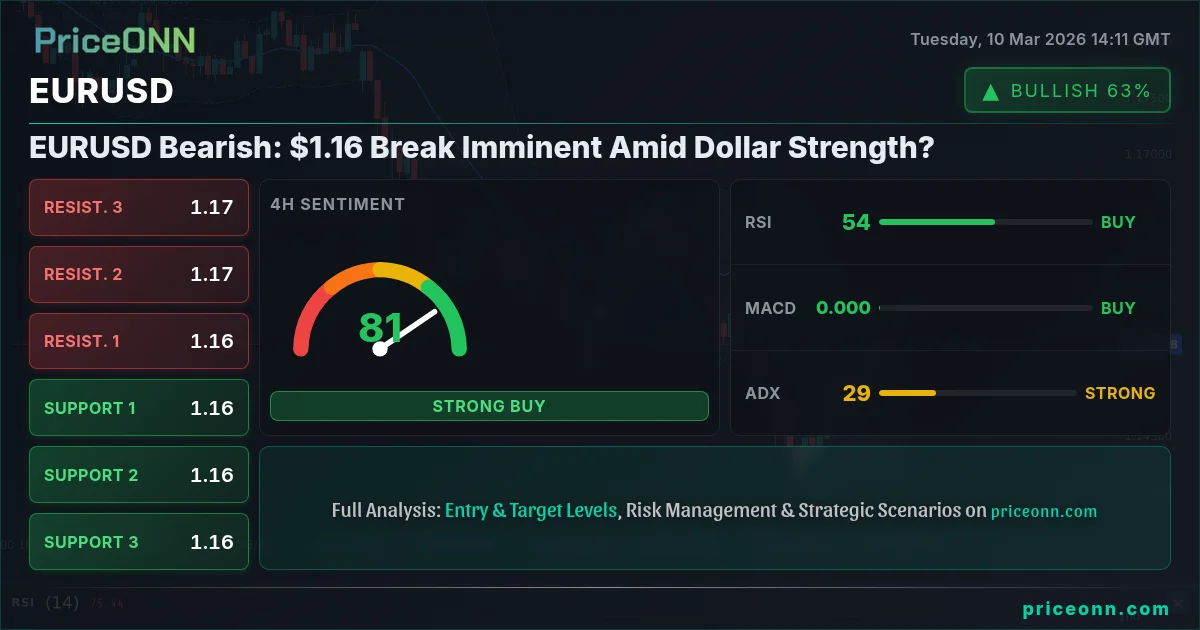
EURUSD is currently trading near $1.16299, facing downward pressure amid a strengthening US Dollar Index (DXY). The pair's direction appears bearish, influenced by geopolitical tensions and broader macroeconomic factors.
- RSI at 37.12 on the 1D chart suggests further downside momentum.
- Key resistance level to watch sits at 1.1679, a break above which could negate the bearish outlook.
- MACD histogram is negative, indicating sustained selling pressure.
- DXY strength is a major driver, with the index currently at 98.5, putting pressure on EURUSD.
The EURUSD pair's recent performance has been closely tied to the movements of the US Dollar Index (DXY), which currently stands at 98.5. As the DXY gains strength, EURUSD faces corresponding downward pressure. This inverse correlation is a critical factor in understanding the pair's current bearish trend. The recent surge in the DXY is fueled by ongoing geopolitical tensions, particularly in the Middle East, which are driving investors toward the safe-haven appeal of the US dollar. This risk-off sentiment is further compounded by looming US CPI data, adding to the uncertainty surrounding the EURUSD pair.
From a technical analysis perspective, the daily chart reveals a bearish outlook, with the overall signal indicating a 'Sell' recommendation. The 1-day RSI, currently at 37.12, suggests that the pair has room to decline further before reaching oversold conditions. This indicates that the bearish momentum is likely to persist in the short term. The MACD histogram also reinforces this bearish sentiment, with negative momentum signaling sustained selling pressure. The current price action is below the Bollinger Bands' middle band, further confirming the downward trend. Key support levels to watch are 1.15488, 1.14624 and 1.14186. These levels could act as potential stopping points for the decline. However, a break below these levels could lead to further downside.
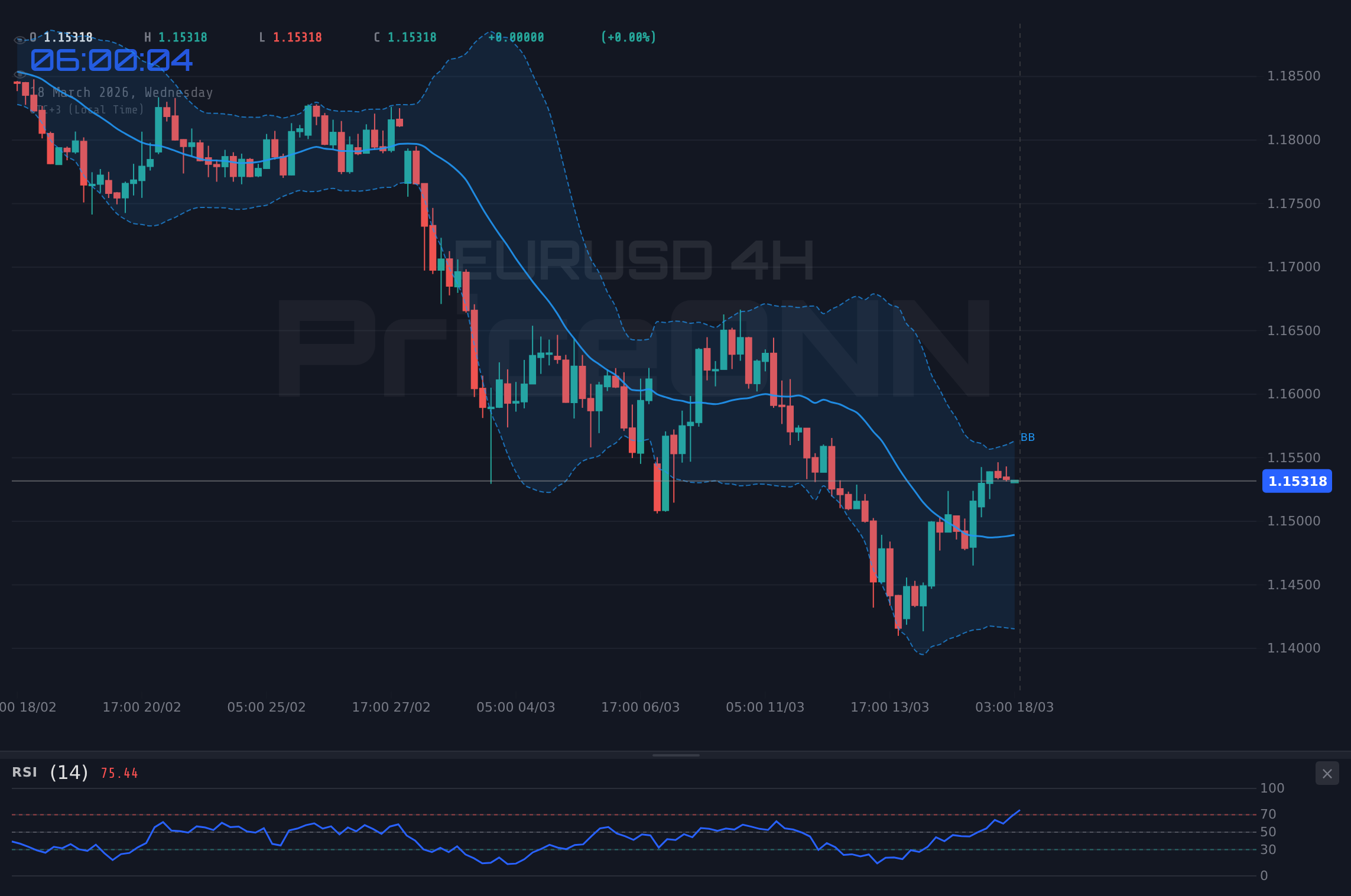
On the hourly timeframe, EURUSD shows a mixed picture. While the trend is currently bullish (89% strength), the overall signal is neutral. The RSI sits at 56.12, in neutral territory, suggesting that the pair is neither overbought nor oversold on this shorter timeframe. The Stochastic oscillator presents a bearish signal, with %K less than %D, indicating potential for short-term downward movement. The ADX indicates a strong bullish trend at 27.93. This conflicting signals on different timeframes highlight the complexities traders face. Scalpers should be cautious of intraday volatility, while swing traders should pay closer attention to the daily chart for a clearer picture of the dominant trend.
Looking at the 4-hour timeframe, the trend is neutral, with the overall signal leaning towards 'Buy'. The RSI is at 52.45, suggesting a balanced market sentiment. The Stochastic oscillator presents a bullish signal, with %K greater than %D. This could indicate a potential for upward movement in the medium term. However, the ADX at 30.1 signals a strong bullish trend. It is crucial to note that these signals must be interpreted in the context of the broader macroeconomic environment. The EURUSD pair's movements are significantly influenced by factors beyond technical indicators, including central bank policies and economic data releases.
Upcoming economic data releases will be critical in shaping the EURUSD's direction. On Wednesday, March 11, the market will be closely watching key economic indicators from both the Eurozone and the United States. Any deviation from expectations could trigger significant volatility in the EURUSD pair. Traders should also be aware of the potential impact of these data releases on the DXY, as any strengthening of the dollar could further pressure the EURUSD. Friday, March 13 will bring further data releases from the US, including key employment figures. Strong employment data could reinforce the dollar's strength, while weak data could provide some relief to the EURUSD.
From a fundamental perspective, the EURUSD pair is influenced by a complex interplay of macroeconomic factors. The European Central Bank's (ECB) monetary policy stance is a key driver, as are economic indicators such as GDP growth, inflation, and unemployment. The US Federal Reserve's (Fed) policies also play a crucial role, with interest rate decisions and quantitative easing measures impacting the dollar's value. Geopolitical risks further complicate the picture, with events such as the ongoing tensions in the Middle East driving safe-haven flows and impacting currency valuations. The "eurusd macroeconomic factors march 2026" are heavily influenced by the global economic landscape.
The correlation between EURUSD and other asset classes is also worth noting. Typically, EURUSD has an inverse relationship with the DXY. However, this correlation can sometimes break down, particularly during periods of heightened risk aversion or unexpected economic news. EURUSD also has a complex relationship with equity markets. During risk-on periods, the EURUSD tends to rise as investors seek higher-yielding assets. Conversely, during risk-off periods, the EURUSD may decline as investors flock to the safe-haven appeal of the US dollar. Oil prices can also impact the EURUSD, as higher oil prices can lead to inflationary pressures and potentially influence central bank policies.
For scalpers, the 1-hour chart provides valuable insights into short-term price movements. Key levels to watch are the immediate support at 1.1623 and resistance at 1.16424. Breakouts beyond these levels could offer opportunities for quick profits. However, scalpers should be mindful of the high volatility and potential for whipsaws, particularly during periods of economic data releases. Swing traders should focus on the daily and 4-hour charts, paying close attention to trend direction and key support and resistance levels. A break below the 1.15488 support level on the daily chart could signal a continuation of the bearish trend, while a break above the 1.1679 resistance level could negate the bearish outlook. Long-term investors should consider the broader macroeconomic environment and central bank policies. The "eurusd forecast australian financial review march 2026" is showing bearish signals.
Historically, EURUSD has exhibited significant volatility during periods of economic uncertainty and geopolitical tensions. For example, during the 2022 energy crisis, the EURUSD experienced a sharp decline as concerns about Europe's economic outlook weighed on the euro. Similarly, during periods of heightened trade tensions between the US and China, the EURUSD has often experienced volatility as investors grapple with the potential impact on global trade and economic growth. Understanding these historical patterns can provide valuable insights into the EURUSD's potential future performance.
The geopolitical landscape is also playing a significant role in the EURUSD's current performance. According to Reuters, the ongoing tensions in the Middle East are driving safe-haven flows into the US dollar, putting downward pressure on the EURUSD. Bloomberg data shows that investors are increasingly pricing in the possibility of further interest rate hikes by the Federal Reserve, further supporting the dollar's strength. These geopolitical and macroeconomic factors are creating a challenging environment for the EURUSD, with bearish momentum likely to persist in the short term.
The EURUSD pair is facing significant downward pressure due to a combination of factors, including a strengthening US dollar, geopolitical tensions, and mixed technical signals. While the short-term outlook may be uncertain, the long-term direction of the EURUSD will ultimately depend on the evolving macroeconomic environment and the policies of the ECB and the Fed. For traders, managing risk and staying informed about key economic data releases and geopolitical developments will be crucial for navigating the EURUSD market.
Frequently Asked Questions: EURUSD Analysis
What happens if EURUSD breaks below 1.15488 support?
If EURUSD breaks below the 1.15488 support, the bearish trend could accelerate, potentially targeting 1.14624 and 1.14186 as the next downside objectives. This scenario would likely be fueled by continued dollar strength and negative economic data from the Eurozone.
Should I sell EURUSD at current levels of $1.16299 given the negative MACD histogram?
Given the negative MACD histogram and the overall bearish trend, selling EURUSD at current levels could be considered, but with caution. A stop-loss order should be placed above the 1.1679 resistance level to limit potential losses if the bearish thesis is invalidated.
Is RSI at 37.12 a sell signal for EURUSD on the daily chart?
An RSI of 37.12 on the daily chart suggests that EURUSD has room to decline further before reaching oversold conditions, supporting the bearish outlook. However, traders should also consider other indicators and factors before initiating a sell position, as oversold conditions can sometimes lead to a short-term bounce.
How will Wednesday's Eurozone economic data affect EURUSD this week?
Wednesday's Eurozone economic data releases could significantly impact EURUSD. Strong data could provide some support to the euro, while weak data could reinforce the bearish trend. Traders should pay close attention to the actual data releases and their deviation from expectations, as this will likely drive the EURUSD's immediate reaction.
Technical Outlook Summary
| Indicator | Value | Signal |
|---|---|---|
| RSI (14) | 37.12 | Bearish |
| MACD Histogram | Negative | Bearish |
| Stochastic | K=35.29, D=29.75 | Bullish |
| ADX | 27.76 | Strong Downtrend |
| Bollinger | Middle Band | Below |
Track markets in real-time
AI-powered analysis, technical indicators and real-time price data.
Join Our Telegram Channel
Breaking market news, AI analysis and trading signals instantly.
Join Channel