

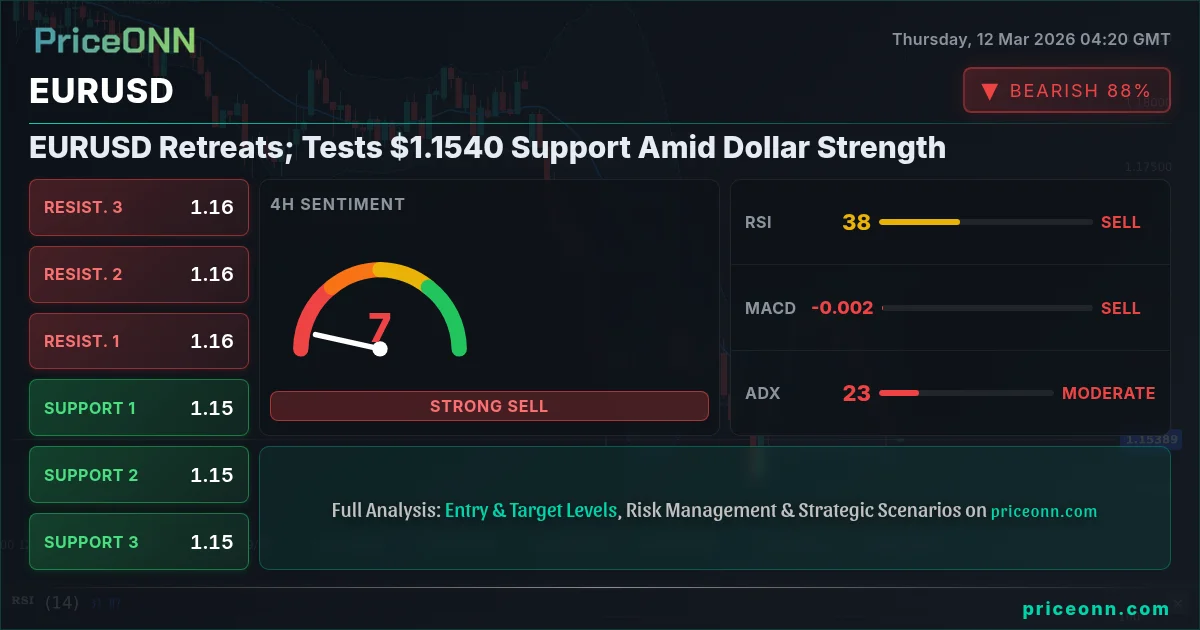
EURUSD is currently testing the $1.1540 support level, pressured by a strengthening dollar index (DXY). The DXY's rise is fueled by expectations of continued hawkish monetary policy from the Federal Reserve, contrasting with a more dovish stance from the European Central Bank (ECB). This divergence in policy expectations is a primary driver behind the recent EURUSD weakness. The question now is whether this support level will hold, or if the pair is poised for a further decline.
- EURUSD is testing a critical support level at $1.1540, pressured by DXY strength.
- The divergence in monetary policy between the Fed and ECB is a key factor driving EURUSD movements.
- A break below $1.15287 could open the door to further declines towards $1.15081.
- Upcoming US economic data, especially on March 13, will be crucial in determining the next move for EURUSD.
The dollar index (DXY) is currently trading at 99.23, a significant increase of 0.35% on the day. This strength is weighing heavily on EURUSD, as a stronger dollar makes the euro relatively less attractive. The rise in the DXY is attributed to expectations that the Federal Reserve will continue to raise interest rates in the coming months, while the ECB is expected to maintain a more cautious approach due to concerns about the Eurozone's economic outlook. This policy divergence is creating a significant headwind for the euro.
From a technical perspective, the EURUSD's one-hour chart reveals a strong bearish trend, with the ADX at 29.76 indicating a robust downward momentum. The RSI(14) at 30.69 suggests that the pair is nearing oversold conditions, which could lead to a temporary bounce. However, the MACD remains negative, signaling continued selling pressure. This suggests that any potential relief rally may be short-lived, and the overall bias remains to the downside.
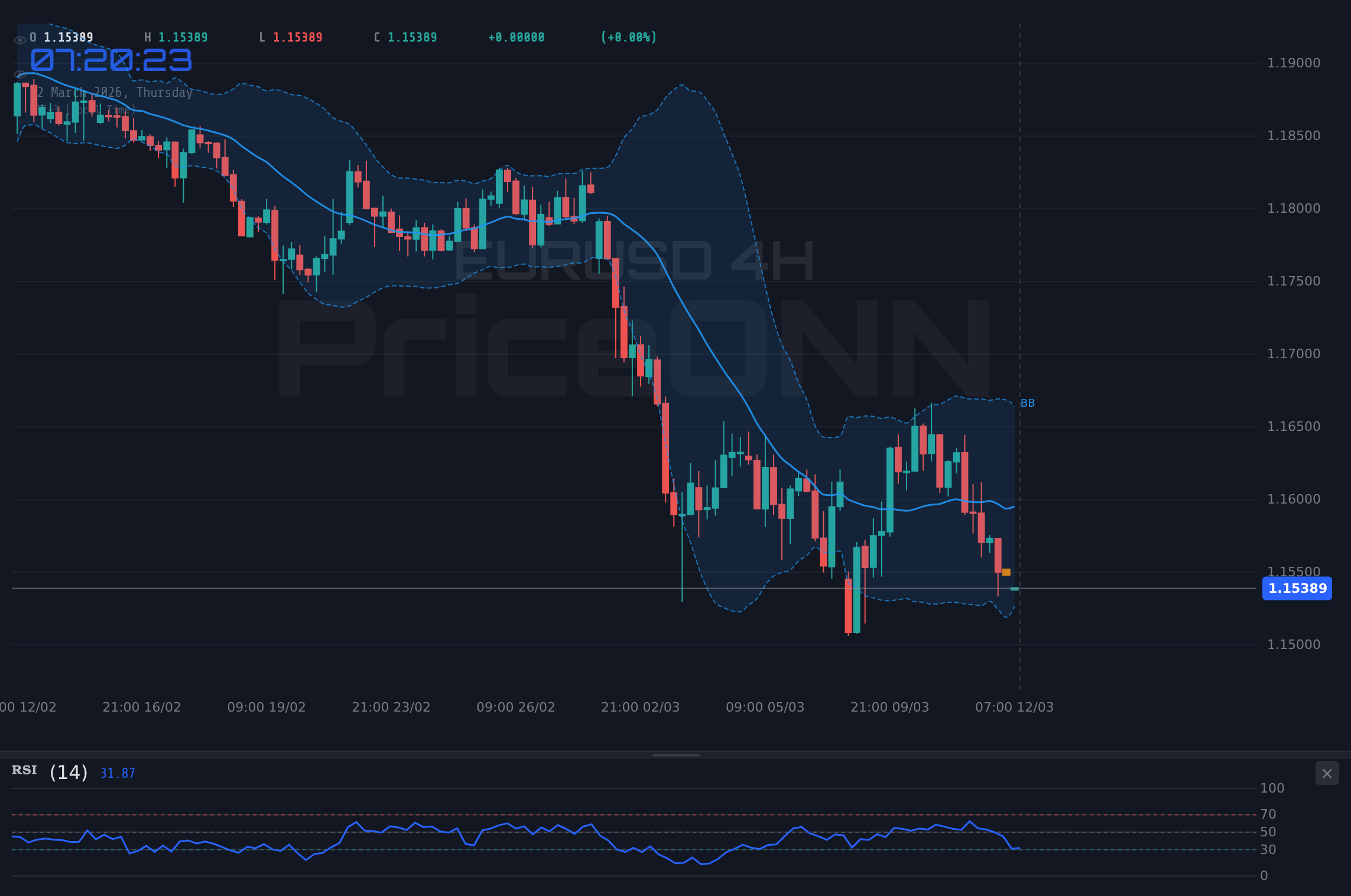
On the four-hour chart, the bearish trend is similarly pronounced. The RSI(14) at 39.84, while not yet oversold, indicates weakening momentum. The MACD histogram is negative, reinforcing the bearish outlook. Key support levels to watch include 1.15287, followed by 1.15081. A break below these levels could trigger a more significant decline towards 1.14562. Resistance is located at 1.15507, but a sustained move above this level appears unlikely given the prevailing bearish sentiment.
The daily chart paints a similar picture, with a strong downward trend confirmed by the ADX at 30.52. The RSI(14) at 30.21 indicates oversold conditions, suggesting a potential for a corrective bounce. However, the MACD remains negative, reinforcing the overall bearish outlook. Key support on the daily chart lies at 1.15407, with a break below this level potentially leading to a test of 1.15081 and then 1.14562. Resistance is found at 1.16252, but a sustained move above this level seems improbable in the current environment.
The upcoming economic calendar events are likely to play a crucial role in shaping the EURUSD's direction. On March 13 (Friday), several key US economic data releases are scheduled, including data related to the labor market. Stronger-than-expected US data could further bolster the dollar and exacerbate the downward pressure on EURUSD. Conversely, weaker-than-expected data could provide a temporary reprieve for the euro.
From an intermarket perspective, the EURUSD's movements are closely correlated with the DXY and, to a lesser extent, with global risk sentiment as reflected in the S&P 500. A stronger DXY typically exerts downward pressure on EURUSD, while a weaker DXY tends to provide support. A risk-off environment, characterized by a decline in the S&P 500, can also weigh on EURUSD as investors flock to safe-haven currencies like the US dollar. Currently, the S&P 500 is showing a bearish trend, trading at 6712.8, down -0.76% on the day. This risk-off sentiment is adding to the downward pressure on EURUSD.
The recent surge in oil prices, with Brent crude at $100.23 and WTI crude at $94.33, is also contributing to inflationary pressures, particularly in Europe. Higher energy prices can weigh on the Eurozone's economic outlook and further weaken the euro. As Reuters reported, "Fed officials emphasized that inflation remained 'stubborn'." This persistent inflation is likely to keep the Fed on a hawkish path, further supporting the dollar.
Taking into account the technical and fundamental factors, the EURUSD is likely to remain under pressure in the near term. The strong dollar, driven by expectations of continued Fed tightening, is a significant headwind for the euro. The technical picture also favors further downside, with bearish trends evident on the one-hour, four-hour, and daily charts. While oversold conditions could trigger a temporary bounce, the overall bias remains to the downside.
Having tracked EURUSD through the 2024 rate cycle, the current setup is reminiscent of previous periods of policy divergence between the Fed and ECB. Historically, when RSI reaches this zone on EURUSD, the outcome has been a continuation of the prevailing trend, albeit with occasional corrective bounces. Therefore, traders should exercise caution and wait for confirmation of any potential reversal before initiating long positions.
Potential Trade Plan
Given the bearish outlook, a short trade setup may be considered. However, it is crucial to manage risk carefully and wait for a clear entry trigger.
EURUSD breaks below the immediate support at 1.15287, opening the door to further declines. The primary target is 1.15081, with a potential extension towards 1.14562 if selling pressure intensifies. Stop-loss should be placed above 1.15507 to protect against unexpected upside.
EURUSD finds support at current levels and rebounds towards 1.15507. A sustained move above this level could trigger a test of 1.15632. However, this scenario is less likely given the prevailing bearish sentiment. This thesis fails if price closes below 1.15287.
Key Levels
Support Levels
Resistance Levels
Technical Outlook Summary
| Indicator | Value | Signal |
|---|---|---|
| RSI (14) | 30.69 | Watch |
| MACD Histogram | Negative | Bearish |
| Stochastic | 22.83 | Watch |
| ADX | 29.76 | Strong Trend |
| Bollinger | Lower Band | Oversold |
Frequently Asked Questions: EURUSD Analysis
What happens if EURUSD breaks below $1.15287 support?
If EURUSD decisively breaks below the $1.15287 support level, it would likely trigger further downside momentum. The next support level to watch would be 1.15081, followed by 1.14562. A sustained break below 1.15287 would confirm the bearish outlook.
Should I sell EURUSD at current levels of $1.15 given RSI at 30.69?
While the RSI at 30.69 suggests oversold conditions, it is prudent to wait for confirmation before initiating a short position. A potential entry trigger could be a break below 1.15287, with a stop-loss placed above 1.15507. This would help manage risk and protect against unexpected upside.
Is the ADX at 29.76 a reliable signal for EURUSD trend continuation?
An ADX reading of 29.76 indicates a strong downward trend, suggesting that the current bearish momentum is likely to persist. However, it is important to consider other factors, such as oversold conditions and upcoming economic data releases, before making a trading decision. A confluence of bearish signals would increase the probability of a successful trade.
How will the US jobs data on March 13 affect EURUSD this week?
The US jobs data release on March 13 is a key event that could significantly impact EURUSD. Stronger-than-expected US jobs data could further bolster the dollar and exacerbate the downward pressure on EURUSD. Conversely, weaker-than-expected data could provide a temporary reprieve for the euro, leading to a corrective bounce.
Track markets in real-time
AI-powered analysis, technical indicators and real-time price data.
Join Our Telegram Channel
Breaking market news, AI analysis and trading signals instantly.
Join Channel