

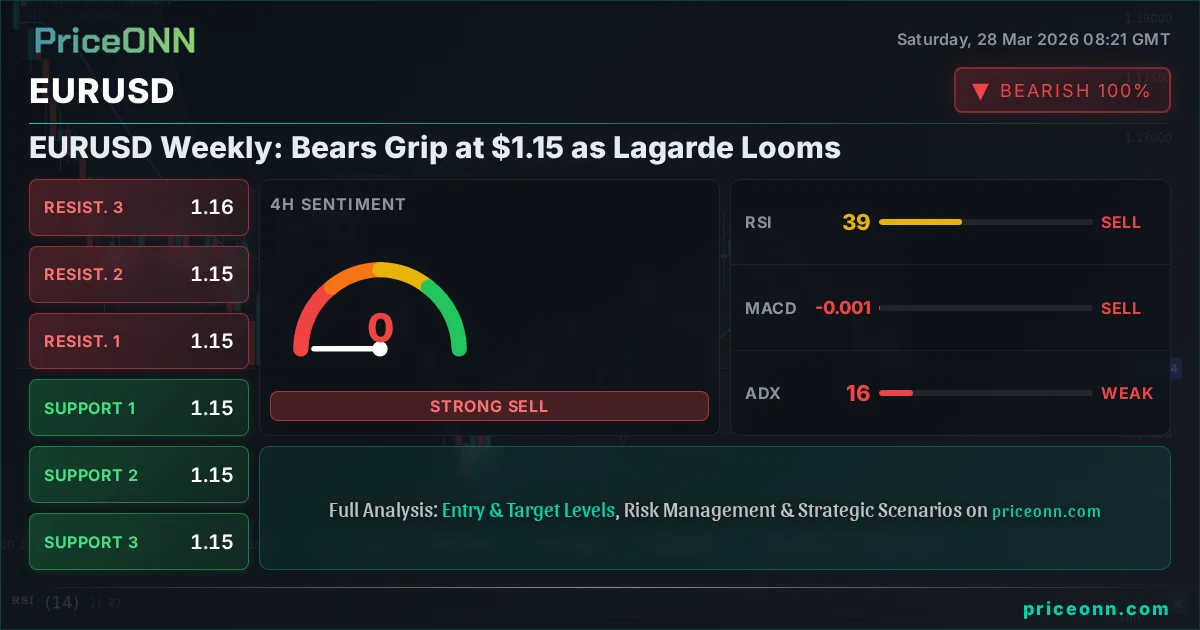
The currency markets are currently navigating a complex landscape, with the EURUSD pair finding itself at a critical juncture around the $1.15 mark. This past week has been defined by a palpable sense of geopolitical tension, primarily stemming from escalating conflicts in the Middle East, which have predictably sent oil prices soaring and injected a significant dose of risk aversion into global financial markets. This risk-off sentiment has bolstered the US Dollar Index (DXY), currently trading at 99.91, as investors flock to perceived safe-haven assets. The DXY's strength inherently puts pressure on major currency pairs like EURUSD, creating headwinds for the Euro. Against this backdrop of heightened global uncertainty and a strengthening dollar, the technical picture for EURUSD presents a mixed, yet predominantly cautious, outlook. Multiple indicators across various timeframes suggest that while the pair has found some footing, significant upside momentum is currently lacking, and the looming presence of ECB President Christine Lagarde's commentary adds another layer of anticipation for market participants.
- With RSI at 42.93 on the 1H chart, the pair shows downward pressure, indicating potential for further decline.
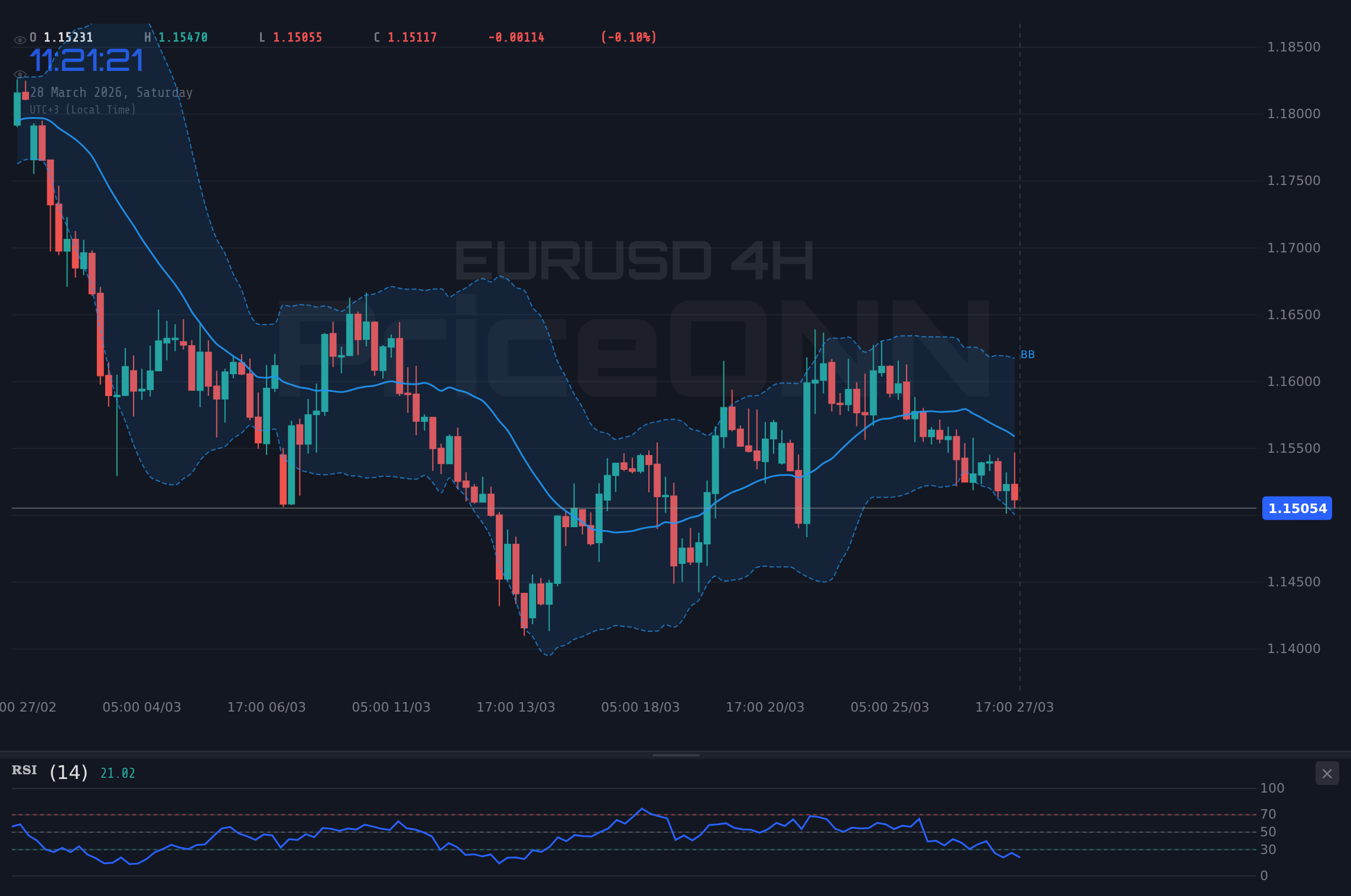
- Critical support sits at $1.15064, tested multiple times this week, with a break below potentially targeting $1.15002.
- The ADX at 16.34 on the 4H chart signals a weak trend, suggesting choppy price action rather than a clear directional move.
- ECB President Lagarde's upcoming statements are a key macro driver, with market participants closely watching for any hints on future monetary policy that could impact EURUSD.
Navigating Geopolitical Storms: Oil Surges, Dollar Strengthens
The most significant driver underpinning market sentiment this past week has undoubtedly been the escalation of geopolitical tensions in the Middle East. Reports of Iran shutting down the Strait of Hormuz, a critical chokepoint for global oil supply, sent Brent crude prices surging by 6.77% to $110.64 and WTI crude by a remarkable 7.69% to $101.19. This surge in energy prices has reignited inflation concerns globally, prompting a flight to safety. The US Dollar Index (DXY), currently hovering around 99.91, has benefited significantly from this 'risk-off' environment. As investors seek refuge, the dollar typically strengthens against other major currencies, including the Euro. This inverse correlation is clearly visible; a rising DXY often correlates with a falling EURUSD. The DXY's own technical indicators on the daily chart show a strong upward trend (ADX: 31.98) with RSI at 61.71, indicating continued bullish momentum that could further pressure the Euro.
This heightened geopolitical risk has a cascading effect across asset classes. For instance, gold, often seen as a safe-haven asset, has seen a significant rally, with XAUUSD surging 2.68% to $4495.44. This move in gold, while driven by similar safe-haven demand, can sometimes diverge from currency pair movements, but the underlying theme of uncertainty remains consistent. The impact on equity markets has been stark, with the S&P 500 (6357.55) and Nasdaq (23092.5) experiencing sharp declines of 2% and 2.23% respectively. This broad market sell-off underscores the prevailing risk aversion, which is a net negative for riskier currencies and a net positive for traditional safe havens like the US dollar. For EURUSD, this environment suggests that any upward momentum will likely face stiff resistance unless there is a significant de-escalation of geopolitical tensions or a clear shift in central bank policy expectations.
The implications of this geopolitical shockwave extend beyond immediate price action. Persistent high energy prices can fuel inflation, complicating the policy decisions for central banks, particularly the European Central Bank (ECB). While the US Federal Reserve has been on a hawkish path, the Eurozone's economic structure, heavily reliant on energy imports, makes it more vulnerable to sustained price shocks. This vulnerability could force the ECB into a more dovish stance or at least delay any aggressive tightening plans, further widening the interest rate differential with the US and reinforcing the bearish case for EURUSD in the medium term. The current market pricing reflects this divergence, with Fed Funds futures showing a higher probability of continued hawkish policy compared to the ECB, which is often perceived as more constrained by inflationary pressures originating from energy costs.
Technical Crossroads: EURUSD's Multi-Timeframe Conundrum
Turning to the technicals, the EURUSD pair presents a picture of consolidation with underlying bearish pressure. On the 1-hour chart, the trend is neutral with a power of 50%, but the RSI at 42.93 indicates downward momentum, suggesting that sellers are gradually gaining control. The MACD is showing a neutral momentum, hovering around the signal line, offering little directional conviction on this very short-term timeframe. However, the Bollinger Bands are currently trading above the middle band, which might suggest a brief pause or potential for a minor bounce, but this is being contradicted by the Stochastic Oscillator, where %K (27.07) is below %D (38.9), signaling a bearish divergence and potential for further downside. The ADX at 12.97 on this timeframe confirms a weak trend, highlighting the choppy nature of price action in the immediate hours. This suggests that while the direction might be down, the conviction is not yet strong enough for a decisive breakout.
The 4-hour timeframe paints a more defined bearish picture, despite a neutral overall trend classification (50% power). Here, the RSI is at 39, firmly in the lower half of the neutral zone and showing a downward eğilim. The MACD displays negative momentum, with the MACD line below its signal line, reinforcing the bearish bias. Bollinger Bands are trading below the middle band, indicating a bearish bias and potential for further contraction. Crucially, the Stochastic Oscillator shows %K (18.51) below %D (20.08), issuing a clear sell signal and suggesting that the pair is approaching oversold territory, but within a downtrend context, this can precede further declines rather than a reversal. The ADX at 16.34 still indicates a weak trend, but it is higher than the 1H chart, suggesting a slightly more defined, albeit still weak, downward move is in play. This timeframe's signals collectively point towards a bearish outlook, anticipating a test of lower support levels.
The daily chart provides the longest-term perspective and solidifies the bearish thesis. Here, the trend is classified as strongly bearish (97% power). The RSI is sitting at 39.98, continuing the narrative of downward pressure and remaining well below the 50-midpoint. The MACD, unlike the shorter timeframes, shows positive momentum on the daily chart, with the MACD line above the signal line. This divergence between the daily MACD and the shorter timeframes is significant; it suggests that while the overall trend is down, there might be underlying buying interest or a potential for a corrective bounce. However, Bollinger Bands are below the middle band, reinforcing the bearish trend. The Stochastic Oscillator is in a bearish state, with %K (49.73) below %D (66.15), indicating a sell signal that aligns with the daily trend. The ADX at 34.07 is notably high, confirming a strong, established downtrend. This suggests that any rallies are likely to be sold into, and the path of least resistance remains downwards, targeting key support levels identified below.
Key Levels: The Battleground for EURUSD
The critical support levels for EURUSD, based on the provided data, are situated at $1.15064, $1.15002, and $1.14938 on the 1-hour chart. These are the immediate lines of defense for the bulls. A decisive break below $1.15002, in particular, would signal a significant loss of short-term momentum and could accelerate the move towards the 4-hour support levels of $1.15054, $1.14879, and $1.14745. The daily support levels are even more critical, commencing at $1.15093, followed by $1.14876, and then a more significant psychological barrier at $1.14565. The confluence of support across multiple timeframes near the $1.15000 psychological level makes it a crucial area to watch. A failure to hold this zone could trigger substantial sell-offs.
On the resistance side, the immediate hurdles are found at $1.1519, $1.15254, and $1.15316 on the 1-hour chart. A sustained move above these levels would be necessary to alleviate immediate selling pressure. The 4-hour resistance cluster lies at $1.15363, $1.15497, and $1.15672. These levels represent the next significant obstacles for any potential upward correction. Looking at the daily timeframe, resistance is seen at $1.15621, $1.15932, and $1.16149. The area around $1.16000 has historically been a significant psychological and technical barrier, and reclaiming this zone would be a major victory for the bulls, suggesting a potential trend reversal. However, given the current bearish technicals and the macro environment, reaching these resistance levels will require considerable buying pressure and a shift in market sentiment.
Lagarde's Shadow: The ECB's Policy Tightrope
Central bank policy remains a crucial, albeit currently secondary, driver for EURUSD compared to the overwhelming geopolitical narrative. The ECB, under President Christine Lagarde, faces a delicate balancing act. On one hand, inflation in the Eurozone remains stubbornly high, partly due to the energy price shock. This would typically warrant a hawkish stance and further interest rate hikes to curb price pressures. However, the Eurozone economy is more sensitive to these energy shocks than the US economy, and aggressive tightening could stifle growth, potentially leading to a recession. The market is keenly awaiting any signals from Lagarde and the ECB regarding their tolerance for inflation versus their concerns about economic growth. Currently, Fed Funds futures price in a higher probability of sustained hawkishness from the Fed compared to the ECB, contributing to the dollar's strength against the Euro.
The divergence in monetary policy outlooks is a key factor supporting the DXY and pressuring EURUSD. While the Fed has demonstrated a commitment to bringing inflation down, even at the risk of a slowdown, the ECB's position is more constrained. Any hint of dovishness from the ECB, or a decision to prioritize growth over aggressive inflation fighting, could lead to a significant sell-off in EURUSD. Conversely, if the ECB signals a strong commitment to tackling inflation, even with growth risks, it could provide some support to the Euro. The upcoming economic data releases from the Eurozone, such as PMI figures and inflation prints, will be crucial in shaping the ECB's forward guidance and, consequently, the market's perception of EURUSD's trajectory. For instance, a surprisingly weak Eurozone PMI reading would likely reinforce the bearish case by suggesting the economy is already struggling, leaving the ECB with less room to hike rates.
The correlation between EURUSD and US Treasury yields is also worth monitoring. As geopolitical tensions rise and inflation expectations firm up, longer-term Treasury yields tend to increase, reflecting higher inflation premiums and potential Fed rate hikes. Higher yields on US debt make dollar-denominated assets more attractive, drawing capital into the US and strengthening the dollar. This dynamic further exacerbates the downward pressure on EURUSD. While the provided data does not include specific Treasury yield figures, the general trend of rising yields in response to inflation and geopolitical risk is a well-established market phenomenon. Traders will be watching the 10-year Treasury yield closely for any significant moves that could corroborate or contradict the current risk-off sentiment and its impact on EURUSD.
Trading Scenarios: What Lies Ahead for EURUSD?
Bearish Scenario: Testing the $1.1500 Barrier
65% ProbabilityNeutral Scenario: Range-Bound Consolidation
25% ProbabilityBullish Scenario: A Geopolitical De-escalation Rally
10% ProbabilityThe current technical setup, particularly the bearish signals on the 1-hour and 4-hour charts, coupled with the prevailing risk-off sentiment driven by geopolitical events, strongly favors the bearish scenario. A daily close below the critical $1.15002 support level would likely confirm this bias, opening the door for a swift move towards the $1.14876 and potentially the $1.14565 levels. The confluence of technical support and the macro environment makes this downside target a high-probability outcome if the $1.15000 psychological barrier gives way. Invalidation of this bearish thesis would require a significant shift in market sentiment, perhaps driven by de-escalation in the Middle East or a surprisingly hawkish turn from the ECB, pushing price decisively back above the $1.15363 resistance level.
The neutral scenario, characterized by range-bound trading between $1.15002 and $1.15363, remains a possibility, especially if market participants adopt a wait-and-see approach ahead of key data or central bank commentary. However, the weak ADX readings across shorter timeframes suggest that any range might be prone to eventual breakouts, with the current prevailing momentum leaning towards the downside. The bullish scenario, while less probable given the current macro and technical conditions, cannot be entirely dismissed. A sudden geopolitical détente or a surprisingly strong dovish signal from the Fed (which seems unlikely currently) could trigger a risk-on rally, potentially pushing EURUSD towards the $1.15621 resistance and beyond. However, for this scenario to materialize, the current bearish pressures would need to abate significantly.
Historical Context: Past Performance in Volatile Times
Looking back at historical precedents, periods of heightened geopolitical tension have consistently led to increased volatility and a flight towards safe-haven assets, primarily the US Dollar. During such times, currency pairs like EURUSD often experience sharp, trend-driven moves followed by periods of consolidation as markets digest new information. For instance, during previous escalations in the Middle East or other major geopolitical crises, the DXY has historically seen significant rallies, often accompanied by sharp declines in major risk assets and currencies like the Euro. The pattern of a strengthening dollar pressuring EURUSD is a recurring theme. When the dollar strengthens due to global uncertainty, it not only makes imports cheaper for the US but also increases the cost of foreign goods for Americans, potentially impacting inflation dynamics differently than in other economies.
Historically, the $1.15000 to $1.16000 range has often served as a significant battleground for EURUSD, especially during periods of policy divergence between the Fed and ECB or heightened global uncertainty. Price action within this range has typically been choppy, characterized by sharp moves followed by retracements. For example, in late 2024, similar geopolitical concerns led to a notable spike in oil prices and a corresponding strengthening of the dollar, which pushed EURUSD down towards the 1.14000 handle before a period of stabilization. The current technical indicators, such as the RSI hovering in the mid-40s on the daily chart, often precede significant trend continuations or reversals, depending on the prevailing macro catalysts. The ADX values, currently indicating weak to strong trends depending on the timeframe, suggest that the market is either consolidating or beginning to establish a new directional move.
The reaction of equity markets during these periods also provides valuable context. Sharp sell-offs in indices like the S&P 500 (currently at 6357.55) and Nasdaq (23092.5) typically coincide with a strengthening dollar and a weakening EURUSD. This correlation is driven by investors rebalancing portfolios away from riskier assets and towards perceived safety. Understanding this interplay is crucial for traders. For example, a continued decline in US equities, coupled with a rising DXY, would reinforce the bearish outlook for EURUSD. Conversely, a stabilization or recovery in stock markets, accompanied by a softening dollar, could signal a potential shift in sentiment and a possible reprieve for the Euro.
Correlation Analysis: The Interconnected Market Web
The current market environment highlights the intricate web of correlations between different asset classes. The most prominent correlation at play is between the US Dollar Index (DXY) and EURUSD. With the DXY at 99.91 and showing strong upward momentum (ADX 31.98 on daily), EURUSD is under pressure, trading at $1.15089. A rising DXY typically signifies a stronger dollar, which, by definition, means a weaker Euro relative to the dollar. This relationship is fundamental: as the dollar strengthens due to global risk aversion and yield differentials, it makes the Euro cheaper for investors holding dollars.
The correlation extends to risk assets like the S&P 500 (6357.55) and Nasdaq (23092.5). These indices have seen significant drops this week, reflecting a decline in risk appetite. This 'risk-off' sentiment directly benefits the US dollar as a safe-haven currency, further reinforcing the bearish pressure on EURUSD. If equities continue to fall, it's highly probable that the dollar will strengthen, and EURUSD will decline further. Conversely, a stabilization or recovery in equity markets could signal a reduction in risk aversion, potentially leading to dollar weakness and a rebound in EURUSD, although this is currently the less probable scenario given the geopolitical backdrop.
Oil prices, currently surging with Brent at $110.64 and WTI at $101.19, play a dual role. On one hand, they are a direct consequence of geopolitical tensions, fueling the risk-off sentiment that strengthens the dollar. On the other hand, high oil prices contribute to global inflation, which could complicate central bank policies. For the Eurozone, high energy costs are particularly damaging, potentially forcing the ECB into a more accommodative stance than the Fed, thereby widening interest rate differentials and weakening the Euro. This inflationary pressure, paradoxically, can contribute to dollar strength through its impact on Fed policy expectations and global risk sentiment, creating a reinforcing loop that weighs heavily on EURUSD.
What Scalpers, Swing Traders, and Long-Term Investors Should Watch
For short-term scalpers operating on the 1-hour charts, the immediate focus will be on the intraday support at $1.15064 and resistance at $1.15190. The weak ADX (12.97) suggests choppy price action, making tight stops and quick entries/exits crucial. Scalpers might look for small opportunities around these levels, anticipating quick profit-taking as momentum indicators like Stochastic show overbought/oversold conditions that may not sustain. The key is to avoid getting caught in larger trend moves and to manage risk tightly, as the underlying momentum on higher timeframes is bearish.
Swing traders, focusing on the 4-hour and daily charts, will be closely watching the $1.15002 support level. A break below this level, confirmed by a 4-hour or daily close, would likely initiate a move towards the $1.14876 and $1.14565 targets. Invalidation for a bearish swing trade would be a strong move back above the $1.15363 resistance. These traders should be wary of the weak trend signals (ADX 16.34 on 4H) which suggest that the move might not be straightforward and could involve significant pullbacks. Patience is key; waiting for the break of support with conviction is more important than trying to anticipate the exact bottom.
Long-term investors and position traders will be evaluating the broader macro picture and the daily chart's technicals. The primary focus remains on the developing geopolitical situation and the ECB's policy response. A sustained break below the $1.14565 daily support level would signal a significant bearish development, potentially opening the door for much lower targets towards $1.13000 or even $1.12000 if the bearish trend fully takes hold. On the upside, reclaiming the $1.16000 psychological level and breaking through the daily resistance at $1.16149 would be necessary to signal a potential trend change, but this appears unlikely in the current environment. Long-term players should consider the possibility of prolonged volatility and the impact of energy prices on Eurozone growth and ECB policy.
Economic Calendar Watchlist: Key Events Ahead
Looking at the economic calendar for the upcoming week, several high-impact events warrant close attention, particularly those related to the US Dollar and the Eurozone. While specific dates for many events were not provided in the live data feed, the general types of releases are critical. For the US, upcoming data on inflation (CPI, PCE), employment (NFP, unemployment rate), and growth (GDP, PMI) will be pivotal. Any deviation from expectations, especially on inflation or employment, could significantly impact Fed policy outlook and, consequently, the DXY and EURUSD. For example, a surprisingly strong NFP report would likely reinforce the dollar's strength, while a weaker-than-expected inflation print could temper hawkish Fed expectations.
From the Eurozone, upcoming PMI figures and inflation data will be crucial for gauging the health of the economy and the ECB's policy path. If these releases show further weakness, it could solidify the bearish case for EURUSD by suggesting that the ECB has limited room for aggressive tightening. Conversely, any signs of resilience or a surprising uptick in inflation could embolden the ECB, potentially offering some support to the Euro, though this seems less likely given the energy price shock. The market will also be dissecting any commentary from ECB officials, particularly President Lagarde, for clues on future monetary policy decisions. The divergence in policy expectations between the Fed and the ECB remains a key theme that will likely continue to influence EURUSD.
The ongoing geopolitical situation in the Middle East remains an overarching factor that could overshadow scheduled economic data. Any further escalation or de-escalation will have an immediate impact on risk sentiment, oil prices, and the US dollar's safe-haven appeal. Therefore, while traders should monitor the economic calendar closely, they must also remain acutely aware of geopolitical developments, as these could prove to be the dominant catalysts for price action in EURUSD in the near term. The interplay between these factors will determine whether the pair continues its bearish trajectory or finds a more stable footing.
Frequently Asked Questions: EURUSD Analysis
What happens if EURUSD breaks below the $1.15002 support level on the daily chart?
A daily close below $1.15002 would strongly invalidate the neutral outlook and confirm the bearish scenario. This would likely trigger a move towards the next significant support at $1.14876, with potential for a further decline towards $1.14565 if selling pressure intensifies.
Should I consider buying EURUSD at current levels around $1.15089 given the RSI at 42.93 on the 1H chart?
Buying at current levels carries significant risk due to the bearish signals on shorter timeframes and the prevailing macro environment. The RSI at 42.93 indicates downward momentum, and a break of support at $1.15064 would likely lead to further losses. A more prudent approach would be to wait for confirmation of a bullish reversal, perhaps a daily close above $1.15363, or a significant de-escalation of geopolitical tensions.
Is the ADX at 16.34 on the 4H chart a sign of a weak trend, and what does it mean for EURUSD?
Yes, an ADX reading of 16.34 on the 4-hour chart indicates a weak trend, suggesting that the market is currently in a choppy or range-bound phase rather than a strong directional move. This means that price fluctuations might be erratic, and traders should exercise caution, perhaps waiting for the ADX to rise above 25 to confirm a stronger trend before committing to larger positions.
How will upcoming US inflation data potentially affect EURUSD this week, given the current geopolitical tensions?
Stronger-than-expected US inflation data would likely reinforce the Fed's hawkish stance, boosting the DXY and pushing EURUSD lower towards $1.14876. Conversely, weaker inflation might temper Fed expectations, potentially leading to dollar weakness and a short-covering rally in EURUSD towards $1.15621, though this is less probable amid current geopolitical risks.
Track markets in real-time
AI-powered analysis, technical indicators and real-time price data.
Join Our Telegram Channel
Breaking market news, AI analysis and trading signals instantly.
Join Channel