EURUSD Weekly: Bears Prevail at $1.15 - Key Levels Ahead
EURUSD struggles below $1.15 as the dollar strengthens and risk aversion grows. Key support at $1.15064 faces pressure, with eyes on upcoming economic data.
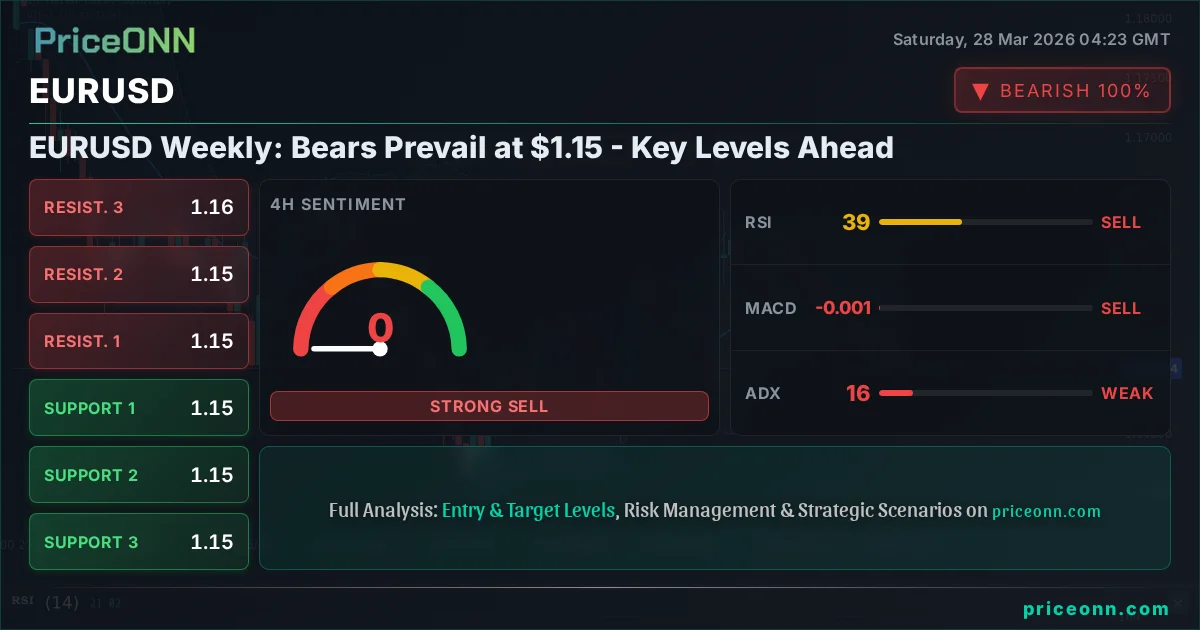
The relentless march of the US dollar and a palpable shift towards risk aversion have firmly placed EURUSD in the crosshairs of bears this past week. Trading at $1.15089 as the week draws to a close, the pair has been unable to shake off the persistent downward pressure, painting a rather bleak picture for euro bulls. This isn't just a minor pullback; it's a narrative shaped by diverging central bank policies, geopolitical anxieties, and a global search for safety. As we look ahead, the critical question isn't just whether the euro can recover, but whether the current levels represent a temporary pause or the prelude to a deeper decline. The interplay between the DXY's strength, the performance of global equities, and the looming economic calendar will be paramount in dictating the euro's fate in the coming days.
- EURUSD is trading at $1.15089, showing a bearish trend on daily charts with ADX at 34.07.
- Critical support sits at $1.15064, tested multiple times this week amid dollar strength (DXY at 99.91).
- RSI at 42.93 on the 1H chart signals bearish momentum, while Stochastic shows a sell signal (%K < %D).
- Fed rate hike expectations are driving EURUSD's correlation with the DXY, suggesting further downside risk if the trend continues.
The Dollar's Dominance: A Tale of Two Economies
The narrative for EURUSD this week has been overwhelmingly dominated by the US dollar's resurgence. The Dollar Index (DXY), currently hovering around 99.91, has found strong footing, reflecting a potent mix of robust economic indicators from the US and a more cautious stance from the European Central Bank. While the DXY's daily chart shows a strong uptrend (ADX: 31.98), indicating sustained buying interest, the euro has struggled to find its footing. This divergence isn't surprising. The market is pricing in a continued hawkish bias from the Federal Reserve, contrasting with a more dovish or at least a slower-to-tighten approach from the ECB. This policy divergence is a fundamental driver that continues to weigh on the EURUSD pair, pushing it towards the lower bound of its recent trading range. The 1-hour RSI at 42.93 further underscores this bearish momentum, suggesting that sellers are firmly in control of the short-term price action. The 4-hour chart, with an RSI of 39 and a MACD below its signal line, reinforces this sentiment, indicating that the downtrend, though perhaps lacking explosive momentum (ADX: 16.34 on 4H), is persistent.
The strength of the dollar isn't merely an isolated phenomenon; it's a symptom of broader global economic trends and investor sentiment. In an environment where geopolitical risks remain elevated, capital tends to flow towards perceived safe-haven assets, and the US dollar, backed by the world's largest economy and deepest financial markets, is always a prime beneficiary. This week's price action in EURUSD demonstrates this flight to safety. As major indices like the S&P 500 (currently at 6357.55, down 2%) and Nasdaq (at 23092.5, down 2.23%) experience significant sell-offs, the demand for the dollar naturally increases. This risk-off sentiment creates a challenging environment for riskier currencies or those tied to economies perceived as less stable or facing greater headwinds, which currently includes the Eurozone.
Geopolitical Tensions and Their Ripple Effects
The global stage continues to be a source of significant market volatility, and the EURUSD currency pair is not immune. Recent news highlights ongoing tensions in the Middle East, with reports of potential force majeure on Russian oil shipments due to Ukrainian drone strikes. This, coupled with India's response of slashing fuel taxes and curbing exports amid the deepening West Asia crisis, underscores the fragile geopolitical landscape. Such events don't just impact energy markets; they create a general air of uncertainty that fuels demand for safe-haven assets. The US dollar, as previously mentioned, benefits immensely from this risk aversion. For the euro, however, the implications are more complex. Europe's proximity to ongoing conflicts and its reliance on global energy markets mean that geopolitical instability can directly impact economic confidence and trade. While the ECB might consider these factors in its policy decisions, the immediate market reaction often favors the dollar as a safe port in the storm.
Furthermore, the ongoing narrative surrounding economic policy normalization in Japan, while seemingly distant, contributes to the global currency dynamics. Reports suggest the Yen faces continued pressure, but former BoJ Governor Kuroda urges the central bank to persist with policy normalization. This global policy divergence is a key theme. Different central banks are at various stages of their economic cycles, leading to differing interest rate trajectories and, consequently, currency movements. The market is constantly trying to price in these differences, and right now, the US appears to be leading the pack in terms of economic resilience and hawkish monetary policy, which naturally supports the dollar against a basket of currencies including the euro. The price action in EURUSD reflects this global economic chess match, with the dollar making steady gains.
Technical Breakdown: Levels to Watch
From a technical standpoint, the EURUSD 1-hour chart paints a picture of bearish consolidation. The RSI is holding at 42.93, indicating a lack of bullish momentum and suggesting that any upward moves are likely to be met with selling pressure. The MACD is showing a balanced momentum, neither strongly bullish nor bearish, but the Stochastic oscillator is flashing a clear sell signal with %K (27.07) crossing below %D (38.9). This suggests that the immediate upward potential is limited, and a continuation of the downtrend is more probable. The ADX at 12.97 confirms what many traders are seeing: a lack of strong directional trend on this shorter timeframe, suggesting chop and potential range-bound movement within a broader bearish context. However, the Bollinger Bands are showing the price trading above the middle band, which could hint at a temporary bounce, but this is within the context of the overall bearish trend.
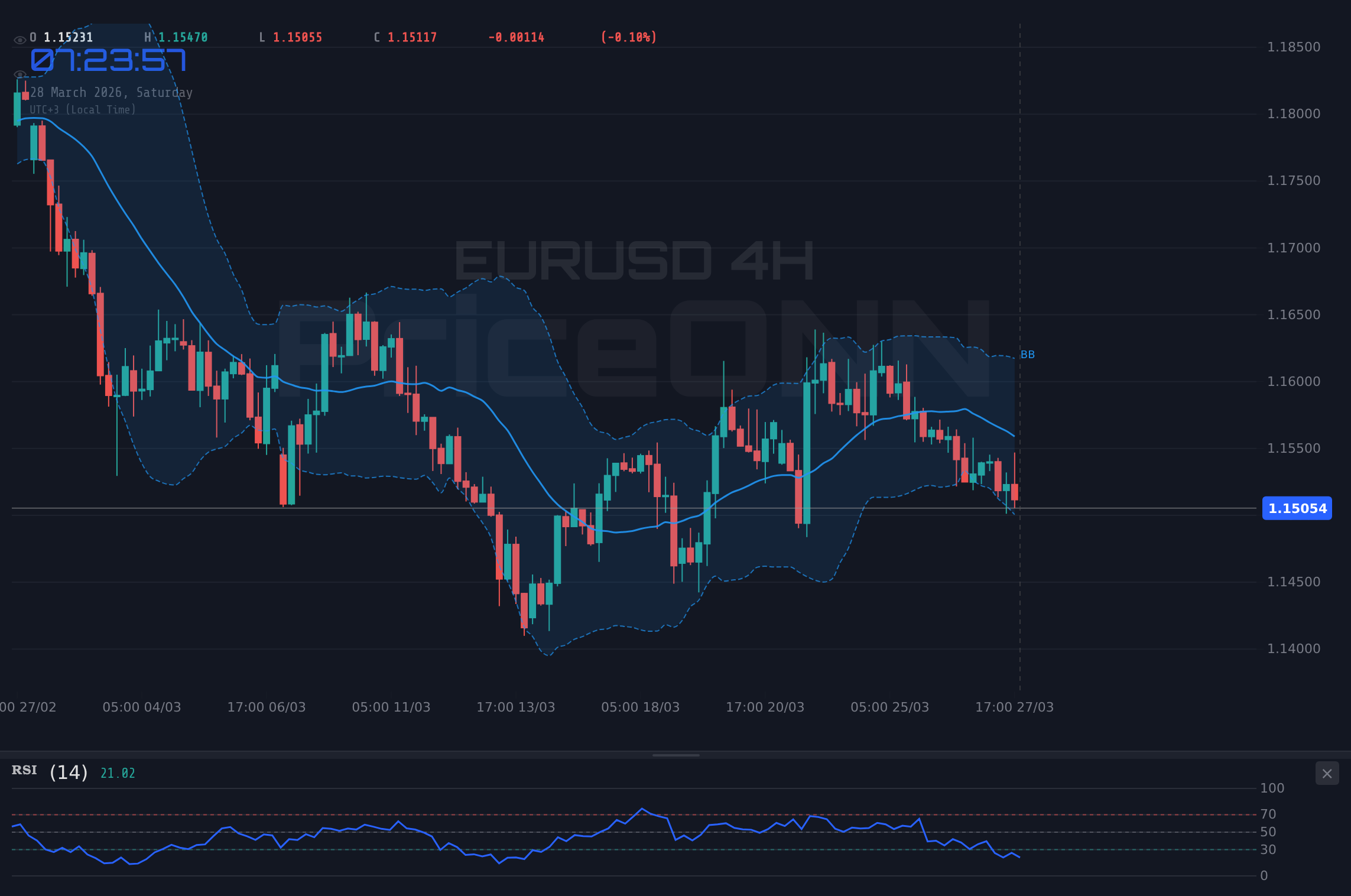
Stepping back to the 4-hour timeframe, the picture becomes clearer. The trend is officially neutral according to the ADX at 16.34, but the underlying indicators lean bearish. The RSI at 49.03 is hovering near the midpoint, showing little conviction, while the MACD is firmly below its signal line, reinforcing the bearish sentiment. The Stochastic, however, shows a potential buy signal (%K at 39.87 crossing above %D at 29.84), creating a slight divergence that traders will watch closely. The Bollinger Bands are also below the middle band, pointing towards a bearish bias. The key takeaway here is that while short-term fluctuations might occur, the medium-term outlook is not yet supportive of a significant euro rally. The crucial support level to watch on this timeframe is around 1.15054. A break below this could accelerate the move downwards.
The daily chart provides the most significant context for the current EURUSD price action. Here, the trend is decidedly bearish, with the ADX at 34.07 indicating a strong downward move. The RSI is firmly in the lower half of its range at 39.98, suggesting ample room for further downside before reaching oversold conditions. The MACD is below its signal line, confirming the bearish momentum. The Stochastic is in oversold territory (K=49.73, D=66.15) but showing a sell signal (%K < %D), which can sometimes precede further declines in a strong downtrend. The Bollinger Bands are hugging the lower band, indicating significant selling pressure. The key support level on the daily chart is 1.15093, followed by 1.14876. Resistance is seen at 1.15621. The overall technical picture, especially on the daily timeframe, suggests that the path of least resistance for EURUSD remains to the downside, barring any significant shifts in market sentiment or central bank policy expectations.
Economic Calendar: Upcoming Catalysts
The economic calendar for the upcoming week holds several high-impact events that could significantly influence the EURUSD trajectory. While specific dates are not provided for all events, the nature of these releases demands attention. We will be closely monitoring US employment data, including the Non-Farm Payrolls (NFP) report, which is a critical gauge of the labor market's health. Any deviation from expectations – whether a stronger-than-anticipated jobs report or a weaker one – could trigger substantial volatility. A robust NFP reading would likely reinforce the Fed's hawkish stance, potentially strengthening the dollar further and adding pressure on EURUSD. Conversely, a disappointing jobs report might lead to a reassessment of Fed policy expectations, offering some respite to the euro.
In addition to US employment figures, Eurozone data will also be crucial. Key indicators such as inflation rates (CPI) and Purchasing Managers' Index (PMI) reports will provide insights into the health of the European economy. If Eurozone inflation proves stickier than expected or if PMIs signal a significant economic slowdown, it could embolden the ECB to maintain its accommodative stance or even consider further easing, which would be bearish for the euro. Conversely, signs of economic resilience or accelerating inflation could prompt a more hawkish outlook from the ECB, offering support to EURUSD. The interplay between US and Eurozone data releases will be key. Traders will be looking for confirmation of divergence or convergence in economic performance and monetary policy expectations to gauge the likely direction of the pair. The current market sentiment, heavily favoring the dollar, means that any positive data from the US or negative data from the Eurozone could exacerbate the downward trend.
Market Sentiment and Intermarket Correlations
The prevailing market sentiment is decidedly risk-off, a crucial factor for EURUSD. This is evident not only in the sell-off across major equity indices like the S&P 500 and Nasdaq but also in the movements of other asset classes. Gold prices, currently at $4495.44, have seen a significant daily rise of 2.68%, indicating a clear demand for safe-haven assets. While gold's rise can be influenced by inflation expectations, its performance in conjunction with a strengthening dollar and falling equities suggests a broader flight to perceived safety. This dynamic often puts pressure on currency pairs like EURUSD, especially when the dollar is the primary beneficiary of this risk aversion.
The correlation between the DXY and EURUSD is particularly noteworthy. As the DXY strengthens (currently at 99.91, up 0.34% daily), EURUSD tends to weaken. This inverse relationship is a fundamental aspect of forex analysis. If the dollar continues its upward trajectory, fueled by Fed expectations or geopolitical uncertainty, EURUSD will likely face further headwinds. Conversely, any sign of weakness in the DXY, perhaps due to a shift in Fed policy expectations or easing geopolitical tensions, could provide a much-needed reprieve for the euro. The current technical setup, with the daily ADX at 34.07 indicating a strong downtrend, suggests that the bearish correlation is firmly in play. Any attempt at a bullish reversal for EURUSD would likely require a significant catalyst to break this established dollar strength narrative.
The energy markets also play a role. Brent crude oil is trading at $110.64, up a substantial 6.77% on the day, while WTI is at $101.19, up 7.69%. This surge in oil prices, driven by geopolitical concerns and potential supply disruptions, adds another layer of complexity. Higher energy prices can fuel inflation expectations, which in turn can influence central bank policy. For the Fed, persistent inflation might reinforce a hawkish stance, further supporting the dollar. For the ECB, higher energy costs could exacerbate existing economic challenges in the Eurozone, potentially leading to a more dovish policy outlook. This inflationary pressure, coupled with geopolitical risks, reinforces the safe-haven appeal of the dollar, creating a challenging outlook for EURUSD in the near term. The strong upward momentum in oil prices suggests that these inflationary concerns are likely to persist, keeping the dollar bid.
Trade Scenarios: Navigating the Downside
Bearish Scenario: Dollar Strength Persists
65% ProbabilityNeutral Scenario: Range-Bound Consolidation
25% ProbabilityBullish Scenario: Unexpected Policy Shift or Geopolitical De-escalation
10% ProbabilityThe current technical setup, particularly the daily chart's strong bearish trend (ADX: 34.07) and the prevailing risk-off sentiment favoring the dollar, makes the bearish scenario the most probable. A daily close below the critical support at $1.15064 would likely trigger a move towards $1.15002 and potentially accelerate towards $1.14938. This aligns with the market's current risk appetite and the dollar's strength. The neutral scenario, involving consolidation, becomes more likely if key support levels hold temporarily but without a strong catalyst for a reversal. This would see EURUSD trading within a tighter range, likely between $1.15064 and $1.15316 in the short term. The bullish scenario remains a low-probability event, requiring a significant shift in either Fed policy expectations or a dramatic de-escalation of global geopolitical risks. Without such catalysts, the euro faces an uphill battle against a resurgent dollar.
The Path Forward: What to Watch Next Week
As we close out the week, the focus shifts to what lies ahead for EURUSD. The dominant theme remains dollar strength, driven by Fed policy expectations and global risk aversion. Next week's economic calendar, particularly US employment figures and Eurozone inflation data, will be critical in either reinforcing or challenging this narrative. A strong US jobs report could solidify the case for further Fed tightening, pushing the DXY higher and EURUSD lower. Conversely, weak data might prompt a reassessment of Fed policy, offering a potential reprieve for the euro. Geopolitical developments will continue to be a wildcard, with any escalation likely to further boost the dollar's safe-haven appeal.
Technically, the pair is testing key support levels. On the daily chart, $1.15093 and $1.14876 are the levels to watch. A decisive break below $1.15064 on the 1-hour chart would be a strong bearish signal, potentially opening the door for a move towards $1.15002 and $1.14938. The invalidation point for this bearish thesis would be a daily close above the resistance at $1.15621. Until then, the bias remains to the downside. Traders should remain vigilant, manage risk diligently, and wait for clear confirmation before committing to positions. The market is signaling caution, and patience will likely be rewarded as clearer trends emerge from the interplay of economic data, central bank policy, and geopolitical events.
Frequently Asked Questions: EURUSD Analysis
What happens if EURUSD breaks below the $1.15064 support level next week?
If EURUSD closes below $1.15064 on a daily basis, it would confirm the bearish trend, potentially triggering a move towards the $1.15002 support level. This scenario is supported by the current DXY strength and risk-off sentiment, making further downside probable.
Is the RSI at 42.93 on the 1-hour chart a sell signal for EURUSD right now?
An RSI of 42.93 indicates bearish momentum but is not yet in oversold territory. Coupled with a Stochastic sell signal (%K < %D), it suggests that downward pressure is likely to continue in the short term, making it a cautious sell signal within the broader bearish context.
How will upcoming US employment data affect EURUSD this week?
A stronger-than-expected US jobs report could reinforce Fed hawkishness, strengthening the dollar and pushing EURUSD lower towards $1.14876. Conversely, weak data might lead to a reassessment of Fed policy, potentially offering a short-term bullish reprieve for EURUSD, targeting resistance near $1.15621.
Should I consider buying EURUSD at current levels of $1.15089 given the bearish technicals?
Buying EURUSD at current levels carries significant risk due to the strong bearish trend indicated by daily ADX and the prevailing risk-off sentiment. A more prudent approach would be to wait for a confirmed break of key resistance at $1.15621 or a significant shift in market fundamentals before considering long positions.
Technical Outlook Summary
| Indicator | Value | Signal | Interpretation |
|---|---|---|---|
| RSI (14) | 42.93 | Bearish | Below 50, indicates bearish momentum. |
| MACD Histogram | -0.0022 | Bearish | Negative momentum, below signal line. |
| Stochastic | K:27.07, D:38.9 | Bearish | %K < %D, sell signal. |
| ADX | 16.34 | Neutral | Weak trend strength on 4H, but strong at 34.07 on daily. |
| Bollinger | Middle Band | Bearish | Price below middle band on 4H. |
Key Levels
Track markets in real-time
AI-powered analysis, technical indicators and real-time price data.
Join Our Telegram Channel
Breaking market news, AI analysis and trading signals instantly.
Join Channel