USDJPY Tests $160.16 Resistance Amid Yen Weakness and Energy Shocks
USDJPY hovers near $160.16 as a strong dollar and soaring energy costs pressure the Yen, while technicals suggest a crucial resistance test. Analysis of correlations and market sentiment.
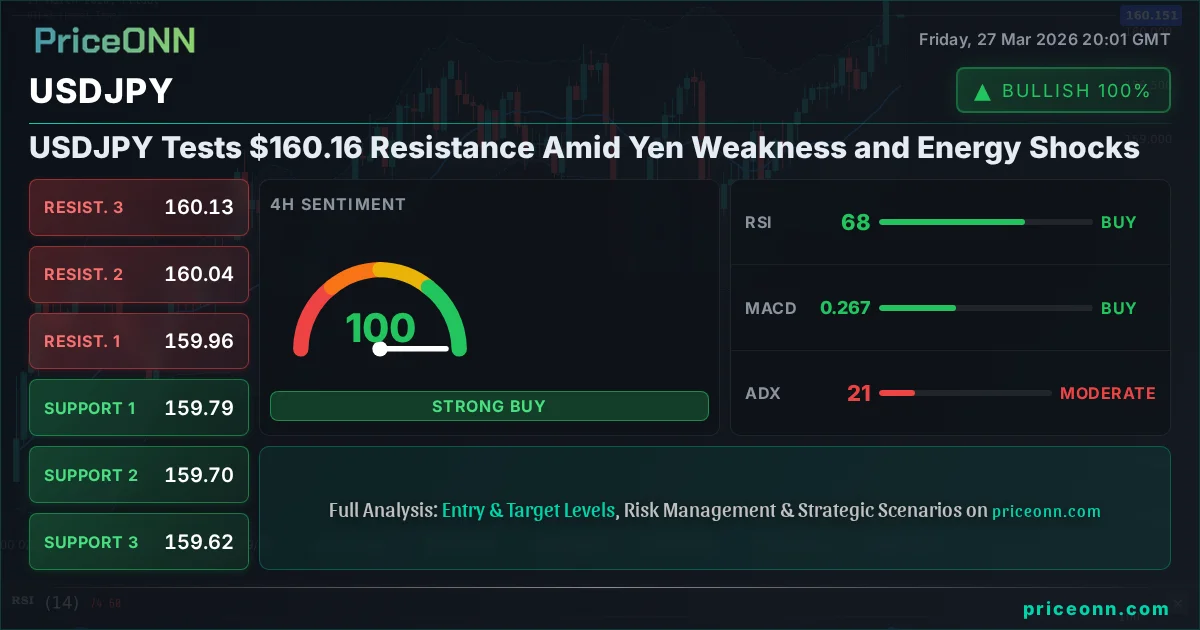
The relentless march of the US Dollar continues to test the resilience of the Japanese Yen, with USDJPY currently challenging the critical $160.16 resistance level. This pivotal moment arrives amidst a confluence of factors, including soaring global energy prices, a strengthening US Dollar Index (DXY), and lingering concerns over Japan's economic stability. While the 1-day and 4-hour charts signal a strong bullish trend for USDJPY, the immediate 1-hour timeframe presents a neutral stance, indicating that the pair is at a crucial juncture where a decisive move could be imminent. Understanding the interplay between macroeconomics, technical indicators, and market sentiment is paramount for navigating this volatile landscape.
- USDJPY is testing resistance at $160.16, with the 1-hour trend neutral despite stronger longer-term signals.
- The Dollar Index (DXY) is strong, trading at 99.91, reinforcing upward pressure on USDJPY.
- Soaring energy prices, with Brent Crude at $109.77 and WTI at $100.29, add to inflation concerns and could indirectly impact the Yen.
- Technical indicators like RSI at 63.81 (1H) suggest overbought conditions are approaching, while the ADX at 28.65 (1H) indicates a moderately strong trend.
The current market environment presents a complex picture for USDJPY. On one hand, the US Dollar Index (DXY) is exhibiting robust strength, trading at 99.91. This upward momentum in the dollar typically exerts downward pressure on other major currencies, including the Japanese Yen. Historically, a stronger dollar often correlates with higher USDJPY levels, and the current data supports this dynamic. The DXY's bullish trend across all timeframes (1H, 4H, 1D) underscores the greenback's dominance, driven by factors such as the Federal Reserve's hawkish stance and global risk aversion.
However, the Yen's unique position as a safe-haven currency complicates this simple correlation. While a rising DXY usually pushes USDJPY higher, escalating geopolitical tensions and soaring energy costs can also bolster demand for the Yen as a refuge. The recent surge in Brent Crude to $109.77 and WTI to $100.29 highlights significant inflationary pressures and potential supply disruptions, which typically fuel safe-haven flows. This creates a tug-of-war: the dollar's strength pulls USDJPY up, while the Yen's safe-haven appeal, amplified by these global risks, attempts to pull it down. The market is currently grappling with which force will ultimately dominate.
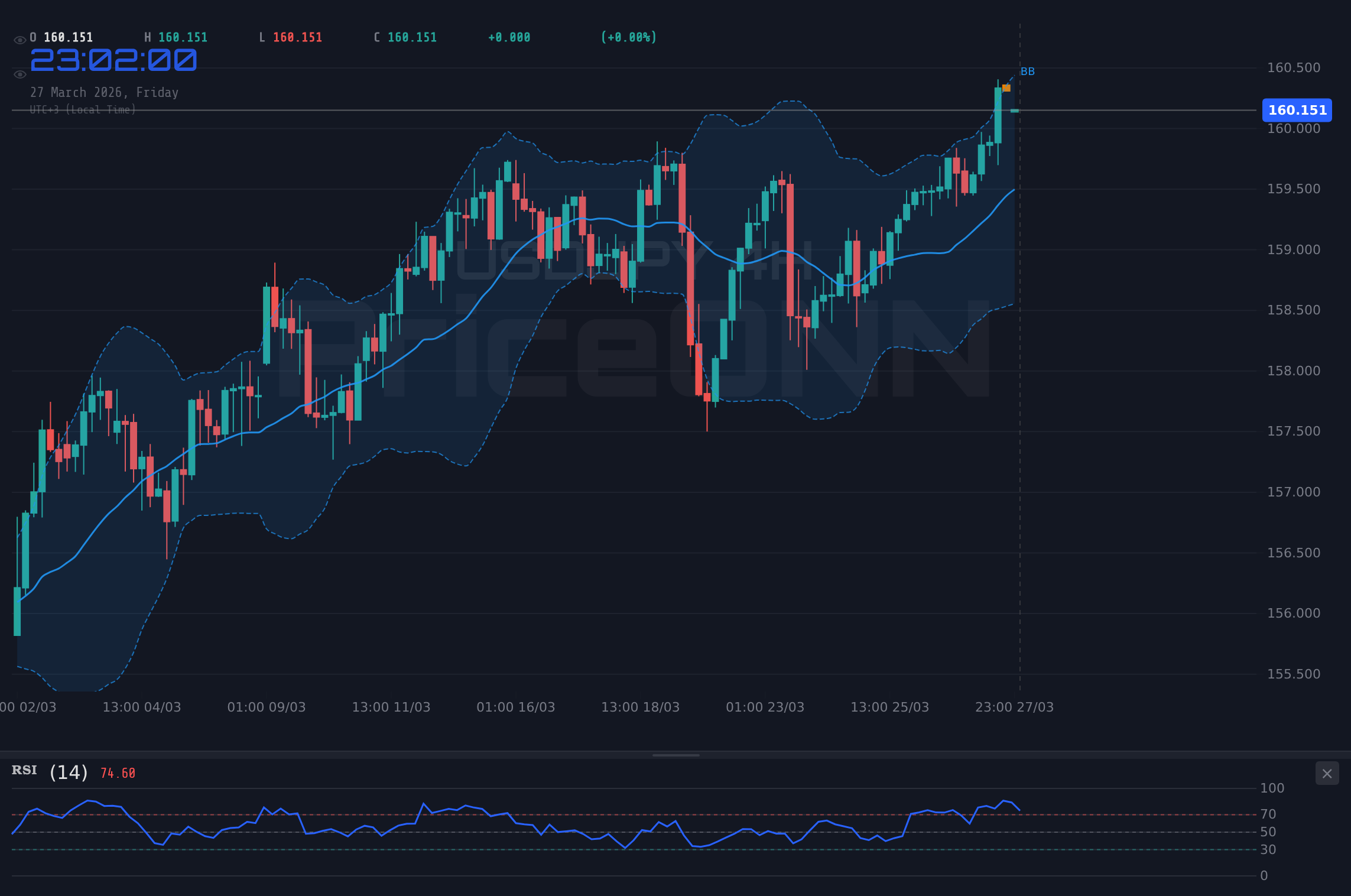
From a technical standpoint, USDJPY is at a critical inflection point. The 1-hour chart shows the pair hovering around $160.16, testing a key resistance zone. While the overall signal on this timeframe is 'BUY' (7 out of 8 indicators), the RSI at 63.81 is approaching overbought territory, and the Stochastic shows a potential bearish crossover (%K < %D). This suggests that the immediate upward momentum might be losing steam, and a pause or pullback could be on the cards. The ADX at 28.65 indicates a moderately strong trend, but the confluence of these short-term indicators hints at potential consolidation before the next major move.
Looking at the longer timeframes, the picture becomes clearer. The 4-hour chart presents a strong bullish trend (91% strength) with a 'BUY' signal across most indicators. RSI at 68.27 is in the upper neutral zone, and Stochastic shows a bullish crossover (%K > %D). Similarly, the daily chart reinforces this bullish sentiment, with an 86% trend strength and a predominantly 'BUY' signal. Here, RSI at 62.59 is comfortably in the neutral zone, and the ADX at 22.78 confirms a moderately strong upward trend. This longer-term bullish bias suggests that any short-term pullback might be a temporary consolidation rather than a reversal.
Navigating the Yen's Safe-Haven Appeal Amidst Inflationary Headwinds
The role of the Japanese Yen as a safe-haven asset is being tested like never before. Typically, during periods of heightened global uncertainty, such as the current energy crisis and geopolitical tensions, investors flock to the Yen for safety. This increased demand should theoretically strengthen the Yen, pushing USDJPY lower. However, the prevailing narrative is complicated by the Bank of Japan's (BoJ) ultra-loose monetary policy. Unlike other major central banks that have been hiking rates to combat inflation, the BoJ has maintained its accommodative stance, widening the interest rate differential with countries like the United States.
This widening interest rate gap is a significant driver for USDJPY. The higher yields available on US dollar-denominated assets compared to Japanese assets make the dollar more attractive to investors, leading to increased demand for dollars and, consequently, a higher USDJPY. The recent comments from former BoJ Governor Haruhiko Kuroda, advocating for policy normalization, have caused some ripples, but the current BoJ policy remains unchanged. This divergence in monetary policy between the Fed and the BoJ is a fundamental pillar supporting the bullish case for USDJPY, overriding some of the traditional safe-haven demand for the Yen.
The impact of soaring energy prices on Japan cannot be understated. As a net importer of energy, Japan is particularly vulnerable to global price shocks. Reports indicate that Japan is even considering removing operational caps on coal-fired power plants to mitigate the impact of high liquefied natural gas (LNG) prices. This situation exacerbates inflation concerns within Japan, which could, in theory, pressure the BoJ to reconsider its policy. However, the BoJ's primary concern has historically been the fragility of its economic recovery, making a swift pivot unlikely without more persistent and significant domestic inflation.
The Dollar's Dominance: DXY and its Influence on Global Markets
The US Dollar Index (DXY) is currently trading at 99.91, firmly in bullish territory across all timeframes. This strength is a critical factor influencing USDJPY and other currency pairs. The DXY's upward trajectory is supported by a relatively hawkish Federal Reserve, which has kept the door open for potential rate hikes amid persistent inflation fears. Market sentiment, as indicated by the S&P 500 trading at 6363.6 and Nasdaq at 23122.76, shows a significant risk-off sentiment, with both indices experiencing sharp declines. This risk aversion typically benefits the dollar as a safe-haven asset, further bolstering the DXY.
The correlation between the DXY and USDJPY is a key dynamic to watch. When the DXY rises, USDJPY tends to follow suit, driven by interest rate differentials and risk sentiment. Conversely, a falling DXY often coincides with a weaker dollar and can provide some respite for the Yen, although this effect is often muted by the BoJ's policy. The current data shows a strong positive correlation: DXY is strong, and USDJPY is testing resistance. This suggests that any weakness in the dollar could provide an opportunity for the Yen to regain some ground, but the underlying bullish trend in the dollar remains dominant.
The broader market context is crucial. The sharp sell-off in major indices like the S&P 500 and Nasdaq, coupled with the strength in the dollar, paints a picture of global risk aversion. This environment generally favors assets perceived as safe havens. While the Yen traditionally falls into this category, its safe-haven status is being challenged by the BoJ's monetary policy and the strong upward trend in USDJPY. Investors are closely watching whether the traditional safe-haven flows into the Yen will gain enough traction to counteract the dollar's strength and the interest rate differentials.
Technical Confluence: Short-Term Caution Meets Long-Term Strength
The technical indicators for USDJPY present a fascinating dichotomy between the short-term and long-term outlooks. On the 1-hour chart, while the overall signal is bullish, there are signs of caution. The RSI at 63.81 is elevated, nearing the overbought threshold, and the Stochastic oscillator is showing a potential bearish crossover (%K at 67.31, %D at 69.97). This suggests that the immediate upward momentum might be facing resistance, and a period of consolidation or a minor pullback could occur. The ADX at 28.65 indicates a moderate trend, but these shorter-term oscillators are flagging potential short-term weakness.
However, the 4-hour and daily charts paint a more robustly bullish picture. The 4-hour trend is strongly bullish (91% strength), with RSI at 68.27 and a bullish Stochastic crossover. The daily chart echoes this sentiment, showing an 86% bullish trend strength, with RSI at 62.59 and a clear upward bias. The ADX values on these longer timeframes (28.83 on 4H, 22.78 on 1D) confirm established, moderately strong uptrends. This longer-term strength suggests that any short-term caution observed on the 1-hour chart might be a precursor to further upside rather than a reversal. The key will be whether the pair can break through the $160.16 resistance and sustain the move.
The support levels identified on the 1-hour chart at $160.194, $160.144, and $160.047 become critical if a short-term pullback materializes. A hold above these levels would maintain the bullish structure. Conversely, a decisive break above the immediate resistance at $160.341, $160.438, and $160.488 would confirm the continuation of the uptrend, potentially targeting higher levels. The market is essentially at a crossroads, and the next few trading sessions will be crucial in determining whether the short-term cautionary signals will prevail or if the longer-term bullish trend will resume with force.
Economic Calendar Watch: Inflation Data and Central Bank Signals
The economic calendar offers crucial insights into potential catalysts that could influence USDJPY. Recent high-impact data releases have shown mixed signals but a general trend of elevated inflation. For instance, a US manufacturing PMI came in at 52.4, exceeding the forecast of 51.5, indicating continued expansion in the sector, albeit at a slower pace than previous periods. Another US release showed a PMI of 51.1, also above the forecast, suggesting underlying economic resilience. These figures, while not directly related to interest rate decisions, contribute to the narrative of persistent inflationary pressures in the US economy.
The release of US employment change data, showing a figure of 6.926 against a forecast of -1.3, signifies a surprisingly strong labor market. Strong employment figures often support a hawkish stance from the Federal Reserve, as they indicate an economy that can withstand higher interest rates. This data point, in particular, could reinforce the dollar's strength and contribute to upward pressure on USDJPY. Investors will be keenly watching upcoming inflation reports, such as CPI and PCE data, as these will be critical in shaping the Fed's future monetary policy decisions.
For Japan, the economic picture is less clear. While energy import costs are soaring, domestic inflation pressures might not be as acute as in the US. The BoJ's commitment to maintaining its ultra-loose policy in the face of potential domestic inflation challenges creates a complex environment. Any shift in the BoJ's forward guidance or a significant change in inflation dynamics within Japan could dramatically alter the trajectory of USDJPY. Currently, the divergence in monetary policy remains the dominant fundamental driver, favoring a stronger dollar against the Yen.
Scenario Analysis: USDJPY at the $160.16 Crossroads
Bearish Scenario: Yen Strength Prevails
15% ProbabilityNeutral Scenario: Consolidation Around Resistance
50% ProbabilityBullish Scenario: Dollar Surge Continues
35% ProbabilityThe path forward for USDJPY hinges on its ability to decisively break through the $160.16 resistance. While the longer-term technicals and the strong dollar narrative favor further upside, short-term indicators suggest a potential for consolidation or a minor pullback. The interplay of global risk sentiment, energy prices, and central bank policies will be critical in determining the next directional move. For traders, patience and risk management are key; waiting for confirmation of a clear break above resistance or a sustained bounce from support levels will be crucial for identifying high-probability trading opportunities.
Frequently Asked Questions: USDJPY Analysis
What happens if USDJPY breaks decisively above $160.488 resistance?
A sustained move above $160.488 on the 1-hour chart would invalidate short-term bearish signals and likely trigger further buying. This could open the door for USDJPY to target psychological levels around $161.49 and potentially higher, aligning with the longer-term bullish trend.
Should I trade USDJPY at current levels of $160.16 given the RSI at 63.81?
Trading at current levels requires caution due to the RSI nearing overbought territory on the 1-hour chart. A high-probability setup would involve waiting for a confirmed break above resistance or a pullback to a key support level like $160.047, with clear invalidation points and defined targets.
Is the RSI at 63.81 a sell signal for USDJPY right now?
An RSI of 63.81 on the 1-hour chart signals strong upward momentum but is not yet in the overbought territory that typically warrants an immediate sell signal. However, it does suggest that further immediate upside might be limited, and a period of consolidation or a minor pullback is possible before the trend continues.
How will soaring energy prices and the Fed's stance affect USDJPY this week?
Soaring energy prices can increase inflation fears, potentially prompting a more hawkish stance from the Fed, which would support the dollar and push USDJPY higher. Simultaneously, high energy costs can also fuel safe-haven demand for the Yen, creating conflicting pressures. The market will likely weigh the Fed's policy outlook against the Yen's safe-haven appeal.
Track markets in real-time
AI-powered analysis, technical indicators and real-time price data.
Join Our Telegram Channel
Breaking market news, AI analysis and trading signals instantly.
Join Channel