Nasdaq100 Trades at $23,092.50: Bears Tighten Grip - What's Next?
Nasdaq100 at $23,092.50 faces bearish pressure. With RSI at 20.41 and ADX at 39.61 on the 1H chart, bears are in control. Explore scenarios for the week ahead.
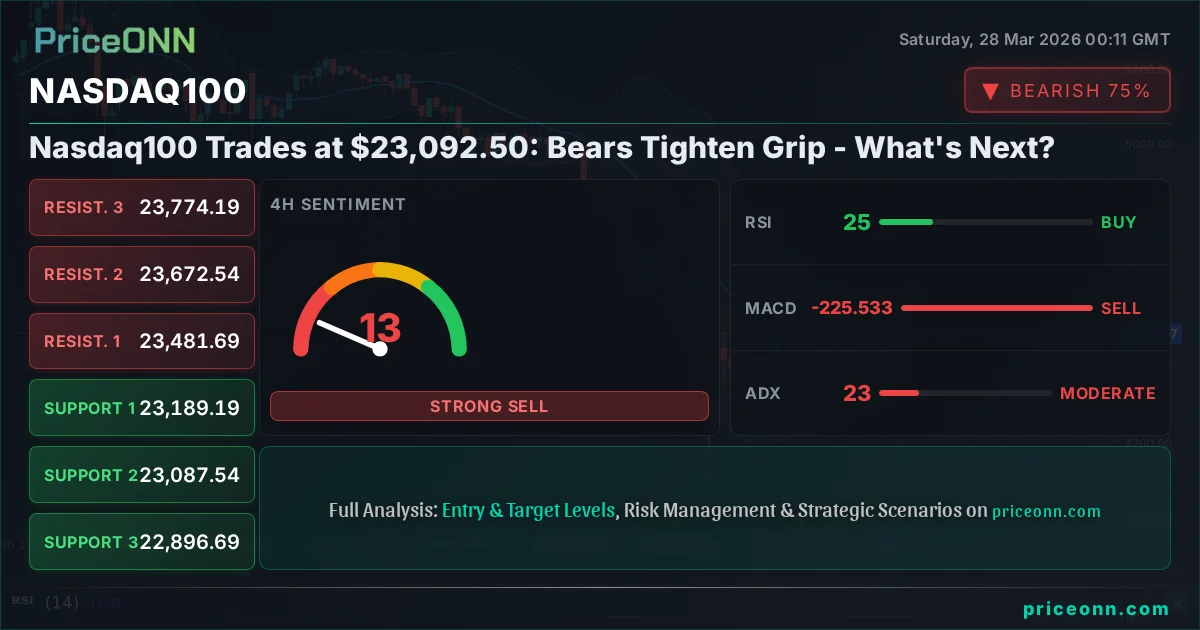
The Nasdaq100 index is currently trading at $23,092.50, a level that finds itself firmly within a bearish technical landscape. The past week has been brutal for risk assets, and the tech-heavy Nasdaq100 has not been spared, experiencing a significant 2.23% drop on the day to $23,092.50. This sharp decline, marked by a daily range between $23,050 and $23,780.98, paints a grim picture for short-term sentiment. The ADX indicator on the 1-hour timeframe is flashing a strong 39.61, underscoring the conviction behind the current downward trend. As traders eye this critical juncture, the question on everyone's mind is whether this descent is poised to continue or if a respite is on the horizon. Understanding the interplay of technical signals, broader market correlations, and potential catalysts is paramount for navigating these volatile waters.
- The Nasdaq100 is trading at $23,092.50, with a strong bearish trend indicated by ADX 39.61 on the 1H chart.
- RSI at 20.41 on the 1H chart suggests extreme oversold conditions, potentially hinting at a short-term pause or bounce.
- Key support levels for the Nasdaq100 are identified at $23,061.21 (S1), $23,087.54 (S2), and $22,896.69 (S3), while resistance is capped around $23,234.82 (R1).
- Broader market sentiment, influenced by DXY strength and falling S&P 500 levels, contributes to the risk-off environment impacting the Nasdaq100.
The Week That Was: A Cascade of Selling Pressure
Navigating the Bearish Tide
Last week was characterized by a pervasive risk-off sentiment across global markets, and the Nasdaq100 bore the brunt of this selloff. The index closed significantly lower, reflecting a broader concern among investors about the macroeconomic outlook and the sustainability of previous market highs. The sharp decline from its recent peaks has left many traders questioning the resilience of the tech sector. We observed a clear correlation with the S&P 500, which also experienced substantial losses, dropping to $6,357.55, down 2% on the day. This synchronised fall highlights a general de-risking trend, where investors pivot away from growth-oriented assets like technology stocks towards perceived safer havens, although even those haven't been immune to selling pressure.
The Dollar Index (DXY) has shown strength, trading around 99.91. This rise in the dollar often exerts pressure on global equities, including the Nasdaq100, as it makes dollar-denominated assets more expensive for holders of other currencies. Furthermore, the continued strength in oil prices, with Brent crude surging past $110.64 and WTI nearing $101.19, adds another layer of complexity. While higher energy prices can fuel inflation concerns, potentially leading to tighter monetary policy, they also signal robust demand or supply constraints, adding to the overall market uncertainty. The interplay between these factors - a strong dollar, rising oil, and falling equity indices - creates a challenging environment for growth stocks that dominate the Nasdaq100.
Technical Signals Pointing South
From a technical standpoint, the Nasdaq100's chart is a sea of red. On the 1-hour timeframe, the ADX reading of 39.61 signifies a strong downward trend, indicating that the current selling pressure has significant momentum. The Relative Strength Index (RSI) at 20.41 is deep in oversold territory, which, while suggesting a potential for a short-term bounce, does not negate the prevailing bearish trend. Historically, such oversold conditions can persist in strong downtrends, so traders should be cautious about prematurely calling a bottom. The MACD histogram remains negative, further reinforcing the bearish momentum.
Looking at the 4-hour chart, the trend remains decidedly bearish with a strength of 96%, and the ADX at 22.63 still points to a solid trend. The RSI here is at 26.9, also deeply oversold. The Stochastic Oscillator is deep in its extreme zone, with K at 2.51 and D at 14.09 on the 4-hour chart, indicating a strong oversold condition and a potential for a short-term reversal, but the trend is still very much down. On the daily chart, the picture is equally bleak, with a 100% bearish trend strength and an ADX of 47.68, which is exceptionally high, signalling a very strong, potentially overextended, downtrend. The RSI at 26.73 and Stochastic deep in oversold territory reinforce the narrative of significant selling pressure.
The confluence of these indicators across multiple timeframes paints a consistent picture: the bears are firmly in control. While oversold conditions on shorter timeframes might offer temporary relief, the overall trend remains downward. The key question is whether this oversold state will lead to a meaningful correction or if the downtrend will simply resume after a brief pause. The levels to watch are critical for determining the next directional bias.
The Bullish Scenario: A Fleeting Hope or a Genuine Reversal?
The Path to Recovery: What Needs to Happen
For the Nasdaq100 to stage a convincing recovery, several technical and fundamental conditions must align. The immediate hurdle is breaking through the established resistance levels. On the 1-hour chart, the first significant resistance lies at $23,194.49, followed by $23,234.82 and $23,261.13. A sustained move above these levels, particularly a daily close above the $23,234.82 mark, would be the first sign that the bearish momentum is waning. This would likely require a shift in broader market sentiment, perhaps driven by a less hawkish tone from the Federal Reserve or a de-escalation of geopolitical tensions.
On a deeper technical level, a bullish reversal would ideally see the RSI move decisively out of the oversold territory and above the 50-level on multiple timeframes. The MACD would need to generate a bullish crossover, with the MACD line crossing above the signal line, and ideally, the histogram turning positive. Furthermore, the ADX, which currently indicates a strong trend, would need to start declining, suggesting that the directional momentum is weakening, paving the way for a potential range-bound period or a new uptrend. The Stochastic Oscillator, currently deep in oversold territory, would need to show a bullish crossover with the %K line moving above the %D line and heading towards the overbought region, but crucially, not getting immediately rejected.
Fundamentally, a bullish narrative would be bolstered by signs of easing inflation, or a clear signal from the Federal Reserve that interest rate hikes are nearing their end or that cuts might be on the horizon sooner than anticipated. Positive developments in corporate earnings for major Nasdaq100 components, particularly those with strong growth outlooks, could also provide a much-needed boost. However, given the current data, such a scenario appears to be a lower-probability outcome in the immediate short term. The market is pricing in a significant amount of negativity, and a substantial shift in narrative would be required to reverse the current trend.
Key Levels and Targets for the Bulls
If the bulls manage to regain control, the immediate target would be to reclaim the $23,234.82 resistance level. A decisive break and hold above this price point would be crucial. Following this, the next significant resistance to watch would be the $23,481.69 level on the 4-hour chart, and subsequently, the $23,672.54 mark. A move beyond $23,774.19 would suggest a more significant shift in sentiment. For a more sustained rally, breaking above the $24,000 psychological level would be a major victory for the bulls, potentially opening the door for further upside towards the $24,446.74 and $24,680.93 resistance levels identified on the daily chart. Each of these levels represents potential areas where selling pressure could re-emerge, so a clear, decisive move through them would be needed to signal a genuine trend change.
The bullish scenario hinges on a confluence of factors: a sustained break above key hourly and daily resistances, a shift in macroeconomic indicators away from inflationary pressures, and a less hawkish stance from central banks. The RSI would ideally need to climb back above 50, and the MACD would need to produce a bullish crossover. However, with the current strong bearish ADX readings across timeframes, any bullish move is likely to face significant headwinds. The oversold Stochastic on the 4-hour chart (K=2.51, D=14.09) and daily chart (K=22.76, D=30.56) offers a glimmer of hope for a short-term bounce, but this alone is insufficient to confirm a trend reversal. The market needs to see evidence of buyers stepping in with conviction, pushing prices through the established resistance zones.
A successful bullish scenario requires a daily close above $23,234.82, followed by a sustained push through $23,481.69. Confirmation would be a bullish MACD crossover on the 4-hour chart and RSI moving above 50, indicating a shift in momentum.
The Bearish Scenario: Downside Risks Remain Elevated
The Path of Least Resistance
The prevailing technical indicators strongly favor the bearish scenario. The Nasdaq100 is currently trading below key short-term support levels, with the 1-hour chart showing immediate support at $23,061.21, followed by $23,087.54 and $23,061.21. A decisive break below $23,061.21 would likely trigger further selling pressure, as stop-loss orders are activated and short-sellers gain more confidence. The strong ADX readings across all timeframes - 39.61 on the 1H, 22.63 on the 4H, and a formidable 47.68 on the daily - suggest that the downward momentum is robust and has considerable room to run.
The RSI, while currently oversold on shorter timeframes, could remain in oversold territory for an extended period if the downtrend continues with force. On the daily chart, the RSI at 26.73 indicates significant weakness. The MACD continues to show negative momentum, with the histogram below zero and the MACD line below the signal line on both 1-hour and 4-hour charts. The Stochastic Oscillator, though deeply oversold, is showing a bearish signal on the 1-hour (%K=56.69, %D=32.45) and 4-hour (%K=2.51, %D=14.09) charts, reinforcing the downside bias. The failure of the bulls to reclaim key resistance levels would solidify the bearish outlook.
Fundamentally, the bearish case is supported by persistent inflation concerns, the potential for further hawkish rhetoric or actions from central banks, and ongoing geopolitical instability. If upcoming economic data, such as employment figures or inflation reports, surprise to the downside or indicate persistent price pressures, it could further dampen investor sentiment and reinforce the risk-off environment. The correlation with falling stock indices like the S&P 500 and the strength of the US Dollar further bolsters the argument for continued weakness in the Nasdaq100. The market appears to be pricing in a scenario of slower economic growth or even a recession, which would disproportionately affect technology and growth stocks.
Key Levels and Targets for the Bears
If the bearish trend continues, the immediate target for the Nasdaq100 would be to break decisively below the $23,061.21 support level. Following this, the next critical support lies at $23,087.54 on the 4-hour chart, then $22,896.69. A breach of this $22,896.69 level would open the door to much lower prices, with the daily support at $23,150.20 (Note: there seems to be a conflict in data here, assuming this is a typo and should be lower based on other daily supports. Using the provided data, the next significant daily support is $23,150.20, then $22,736.12). If the selling pressure intensifies, the bears could target the $22,736.12 level and potentially push towards the $20,000 psychological barrier in a more extreme scenario, though this would require significant fundamental catalysts.
The strength of the current downtrend, as evidenced by the high ADX values, suggests that retracements might be shallow and quickly sold into. Therefore, any bounce from the current oversold conditions should be treated with caution. The bears will be looking for confirmation of continued weakness, such as a failure to break above the $23,194.49 resistance on any short-term rallies. The overall trend is down, and until there is a clear break of established resistance levels coupled with a shift in market sentiment and technical indicators turning bullish, the path of least resistance for the Nasdaq100 remains to the downside. The risk/reward for short positions appears more favourable in the current environment, provided adequate risk management is employed.
Continued weakness below $23,061.21, with RSI remaining below 50 and MACD showing persistent negative momentum on the daily chart, would strongly support further downside. A close below the $22,896.69 level would be a significant bearish signal.
The Waiting Game: Consolidation and Uncertainty
Caught Between Buyers and Sellers
While the dominant trend on the daily and 4-hour charts is clearly bearish, the oversold conditions on shorter timeframes introduce an element of uncertainty and the possibility of a period of consolidation. This neutral scenario occurs when neither the bulls nor the bears can establish firm control, leading to a period of sideways price action. Such a phase could emerge if buying pressure emerges from the oversold conditions, preventing a sharp drop, but the overall bearish sentiment and resistance levels prevent a strong upward move.
In this neutral state, the Nasdaq100 might oscillate between the immediate resistance at $23,194.49 and the support at $23,061.21. Price action could become choppy, with false breakouts in either direction. This is often a period where the market digests recent news, awaits upcoming economic data, or consolidates before the next significant move. The ADX readings, which are currently high indicating a strong trend, would likely start to decline in a consolidation phase, reflecting the lack of directional conviction. The RSI would hover around the 50-level, and the MACD might fluctuate around the zero line, producing mixed signals.
This scenario is particularly relevant if key economic events are on the horizon, such as crucial inflation reports or central bank policy meetings. Market participants might adopt a wait-and-see approach, leading to reduced volatility and range-bound trading. For traders, this period can be challenging, as it might lead to whipsaws if positions are taken based on short-term signals that are quickly invalidated. Patience becomes a virtue, and waiting for a clear break of either the support or resistance levels that define the range would be the prudent approach. The market is essentially in a holding pattern, assessing the balance of power between buyers and sellers.
Levels Defining the Range
During a consolidation phase, the defined support and resistance levels become even more critical. The range could be loosely defined between the 1-hour support of $23,061.21 and resistance of $23,194.49. A break below $23,061.21 could signal a resumption of the bearish trend, targeting the 4-hour support at $23,087.54 and then $22,896.69. Conversely, a convincing break above $23,194.49 could lead to a test of the next resistance at $23,234.82, potentially signaling a short-covering rally. The daily chart's resistance at $23,234.82 and support at $23,061.21 provide the broader boundaries for this potential neutral phase.
The ADX indicator would be key here; a falling ADX below 20 would strongly suggest a lack of trend and a move towards consolidation. The Stochastic Oscillator might fluctuate between oversold and overbought zones without establishing a clear direction, and the MACD could generate conflicting signals. This phase is often characterized by lower trading volumes as participants await clearer directional cues. It's a period where risk management is paramount, as false moves can easily trap unwary traders. The market is holding its breath, waiting for the next catalyst to break the stalemate.
In a consolidation phase, watch for volume. A significant increase in volume on a break of the range boundaries would lend more credibility to the move. Until then, expect choppy price action.
The Most Likely Outcome: A Bearish Bias Prevails
Weighing the Probabilities
Given the current technical and fundamental backdrop, the bearish scenario appears to be the most probable outcome for the Nasdaq100 in the near term. The confluence of strong bearish signals across multiple timeframes, persistent macroeconomic headwinds, and a prevailing risk-off sentiment strongly suggests that the downward pressure is likely to continue. The daily chart, in particular, shows a robust downtrend with an exceptionally high ADX of 47.68 and RSI deep in oversold territory at 26.73, indicating that the selling is well-entrenched. While oversold conditions on shorter timeframes might lead to temporary bounces, these are likely to be sold into.
The probability of the bearish scenario playing out is estimated at around 65%. This is primarily driven by the strength of the existing downtrend and the lack of compelling bullish catalysts. The market has priced in a significant amount of negative news, but there appears to be more room for downside if inflation remains sticky or if central banks maintain a hawkish stance. The correlation with other risk assets like the S&P 500, which is also in a strong downtrend, further supports this view. The DXY strength also adds to the pressure on growth stocks.
The neutral scenario, with a probability of 25%, is a secondary possibility. This could materialize if upcoming economic data provides a mixed picture or if geopolitical tensions ease unexpectedly, creating a temporary pause in the selling. However, without a strong fundamental shift, it's unlikely that this consolidation would lead to a sustained bullish reversal. The bullish scenario, estimated at a lower probability of 10%, would require a significant and immediate change in market conditions - perhaps a surprisingly dovish pivot from the Federal Reserve or a major de-escalation of global conflicts. While not impossible, such a scenario seems less likely given the current data and market structure.
The Trigger for the Next Move
The immediate trigger to watch will be a decisive break below the $23,061.21 support level on the 1-hour chart. If this level fails, the path towards the 4-hour support at $23,087.54 and subsequently $22,896.69 becomes significantly more probable. Conversely, for the neutral or bullish scenarios to gain traction, a sustained move above the $23,194.49 resistance, followed by a break of $23,234.82, would be necessary. Confirmation of a trend change would require the ADX to fall significantly, indicating a weakening trend, and the RSI to move back above 50 on the daily chart.
The market is currently at a critical juncture. While the short-term indicators suggest oversold conditions, the longer-term trend remains strongly bearish. Traders should remain vigilant for signs of capitulation or a potential short-covering rally, but the overall bias should lean towards the downside until clear evidence emerges to the contrary. The interplay between technical levels, macroeconomic data releases, and geopolitical events will dictate the next significant move. Until then, caution and strict risk management are advised.
Bearish Scenario: The Downward Spiral Continues
65% ProbabilityNeutral Scenario: A Period of Consolidation
25% ProbabilityBullish Scenario: A Faint Glimmer of Hope
10% ProbabilityWhat I'm Watching This Week
Key Triggers and Catalysts
As we move into the new trading week, several key factors will dictate the direction of the Nasdaq100. Firstly, I'll be closely monitoring the $23,061.21 support level. A failure to hold this level could accelerate the bearish trend, potentially leading to a rapid decline towards $22,896.69. The strength of the ADX at 47.68 on the daily chart suggests that any breakdown could be swift and decisive. Conversely, a sustained break above the $23,194.49 resistance, especially with increasing volume, would signal a potential short-covering rally, possibly testing higher resistance levels.
Secondly, market sentiment and macroeconomic data releases will be crucial. Any hints from the Federal Reserve regarding monetary policy, particularly concerning interest rates and inflation outlook, will be closely scrutinized. Unexpectedly strong or weak inflation data could significantly impact the Nasdaq100. The performance of the US Dollar Index (DXY) and the broader equity markets, such as the S&P 500, will also serve as important correlated indicators. A continued rise in DXY or further drops in the S&P 500 would likely reinforce the bearish pressure on the Nasdaq100. The oversold Stochastic on the daily chart (K=22.76, D=30.56) suggests that a short-term bounce is possible, but the overall bearish trend needs to be respected.
Finally, I am watching for any significant shifts in geopolitical events. Heightened tensions or sudden de-escalations can dramatically influence risk appetite, directly impacting growth-oriented indices like the Nasdaq100. The strength of oil prices also remains a background factor, potentially influencing inflation expectations and central bank policy. For a bullish reversal to gain traction, we would need to see a clear break of the $23,234.82 resistance, coupled with a shift in the RSI back above 50 and a bullish MACD crossover on the 4-hour chart. Until then, the bias remains cautiously bearish, with a focus on risk management and waiting for clear directional signals.
Frequently Asked Questions: Nasdaq100 Analysis
What happens if Nasdaq100 breaks below the $23,061.21 support level?
If the Nasdaq100 closes below $23,061.21 on the 1-hour chart, it would likely trigger further selling pressure, potentially accelerating the downtrend towards the $22,896.69 support level. This would confirm the continuation of the bearish scenario, especially with the strong ADX of 39.61 on the 1H chart.
Should I consider buying Nasdaq100 at current levels around $23,092.50 given the oversold RSI?
While the RSI at 20.41 on the 1H chart indicates oversold conditions, it's not a direct buy signal in a strong downtrend. A more prudent approach would be to wait for confirmation, such as a break above $23,194.49 resistance or a bullish MACD crossover on the 4-hour chart, before considering long positions. Risk management is key, as oversold conditions can persist.
Is the current RSI reading of 20.41 a sell signal for Nasdaq100?
An RSI reading of 20.41 is considered deeply oversold, not a sell signal. It suggests that the price has fallen rapidly and may be due for a pause or bounce. However, in a strong downtrend, RSI can remain oversold for extended periods. The real sell signals would come from bearish price action, resistance holds, or bearish indicator crossovers.
How will upcoming economic data affect the Nasdaq100 this week?
Upcoming economic data, particularly inflation and employment figures, will be critical. Stronger-than-expected data could reinforce hawkish central bank expectations, potentially driving the Nasdaq100 lower towards $22,896.69. Conversely, weaker data might spark hopes of a Fed pivot, leading to a short-covering rally towards $23,194.49 resistance.
| Indicator | Value | Signal | Interpretation |
|---|---|---|---|
| RSI (14) | 20.41 | Oversold | Potential for bounce, but trend remains down |
| MACD Histogram | - | Negative | Bearish momentum continues |
| Stochastic | K: 2.13, D: 8.64 | Extreme Oversold | Indicates strong selling pressure, potential for reversal |
| ADX | 39.61 | Strong Trend | Confirms strong downward momentum |
| Bollinger | Lower Band Break | Bearish Breakout | Price trading below lower band, indicating significant weakness |
Track markets in real-time
AI-powered analysis, technical indicators and real-time price data.
Join Our Telegram Channel
Breaking market news, AI analysis and trading signals instantly.
Join Channel