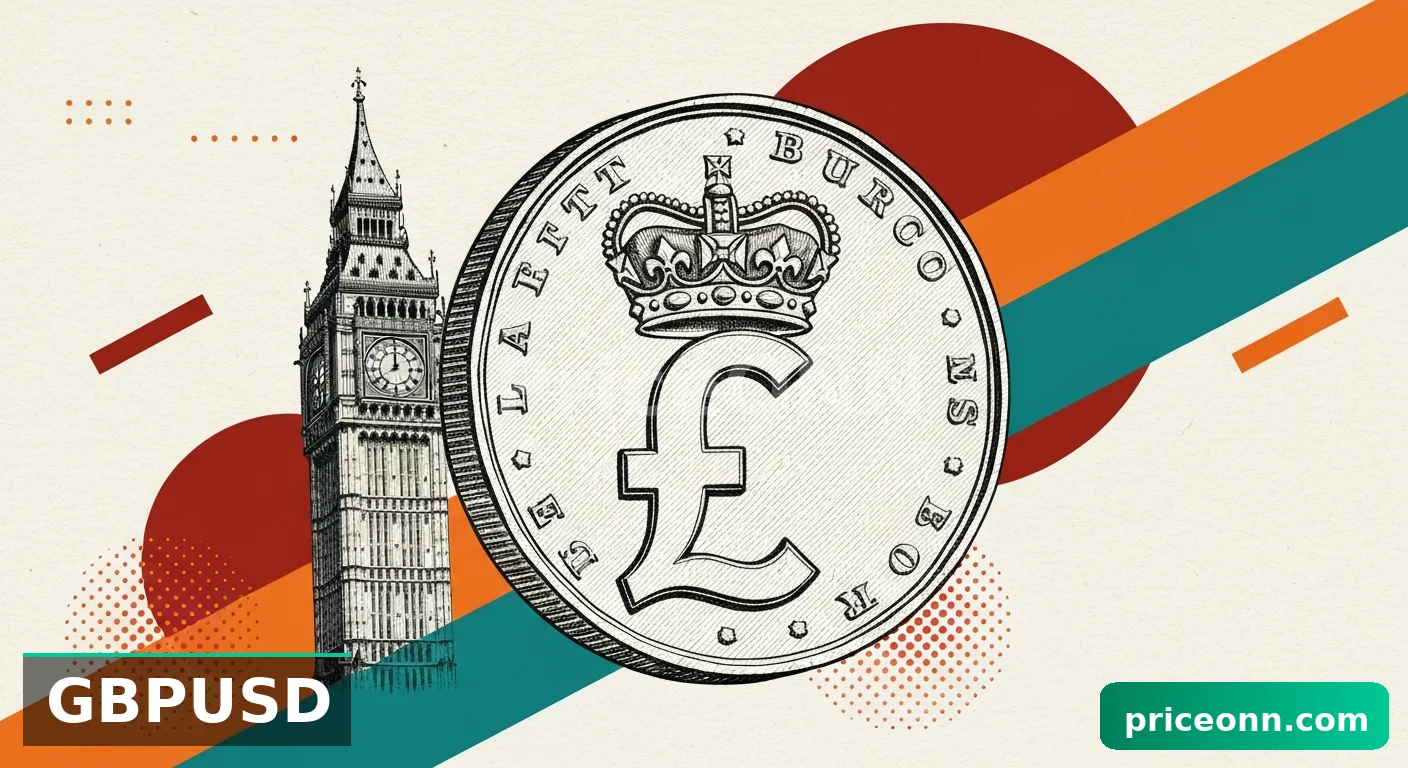
GBPUSD Tests $1.34 Resistance Amidst Shifting Fed Expectations
GBPUSD hovers around $1.34 as markets digest hawkish Fed commentary and geopolitical risks. Will the dollar's strength persist, or can the pound find further footing?
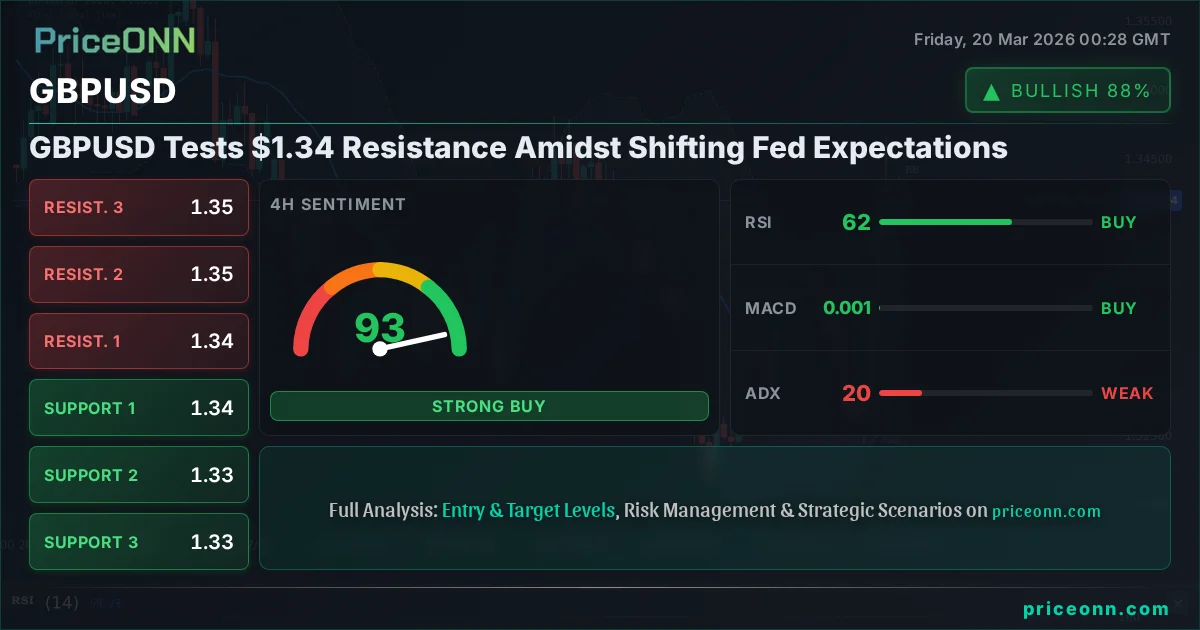
The GBPUSD currency pair is currently navigating a critical juncture, trading around the $1.34 mark. This level represents a significant point of contention, as markets grapple with a cocktail of conflicting signals: renewed hawkishness from the Federal Reserve, escalating geopolitical tensions, and divergent monetary policy outlooks. The recent surge in the Dollar Index (DXY) to 99.08, alongside the sharp decline in gold prices to $4648.58, underscores a renewed appetite for safe-haven assets, potentially capping further upside for risk-sensitive currencies like the British pound. This analysis delves into the intricate interplay of fundamental drivers and technical patterns to assess the most probable path forward for GBPUSD.
- The GBPUSD is testing resistance near $1.34 with RSI at 67.34, signaling overbought pressure that warrants caution.
- Critical support for GBPUSD is identified at $1.32194, a level tested multiple times in recent trading sessions.
- MACD histogram divergence suggests bullish momentum is fading, indicating a potential shift in short-term sentiment.
- Fed rate cut expectations are being recalibrated following recent hawkish commentary, influencing the DXY's upward trajectory and correlating with GBPUSD's price action.
The Shifting Sands of Monetary Policy: Fed's Hawkish Stance and its GBPUSD Implications
Fed Commentary Dampens Rate Cut Hopes
Recent pronouncements from Federal Reserve officials have significantly altered the market's perception of future monetary policy. The narrative that once leaned towards a series of rate cuts in 2026 has been substantially revised, with commentary suggesting a more cautious, data-dependent approach. This shift is crucial for GBPUSD as it directly impacts the relative attractiveness of US dollar-denominated assets. When the Fed signals a higher-for-longer interest rate environment, it tends to strengthen the dollar, creating headwinds for pairs like GBPUSD. The CME FedWatch tool, while not explicitly provided, would likely reflect this recalibration, showing a lower probability of imminent cuts. This increased demand for the dollar, as evidenced by the DXY's current levels, puts a lid on GBPUSD's potential gains, especially as it approaches resistance.
The Bank of England's Tightrope Walk
Meanwhile, the Bank of England (BoE) finds itself in a delicate balancing act. While inflation remains a concern, the economic growth outlook for the UK presents a less robust picture compared to the US. The BoE faces the challenge of taming inflation without stifling a fragile recovery. Market participants are closely watching for any hints of divergence in policy between the Fed and the BoE. Should the BoE signal a more dovish stance or an earlier pivot to rate cuts than the Fed, it could exert downward pressure on GBPUSD. Conversely, if the BoE maintains a hawkish bias, it could offer some support to the pound. The current data suggests a neutral to slightly dovish leaning for the BoE relative to the Fed's recent hawkish tone, which contributes to the existing pressure on GBPUSD.
ECB's Balancing Act and EURGBP Dynamics
The European Central Bank (ECB) also plays a significant role in the broader FX landscape, influencing the EURGBP cross-currency pair and, by extension, GBPUSD. With the ECB also navigating inflation concerns amidst a complex European economic backdrop, its policy decisions are closely scrutinized. Recent news indicates that the ECB, like the BoE and SNB, is expected to maintain current interest rates, shifting focus to forward guidance. Any perceived dovishness from the ECB could weaken the Euro, potentially offering some indirect support to GBPUSD if the pair is trading above EURGBP's current levels around 0.8640. However, the primary driver for GBPUSD remains the interplay between the US dollar and the British pound, with global risk sentiment acting as a significant overlay.
Geopolitical Storm Clouds Gathering: Impact on Global Markets and GBPUSD
Crude Oil's Volatility and Inflation Fears
The surge in crude oil prices, with Brent reaching $107.81 and WTI at $94.43, is a stark indicator of escalating geopolitical risks, particularly in the Middle East. This price action is not merely a commodity market event; it has profound implications for global inflation expectations. Higher energy costs translate directly into increased transportation and production costs across economies, potentially reigniting inflationary pressures. For central banks, this presents a challenging scenario. The Federal Reserve, already concerned about persistent inflation, may find its hawkish stance reinforced by rising oil prices, further reducing the likelihood of near-term rate cuts. This dynamic strengthens the US dollar, creating a bearish signal for GBPUSD, as the pair typically exhibits an inverse correlation with the DXY. The significant daily drops in both Brent and WTI suggest heightened market sensitivity to supply disruptions.
Gold's Safe-Haven Appeal Tested
Gold prices have experienced a dramatic sell-off, tumbling to $4648.58. This decline, described as a crash below $4,600, is attributed to renewed Federal Reserve hawkishness overshadowing geopolitical fears. Historically, gold acts as a safe-haven asset, and rising geopolitical tensions typically boost its appeal. However, the current market environment suggests that the prospect of higher interest rates for longer is proving a more dominant factor. As yields on US Treasuries potentially rise in anticipation of a tighter Fed policy, the opportunity cost of holding non-yielding gold increases, making it less attractive. This has led to a significant unwinding of gold positions, contributing to the bearish sentiment in risk assets and indirectly supporting the dollar, thus weighing on GBPUSD.
Broader Market Risk Appetite
The performance of major equity indices like the SP500, trading at 6618.9, and the Nasdaq100 at 24385.99, provides a barometer for global risk appetite. Currently, both indices show mixed signals on the 1-hour chart but exhibit stronger bearish trends on the 4-hour and daily timeframes. A sustained decline in these indices, driven by inflation fears or geopolitical uncertainty, would typically lead to a flight towards safer assets, including the US dollar. This risk-off sentiment can further pressure GBPUSD, especially if the pound is perceived as a riskier currency. The Dow Jones Industrial Average, at 46125, also reflects this cautious sentiment, with a strong bearish trend on the daily chart. This broader market weakness reinforces the case for dollar strength and acts as a headwind for GBPUSD.
GBPUSD Technical Landscape: Levels, Indicators, and Scenarios
The Crucial $1.34 Level: Resistance or Pivot?
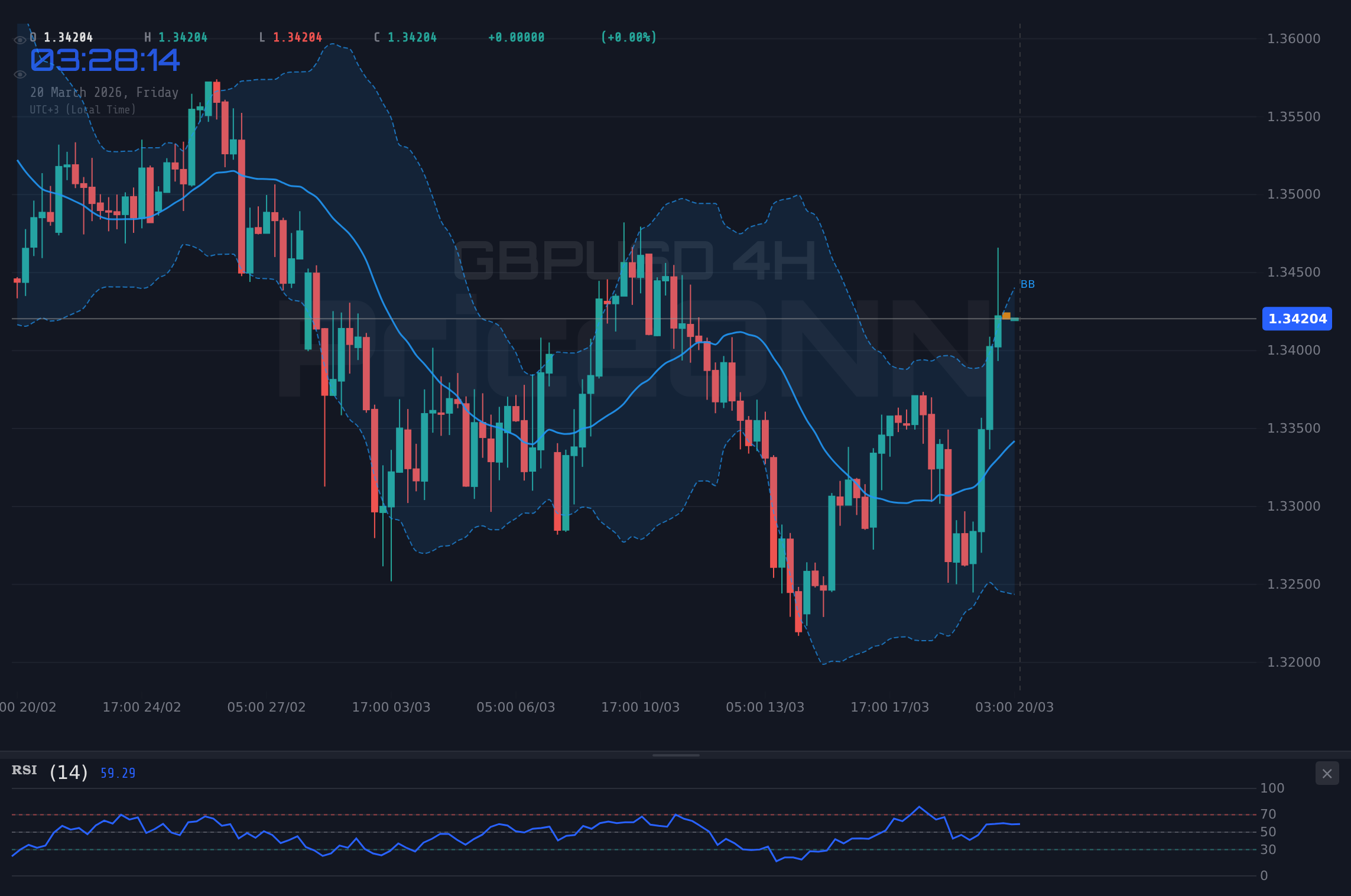
The GBPUSD pair finds itself testing resistance around the $1.34 level. On the 1-hour chart, this area has acted as a ceiling, with the price retreating from $1.34374. The 4-hour chart identifies resistance at $1.34287, $1.3455, and $1.3501, suggesting that breaking through the $1.34 psychological mark will require significant buying pressure. Conversely, the 1-hour support levels are clustered around $1.34162, $1.34075, and $1.3395. A decisive break below these immediate supports could signal a test of lower ground, with the daily chart highlighting key support at $1.32194. The current technical signals present a complex picture, with short-term indicators showing signs of overbought conditions while longer-term trends remain bearish.
Dissecting the Indicators: A Mixed Bag
The technical indicators for GBPUSD offer a nuanced view. On the 1-hour timeframe, the RSI stands at 73.64, firmly in overbought territory, suggesting a potential for pullback. Similarly, the Stochastic oscillator (%K=69.92, %D=82.87) also indicates overbought conditions, with the %K line below the %D line, hinting at a possible bearish crossover. The MACD, while showing positive momentum on the 1-hour chart, is below its signal line on the 4-hour and daily charts, suggesting weakening upside momentum. The ADX, however, presents a conflicting signal. While it indicates a strong uptrend on the 1-hour (ADX: 42.16) and 4-hour (ADX: 19.95) charts, the daily ADX at 30.82 still points to a strong downtrend. This divergence across timeframes and indicators means that a clear directional bias is not yet established, and confirmation is key.
The Bullish Case: A Sustainable Break Above $1.34?
For GBPUSD to sustain an upward move, bulls need to decisively break and hold above the $1.34 resistance. This would require overcoming the immediate hurdles at $1.34374 and $1.3455. A successful breach of these levels, accompanied by strong volume and a bullish confirmation from indicators like the RSI moving out of overbought territory and MACD maintaining positive momentum, could open the door for a move towards the next significant resistance at $1.3501. The daily chart's potential for a trend reversal would be confirmed if price consistently stays above the middle Bollinger Band and the ADX begins to trend lower, indicating a weakening downtrend. This scenario would likely be fueled by a significant shift in central bank expectations, perhaps a more dovish tone from the Fed or stronger UK economic data, which seems unlikely given current conditions. The probability of this scenario playing out in the short term is relatively low given the prevailing bearish trends and dollar strength.
The Bearish Scenario: Resuming the Downtrend
The path of least resistance for GBPUSD appears to be downwards, given the prevailing downtrend on the daily chart and the confluence of bearish factors. A break below the immediate 1-hour support at $1.34162 would be the first sign of renewed selling pressure. A decisive close below $1.3395 could accelerate the decline towards the 4-hour support at $1.33564. The most critical level to watch is the daily support at $1.32194. A break below this significant floor would solidify the bearish outlook and could trigger further downside towards $1.3174 and potentially $1.3097. This scenario is supported by the DXY's strength, rising oil prices fueling inflation concerns that keep the Fed hawkish, and the general risk-off sentiment in global markets. The technical indicators, particularly on the daily timeframe (RSI: 45.12, MACD below signal line, ADX: 30.82), align with this bearish thesis. The probability of this scenario unfolding in the coming week is significant, contingent on continued dollar strength and any further negative surprises in UK economic data.
The Range-Bound Stalemate: Consolidation Around $1.34
It's also plausible that GBPUSD could enter a period of consolidation, trading within a defined range as markets digest the current information and await further catalysts. This neutral scenario would see the pair oscillate between the immediate resistance around $1.34374 and the support near $1.3395. Such a range-bound environment typically occurs when there's a balance of buying and selling pressure, or when market participants are hesitant to commit to a direction ahead of major economic events, such as upcoming central bank communications or key economic data releases. In this scenario, indicators might show conflicting signals, with short-term overbought readings being counteracted by longer-term bearish trends, leading to choppy price action. Volatility might decrease, and the ADX could trend lower, indicating a lack of strong directional momentum. This scenario remains a possibility, especially if upcoming data provides no clear direction or if geopolitical events remain static.
The Road Ahead: Key Triggers and What to Watch
Economic Calendar Watchlist
The coming week is packed with crucial economic events that will likely dictate the direction of GBPUSD. Investors will be keenly awaiting the US Non-Farm Payrolls (NFP) report, which will provide a vital update on the health of the US labor market and could significantly influence Fed policy expectations. Similarly, UK employment data and inflation figures will be critical for the Bank of England's forward guidance. Any deviation from expectations in these high-impact releases could trigger significant volatility in GBPUSD. For instance, a stronger-than-expected NFP print could reinforce the dollar's strength and push GBPUSD lower, while surprisingly weak UK inflation could pressure the BoE towards a more dovish stance, also weighing on the pair.
Geopolitical Developments as a Wildcard
The ongoing geopolitical tensions, particularly in the Middle East, remain a significant wildcard. Any escalation or de-escalation of conflicts could rapidly alter market sentiment and trigger safe-haven flows. A sudden increase in geopolitical risk would likely benefit the US dollar and potentially cap any upside in GBPUSD. Conversely, a swift resolution to current tensions might reduce demand for the dollar and offer some relief to the pound. Traders must remain vigilant to news flow from these regions, as it can override fundamental and technical analyses in the short term. The correlation between oil prices and inflation expectations means that energy market developments will be closely watched for their potential impact on central bank policy and, consequently, on GBPUSD.
Technical Confluence Points
From a technical standpoint, several key price levels and indicator readings will be crucial to monitor. On the resistance side, a sustained break and hold above $1.3455 is needed for the bullish scenario to gain traction. On the support side, the $1.32194 level on the daily chart remains a critical line in the sand. A break below this level would strongly favor the bearish scenario. Furthermore, watching for confirmation signals from indicators will be vital. For instance, if the RSI on the 1-hour chart moves below 50, and the MACD on the daily chart crosses below its signal line, it would add conviction to the bearish outlook. Conversely, a strong close above $1.3501 with increasing volume would support a bullish reversal.
Bearish Scenario: Resuming the Downtrend
65% ProbabilityNeutral Scenario: Consolidation Around $1.34
25% ProbabilityBullish Scenario: A Surprising Reversal
10% ProbabilityFrequently Asked Questions: GBPUSD Analysis
What happens if GBPUSD breaks below $1.3395 support?
A close below $1.3395 would likely confirm the resumption of the bearish trend, potentially accelerating towards the 4-hour support at $1.33564. This would be driven by continued dollar strength and risk aversion.
Should I buy GBPUSD at current levels around $1.34 given the RSI at 67.34?
Buying at current levels with RSI in overbought territory carries significant risk. While a short-term bounce is possible, the prevailing downtrend and hawkish Fed expectations suggest caution. A confirmed breakout above $1.3455 with strong conviction would be a more prudent entry trigger, though this scenario currently holds only a 10% probability.
Is the MACD histogram divergence a strong sell signal for GBPUSD?
The MACD histogram divergence on shorter timeframes suggests that bullish momentum is fading, which can precede a price reversal or a deeper pullback. While not a standalone sell signal, it adds to the cautious outlook, especially when coupled with the overbought RSI and the approach of key resistance levels near $1.34.
How will upcoming Fed commentary affect GBPUSD this week?
Further hawkish commentary from the Fed would likely strengthen the US dollar, increasing downward pressure on GBPUSD and reinforcing the bearish scenario. Conversely, any signs of a dovish pivot, however unlikely, could provide temporary relief and support a move back towards resistance levels.
Track markets in real-time
AI-powered analysis, technical indicators and real-time price data.
Join Our Telegram Channel
Breaking market news, AI analysis and trading signals instantly.
Join Channel