USDJPY at $159.23: Navigating Resistance Amidst Shifting Market Sands
USDJPY hovers near $159.23, facing resistance as DXY firms and risk sentiment cools. Key levels watched for potential shifts.
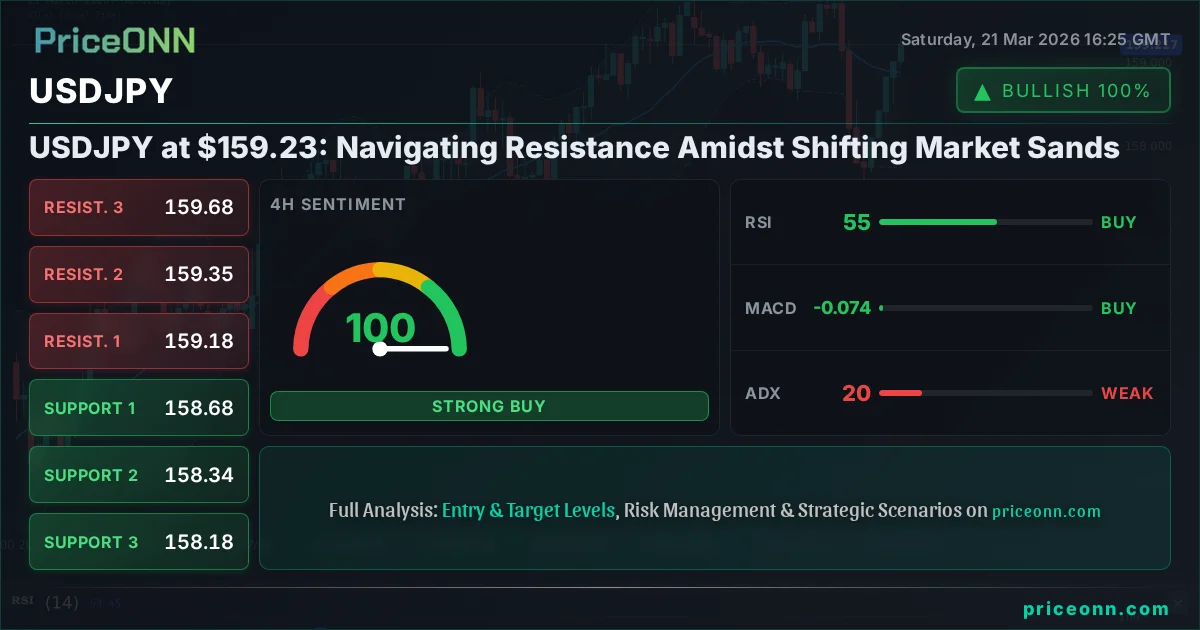
The battleground for USDJPY is squarely set near the psychological and technical barrier of $159.23. As the week concluded, the pair found itself consolidating just shy of this critical resistance, a testament to the tug-of-war between a strengthening US Dollar and the historically weak Japanese Yen. This pivotal juncture demands a deep dive into the cross-market dynamics, geopolitical undercurrents, and shifting central bank expectations that are shaping the outlook for this high-profile currency pair. The market's next move hinges on whether bulls can decisively clear $159.23, or if bears will capitalize on the prevailing headwinds to push back.
- USDJPY is currently consolidating near $159.23, facing significant resistance after a week of volatile trading.
- The US Dollar Index (DXY) showed signs of life, rising to 99.39, which typically pressures USDJPY higher but is currently being met with selling pressure near resistance.
- Risk appetite has soured, with SP500 falling to 6536.05 and Nasdaq to 23992.13, potentially supporting safe-haven flows but not significantly aiding the Yen against the Dollar.
- Gold prices have plunged to $4497.65, indicating a strong risk-off sentiment that usually benefits currencies like the Yen, yet USDJPY remains elevated.
- Technical indicators on USDJPY show mixed signals: RSI at 59.49 on the daily chart suggests room for further upside, but Stochastic is entering overbought territory, hinting at a potential pullback.
- The Bank of Japan's recent signals of potential policy shifts have provided some underlying support for the Yen, but the interest rate differential with the Fed remains a dominant factor.
- Key levels to watch are support at $158.678 and resistance at $159.682 on the 4-hour chart. A decisive break above $159.682 could open the door to further gains.
Last Friday's close for USDJPY found the pair hovering around the $159.23 mark, a price point that has become a focal point for market participants. The preceding week was a rollercoaster, marked by significant volatility across global markets. Geopolitical tensions, particularly in the Middle East, have escalated, sending shockwaves through energy markets with Brent Crude rallying to $112.79 and WTI to $98.50. This surge in oil prices, while a clear indicator of heightened geopolitical risk, also fuels inflation concerns, a factor that central banks, especially the US Federal Reserve, are keenly watching. The divergence in central bank policy remains a cornerstone of the USDJPY narrative; the Fed's hawkish undertones, even if paused on rates for now, stand in stark contrast to the Bank of Japan's (BoJ) historically accommodative stance, albeit with murmurs of a potential policy pivot on the horizon. This widening interest rate differential is a primary driver underpinning the strength of the Dollar against the Yen, pushing USDJPY towards levels not seen in decades.
The broader market sentiment paints a complex picture. Risk assets have experienced significant selling pressure. The S&P 500 closed at 6536.05, and the Nasdaq at 23992.13, both registering notable declines. This broad-based retreat in equities often correlates with a flight to safety, which traditionally benefits currencies like the Japanese Yen. However, the USDJPY pair has shown remarkable resilience, even strength, in the face of this risk-off sentiment. This decoupling is a significant observation, suggesting that other powerful forces, primarily the interest rate differential and the sheer momentum behind the Dollar's ascent, are overriding typical safe-haven dynamics. Gold, often considered the ultimate safe haven, has seen a dramatic fall to $4497.65, further complicating the narrative around risk sentiment and its impact on currency pairs.
The US Dollar Index (DXY) has been a key barometer for currency markets, and its recent uptick to 99.39 warrants close attention. A stronger dollar typically exerts downward pressure on USDJPY, but the pair has managed to hold its ground and even advance, underscoring the Yen's own weakness. The DXY's movement is influenced by a myriad of factors, including Fed policy expectations, global economic health, and geopolitical stability. While the Fed has held rates steady, market participants are scrutinizing every utterance from Fed officials for clues about future policy direction. The narrative remains tilted towards a Fed that is more concerned about persistent inflation than a potential economic slowdown, keeping the door ajar for future tightening or at least a prolonged period of higher rates. This stance provides a fundamental tailwind for the US Dollar.
On the other side of the trade, the Bank of Japan's policy remains a critical variable. While the BoJ has maintained its ultra-loose monetary policy, recent comments from officials have hinted at a potential shift away from negative interest rates and yield curve control. This has provided some underlying support for the Yen, preventing a complete capitulation. However, the pace and magnitude of any policy change remain uncertain. The sheer size of the interest rate gap between the US and Japan means that even a minor hawkish shift from the BoJ might not be enough to counteract the powerful carry trade dynamics that favor selling the Yen. The market is keenly awaiting any concrete signals that could alter this fundamental imbalance.
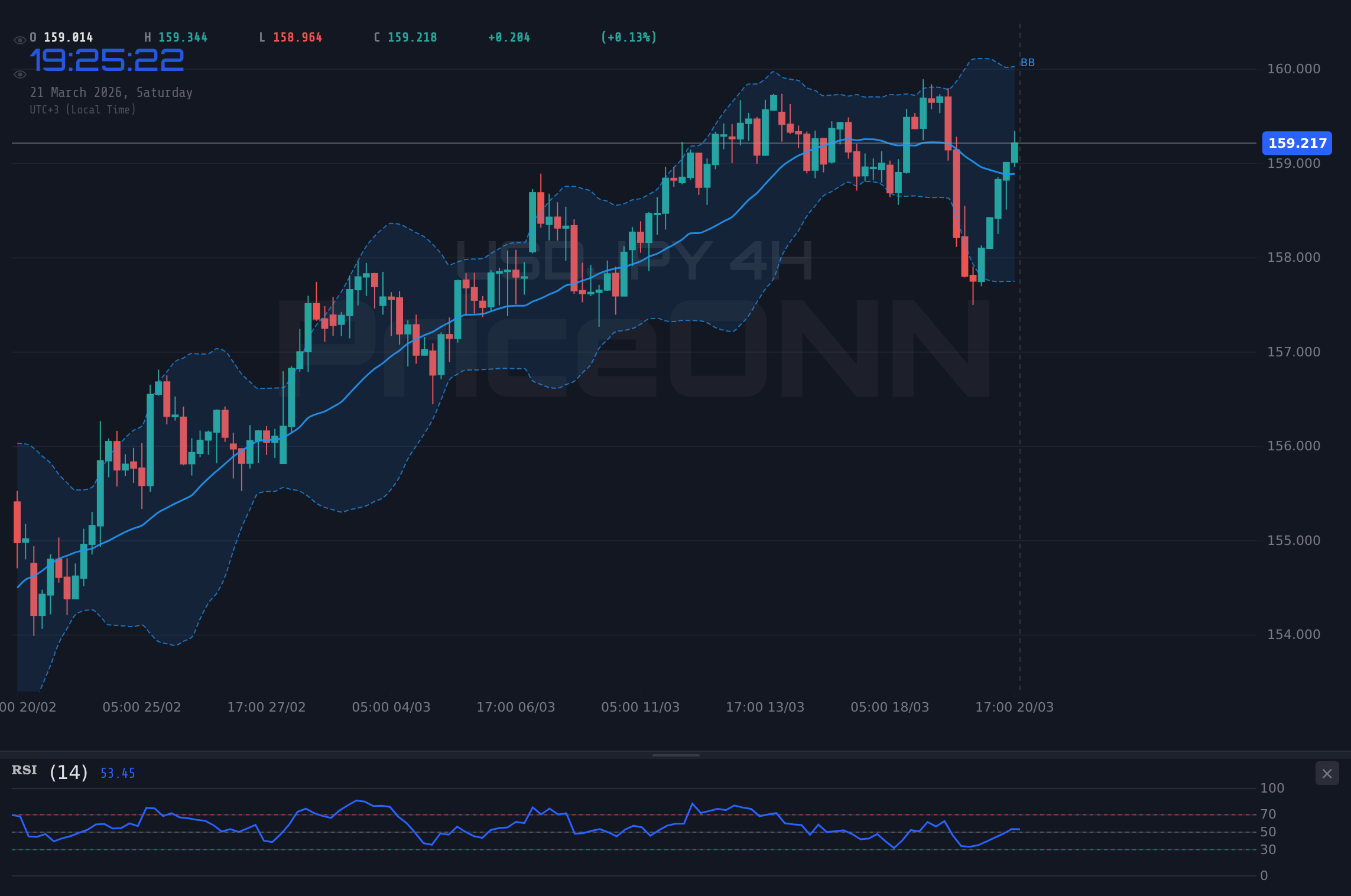
Technically, the USDJPY pair is at a crucial juncture. On the 1-hour chart, the trend is neutral, with the RSI at 63.52 suggesting a slightly bullish lean but approaching overbought territory. The MACD shows positive momentum, and the Stochastic is deep in overbought territory, signaling caution. The 4-hour chart also presents a neutral picture, with RSI at 54.99 and Stochastic showing a potential dip. However, the daily chart paints a more compelling narrative for the bulls, with RSI at 59.49 indicating room for further upside, and ADX at 22.03 suggesting a moderately trending market. The key resistance level, $159.682 on the 4H chart, looms large. A decisive breach above this level, especially with strong volume and follow-through, could signal the next leg of the rally. Conversely, failure to break this resistance could lead to a pullback towards the support levels identified around $158.678.
The sheer strength of the Dollar's trend, coupled with the Yen's inherent weakness amplified by the carry trade, presents a strong case for the bulls. The historical pattern of USDJPY appreciating when interest rate differentials widen is a powerful technical and fundamental driver. Furthermore, the ongoing geopolitical uncertainty, while typically a boon for the Yen, seems to be overshadowed by inflation fears and the Fed's hawkish stance, leading investors to favor the perceived stability and higher yields of the US Dollar. The fact that USDJPY has managed to climb towards these lofty levels despite significant risk aversion in global equity markets is a testament to its underlying strength. The momentum indicators, while showing some signs of overheating, have not yet given a definitive sell signal on the longer timeframes, suggesting that the upward trend might still have legs.
However, the bears have valid arguments, primarily centered around the pair's proximity to significant resistance and the potential for a market correction. The $159.23 level is not just a psychological barrier; it represents a confluence of technical factors that could cap further upside. The overbought readings on shorter-term oscillators like the Stochastic indicator on the 1-hour and 4-hour charts cannot be ignored. These suggest that the recent rally may be overextended in the short term, increasing the probability of a profit-taking pullback. Moreover, the escalating geopolitical risks, while not currently overpowering the Dollar's strength, carry the potential to trigger a significant flight to safety. Should tensions flare further, the Yen could see renewed demand, forcing USDJPY lower. The weakening of risk assets like the S&P 500 and Nasdaq also adds to the bearish case; a sustained downturn in equities could amplify risk aversion and lead to a reassessment of positions that rely on higher yields.
The conflicting signals from different timeframes and indicators add to the complexity. While the daily chart might show room for upside, the shorter-term charts are flashing warnings. This divergence often precedes a period of consolidation or a reversal. Traders are thus caught between the powerful, longer-term trend driven by interest rate differentials and the short-term technical exhaustion signals. The ability of USDJPY to sustain its upward trajectory will likely depend on a continued hawkish bias from the Fed, persistent inflation concerns, and a lack of escalation in geopolitical conflicts that would unequivocally drive investors towards the Yen as a safe haven. The market is at a crossroads, and the next few trading sessions will be crucial in determining the pair's immediate direction.
Looking ahead, the economic calendar will be key. Any hints from the Federal Reserve about the timing or possibility of future rate hikes will significantly influence the Dollar's trajectory. Conversely, any concrete policy shifts from the Bank of Japan could provide temporary respite for the Yen. The geopolitical landscape remains a wild card, capable of introducing sudden volatility that could override fundamental drivers. From a technical standpoint, the $159.682 resistance level on the 4-hour chart is the immediate hurdle. A clean break and hold above this level could open up targets towards $160.682 and potentially higher. However, a failure to breach this resistance could see a retracement towards the $158.678 support zone, with a break below it potentially exposing the $158.176 level. The market is watching closely to see if the bulls can muster the strength to push through, or if the bears will successfully defend this critical resistance zone.
The current technical setup on USDJPY presents a fascinating dichotomy. On the 1-hour timeframe, the ADX at 29.64 indicates a strong upward trend, yet the Stochastic (%K: 88.06, %D: 93.24) is deeply entrenched in overbought territory. This suggests that while momentum is strong, the market is stretched and ripe for a correction or at least a period of consolidation. The MACD histogram is positive, but the RSI at 63.52, while not yet overbought, is approaching levels that often precede a pause. This short-term overextension is a primary concern for bulls looking to enter long positions. The 4-hour chart echoes this sentiment, with an ADX of 19.58 indicating a weaker trend, a contrast to the 1-hour's strength, and a Stochastic that is moving lower from overbought levels. The daily timeframe offers a slightly different perspective, with an RSI of 59.49 and an ADX of 22.03, suggesting a more sustainable trend with room to grow, but the Stochastic (%K: 61.68, %D: 79.82) is showing a bearish divergence, hinting that the upward momentum might be waning.
The interplay between these indicators across different timeframes creates a challenging environment for traders. The daily chart's bullish lean is tempered by the shorter-term overbought conditions and the proximity to significant resistance. This suggests that while the longer-term trend might favor the upside, the immediate risk of a pullback or consolidation is elevated. The market is essentially at a crossroads, where the powerful fundamental driver of interest rate differentials is clashing with short-term technical exhaustion and the ever-present risk of geopolitical events triggering safe-haven flows into the Yen. The next few days will likely be characterized by heightened volatility as the market digests incoming economic data and geopolitical developments, seeking a catalyst to break the current stalemate.
The recent sharp decline in gold prices to $4497.65, alongside significant drops in silver (XAG/USD) and copper, signals a notable shift in market sentiment or perhaps a 'risk-on' phase that is unusual given the geopolitical backdrop. Typically, such a broad selloff in commodities, especially gold, would coincide with a strengthening Yen. The fact that USDJPY is holding firm, or even pushing higher, despite this commodity-driven risk-off signal is a strong indication of the Yen's independent weakness. This implies that the market is prioritizing the interest rate differential and the perceived safety of the US Dollar over traditional safe-haven assets and currencies. This dynamic is crucial for understanding USDJPY's resilience and suggests that only a significant shock, or a clear pivot from the Fed, could reverse the current trend.
Furthermore, the performance of other forex pairs provides context. The Euro, for instance, shows weakness against the Dollar, with EURUSD trading at 1.15728 and exhibiting a daily downtrend. Similarly, GBPUSD at 1.33435 and AUDUSD at 0.70241 are also showing downward pressure. This broad-based weakness in major currencies against the Dollar reinforces the strength of the USD trend. The Yen, however, is in a unique position. While it typically benefits from risk aversion, its own policy divergence and the carry trade dynamics are creating a persistent bid for USDJPY. The BoJ's signals, while potentially a precursor to future Yen strength, have not yet manifested into a sustained recovery, leaving the Yen vulnerable.
The Federal Reserve's stance, as reflected in market expectations, remains a primary driver. While the Fed has paused rate hikes, the narrative of keeping rates higher for longer persists. This is crucial because it maintains the attractiveness of the US Dollar from a yield perspective. If inflation proves stickier than anticipated, or if economic data continues to show resilience, the market might even price in a possibility of a future hike, further bolstering the Dollar. Conversely, any signs of significant economic weakening or a sudden drop in inflation could lead to a dovish repricing, potentially pressuring USDJPY lower. For now, the balance of probabilities seems to favor continued Dollar strength, at least until a clear policy shift from either the Fed or the BoJ occurs, or a major geopolitical event forces a reassessment of risk.
The technical picture on the daily chart for USDJPY, with an RSI of 59.49, suggests that while the pair is not yet in overbought territory, it is approaching it. This implies that there is still some room for upward movement, but the pace might slow down, and the risk of a correction increases. The ADX at 22.03 confirms a trending market, but not an excessively strong one, indicating that the move might face some resistance. The Stochastic's bearish divergence, with %K (61.68) crossing below %D (79.82), is a significant warning sign that the upward momentum may be fading. This confluence of a daily chart that still has some room to run, yet is showing signs of topping out on longer-term oscillators, suggests that the current resistance at $159.23-$159.682 is a critical area. A failure to decisively break through could lead to a significant pullback, potentially testing the support levels around $158.678 and even lower if sentiment shifts dramatically.
The market structure and liquidity conditions also play a role. As we approach the end of the week, trading volumes might thin out, increasing the potential for exaggerated price movements on lower liquidity. This is particularly relevant around key psychological levels like $159.23. Option expiries and futures rollovers can also introduce volatility. While specific data on these are not provided, it's a general consideration for traders operating in these high-stakes markets. Understanding these structural elements can help in interpreting price action and avoiding potential traps set by low-liquidity environments.
The geopolitical situation, particularly the escalating tensions in the Middle East, adds a layer of complexity. While typically a driver for Yen strength, the current narrative seems to be dominated by inflation concerns and the Fed's policy outlook. If the geopolitical situation were to significantly worsen, triggering a global flight to safety, the Yen could indeed see a surge in demand. However, the recent behavior of gold and other risk assets suggests that investors are currently pricing in a different risk-reward scenario, favoring the Dollar's yield advantage. The key here is how central banks respond to potential inflation spikes driven by energy prices. If the Fed maintains its hawkish stance despite rising oil prices, the Dollar could continue to strengthen, pushing USDJPY higher regardless of geopolitical alarms.
The Bank of Japan's internal debate about exiting its ultra-loose policy is a slow-burning fuse under the Yen. Any indication of a move towards normalization, however gradual, would be a significant event. But the market is pricing in a very slow transition, meaning the interest rate differential is likely to remain a dominant factor for the foreseeable future. This structural advantage for the Dollar against the Yen is unlikely to disappear overnight, providing a supportive backdrop for USDJPY in the medium term, even if short-term corrections occur. The question is not if the BoJ will eventually tighten, but when and how aggressively, and whether it will be enough to offset the Fed's actions and market expectations.
Considering the confluence of factors, the immediate outlook for USDJPY remains at a critical juncture near $159.23. The bullish case is supported by the strong Dollar trend, the widening interest rate differential, and the resilience shown even amidst risk aversion. The technicals on the daily chart still offer some room for upside. However, the bearish case is compelling due to short-term overbought conditions on oscillators, the significant resistance at $159.23-$159.682, and the potential for geopolitical events to trigger a flight to safety. The conflicting signals across timeframes suggest that a period of consolidation or a sharp pullback is a distinct possibility if resistance holds firm. The market will be looking for a clear catalyst – either a decisive break above resistance or a significant shift in macro sentiment – to dictate the next major move.
The current ADX reading of 19.58 on the 4-hour chart indicates a weak trend, which contradicts the strong trend suggested by the 1-hour ADX of 29.64. This discrepancy highlights the choppy nature of the market around this resistance level. While the daily ADX of 22.03 suggests a trending market, the shorter-term weakness implies that the current upward momentum may not be sustainable without a consolidation or pullback. The RSI on the daily chart at 59.49 is healthy, but the Stochastic's bearish divergence is a significant warning. This means that while the price has been moving up, the underlying momentum might be weakening, setting the stage for a potential reversal or at least a significant pause in the trend. For bulls, a close above the 4H resistance of $159.682 is essential confirmation. For bears, a failure to break and a subsequent move back below the 1H support at $159.103 would be the first sign of weakness.
The price action around $159.23 is critical. If USDJPY fails to decisively break and hold above the $159.682 resistance level on the 4-hour chart, we could see a retracement. The first significant support level to watch on the 4-hour chart is $158.678. A break below this level would invalidate the immediate bullish outlook and could open the door for a deeper correction towards $158.176. On the other hand, a sustained move above $159.682, ideally with strong follow-through buying and increasing volume, would signal a continuation of the bullish trend. The next significant resistance level would then be around $160.682, a level that has not been tested in this data set but is a logical psychological target.
The broader market context of falling equities (SP500: 6536.05, Nasdaq: 23992.13) and commodities like gold ($4497.65) suggests a risk-off environment. In such conditions, the Yen typically strengthens. The fact that USDJPY remains elevated despite this risk-off sentiment speaks volumes about the Yen's weakness and the Dollar's strength. This resilience suggests that the fundamental driver – the interest rate differential and the Fed's hawkish bias – is currently outweighing the typical safe-haven flows into the Yen. This dynamic is unusual and highlights the significant structural forces at play. It implies that only a dramatic shift in Fed policy or a severe geopolitical escalation directly impacting US economic interests might be enough to reverse the trend decisively.
The Bank of Japan's position is delicate. They are caught between the need to support their economy with ultra-loose policy and the increasing pressure from a rapidly depreciating Yen, which fuels imported inflation. While their signals suggest a potential normalization, the pace is likely to be very gradual, meaning the interest rate differential will persist. This structural advantage for the Dollar is a powerful force that is unlikely to be overcome by minor policy tweaks from the BoJ alone. Therefore, for USDJPY to see a sustained downturn, a more significant shift in Fed policy expectations or a dramatic change in global risk sentiment would likely be required.
The technical indicators on the daily chart present a mixed but potentially cautionary picture for the bulls. While the RSI at 59.49 indicates room for growth, the Stochastic's bearish divergence (K=61.68 crossing below D=79.82) is a strong signal that upward momentum may be waning. This suggests that the pair might be approaching a turning point or at least a period of consolidation. The ADX at 22.03 confirms a trend, but not an exceptionally strong one, indicating that the move may face headwinds. Therefore, while the longer-term trend might still favor the upside, the immediate risk of a correction or consolidation around the current resistance levels is significant. A decisive break above $159.682 would be needed to invalidate this caution and signal a continuation of the bullish trend.
The narrative around USDJPY is currently dominated by the powerful combination of a strong US Dollar, driven by Fed policy expectations and yield advantage, and a structurally weak Japanese Yen, exacerbated by carry trade dynamics and a slow-moving BoJ. While geopolitical risks and a broader risk-off sentiment in markets like equities and commodities could theoretically support the Yen, these factors have so far been overshadowed. The pair is currently consolidating near a critical resistance zone around $159.23-$159.682. The technical indicators offer conflicting signals across timeframes, suggesting that the immediate direction is uncertain and hinges on a decisive break of these key levels or a significant shift in the underlying macro narrative. Patience and risk management will be paramount for traders navigating this complex environment.
The current market environment for USDJPY is characterized by a tug-of-war at a critical resistance level. The bulls are supported by the fundamental advantage of interest rate differentials and a resilient Dollar, while bears are looking at overbought conditions on shorter timeframes and the potential for geopolitical events to trigger a Yen rally. The resilience of USDJPY despite falling equities and commodities is a key observation, indicating that the Dollar's strength is currently the dominant factor. However, the proximity to resistance and conflicting technical signals suggest that a period of consolidation or a sharp pullback is a distinct possibility. Traders should remain vigilant for a clear break above $159.682 to confirm further upside, or a failure to do so, which could lead to a retracement towards $158.678.
The market is at a pivotal point. The potential for the Bank of Japan to eventually normalize its policy provides a floor for the Yen, but the Fed's stance on inflation and rates continues to be the primary driver for the Dollar. The current consolidation near $159.23-$159.682 is a crucial test. A sustained break above this resistance could signal a continuation of the strong bullish trend, potentially targeting higher levels. However, if this resistance holds, a correction is likely, testing lower support levels. The interplay of macroeconomics, central bank policies, and geopolitical risks will dictate which scenario unfolds. Vigilance around these key levels and upcoming economic data will be essential for navigating this volatile pair.
The recent price action around $159.23 on USDJPY warrants careful observation. While the daily chart indicators like RSI (59.49) and ADX (22.03) suggest some room for upside, the shorter-term indicators, particularly the Stochastic's bearish divergence, hint at waning momentum. This divergence between price strength and underlying momentum is a classic warning sign of a potential trend exhaustion or reversal. Therefore, the resistance zone between $159.23 and $159.682 is particularly critical. A failure to decisively break this zone, coupled with a close below the 1-hour support at $159.103, could initiate a corrective move, targeting the $158.678 support level. Conversely, a strong daily close above $159.682 would invalidate this bearish divergence signal and suggest a continuation of the upward trend.
The broader market context cannot be ignored. The significant drops in SP500 (to 6536.05) and Nasdaq (to 23992.13), alongside the sharp decline in gold prices to $4497.65, indicate a significant risk-off sentiment. In normal circumstances, this would fuel demand for the Japanese Yen. However, USDJPY's resilience highlights the overriding influence of the interest rate differential and the strength of the US Dollar. This decoupling suggests that the Yen's weakness is structural, driven by carry trade dynamics and the BoJ's policy, rather than solely being a function of global risk appetite. This makes the Yen a less reliable safe haven in the current environment, reinforcing the bullish case for USDJPY as long as the Fed remains on a hawkish path.
The Bank of Japan's policy dilemma is at the heart of the Yen's weakness. While the domestic economy might benefit from a weaker Yen in terms of export competitiveness, the rising cost of imports and the potential for capital flight due to negative real interest rates are significant concerns. The market is anticipating a policy shift, but the pace remains slow. This creates a persistent tailwind for USDJPY, as the interest rate differential is likely to remain wide for some time. Any hawkish signals from the Fed, even if they are just signaling a delay in rate cuts rather than hikes, will further exacerbate this differential and support USDJPY. Therefore, the fundamental picture remains tilted towards Dollar strength against the Yen, making the current resistance levels a crucial battleground.
The technical setup near $159.23 presents a classic scenario of a market testing significant resistance after a strong rally. The daily chart indicators offer a mixed outlook: RSI at 59.49 suggests room for upside, but the Stochastic's bearish divergence is a significant warning sign. The ADX at 22.03 indicates a trending market, but not an excessively strong one, implying that the upward momentum might be losing steam. The 1-hour and 4-hour charts show overbought conditions on oscillators and weaker trend strength, further emphasizing the challenge of breaking through current levels. For the bulls to maintain control, a decisive close above $159.682 is imperative. Failure to do so could lead to a significant pullback, potentially testing the $158.678 support.
The current market sentiment, as indicated by falling equities and commodities, is risk-off. However, USDJPY's strength suggests that the Yen is not benefiting from its traditional safe-haven status. This is primarily due to the wide interest rate differential and the Fed's hawkish stance, which continue to favor the US Dollar. The Bank of Japan's cautious approach to policy normalization further exacerbates the Yen's weakness. Therefore, while geopolitical risks could theoretically support the Yen, the fundamental drivers currently point towards continued Dollar strength. The pair is consolidating near a critical resistance zone around $159.23-$159.682, making it a key battleground for the next directional move.
The technical indicators present a conflicting picture. Daily RSI at 59.49 and ADX at 22.03 suggest a healthy trend with room for growth. However, the Stochastic's bearish divergence and the overbought conditions on shorter-term charts raise caution flags. This suggests that while the long-term trend may still be bullish, the immediate risk of a pullback or consolidation is elevated. A decisive break above the 4-hour resistance at $159.682 is needed to confirm further upside potential. Conversely, failure to do so could lead to a retracement towards the $158.678 support level. The market is waiting for a catalyst to break this stalemate, be it a shift in central bank policy or a significant geopolitical event.
As the market approaches the end of the week, USDJPY is poised at a critical resistance level near $159.23. The interplay between the Fed's hawkish stance, the BoJ's cautious approach, and geopolitical uncertainties creates a complex environment. While the fundamental drivers suggest a continued bullish bias for the Dollar, short-term technical indicators are flashing warnings of overextension. The resilience of USDJPY amidst broader risk aversion is a key observation, highlighting the structural weakness of the Yen. The coming week will be crucial in determining whether the bulls can overcome this resistance or if a correction is imminent. Vigilance around the key levels of $159.682 resistance and $158.678 support will be paramount.
Frequently Asked Questions: USDJPY Analysis
What happens if USDJPY breaks above the $159.682 resistance level?
A sustained break above $159.682, confirmed by strong volume, would likely signal a continuation of the bullish trend, potentially targeting $160.682 and higher. This would validate the daily chart's bullish leanings.
Should I consider buying USDJPY at current levels near $159.23 given the RSI at 59.49?
While the daily RSI at 59.49 suggests room for upside, the Stochastic's bearish divergence and shorter-term overbought conditions near resistance warrant caution. A confirmed break above $159.682 would be a more prudent entry trigger than buying at current levels.
Is the Stochastic's bearish divergence at 61.68 below 79.82 a sell signal for USDJPY?
The bearish divergence on the daily Stochastic (K=61.68, D=79.82) suggests waning upward momentum and increases the risk of a pullback or consolidation. It's a warning sign, not a direct sell signal, especially with the broader trend still potentially intact.
How will the Fed's stance on inflation affect USDJPY this week?
If the Fed maintains a hawkish bias or signals higher-for-longer rates due to persistent inflation, it would likely strengthen the US Dollar, supporting USDJPY. Conversely, any dovish shift or economic slowdown concerns could pressure the pair lower.
Track markets in real-time
AI-powered analysis, technical indicators and real-time price data.
Join Our Telegram Channel
Breaking market news, AI analysis and trading signals instantly.
Join Channel