

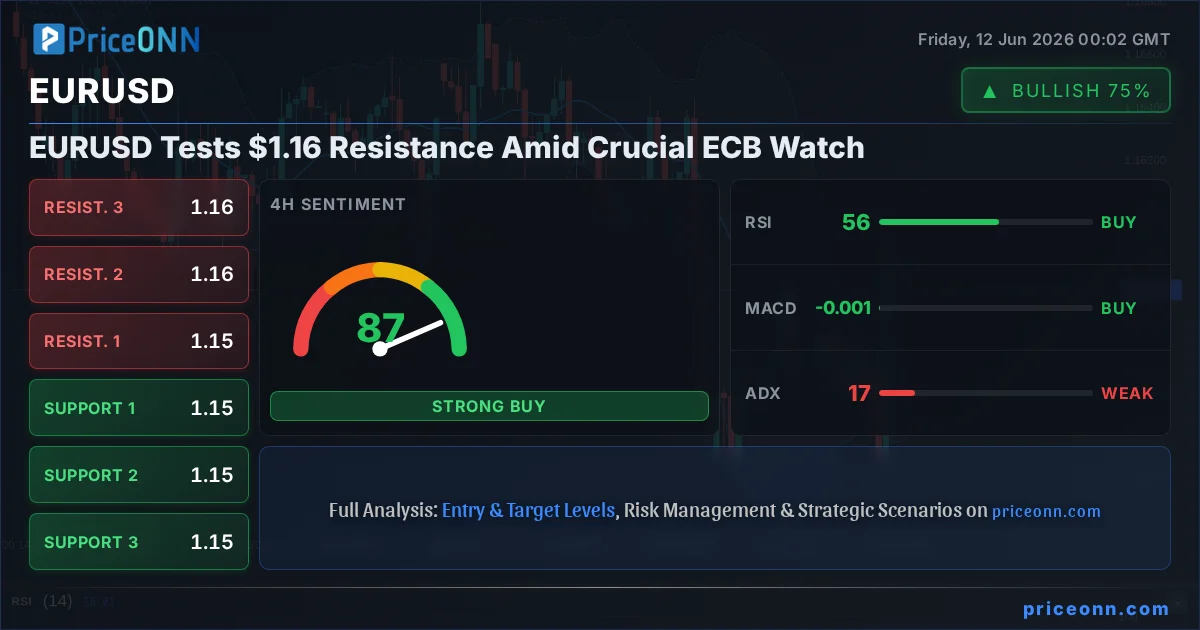
The EURUSD pair is currently testing critical resistance levels around the $1.16 mark, a crucial juncture for its near-term trajectory. With the European Central Bank (ECB) meeting on the horizon, market participants are keenly observing whether the euro can solidify its gains or if the dollar will reassert its dominance. This analysis delves into the intricate technical landscape, fundamental drivers, and potential scenarios shaping the EURUSD outlook, providing a comprehensive view for traders and investors.
- RSI at 61.43 on the 1H chart signals upward momentum but remains in neutral territory, suggesting room for further gains before overbought conditions emerge.
- The key resistance level to watch is $1.16005, with a decisive break above this potentially targeting $1.16627.
- MACD on the 1H chart shows positive momentum, but on the 1D chart, it remains below the signal line, indicating conflicting signals across timeframes.
- The DXY index is currently at 99.46, showing a bearish trend on the 1H and 4H charts, which typically supports EURUSD, but a neutral stance on the daily chart warrants caution.
The Bull's Roadmap: Can EURUSD Break Higher?
The immediate path for EURUSD appears to be one of cautious optimism, with bulls attempting to push past the significant resistance cluster identified around $1.16005. On the 1-hour chart, the trend is neutral with a 50% strength, but the signals are predominantly bullish, with 6 out of 8 indicators suggesting a buy. The RSI at 61.43 indicates a healthy upward trend, not yet entering overbought territory, while the MACD shows positive momentum, trading above its signal line. This suggests that short-term traders might find opportunities on the long side if key immediate resistance levels are convincingly breached. The Stochastic oscillator, currently at 87.68, is nearing the overbought zone, which could signal a temporary pause or pull-back, but the ADX at 24.82 indicates a moderate uptrend is in play, suggesting that momentum could sustain a move higher if the right catalysts emerge.
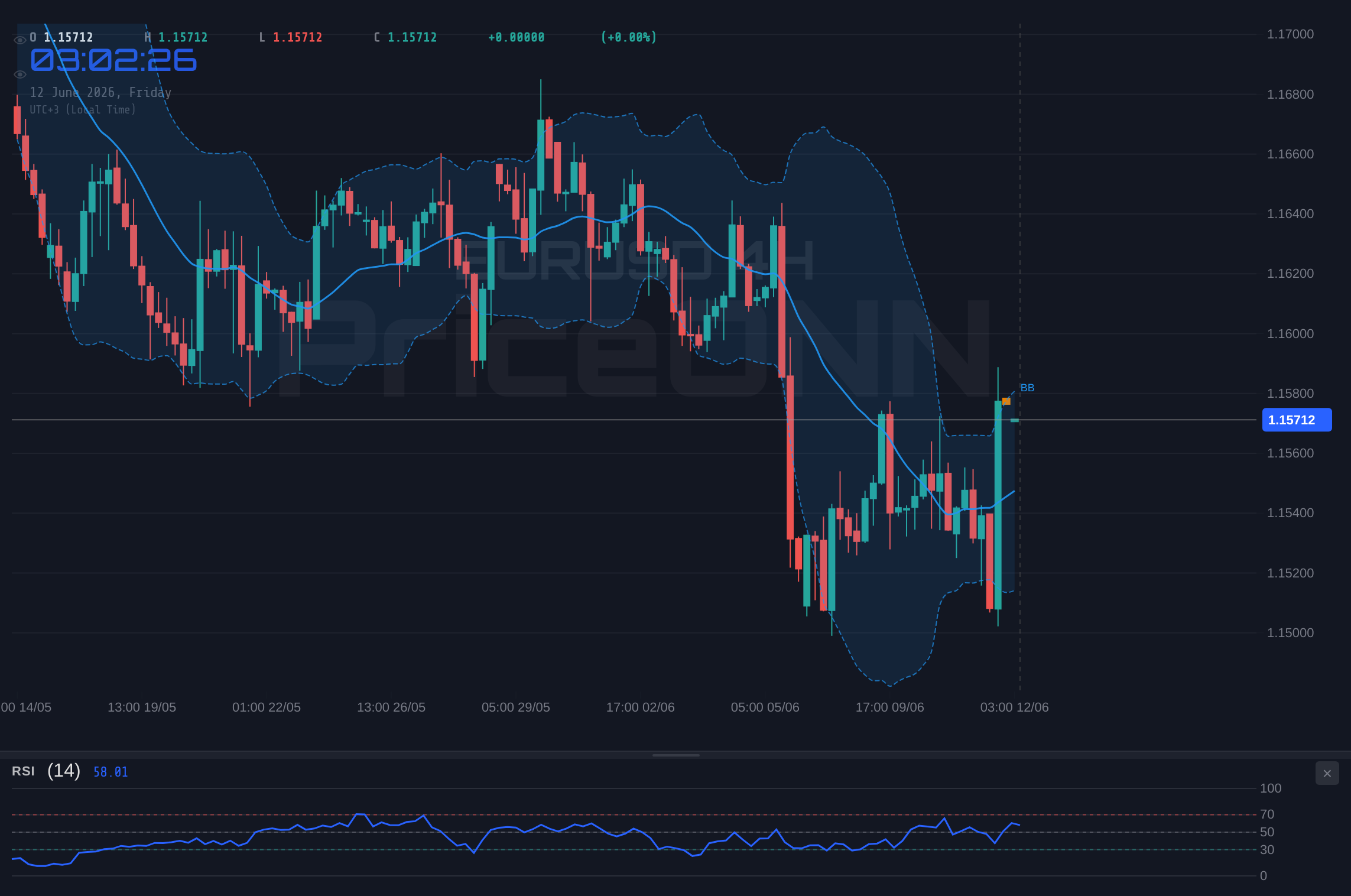
The 4-hour chart presents a slightly different, yet still encouraging, picture for the bulls. While the trend is noted as bearish with 99% strength, the technical indicators are surprisingly leaning towards a buy signal (6 out of 8). This divergence between the stated trend and the short-term signals is common in ranging or consolidating markets. The RSI at 55.61 is comfortably in neutral territory, showing an upward bias, and the MACD remains positive. The Stochastic oscillator, with %K (43.38) above %D (31.82), provides a clear bullish signal. However, the ADX at 17.31 points to a weak trend, underscoring the potential for sideways movement rather than a strong directional impulse. This suggests that while there might be upward pressure, significant conviction is lacking on this timeframe, meaning any bullish move might be capped without a stronger fundamental push.
The daily timeframe offers a more challenging outlook for the bulls. The trend is clearly bearish with 90% strength, and the majority of indicators (7 out of 8) are signaling a sell. The RSI at 44.03 is in the lower half of the neutral zone, indicating a downward bias, and the MACD is negative, trading below its signal line. Bollinger Bands are also below the middle band, reinforcing the bearish sentiment. The Stochastic oscillator, however, shows a potential for a bounce, with %K (29.85) above %D (20.01) and entering oversold territory. The ADX at 19.51 confirms a weak trend, which could mean that the bearish momentum is not accelerating but rather that the pair is consolidating within a broader downtrend. For EURUSD to sustain a bullish move, it would need to overcome not only the immediate 1-hour resistance but also demonstrate a significant shift in sentiment on the daily chart, which currently appears unlikely without a strong fundamental catalyst.
The Waiting Game: Consolidation Around $1.16
The current technical setup for EURUSD paints a picture of a market at a crossroads, potentially leading to a period of consolidation around the $1.16 level. The conflicting signals across different timeframes are a strong indicator of this. On the 1-hour chart, the bullish bias is evident, suggesting short-term buying interest. However, the approaching overbought conditions in the Stochastic oscillator and the neutral RSI might temper immediate upside. Simultaneously, the 4-hour chart, despite its bearish trend classification, shows bullish short-term indicator signals, albeit with a weak ADX suggesting a lack of strong directional conviction. This creates a scenario where price action might become choppy, with buyers and sellers battling for control in a relatively tight range, likely between the immediate support at $1.15763 and the resistance at $1.16005.
The daily timeframe's bearish leanings further complicate the bullish narrative. Without a clear break above key daily resistance levels, such as $1.16005 and subsequently $1.16627, any upward movement could be viewed as a bear market rally, ripe for profit-taking. The fact that the ADX is low across multiple timeframes (17.31 on 4H, 19.51 on 1D) points towards a lack of a strong, sustained trend. This often leads to price action oscillating within defined boundaries. Traders might be waiting for clearer signals from the upcoming ECB meeting or significant US economic data, such as inflation figures, before committing to a strong directional stance. This period of watchful waiting can extend the consolidation phase, making it challenging for breakout strategies to yield consistent results.
The interplay between the DXY index and EURUSD also plays a crucial role in this consolidation narrative. While the DXY shows a bearish trend on the 1-hour and 4-hour charts (at 99.46), its neutral stance on the daily chart suggests that the dollar's weakness might not be a sustained trend. If the DXY finds support and starts to recover, it would naturally put pressure on EURUSD, reinforcing the bearish case on the daily chart and potentially pushing the pair back towards its support levels, such as $1.15763 or even $1.15682. Conversely, if the DXY continues its decline, it could provide the necessary external push for EURUSD to challenge higher resistance levels, but the internal technical picture on the daily chart still needs to align for a significant breakout.
Where Bears Take Control: The Downside Risk
Despite the short-term bullish signals, the bearish case for EURUSD remains significant, particularly when considering the daily timeframe's technicals and the broader market context. The daily trend is firmly bearish, with 7 out of 8 indicators signaling a sell. The current price of $1.16 is well below the daily resistance level of $1.16005, and a failure to decisively break and hold above this level could lead to a sharp reversal. The RSI at 44.03 is in the lower neutral zone, and the MACD's negative momentum suggests that selling pressure is building. If EURUSD fails to hold above the immediate support at $1.15763, the next logical targets would be $1.15682 and then $1.15642. A break below these levels would confirm the continuation of the downtrend, potentially accelerating towards the more significant support cluster around $1.15203.
The ADX on the daily chart at 19.51, while indicating a weak trend, doesn't negate the possibility of a downward move, especially if external factors align. A strengthening DXY, driven by hawkish signals from the Federal Reserve or surprising strength in US economic data, could easily trigger a sell-off in EURUSD. Furthermore, if the ECB meeting delivers a dovish message, perhaps by signaling a readiness to cut rates sooner than expected or by downplaying inflation concerns, it would put significant downward pressure on the euro. In such a scenario, the pair could quickly retrace its recent gains and test lower support levels. The Stochastic oscillator nearing oversold territory on the daily chart could provide a temporary floor, but in a strong bearish trend, oversold conditions can persist.
The correlation with broader market sentiment also plays a role. If risk appetite wanes globally, leading to a sell-off in equities like the S&P 500 (currently at 6572.87, showing a 1H bullish trend but 1D bearish) and Nasdaq (29551.6, with similar conflicting signals), safe-haven assets like the US dollar tend to strengthen. This would directly impact EURUSD negatively. The current price action, hovering near resistance, combined with the bearish daily indicators and the potential for a dollar recovery, creates a substantial risk of a reversal. The $1.16 level, therefore, represents not just a technical resistance but a potential pivot point where the bearish forces could regain the upper hand if key conditions are met.
The ECB's Shadow: A Catalyst for Change?
The upcoming European Central Bank (ECB) meeting is undoubtedly the most significant fundamental event on the horizon for EURUSD. Market expectations are finely tuned, and any deviation from the consensus could trigger substantial volatility. While the Fed has been signaling a cautious approach, the ECB's stance on inflation and potential monetary policy adjustments will be critical. If the ECB adopts a more dovish tone, perhaps hinting at future rate cuts or downplaying immediate inflation risks, it could weaken the euro significantly. This would likely align with the bearish daily technicals, pushing EURUSD towards its support levels.
Conversely, a more hawkish stance from the ECB, perhaps by emphasizing persistent inflation or adopting a more cautious outlook on future rate cuts, could provide the necessary fundamental support for EURUSD to break its daily downtrend. This would align with the bullish signals seen on the shorter timeframes and potentially propel the pair towards higher resistance levels. The market's reaction will depend not just on the headline decision but also on the nuances of the accompanying statement and press conference. Traders will be dissecting every word for clues about the ECB's future path, making this a high-stakes event for the single currency.
The recent news flow also provides context. Reports indicate that the Euro has shown signs of stabilization after a sell-off, but it remains sensitive to US CPI data and upcoming central bank meetings. The fact that the dollar is failing to capitalize on this favour suggests underlying weakness in the greenback, which could benefit EURUSD if the ECB meeting is not overly dovish. However, the mention of key levels and potential breakdowns for AUD/USD if US Core CPI tops 3% highlights the sensitivity of currency pairs to US inflation data. If US inflation proves to be hotter than expected, it could strengthen the dollar, thereby pressuring EURUSD, even if the ECB doesn't deliver a strongly dovish message.
Bearish Scenario: The $1.16 Rejection
65% ProbabilityNeutral Scenario: Range-Bound Chop
25% ProbabilityBullish Scenario: ECB Support & Dollar Weakness
10% ProbabilityWhat I'm Watching This Week
The critical factor for EURUSD this week remains the ECB's policy decision and accompanying commentary. A dovish tilt would likely confirm the bearish daily setup, while a hawkish surprise could fuel a short-covering rally. Secondly, I'll be monitoring the DXY index closely. Any signs of a sustained recovery in the dollar, especially if accompanied by rising US Treasury yields, would add significant pressure to EURUSD. Finally, US inflation data, particularly core CPI, will be crucial. Hotter-than-expected figures could bolster the dollar and reinforce the bearish outlook for EURUSD, regardless of the ECB's immediate stance. The $1.16005 resistance level is the immediate technical battleground; a failure here could signal a swift move lower.
Frequently Asked Questions: EURUSD Analysis
What happens if EURUSD fails to break above the $1.16005 resistance level?
If EURUSD fails to decisively break and hold above the $1.16005 resistance, the bearish sentiment on the daily chart could reassert itself. This would likely lead to a retest of the $1.15763 support, with a potential downside target towards $1.15682 in the short term.
Should I consider buying EURUSD at current levels around $1.16 given the mixed signals?
Given the conflicting signals across timeframes and the upcoming ECB meeting, entering long positions around $1.16 carries significant risk. A more prudent approach would be to wait for confirmation, such as a clear break above $1.16005 with strong volume, or a confirmed bullish reversal signal on the daily chart, possibly after the ECB decision.
Is the RSI at 61.43 on the 1-hour chart a buy signal for EURUSD?
An RSI of 61.43 on the 1-hour chart indicates positive momentum but is not yet in overbought territory. While it supports a bullish short-term outlook, it should be considered alongside other indicators and timeframes. The 1D chart's RSI at 44.03 suggests broader weakness, so this 1H signal alone is not a sufficient reason to buy.
How will the ECB meeting decision impact EURUSD this week?
The ECB meeting is a pivotal event. A dovish outcome, hinting at rate cuts, could weaken the Euro and push EURUSD lower towards $1.15203. Conversely, a hawkish surprise might support the Euro, potentially leading to a rally towards $1.16627, especially if the DXY index also weakens.
| Indicator | Value | Signal | Interpretation |
|---|---|---|---|
| RSI (14) | 61.43 | Neutral | Upward momentum, but not overbought |
| MACD | Positive | Bullish | Positive momentum on 1H, conflicting on 1D |
| Stochastic | K=87.68, D=81.41 | Bearish | Approaching overbought on 1H, potential pullback |
| ADX | 24.82 | Bullish | Moderate uptrend strength on 1H |
| Trend (1D) | Bearish | Bearish | Dominant trend on daily chart |
Track markets in real-time
AI-powered analysis, technical indicators and real-time price data.
Join Our Telegram Channel
Breaking market news, AI analysis and trading signals instantly.
Join Channel