

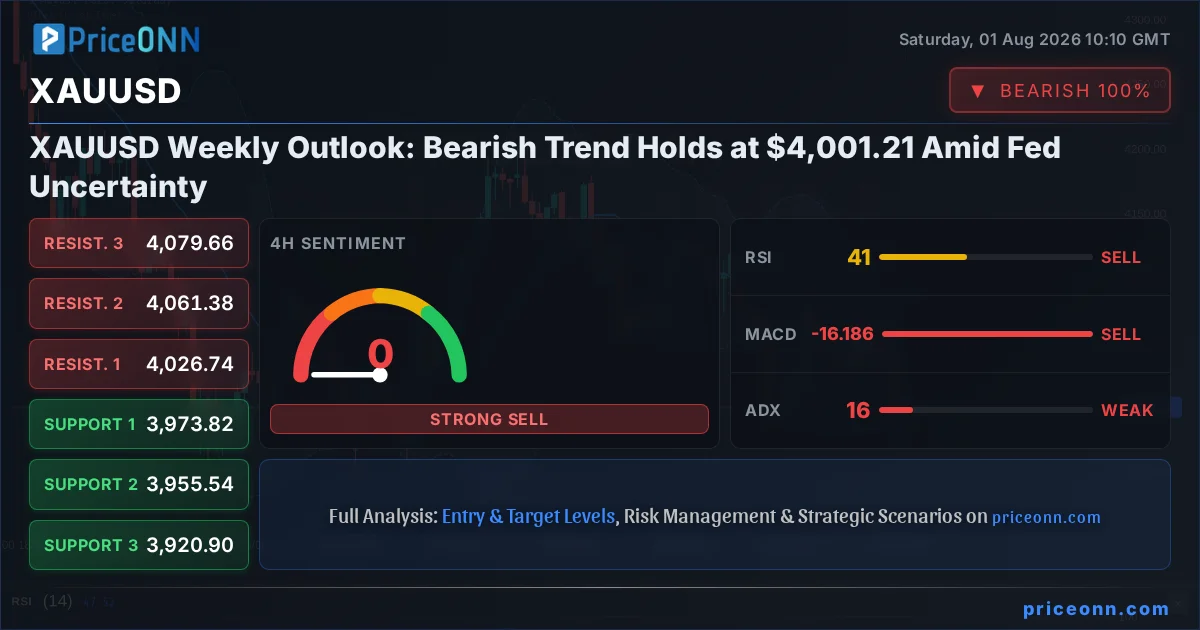
The battleground for gold is clearly defined this week, with bulls and bears fiercely contesting the $4,001.21 level. As we wrap up the trading week, the overriding narrative for XAUUSD is one of a persistent bearish trend, despite a choppy market environment indicated by a relatively low ADX of 15.79. This suggests that while the overall direction leans downwards, the conviction behind the moves is not yet overwhelming, creating a challenging landscape for traders. The upcoming week's outlook hinges on key economic data releases and geopolitical developments that could either reinforce the current downtrend or spark a significant shift in sentiment. Understanding the interplay between these factors and the technical signals is crucial for navigating the gold market.
- XAUUSD is showing a bearish trend with the current price at $4,001.21, down 1.46% for the week.
- The ADX reading of 15.79 on the 4-hour chart indicates a weak trend, suggesting a choppy market.
- Key support is observed at $3,991.80, while resistance is eyed at $4,019.21.
- DXY strength at 100.7 is putting downward pressure on gold, reflecting risk aversion and fading Fed rate cut expectations.
The past week has been a testament to the complex forces shaping the gold market. We saw a significant daily drop of -1.46% (-$59.19) in XAUUSD, pushing the price to $4,001.21. This move occurred within a daily range of $3,973.8 to $4,065.47, highlighting intraday volatility that often accompanies periods of uncertainty. The 1-hour chart paints a picture of a neutral trend with a strong downward inclination, as indicated by an RSI of 37.81 and negative MACD momentum. The Stochastic oscillator, however, offers a glimmer of a potential upward signal (%K > %D), a divergence that warrants attention but is currently overshadowed by the broader bearish sentiment.
Digging deeper into the technicals, the 4-hour timeframe reinforces the bearish narrative. The trend is decidedly down, with an 83% strength rating. Support levels are clearly defined at $3,973.82, $3,955.54, and $3,920.9, while resistance is capped around $4,026.74. The RSI at 40.59 confirms the downward bias, and the MACD remains firmly below its signal line. The Stochastic indicator here also shows a bearish signal (%K
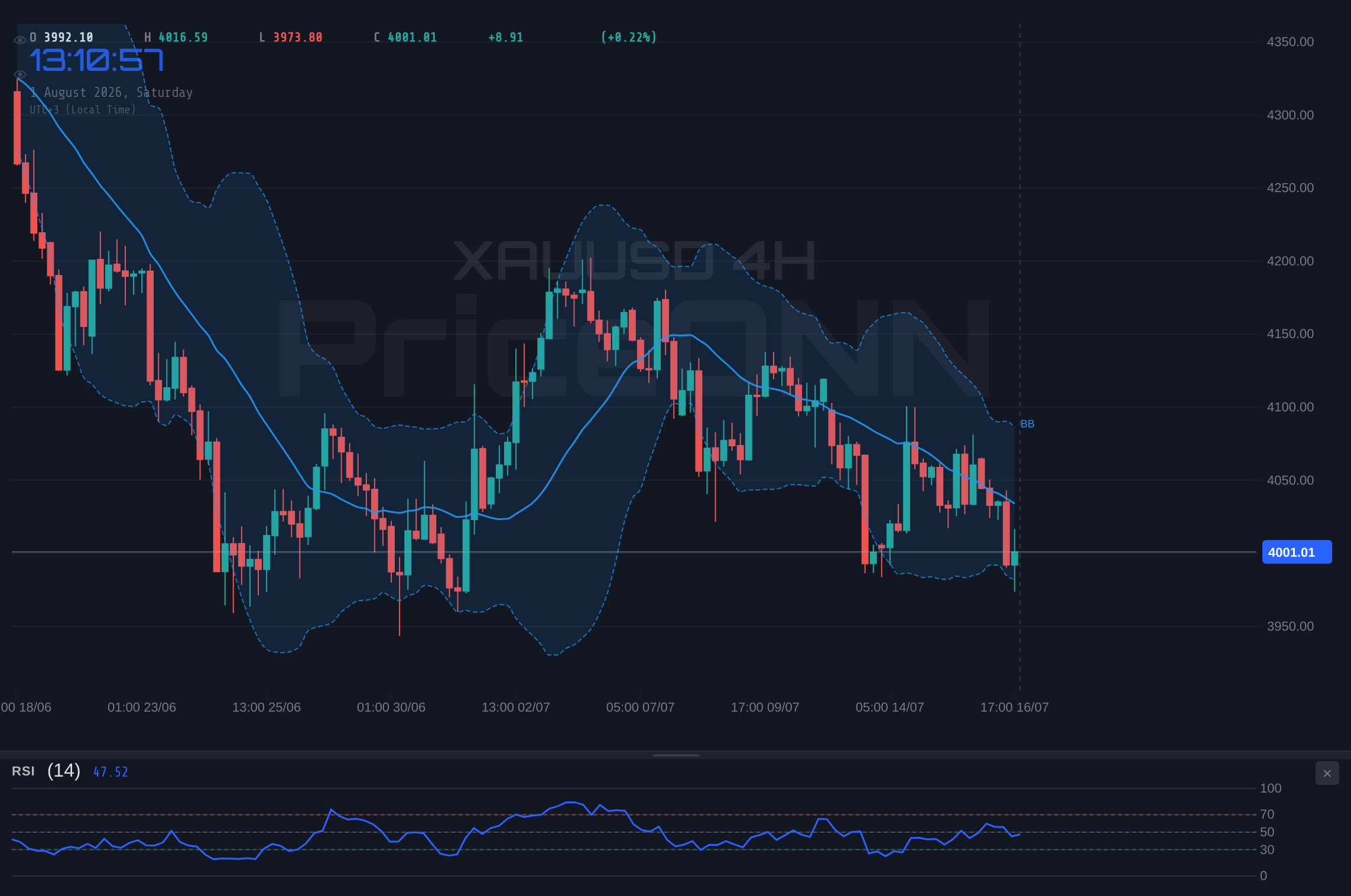
The daily chart provides the overarching view, and it strongly indicates a bearish trend with 95% strength. The RSI at 38.86 continues to hover in neutral territory but leans towards further downside. Intriguingly, the MACD on the daily chart shows positive momentum with the MACD line above its signal line, a contrast to the shorter timeframes. This divergence could be a sign of underlying strength that is not yet reflected in price action, or it could be a lagging indicator that will soon align with the shorter-term bearish signals. Bollinger Bands on all timeframes are showing the price below the middle band, reinforcing the bearish inclination. The overall signal across the daily indicators is a strong 'SELL', underscoring the prevailing sentiment among technical indicators.
The Dollar's Grip: A Major Headwind for Gold
The performance of the US Dollar Index (DXY) is inextricably linked to gold's trajectory, and this week has been no exception. With the DXY currently trading at 100.7, showing a daily increase of 0.21%, the greenback is regaining traction. This rise in the dollar is a significant headwind for gold. Historically, a stronger dollar makes gold more expensive for holders of other currencies, thus dampening demand. The recent post-Fed drop in the dollar, which briefly pushed it lower, appears to be reversing. News reports suggest that worsening geopolitical situations are expected to continue fueling inflation, which, counterintuitively in this context, seems to be bolstering the dollar as a perceived safe-haven asset, or at least as a currency less exposed to immediate geopolitical fallout compared to others. This dynamic is crucial: if the dollar continues its upward march, gold's ability to stage a meaningful recovery will be severely hampered.The interplay between central bank policies and currency strength cannot be overstated. Recent reports highlight that markets are issuing a 'yellow card' to the Fed, implying a growing skepticism about the pace or extent of future rate hikes. This reduced expectation of aggressive monetary easing by the Fed tends to strengthen the dollar, as higher interest rates make dollar-denominated assets more attractive. The fact that gold and silver are not keeping pace with the dollar's decline, as noted in market commentary, suggests that the drivers of this market move are complex. While a weaker dollar usually lifts gold, this week's decline appears to be driven by fading Fed hike bets and possibly by profit-taking, rather than a broad risk-off sentiment that would typically benefit gold as a safe haven.
Geopolitical Tensions and Inflationary Pressures
The global geopolitical landscape remains a significant factor influencing gold prices. While there have been hopes for a truce, particularly between the US and Iran, these appear to be diminishing, according to recent news. The conflict in the Middle East, as well as broader global tensions, can fuel inflation expectations. Typically, gold acts as a hedge against inflation. However, the current market seems to be prioritizing other factors, such as the strength of the dollar and shifting central bank expectations. The war in Saudi Arabia, for instance, has seen oil output decline while revenue increases, indicating a tightening market. This could eventually translate into higher energy prices and, consequently, inflationary pressures, which should theoretically support gold. Yet, the immediate price action shows gold slumping, suggesting that the inflation hedge narrative is currently taking a backseat to dollar strength and profit-taking.The energy markets, particularly oil, are a bellwether for inflation expectations. Brent crude is trading at $83.79, down 0.83% for the day, and WTI at $79.59, down 1.03%. Despite the recent dip, the underlying factors driving oil prices - such as the aforementioned geopolitical tensions and potential supply disruptions - remain. Goldman Sachs's warning about a diesel crunch being the biggest threat in oil markets underscores the potential for future price spikes. If oil prices were to rebound strongly, it could reignite inflation concerns, potentially boosting gold's appeal as an inflation hedge. However, for now, the market seems more focused on the Fed's stance and the dollar's strength.
The Bull Case: A Potential Reversal Brewing?
Despite the prevailing bearish trend, there are elements that could support a bullish reversal for XAUUSD. The divergence between the daily MACD (positive momentum) and the shorter timeframes is a key technical observation. If this positive momentum translates into price action, we could see a move higher. The Stochastic oscillator on the 1-hour chart is also showing a bullish signal (%K > %D), suggesting that while the immediate trend is down, there might be an oversold condition developing that could lead to a short-term bounce. Furthermore, the ADX reading of 15.79 across the 4-hour timeframe signifies a weak trend, meaning that the current downtrend lacks strong conviction and could be vulnerable to a reversal. A break above the immediate resistance at $4,019.21 would be the first sign of a potential shift in momentum.The broader market sentiment, while currently leaning towards risk aversion, can pivot quickly. If geopolitical tensions escalate significantly, or if upcoming economic data points towards a sharper economic slowdown than anticipated, safe-haven demand for gold could surge. The news that Gold Prices Dip Toward $4,000 Ahead Of Fed Decision last week indicates that even during periods of uncertainty, gold can find buyers. A key event to watch will be the upcoming US Non-Farm Payrolls (NFP) report. If this report shows a significant slowdown in job growth, it could increase expectations for Fed rate cuts, weaken the dollar, and consequently boost gold prices. The historical tendency for gold to act as a safe haven during times of economic distress or geopolitical uncertainty remains a powerful underlying factor that cannot be ignored.
The Bear Case: Technicals and Fundamentals Aligning Downwards
The arguments for a continued bearish trend in XAUUSD are substantial, drawing strength from both technical indicators and fundamental drivers. The daily signal across most timeframes is a strong 'SELL'. The RSI on the 1-hour (37.81), 4-hour (40.59), and daily (38.86) charts all indicate downward pressure, with readings below 50 and leaning towards oversold territory. The MACD on the 1-hour and 4-hour charts shows negative momentum, confirming the selling pressure. Bollinger Bands consistently show the price below the middle band, suggesting a bearish bias across different timeframes. The dominant 'SELL' signals from technical indicators, combined with the strengthening dollar (DXY at 100.7) and fading Fed hike expectations, create a compelling case for further downside.The narrative from recent market news also supports the bearish outlook. Reports explicitly state 'Gold Slumps Amid Diminishing Signs Of Near-Term U.S.-Iran Truce, Profit Taking' and 'Gold Prices Decline As Fed Uncertainty Weighs'. This suggests that the immediate catalysts for a gold rally are weakening, while factors that pressure gold - like dollar strength and uncertainty about Fed policy - are gaining prominence. The fact that gold and silver are not benefiting from a falling dollar, as highlighted by analysis, indicates a potential shift in market dynamics where the dollar's strength is overriding traditional safe-haven flows. This suggests that the market is currently pricing in a scenario where the US economy remains relatively resilient or where geopolitical risks are being absorbed differently by markets.
The Verdict: A Cautious Approach Amidst Bearish Signals
Considering the confluence of technical and fundamental factors, the immediate outlook for XAUUSD appears bearish. The consistent 'SELL' signals across multiple timeframes, the strengthening dollar, and the diminishing prospects of imminent Fed rate cuts all point towards potential further declines. The weak trend strength (ADX around 15-20) suggests that the downside may not be a straight line, and periods of consolidation or minor bounces are likely. However, the overall bias remains negative. A daily close below the key support level of $3,991.80 would be a significant confirmation of the bearish trend and could open the door for a move towards the next support at $3,976.78. Conversely, a sustained move and daily close above the resistance at $4,019.21 would be required to challenge the current bearish narrative and signal a potential reversal.The current technical condition, with an ADX of 15.79, indicates a choppy market. This means that while the overall directional signal is bearish, the trade plan needs to be cautious. A valid setup for a bearish continuation would likely require price to break decisively below the $3,991.80 support level, ideally with increasing volume and confirming signals from RSI and MACD on the shorter timeframes. Until such a break occurs, or a clear bullish divergence forms and is confirmed by a break of resistance, range-bound trading or caution is advised. Patience will be key; waiting for the market to provide clearer directional signals or for price to reach more definitive support or resistance levels will be crucial for risk management. The market always gives a second chance, especially in these uncertain times.
Navigating the Gold Market: Key Levels and Future Expectations
Looking ahead, the focus will remain on the US Dollar Index and upcoming economic data. The $4,001.21 level for XAUUSD is a critical juncture. A break below the immediate support at $3,991.80 could accelerate the decline towards $3,976.78. On the other hand, a successful defense of these lower levels, followed by a decisive move above $4,019.21, could signal a short-term reprieve. The long-term trend, however, remains under pressure as long as the dollar stays strong and Fed policy remains uncertain. Investors should closely monitor the NFP report and any further geopolitical escalations, as these could be the catalysts that either reinforce the current bearish trend or trigger a significant shift in gold's price action. The market is currently in a 'WATCH_ZONE' due to the choppy conditions, emphasizing the need for disciplined trading and risk management.Frequently Asked Questions: XAUUSD Analysis
What happens if XAUUSD breaks below $3,991.80 support?
A break below $3,991.80 on a daily close basis would confirm the bearish trend, potentially accelerating declines towards $3,976.78. This would likely be accompanied by stronger dollar sentiment and fading risk appetite.
Should I buy XAUUSD at current levels of $4,001.21 given the choppy market?
Caution is advised at current levels due to the choppy market (ADX 15.79) and bearish signals. A valid bullish setup would require a clear break above $4,019.21 resistance, with confirmation of underlying strength.
Is the RSI at 37.81 a sell signal for XAUUSD on the 1-hour chart?
An RSI of 37.81 on the 1-hour chart indicates downward momentum but is not yet oversold. While it aligns with the bearish trend, a sustained move below 30 would be a stronger signal, though it could also precede a bounce in a choppy market.
How will the upcoming NFP report affect XAUUSD this week?
A weaker-than-expected NFP report could increase Fed rate cut expectations, weaken the dollar, and boost gold prices. Conversely, a strong NFP could reinforce dollar strength and pressure gold lower, aligning with the current bearish trend.
Track markets in real-time
AI-powered analysis, technical indicators and real-time price data.
Join Our Telegram Channel
Breaking market news, AI analysis and trading signals instantly.
Join Channel