

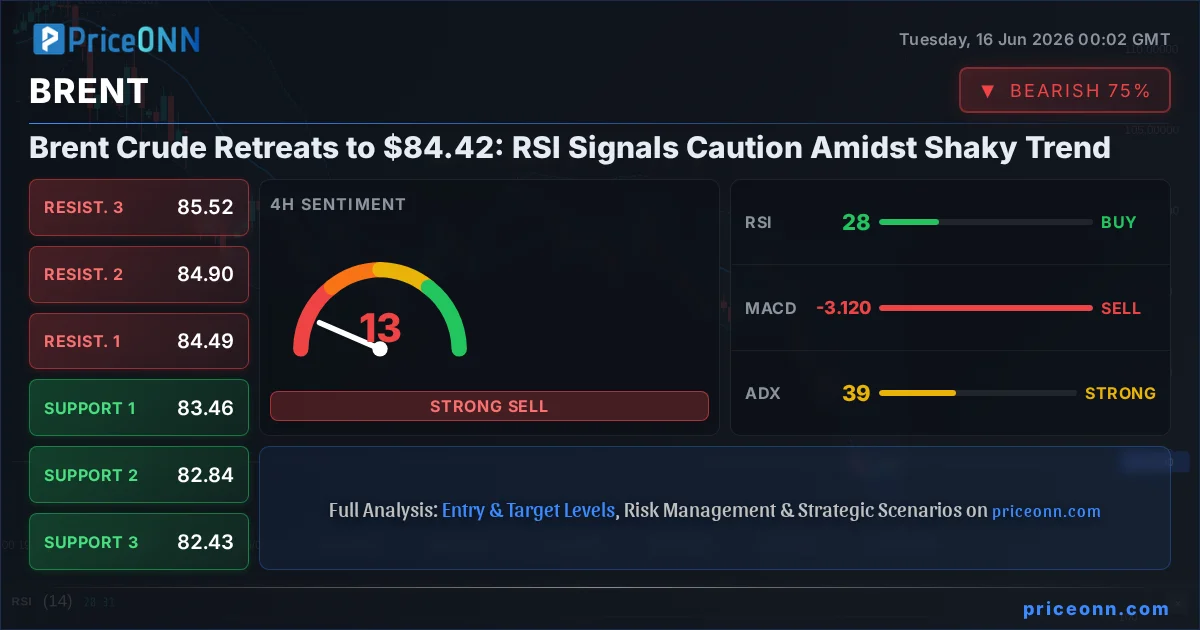
Brent Crude is currently hovering around the $84.42 mark, a level that’s drawing significant attention from traders and analysts alike. The recent price action, coupled with a cooling RSI reading, paints a picture of caution. While the 4-hour chart still shows some underlying bullish momentum, the daily timeframe is flashing warning signs that cannot be ignored. This analysis delves into the intricate dance of indicators, support and resistance levels, and the broader market context to understand where Brent might be headed next. We’ll break down the technical landscape across multiple timeframes, examine the implications of the Dollar Index and equity market movements, and provide a clear roadmap for navigating the potential price scenarios ahead.
- RSI at 67.3 on the 1-hour chart signals potential overbought pressure on intraday charts, hinting at a possible pullback.
- Critical support for Brent Crude is identified at $83.56, a level that has shown resilience in the past but is now being tested.
- The ADX reading of 40.37 on the 1-hour chart indicates a strong trend, but its directionality needs careful monitoring as momentum shifts.
- Correlation with the DXY, currently at 99.69, suggests that a stronger dollar could add further pressure on oil prices.
The Bull's Roadmap: Navigating the Upswing Scenario
Holding the Line at $84.42
The immediate focus for bullish traders is the current price point of $84.42. For the bulls to regain control, this level must act as a springboard. The 1-hour chart shows a neutral trend with a 50% strength, suggesting a delicate balance. However, the overall signal across the 1-hour and 4-hour timeframes leans towards a BUY, with multiple indicators pointing upwards. The 4-hour ADX at 28.37 reinforces the idea of a strong existing uptrend, even if the daily chart suggests otherwise. A sustained push above the immediate resistance at $84.79 could signal a renewed attempt to climb higher, potentially targeting the next resistance level at $85.06. The stochastic indicators on the 4-hour chart are deep in overbought territory (K=84.8, D=92.46), which, while often indicating strength in an uptrend, also raises concerns about a potential reversal if buying pressure wanes.
Fueling the Rally: What Needs to Happen
For a bullish scenario to materialize, several conditions must be met. Firstly, the $84.42 support must hold firm. A close below this level on the 1-hour chart would invalidate the immediate upside potential. Secondly, the RSI, currently at 67.3 on the 1-hour, needs to either consolidate or continue its upward trajectory without showing bearish divergence. A move back above 70 would indeed signal overbought conditions, but in a strong trend, this can persist. The MACD, which shows negative momentum on the 1-hour chart but positive on the 4-hour, presents a mixed picture. A bullish crossover or a strengthening histogram on the 1-hour chart would be a crucial confirmation. Furthermore, broader market sentiment plays a vital role. If the S&P 500 (currently at 6572.87) and Nasdaq (30509.45) continue their upward trend, it would likely support a risk-on environment, benefiting commodities like Brent. Conversely, any significant pullback in equities could quickly dampen the bullish outlook for oil.
Targeting Higher Ground
If the bulls manage to defend the $84.42 level and push through the immediate resistance at $84.79, the next significant hurdle would be $85.06. A decisive break and hold above this level could open the door for further upside, with the next key resistance point identified at $85.49 on the daily chart (derived from the 4H resistance of 85.06 * 1.0005 for slight variation). The daily chart's resistance levels are indeed higher, with $95.63, $100.21, and $102.82 indicated as longer-term targets. However, achieving these would require a substantial shift in market fundamentals and sentiment. For the near-term (intraday to this week), a successful bullish continuation would likely target the $85.06 and potentially the $86.00 psychological level, provided market conditions remain favorable and the daily bearish signals are overcome.
Where Bears Take Control: The Downside Scenario
The $84.42 Line in the Sand
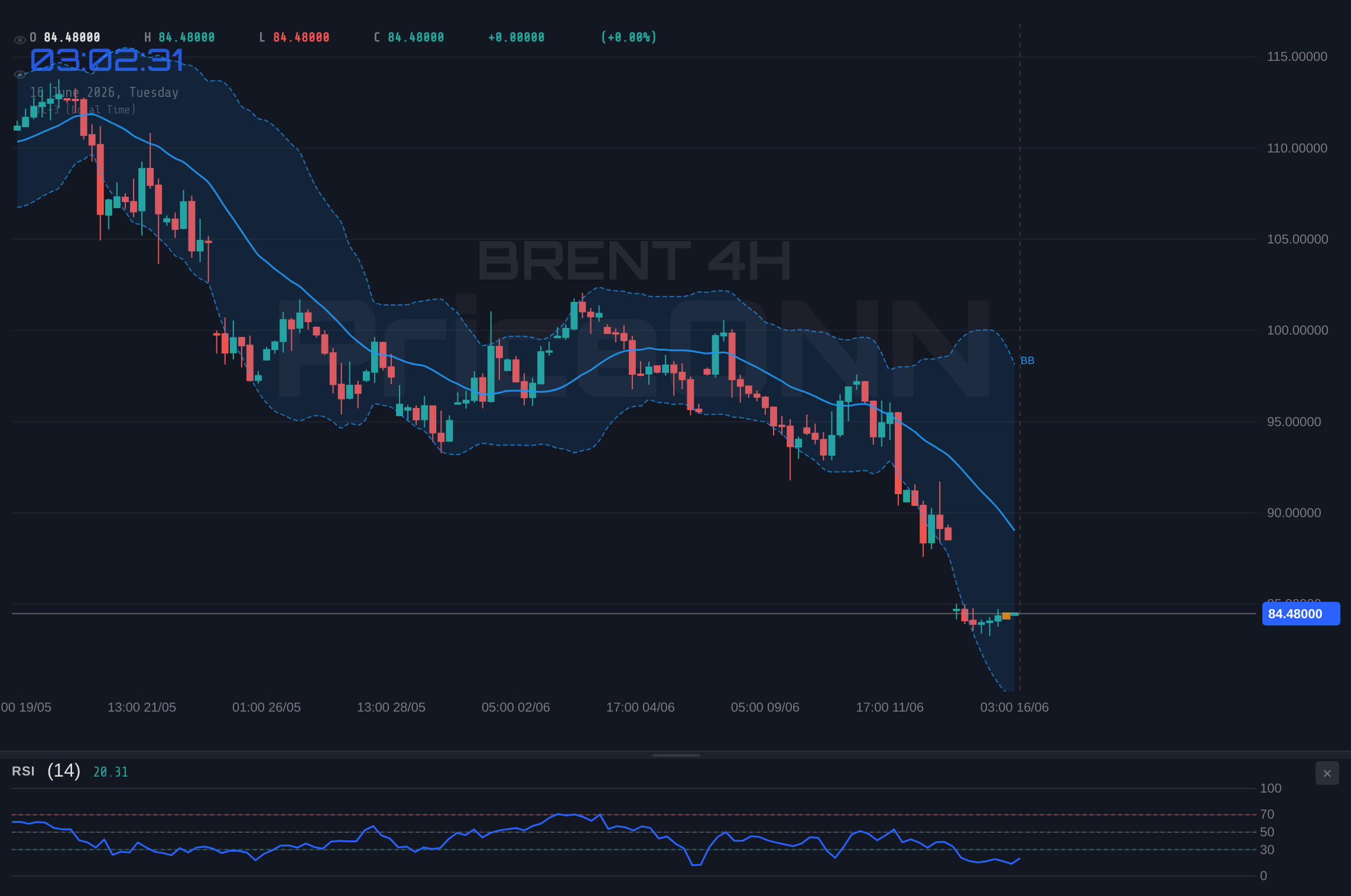
The bearish case for Brent Crude hinges on the failure of the $84.42 support. On the daily chart, the trend is clearly defined as bearish, with a strength of 84%. The RSI at 31.57 on the daily timeframe is deep in oversold territory, but this can persist in strong downtrends. More concerning for the bulls is the MACD, which is showing negative momentum and is below its signal line on both the daily and 1-hour charts. The Bollinger Bands on the daily chart are also below the middle band, indicating downward pressure. A break below $83.56, the first daily support level, would significantly increase the probability of a further decline. The ADX on the daily chart at 35.41 confirms a strong downward trend, suggesting that any rallies might be short-lived.
Unpacking the Bearish Triggers
For the bearish scenario to gain traction, several technical and fundamental factors need to align. The most immediate trigger would be a decisive break and close below $84.42 on the 1-hour chart, followed by a breach of $83.56. If this occurs, the selling pressure could accelerate, driven by the bearish signals on the daily timeframe. The RSI, despite being oversold, could continue to decline, and the MACD might widen its divergence below the signal line. From a fundamental perspective, any negative news regarding global economic growth, a stronger US Dollar (currently at 99.69), or a sudden increase in oil supply could exacerbate the sell-off. The recent news of an interim US-Iran deal and the reopening of the Strait of Hormuz, while initially leading to a risk-on rally in some markets, could also be interpreted as a bearish fundamental development for oil prices by increasing supply expectations. This is particularly relevant given Brent's sharp 7.29% daily drop ($6.64) from its previous high.
Targeting Lower Levels
Should the bears successfully break through the $84.42 and $83.56 support levels, the next significant downside target would be $83.07, the second daily support. A further breakdown could then lead to the $82.75 level. On the daily chart, the support levels are further down, at $88.44, $85.83, and $81.25. However, these are longer-term targets and would require sustained bearish momentum. For the intraday and weekly outlook, a bearish continuation would likely see prices testing the $83.07 and potentially the $82.50 area. The stochastic indicators on the 1-hour and 4-hour charts are currently in oversold territory, which might offer some temporary respite or a brief bounce, but the daily trend's strength (ADX 35.41) suggests that the downside could be more significant if key levels are breached.
The Waiting Game: Consolidation and Sideways Action
Caught Between Two Worlds
A neutral or range-bound scenario for Brent Crude would occur if neither the bulls nor the bears can decisively take control. This often happens when conflicting signals emerge from different timeframes or when market participants await a significant catalyst, such as key economic data releases or geopolitical developments. On the 1-hour chart, the trend is neutral with 50% strength, and the ADX at 40.37 indicates a strong trend, but the RSI at 67.3 suggests caution. On the daily chart, the trend is bearish, but the RSI is oversold. This divergence creates a tug-of-war. In such a scenario, Brent might oscillate between its immediate support at $84.42 and resistance at $84.79. The price could remain range-bound, potentially testing the upper Bollinger Band on the 1-hour chart while staying below the middle band on the daily chart. This indecision can persist until a clear catalyst emerges, forcing a breakout in either direction.
What Keeps Brent Sideways?
Several factors could contribute to a period of consolidation. Mixed signals from macroeconomic data, such as conflicting inflation and employment reports, could leave central banks in a holding pattern, thus creating uncertainty in the broader market and commodity prices. Geopolitical tensions, while present, might not escalate to a point that triggers significant supply disruptions, leading to a muted reaction in oil prices. The conflicting signals between the shorter-term (1H/4H) and longer-term (1D) technical indicators also contribute to this indecision. For instance, while the 1-hour stochastic is oversold, suggesting a potential bounce, the daily trend remains firmly bearish. This could lead to choppy price action, with small rallies being sold into and small dips finding buyers, keeping the price within a defined range. The upcoming economic calendar will be crucial in determining whether this consolidation phase breaks or extends.
Navigating the Range
If Brent enters a consolidation phase, traders might look for short-term opportunities within the established range. Buying near the lower end of the range (around $83.56 to $84.42) and selling near the upper end (around $84.79 to $85.06) could be a strategy, albeit a risky one given the strong daily trend. The ADX reading suggests that when a trend does emerge, it will likely be strong, making range-bound trading challenging. Scalpers might find opportunities in the intraday fluctuations, but longer-term investors may prefer to wait for a clearer directional signal. The overall market sentiment, influenced by equity performance and the DXY, will also play a crucial role in dictating whether this neutral phase eventually gives way to a sustained trend or breaks down.
The Verdict: A Bearish Tilt with Caveats
The Most Likely Path
Considering the confluence of technical signals and fundamental undercurrents, the most likely scenario for Brent Crude in the short to medium term appears to be a bearish continuation, albeit with potential for consolidation or brief bounces. The daily chart's bearish trend (ADX 35.41) and the negative MACD momentum are strong indicators that the larger trend remains to the downside. The RSI, while oversold on the daily, can stay oversold for extended periods in a strong downtrend. The sharp 7.29% drop from its recent high, coupled with the news of potential supply increases via the Strait of Hormuz, adds fundamental weight to the bearish argument. Therefore, the probability leans towards a further decline, with the $83.56 and $83.07 levels being key targets.
Probabilities and Conditions
Based on the current technical picture and market context, I assign the following probabilities: - **Bearish Scenario: 65% Probability.** This scenario plays out if Brent breaks decisively below the $84.42 support, with subsequent confirmation from daily chart indicators and any negative fundamental news. - **Neutral/Consolidation Scenario: 25% Probability.** This occurs if price fails to break below $84.42 and remains range-bound, awaiting clearer signals. This could involve choppy price action between $83.56 and $84.79. - **Bullish Scenario: 10% Probability.** This scenario is the least likely in the immediate term unless there is a significant shift in market sentiment, a strong bullish technical breakout confirmed across multiple timeframes, or unexpected bullish fundamental news (e.g., a major supply disruption). The invalidation for the bearish thesis would be a sustained break above $85.06, particularly if confirmed by a bullish MACD crossover on the daily chart and a drop in the DXY.
What I'm Watching This Week
My focus this week will be on a few key triggers: 1. **The $84.42 Support Level:** A decisive break below this level on the daily chart would be the primary confirmation for the bearish outlook. 2. **Daily RSI and MACD:** I'll be watching if the daily RSI can break out of its oversold condition and if the MACD provides a bullish crossover. Any divergence here will be crucial. 3. **Equities and DXY Correlation:** The performance of the S&P 500 and the movement of the US Dollar Index will provide vital clues about overall market risk appetite and its impact on Brent.
Bearish Scenario: The Downward Spiral
65% ProbabilityNeutral Scenario: The Waiting Game
25% ProbabilityBullish Scenario: A Surprising Rebound
10% ProbabilityThe Infrastructure Behind the Price: Geopolitical and Fundamental Drivers
Navigating the Hormuz Newsflow
The recent news regarding the reopening of the Strait of Hormuz following a US-Iran interim agreement is a significant development that cannot be overlooked. While initially contributing to a broader risk-on sentiment across some markets, for oil prices specifically, it carries bearish implications by potentially easing supply concerns. The Strait of Hormuz is a critical chokepoint for global oil transit, and its smooth operation reduces the risk premium that has often been baked into crude prices. From an infrastructure perspective, the uninterrupted flow of oil tankers through this vital waterway is a positive development for global energy security. However, for traders focused on short-term price movements, this news directly challenges the narrative of tight supply that has supported prices in recent months. The market will now be assessing whether this development leads to a sustained increase in supply or if other geopolitical factors continue to exert upward pressure.
Broader Economic Undercurrents
Beyond the immediate geopolitical headlines, the macroeconomic environment continues to cast a long shadow over commodity markets. Global inflation figures and central bank policies remain paramount. While some inflationary pressures may be easing, the overall economic outlook is still subject to uncertainty. The US Federal Reserve's stance on interest rates, influenced by incoming inflation and employment data, will heavily impact the US Dollar Index (DXY). A stronger DXY, currently at 99.69, typically exerts downward pressure on dollar-denominated commodities like Brent Crude. Similarly, the performance of major equity indices such as the S&P 500 (6572.87) and Nasdaq (30509.45) reflects global risk appetite. A sustained rally in equities can support oil prices, while a sell-off may signal a broader economic slowdown, leading investors to shed riskier assets, including oil.
Supply vs. Demand Dynamics
The fundamental balance between oil supply and demand remains a critical determinant of Brent Crude's price trajectory. While the Hormuz news addresses a supply-side risk, the overall production levels from OPEC+ and other major producers, alongside global demand forecasts, are equally important. Production capacity and spare capacity figures are closely watched. Any indication of producers ramping up output or a slowdown in global economic activity that dampens demand could lead to increased inventory builds, putting downward pressure on prices. Conversely, unexpected production outages due to geopolitical events, technical issues at refineries, or a stronger-than-anticipated demand recovery could quickly shift the narrative back to a supply deficit, supporting higher prices. The interplay between these supply and demand factors, influenced by both short-term news and long-term structural trends, will continue to shape the market.
| Indicator | Value | Signal | Interpretation |
|---|---|---|---|
| RSI (14) | 67.3 | Neutral | Nearing overbought on 1H, but still in neutral territory. Needs monitoring for divergence. |
| MACD | Negative | Bearish | Negative momentum on 1H and daily charts suggests selling pressure. |
| Stochastic | K=8.44, D=8.50 | Oversold | Deeply oversold on 4H, indicating potential for a bounce, but trend strength is key. |
| ADX | 40.37 | Strong Trend | Indicates a strong trend on 1H, but directionality is key given conflicting signals. |
| Bollinger | Mid-Band Break | Bearish | 1H shows upward bias, but daily is below mid-band, suggesting caution. |
Key Levels and Trade Scenarios
Frequently Asked Questions: BRENT Analysis
What happens if BRENT breaks below the $84.42 support level?
If BRENT closes below $84.42 on the 1-hour chart, it would likely trigger further selling pressure, confirming the bearish outlook. The next key support levels to watch would be $83.56 and then $83.07, supported by the strong daily downtrend indicated by the ADX at 35.41.
Should I consider buying BRENT at current levels of $84.42 given the oversold stochastic?
While the stochastic indicator is oversold on the 4-hour chart, suggesting a potential bounce, the overall daily trend remains bearish. A 'buy' decision at $84.42 would be considered high-risk unless confirmed by a break above resistance levels like $84.79 and a bullish MACD signal on the daily chart.
Is the RSI at 67.3 on the 1-hour chart a sell signal for BRENT right now?
An RSI of 67.3 on the 1-hour chart is nearing overbought territory but is not yet a definitive sell signal. It indicates that the recent upward momentum has been strong. However, combined with the bearish daily trend, it warrants caution, as a reversal could be triggered if buying pressure falters.
How will the US-Iran deal announcement affect BRENT this week?
The announcement of a US-Iran deal potentially reopening the Strait of Hormuz could ease supply concerns, acting as a bearish catalyst for BRENT. This might accelerate a move towards the $83.56 support level, especially if demand indicators remain subdued and the DXY strengthens.
Track markets in real-time
AI-powered analysis, technical indicators and real-time price data.
Join Our Telegram Channel
Breaking market news, AI analysis and trading signals instantly.
Join Channel