

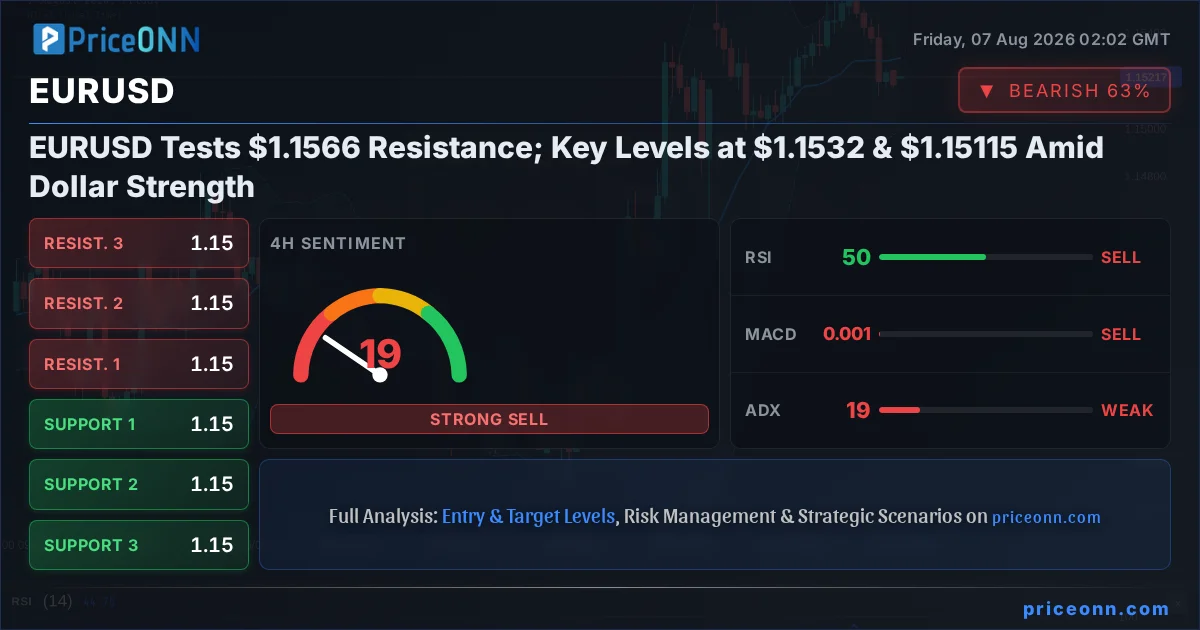
The tug-of-war at the $1.15 mark for EURUSD intensified this week. As the US dollar, measured by the DXY index, flexes its muscles near 100, the single currency finds itself at a crucial juncture. Will the bulls manage to push EURUSD decisively above the $1.1566 resistance, or will the persistent dollar strength, fueled by shifting Federal Reserve expectations, drag the pair lower towards the $1.1532 support? This analysis delves into the competing forces shaping EURUSD's immediate future, examining the fundamental drivers, technical signals, and market sentiment that traders are closely watching.
- RSI at 38.63 on the 1H chart signals bearish pressure, while the 1D chart shows a 58.27 RSI with a bullish inclination.
- Critical support for EURUSD is identified at $1.1532, with further levels at $1.15115 and $1.14982.
- Resistance is observed at $1.15658, with a key upper bound at $1.15996.
- The DXY index at 99.98 is strengthening, correlating with downward pressure on EURUSD.
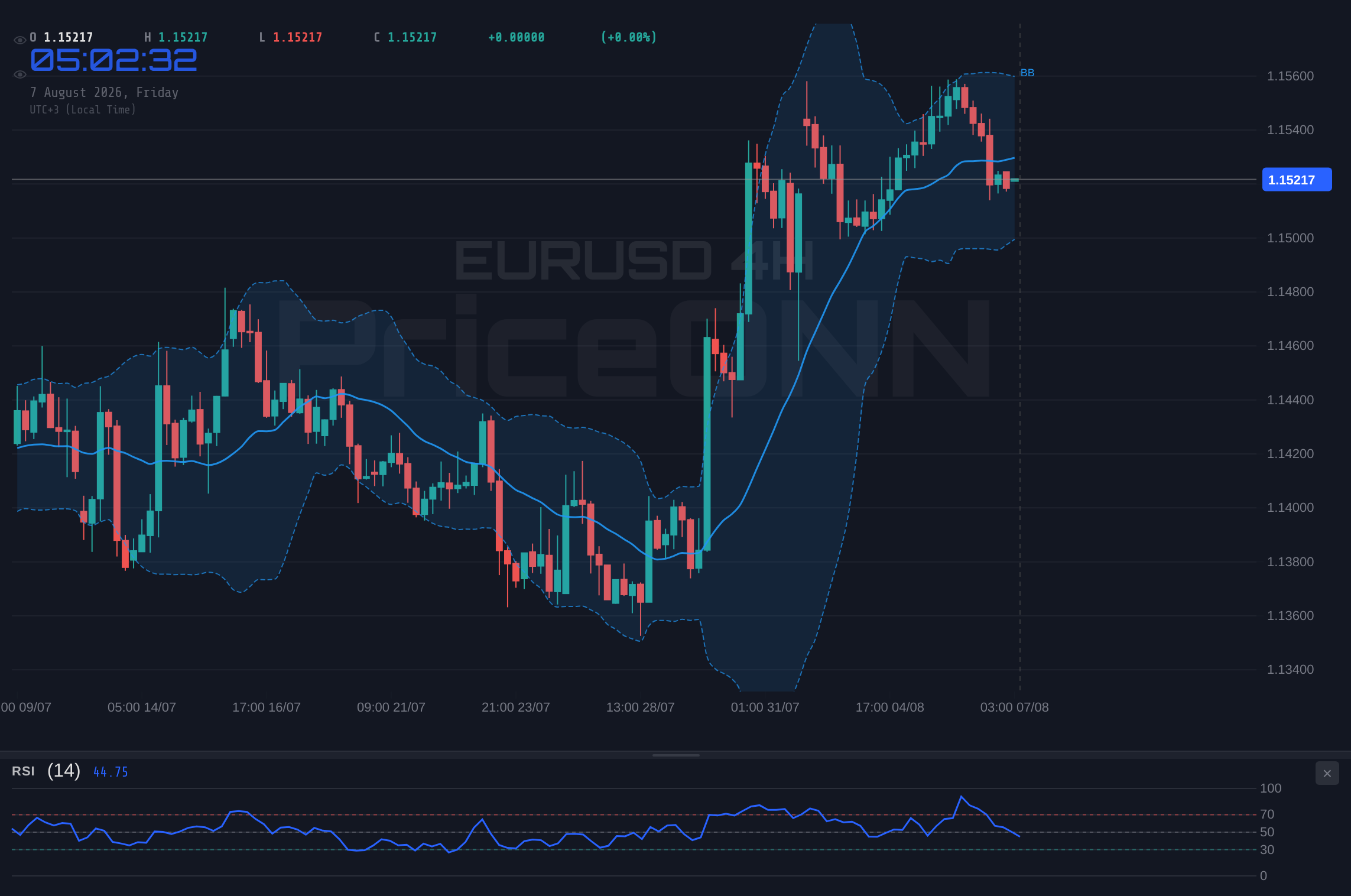
The battleground for EURUSD is clearly defined around the 1.15 handle. On the 1-hour chart, the pair is showing signs of bearish momentum, with an RSI reading of 38.63 suggesting room for further downside before hitting oversold territory. This is corroborated by negative MACD momentum and a general sell signal across shorter timeframes. However, the longer-term daily chart paints a different picture, with an RSI of 58.27 and a strong bullish ADX of 25.71, indicating that underlying strength might still be present. This divergence across timeframes is a classic sign of market indecision, where short-term traders are selling into rallies while longer-term players might be accumulating on dips. The current price action around $1.15217 reflects this tug-of-war, with the market struggling to commit to a clear direction.
The overarching narrative continues to be dominated by the US dollar's resurgence. With the DXY index hovering around 99.98 and showing a strong upward trend on the 1-hour chart (ADX 27.49), the greenback is acting as a magnet for capital seeking safety or yield. This strength is a direct headwind for EURUSD. Typically, a rising DXY puts downward pressure on major currency pairs, and EURUSD is no exception. The fact that the DXY is currently trading above its 1-hour middle Bollinger band and showing a general 'AL' (Buy) signal across its shorter timeframes suggests that dollar strength might persist in the immediate term, posing a challenge for euro bulls.
The Bull Case: Can the Euro Find Its Footing?
Despite the prevailing dollar strength, there are arguments to be made for a potential rebound in EURUSD. The daily chart, in particular, offers some comfort to the bulls. The RSI at 58.27, while not in overbought territory, indicates a healthy upward bias. Furthermore, the Stochastic Oscillator on the daily timeframe is showing a strong bullish signal with %K at 88.62 and %D at 85.95, suggesting that the pair is in or approaching overbought conditions, which on a daily chart can precede further upside momentum if a breakout occurs. The ADX on the daily chart, though at 25.71, still points to a strong upward trend, which could reassert itself if the bulls can defend key support levels.
The macroeconomic backdrop, while currently favoring the dollar, isn't entirely devoid of euro-positive elements. Recent news highlighted that the Euro and Pound held gains against the dollar following the Fed meeting, suggesting that perhaps some of the earlier hawkish sentiment priced into the dollar might be starting to ebb. If market participants begin to anticipate a less aggressive Fed stance going forward, or if European economic data starts to show unexpected resilience, the euro could find a renewed bid. For instance, any upside surprises in upcoming Eurozone PMI or inflation data could provide a much-needed catalyst for a move higher, potentially challenging the resistance levels identified at $1.15658 and above.
From a technical perspective, the bulls are looking to defend the $1.1532 support level. This is a crucial psychological and technical point. A failure to hold this level could invite further selling pressure, but a successful defense here, perhaps accompanied by a volume surge, could signal the market's readiness to absorb selling and push higher. The $1.15115 and $1.14982 levels represent deeper support zones, acting as potential bounce points if the initial defense at $1.1532 fails. However, the immediate focus remains on whether the pair can recapture the territory above $1.1532 and aim for the $1.15658 resistance. A sustained move above this resistance, especially on increasing volume, would be a strong signal for a continuation of the bullish trend observed on the daily chart.
The Stochastic on the daily chart reaching 88.62/85.95 is a significant bullish signal, often preceding a strong move higher. However, the concurrent bearish signals on shorter timeframes and the strong DXY present a clear conflict. Bulls need to see a decisive break and hold above $1.15658, ideally with confirming volume, to invalidate the short-term bearish momentum.
The Bear Case: Dollar Dominance and Macro Headwinds
On the flip side, the bears have a compelling narrative, largely driven by the persistent strength of the US dollar and the technical picture on shorter timeframes. The 1-hour chart's RSI at 38.63 and negative MACD momentum are clear indicators of selling pressure. The Stochastic on the 1-hour chart also shows a bearish signal with %K below %D, reinforcing the idea that the immediate trend is downwards. This suggests that any rallies are likely to be met with selling, especially as the pair approaches resistance levels.
The DXY's current position around 99.98, with a strong bullish trend on the 1-hour chart, is a significant obstacle for EURUSD bulls. The correlation between the dollar index and EURUSD is typically inverse, meaning a stronger dollar generally leads to a weaker EURUSD. As long as the DXY maintains its upward trajectory and shows bullish signals across multiple timeframes, it will continue to exert downward pressure on the euro. The general 'AL' signal for the DXY on its 1-hour chart further supports the idea that dollar strength is the dominant theme currently.
Fundamentally, the narrative around the Federal Reserve continues to be a key driver. While the recent Fed meeting might have been perceived as less hawkish than some feared, underlying economic data from the US, such as employment figures, has remained relatively robust. This resilience in the US economy supports the argument for the Fed to maintain a tighter monetary policy for longer, or at least delay any significant rate cuts. This divergence in monetary policy expectations between the Fed and the European Central Bank (ECB) could continue to favor the dollar. Any signs of weakening economic data in the Eurozone, or a more dovish tilt from the ECB, would further bolster the bearish case for EURUSD.
The immediate technical downside targets for the bears are clear. A break below the $1.1532 support level would be a significant bearish development, opening the door for a move towards $1.15115 and potentially $1.14982. The ADX on the 1-hour chart at 32.8 indicates a strong downtrend is in play on this timeframe, suggesting that a break of support could accelerate. The general 'SAT' (Sell) signal across the 1-hour and 4-hour timeframes for EURUSD further reinforces this bearish outlook. The bears are likely looking for confirmation of a sustained move below $1.1532 to initiate or add to short positions.
The Stochastic Oscillator on the 1D chart reaching 88.62/85.95 is a strong sign of an overbought condition. While this can precede further upside, it also means the pair is vulnerable to a sharp pullback or reversal if key support levels fail. Traders should be wary of chasing rallies without clear confirmation from price action and volume.
Navigating the Uncertainty: What to Watch Next
The current market environment for EURUSD is characterized by conflicting signals across different timeframes and a strong dollar narrative. The key levels to watch are undoubtedly $1.1532 for support and $1.15658 for resistance. A decisive break and sustained move above $1.15658, supported by increasing volume and positive divergence in short-term indicators, could signal a continuation of the daily bullish trend. Conversely, a break and close below $1.1532, especially with strong dollar momentum and bearish technicals on shorter timeframes, would likely lead to further downside towards $1.15115.
The upcoming economic calendar will be crucial in shaping the direction. For the Eurozone, key data releases such as inflation figures and PMI surveys will provide insights into the economic health and potential ECB policy path. For the US, employment data and inflation reports remain paramount in shaping Federal Reserve expectations. Any deviation from forecasts in these reports could significantly alter the market's perception of monetary policy, impacting the DXY and, consequently, EURUSD. The recent news regarding the Hormuz crisis and its potential impact on energy prices and global trade adds another layer of geopolitical uncertainty, which often favors safe-haven assets like the dollar, but could also introduce volatility across markets.
The interplay between the strong dollar, potential shifts in Fed policy, and Eurozone economic performance will dictate the next move. Traders should exercise caution, paying close attention to the confluence of technical levels and fundamental catalysts. The divergence in signals between the daily and hourly charts suggests that a period of consolidation or a sharp directional move is likely to resolve this ambiguity. Patience will be key; waiting for a clear breakout above resistance or breakdown below support, confirmed by volume and broader market sentiment, will be crucial for navigating this complex market environment.
Bearish Scenario: Dollar Dominance Prevails
65% ProbabilityNeutral Scenario: Range-Bound Consolidation
25% ProbabilityBullish Scenario: Euro Strength Emerges
10% ProbabilityFrequently Asked Questions: EURUSD Analysis
What happens if EURUSD breaks below the $1.1532 support level?
A break below $1.1532 would invalidate the daily bullish momentum and likely trigger further selling. The immediate downside target would be $1.15115, with a secondary target at $1.14982. This scenario is favored by continued dollar strength and bearish signals on shorter timeframes.
Should I buy EURUSD at current levels near $1.15217 given the mixed signals?
Caution is advised. While the daily chart shows bullish potential with an RSI of 58.27, the short-term charts exhibit bearish pressure. A buy signal would be stronger if price holds above $1.1532 and shows confirmation from volume or a bullish divergence on the 1-hour chart.
Is the RSI at 38.63 on the 1-hour chart a sell signal for EURUSD?
The RSI at 38.63 on the 1-hour chart indicates bearish momentum, suggesting that downward pressure is dominant in the short term. However, it's not yet in oversold territory, so it doesn't automatically signal a 'sell'. It rather suggests that rallies might face selling pressure.
How will the upcoming US employment data affect EURUSD this week?
Stronger-than-expected US employment data would likely boost the dollar (DXY), putting downward pressure on EURUSD towards $1.1532 or lower. Conversely, weaker data could ease dollar strength, potentially allowing EURUSD to test resistance near $1.15658.
Track markets in real-time
AI-powered analysis, technical indicators and real-time price data.
Join Our Telegram Channel
Breaking market news, AI analysis and trading signals instantly.
Join Channel