

The currency markets are currently a fascinating tapestry of conflicting signals, with GBPUSD finding itself at a critical juncture near the $1.35 handle. This seemingly quiet consolidation, however, belies a brewing storm of fundamental and technical pressures. Today's article delves into the intricate dance between the US Dollar Index, the latest Non-Farm Payrolls shockwave, and the simmering geopolitical tensions around the Strait of Hormuz, all while dissecting the technical landscape that dictates GBPUSD's immediate future. The narrative is shifting, and understanding these dynamics is key to navigating the choppy waters ahead.
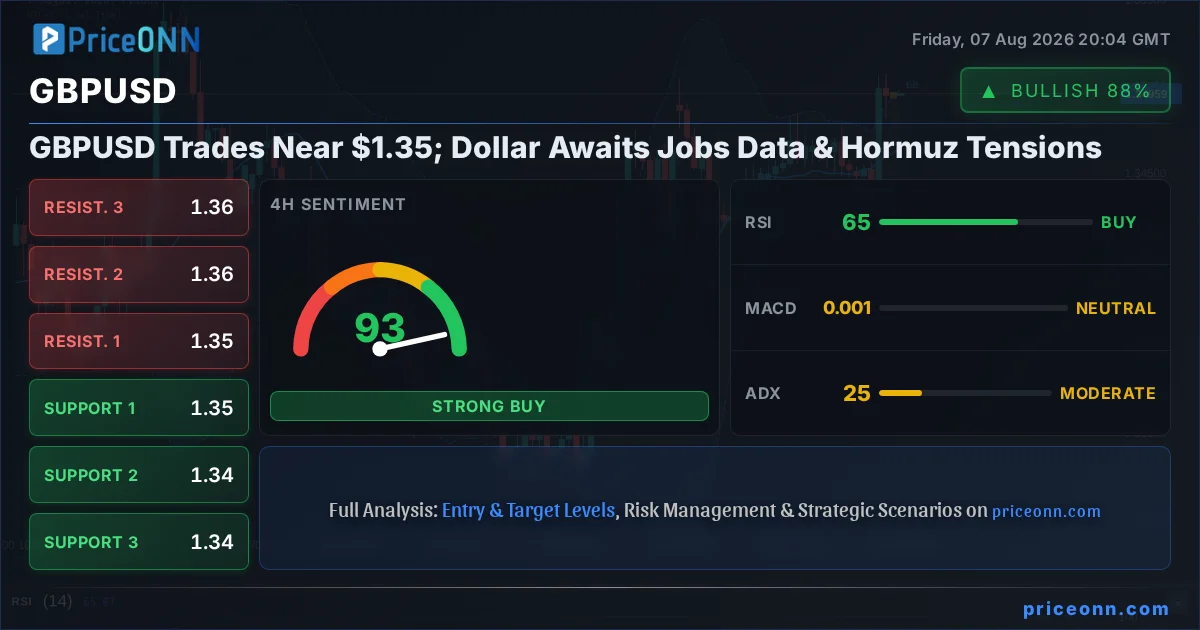
- GBPUSD is trading around $1.35, with key support at $1.3440 and resistance at $1.3510.
- The US economy unexpectedly lost 23,000 jobs in July, sending the Dollar Index (DXY) down to 99.58 and weakening its grip on major currency pairs.
- Gold prices surged above $4,300 following the weak jobs report, highlighting a flight to safety amid rising geopolitical risks, particularly concerning the Hormuz Strait.
- Technical indicators for GBPUSD show mixed signals: RSI at 67.23 suggests potential overbought conditions, while ADX at 33.13 indicates a strong trend is still in play, creating a 'watch zone' scenario.
The economic calendar has just delivered a bombshell that has sent ripples across global financial markets: the US economy unexpectedly shed 23,000 jobs in July. This stark contrast to the projected increase of 83,000 has not only surprised analysts but has fundamentally altered the immediate outlook for monetary policy and risk appetite. For GBPUSD, currently trading around the psychologically significant $1.35 level, this data point is not just another piece of economic news; it's a potential catalyst that could redefine its short-term trajectory. The unexpected jobs data has directly impacted the Dollar Index (DXY), which has seen a notable decline, retreating from recent highs and trading near 99.58. This weakening dollar environment typically provides a tailwind for major currency pairs like GBPUSD, but the narrative is far from straightforward, especially when considering the concurrent rise in geopolitical risks.
The immediate fallout from the weak Non-Farm Payrolls (NFP) report has been palpable. The market's reaction was swift and decisive, particularly concerning the Federal Reserve's monetary policy stance. With employment figures contracting, the probability of an aggressive September rate hike has diminished significantly, creating a more dovish sentiment around the US dollar. This shift is crucial for GBPUSD, as it directly influences the interest rate differential between the UK and the US. A less hawkish Fed implies potentially slower interest rate hikes, or even a pause, which can reduce the dollar's attractiveness relative to other currencies, including the British Pound. The DXY's move below the 100 mark underscores this sentiment. However, the story doesn't end with interest rate expectations. The surge in gold prices, crossing the $4,300 threshold, is a clear indicator of increasing risk aversion in the market. This isn't solely driven by the jobs data; it's amplified by escalating geopolitical tensions, particularly the ongoing crisis surrounding the Strait of Hormuz. This complex interplay of factors creates a challenging environment for predicting GBPUSD's next move, demanding a careful blend of fundamental and technical analysis.
Navigating the Geopolitical Crosscurrents: Hormuz and Market Sentiment
The situation in the Strait of Hormuz has escalated dramatically, effectively closing this vital chokepoint for global energy trade. Reports of continued Iranian attacks on vessels have cast a long shadow over energy markets and broader geopolitical stability. This development adds a significant layer of uncertainty, acting as a potent driver for safe-haven assets. Gold's impressive rally above $4,300 is a direct consequence of this rising risk premium. For GBPUSD, this geopolitical backdrop introduces a divergence in potential market movements. On one hand, a weakening dollar due to dovish Fed expectations could support the pair. On the other hand, heightened global tensions often lead to a 'risk-off' sentiment, where investors flock to perceived safe havens, potentially benefiting currencies like the USD (despite its current weakness) or CHF, while putting pressure on riskier currencies or those more exposed to global trade disruptions. The fact that gold is surging while the dollar is weakening simultaneously highlights the complex, multi-faceted nature of current market drivers. This makes it imperative to watch how these competing forces resolve themselves, especially as traders await further clarity on the geopolitical front and potential policy responses.
The impact of these geopolitical shifts cannot be overstated. The closure of the Strait of Hormuz has immediate implications for global oil supply and, consequently, inflation expectations. Higher energy prices, if sustained, could force central banks to reconsider their policy paths, potentially reigniting inflation concerns that were thought to be subsiding. This creates a conundrum for the Federal Reserve and other major central banks. The weak US jobs report suggests a need for caution and potentially looser policy, but rising energy prices could introduce inflationary pressures that necessitate a tighter stance. This policy dilemma can lead to increased volatility across currency markets. For GBPUSD, this means the fundamental picture is far from clear. While the immediate reaction to the jobs data favors Sterling strength against a weaker dollar, the looming threat of sustained geopolitical instability and its impact on inflation could quickly shift the balance. Traders are now tasked with weighing the immediate implications of a dovish Fed against the longer-term risks of escalating global conflict and its potential to disrupt supply chains and reignite inflationary fires.
GBPUSD: A Technical Tightrope Walk Near $1.35
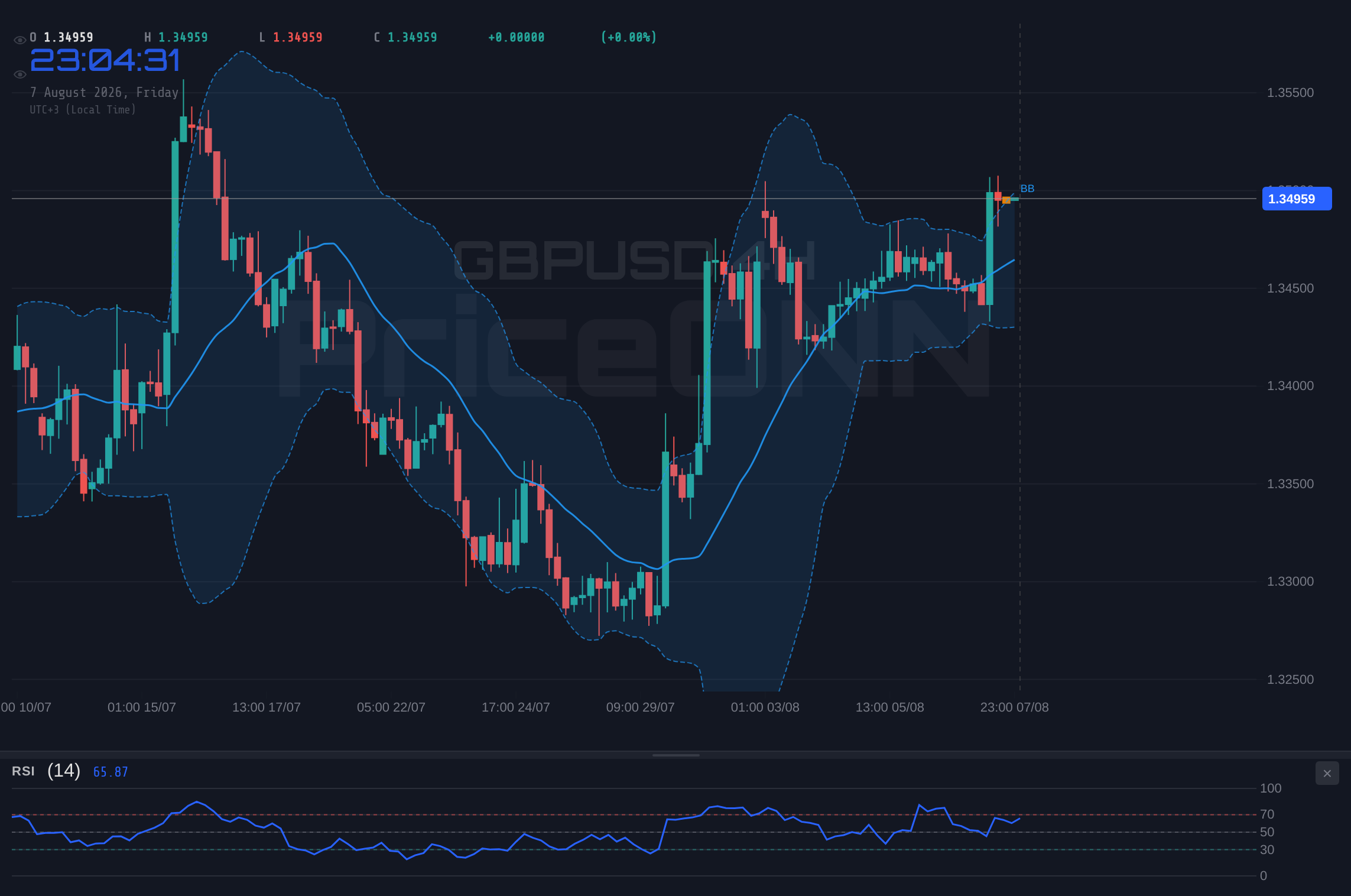
Against this backdrop of shifting economic data and geopolitical uncertainty, the technical picture for GBPUSD presents a nuanced challenge. The pair is currently hovering precariously around the $1.3500 mark. On the 1-hour chart, the trend is described as neutral with a strength of 50%, indicating a lack of clear direction in the very short term. However, the RSI(14) at 67.23 on the 4-hour timeframe and 65.82 on the daily chart suggests that the recent upward momentum has pushed the pair into elevated territory, bordering on overbought conditions. This doesn't necessarily signal an immediate reversal, but it does indicate that further significant upside may require substantial buying conviction or a fresh catalyst. The ADX, however, paints a different story. On the 1-hour chart, it stands at 33.13, and on the 4-hour chart at 40.51, both indicating a strong existing trend. This divergence between RSI suggesting caution and ADX confirming trend strength creates a 'watch zone' scenario, where aggressive positioning might be premature.
Digging deeper into the intraday technicals, the 1-hour chart shows support levels at $1.34928, $1.34872, and $1.34839, while resistance is noted at $1.35017, $1.35050, and $1.35106. These are tight bands, suggesting that any move outside this range could initiate a more defined price action. The Stochastic Oscillator on the 1-hour chart shows K=84.45 and D=81.14, indicating an overbought condition and a potential bearish signal as %K is above %D. This aligns with the RSI readings but contrasts with the strong ADX trend. On the daily timeframe, the ADX at 19.71 suggests a weaker trend, which is somewhat at odds with the 1-hour and 4-hour readings. This inconsistency across different timeframes and indicators highlights the current indecision and the need for a clearer signal. The price action around $1.35 is therefore critical; a sustained break above the immediate resistance levels could signal a continuation of the bullish momentum, while a failure to hold above $1.3480 could invite further downside.
The Dollar's Predicament: Beyond the Jobs Report
The US Dollar Index (DXY) has been a dominant force in currency markets, but recent events have significantly challenged its upward trajectory. The unexpected negative NFP print of -23,000 jobs has been a major blow, pushing the DXY down to 99.58. This is a critical level, as it represents a significant psychological and technical barrier. Historically, such a sharp decline in employment figures would typically lead to a substantial reassessment of the Federal Reserve's monetary policy. Futures markets are now pricing in a lower probability of a September rate hike, shifting the narrative from tightening to potential easing or at least a prolonged pause. This dovish pivot is a substantial headwind for the dollar. However, the situation is complicated by the escalating geopolitical tensions in the Middle East. The closure of the Strait of Hormuz, a vital artery for global oil supply, has sent crude oil prices soaring and increased demand for safe-haven assets. While this typically supports the dollar as a safe haven, the current dynamic shows gold rallying strongly above $4,300, suggesting that investors are seeking refuge in assets other than the dollar, or that the dollar's safe-haven appeal is being overridden by the immediate impact of dovish Fed expectations.
This complex interplay means the dollar's weakness might not be a one-way street. If geopolitical risks continue to escalate, leading to sustained increases in energy prices and broader market uncertainty, investors might eventually turn back to the dollar for its perceived safety, regardless of Fed policy. The Treasury yields also play a crucial role here. While the immediate reaction to the jobs report might have put downward pressure on yields, any resurgence of inflation fears due to oil prices could push yields higher, providing some support for the dollar. Therefore, while the immediate technicals and the NFP data point towards dollar weakness, the underlying geopolitical risks and the potential for renewed inflation provide a cautionary note. For GBPUSD, this means that while the immediate environment might favor Sterling strength, the dollar's potential to regain footing under specific circumstances cannot be ignored. The $1.35 level for GBPUSD becomes even more significant in this context – a break above it could signal resilience, while a failure to hold ground could expose the pair to renewed dollar strength.
Trade Scenarios for GBPUSD: A Path Forward
Given the conflicting signals from economic data, geopolitical events, and technical indicators, the current environment for GBPUSD presents a 'watch zone' scenario. The ADX at 33.13 on the 1-hour chart and 40.51 on the 4-hour chart indicates strong trend conditions are present, but the RSI readings hovering around 65-70 suggest caution is warranted. The Stochastic Oscillator also points towards overbought conditions on shorter timeframes. This suggests that while a trend may be in place, the immediate conditions might not be ripe for a fresh entry without further confirmation or a specific trigger.
Bearish Scenario: Dollar Recovers, Geopolitical Fears Mount
60% ProbabilityNeutral Scenario: Consolidation Amidst Uncertainty
25% ProbabilityBullish Scenario: Sterling Resilience, Dollar Weakness Persists
15% ProbabilityThe current technical setup indicates that while there's a strong trend indicated by the ADX, the RSI and Stochastic oscillators are flashing caution, particularly on shorter timeframes. This suggests that the market is in a delicate balance. For a bullish scenario to gain traction, GBPUSD needs to decisively break and hold above the immediate resistance at $1.3510. This would likely require continued dollar weakness, perhaps driven by further dovish commentary from the Fed or a de-escalation of the Hormuz crisis. Conversely, a bearish scenario would be triggered by a break below the $1.3480 support level, which could be fueled by a dollar recovery, a worsening geopolitical situation, or simply a market correction after the recent rally. Given the current indecision and the presence of strong conflicting signals, a period of consolidation between $1.3480 and $1.3510 seems plausible in the short term, but the underlying forces suggest that a significant move is brewing.
The Path Ahead: What to Watch Next
Looking forward, the primary driver for GBPUSD in the immediate short term will undoubtedly be the ongoing market reaction to the US jobs data and the evolving geopolitical landscape. Any further clarification from Federal Reserve officials regarding their policy path in light of the weak NFP report will be closely scrutinized. Similarly, developments concerning the Strait of Hormuz could dramatically influence risk sentiment and, consequently, currency valuations. From a technical standpoint, the $1.3500 level remains a key psychological and price pivot. A decisive break above $1.3510 would open the door for further upside towards the $1.3526 and $1.3553 resistance levels, as seen on the 4-hour chart. However, failure to overcome this immediate resistance, especially if the dollar begins to find its footing or geopolitical tensions flare, could see GBPUSD retreating towards the $1.3480 support, with a subsequent break potentially targeting $1.3440 and $1.3409. The ADX's persistent strength across multiple timeframes suggests that when a direction does emerge, it could be swift and decisive. Traders should remain vigilant, managing risk carefully and waiting for clear confirmation before committing to significant positions. The market is at a crossroads, and the next few trading sessions will be crucial in determining the next significant move for GBPUSD.
Frequently Asked Questions: GBPUSD Analysis
What happens if GBPUSD breaks below the $1.3480 support level following the weak jobs data?
A break below $1.3480 would likely trigger a bearish scenario, targeting $1.3440 as the first key support. This would be exacerbated if the Dollar Index rebounds above 99.80 and geopolitical tensions escalate further, suggesting a flight to safety away from Sterling.
Should I consider buying GBPUSD at current levels near $1.35 given the mixed technical signals?
Entering at current levels requires caution due to RSI readings around 67. A more prudent approach would be to wait for a confirmed break above $1.3510 resistance or a clear pullback to support levels like $1.3440, coupled with confirmation from the DXY and geopolitical news flow.
Is the RSI at 67.23 a sell signal for GBPUSD, despite the strong ADX trend?
An RSI reading of 67.23 suggests overbought conditions on the 4-hour chart, indicating potential for a pullback or consolidation. However, the strong ADX reading of 40.51 confirms an underlying trend is in place, meaning the RSI signal alone isn't a definitive sell. Confirmation from price action breaking support or a shift in the DXY narrative would be needed.
How will the ongoing Hormuz crisis and its impact on oil prices affect GBPUSD this week?
Escalating Hormuz tensions could increase oil prices, potentially reigniting inflation fears and complicating the Fed's policy path. This could create broader market uncertainty, potentially benefiting the dollar as a safe haven, which would put downward pressure on GBPUSD, overriding the immediate impact of the weak jobs report.
Track markets in real-time
AI-powered analysis, technical indicators and real-time price data.
Join Our Telegram Channel
Breaking market news, AI analysis and trading signals instantly.
Join Channel