

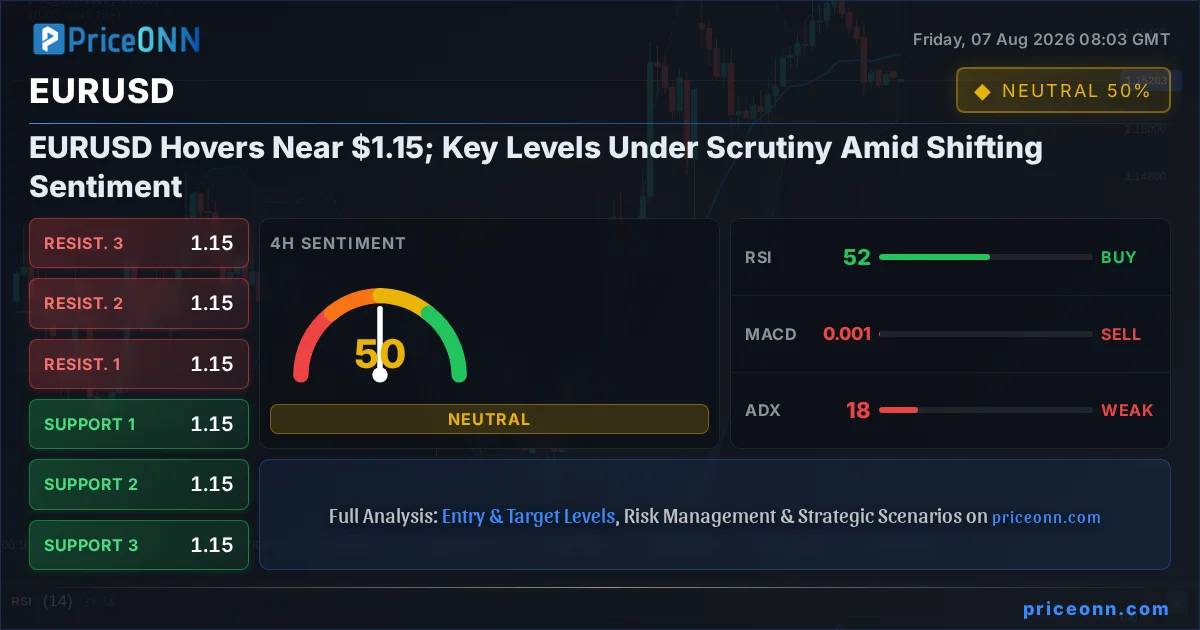
The EURUSD pair is currently navigating a critical juncture, trading precariously close to the $1.15 mark. This pivotal level, long watched by traders and analysts alike, finds itself at the heart of a complex market environment shaped by shifting geopolitical tides, evolving central bank expectations, and the ever-present influence of the US Dollar Index (DXY). While the immediate price action might appear range-bound, the underlying currents suggest a potential for significant movement as key economic indicators loom on the horizon. Understanding the interplay between macro drivers and technical signals is paramount for deciphering EURUSD's next move.
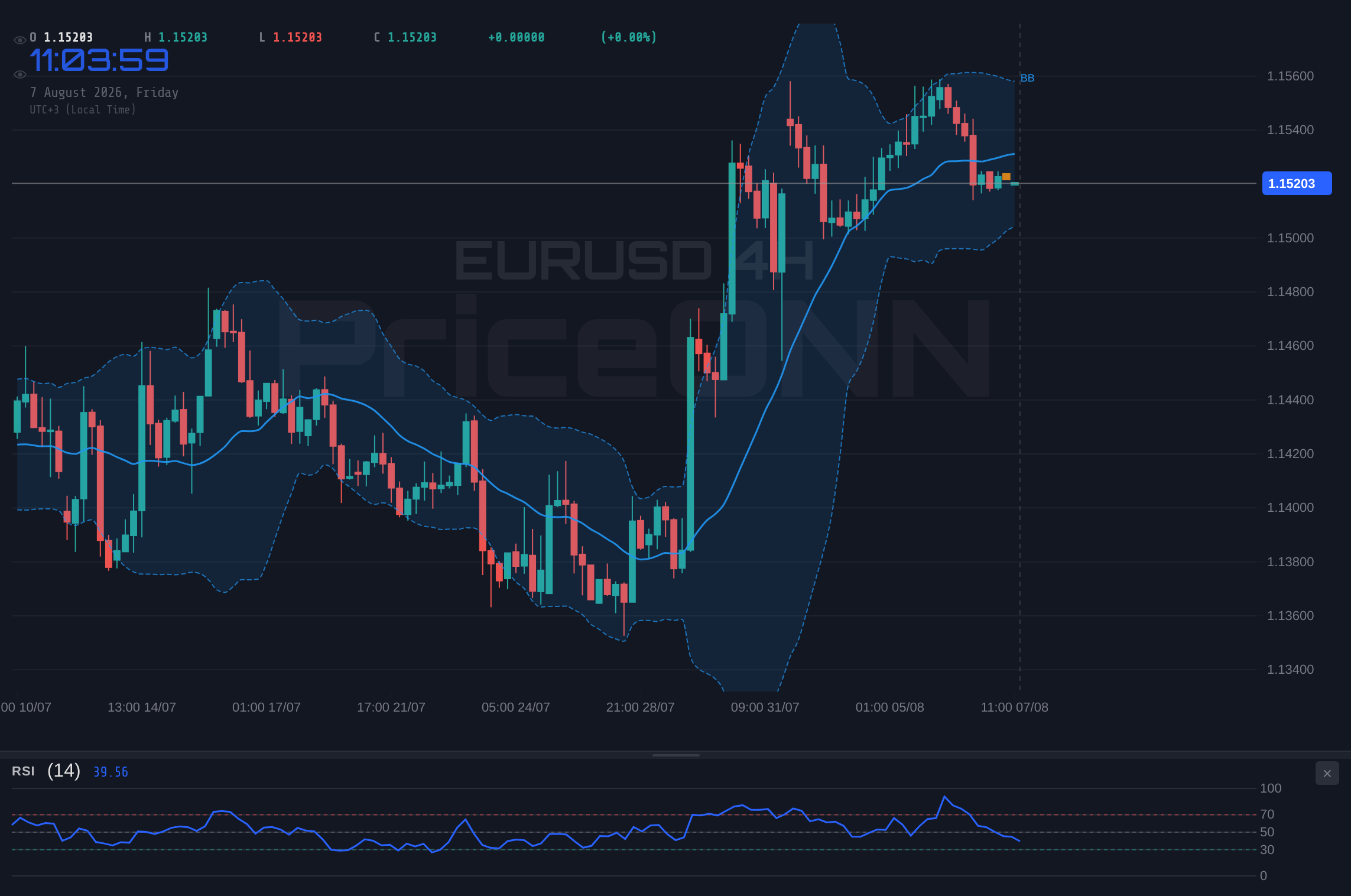
- EURUSD is trading near $1.15, with the 1-hour RSI at 40.24 indicating bearish pressure.
- Critical support is observed at $1.1505, with the 4-hour ADX at 18.33 suggesting a weak trend.
- The US Dollar Index (DXY) is hovering near 99.98, correlating with potential pressure on EURUSD.
- Upcoming US Nonfarm Payrolls data is a key event to watch for potential volatility.
The recent consolidation observed in EURUSD, with the pair hovering near the $1.15 psychological level, reflects a market grappling with conflicting signals. On one hand, the US dollar, as measured by the DXY, shows resilience, currently trading around 99.98. This strength in the dollar typically exerts downward pressure on major currency pairs like EURUSD. However, the Euro is not without its own catalysts, and the market's assessment of the European Central Bank's (ECB) policy path, coupled with broader risk sentiment, plays a crucial role in this dynamic. The current neutral trend across multiple timeframes for EURUSD suggests that neither the bulls nor the bears have a clear upper hand just yet, leading to a period of cautious observation.
Digging deeper into the technicals, the 1-hour chart for EURUSD presents a picture of indecision, yet leaning towards bearish momentum. The Relative Strength Index (RSI) at 40.24, while in the neutral zone, exhibits a downward inclination, hinting that sellers might be gaining a slight edge. The Moving Average Convergence Divergence (MACD) histogram, though positive, indicates momentum is not strongly in favor of a sustained upward push. More telling is the Average Directional Index (ADX) at 33.31 on the 1-hour timeframe, which signifies a strong trend, but the overall signal for EURUSD leans towards a 'SELL' (Al: 3, Sat: 5, Nötr: 0). This suggests that short-term traders might be favoring downside exposure, anticipating a test of lower support levels.
Navigating the Dollar's Strength: DXY's Influence on EURUSD
The US Dollar Index (DXY), a benchmark for the dollar's strength against a basket of major currencies, is currently exhibiting a firm stance around 99.98. This level, while not a dramatic surge, represents a consolidation phase that often precedes more significant moves. Historically, a stronger DXY correlates inversely with EURUSD. When the dollar strengthens, it becomes more expensive for holders of other currencies to acquire, thus reducing demand for them and, by extension, for the Euro. The current DXY data shows a neutral trend on the 1-hour and 4-hour charts, but a strong 'BUY' signal (Al: 7, Sat: 1, Nötr: 0) on the 1-hour suggests underlying buying interest is present. This resilience in the dollar is a key factor weighing on EURUSD, preventing any substantial upward rallies.
The DXY's technical indicators on the 1-hour chart paint a picture of cautious optimism for dollar bulls. With an RSI at 63.8, it sits comfortably in the neutral zone with an upward bias, suggesting room for further appreciation. The MACD is positioned above its signal line, reinforcing positive momentum. Stochastic Oscillator K value at 61.7, exceeding the D value of 59.64, further supports a bullish outlook for the dollar in the short term. The ADX at 29.24 indicates a strong trend, aligning with the overall 'BUY' signal. This strength from the dollar needs to be closely monitored as it directly impacts the EURUSD's ability to find sustainable footing or even stage a significant recovery.
On the 4-hour timeframe, the DXY shows a slightly different picture. The RSI at 49.73 is nearing the midpoint, indicating a more balanced market sentiment. However, the MACD remains positive, and the Stochastic Oscillator is in the overbought territory with a K value of 88.44, suggesting potential for a short-term pullback or consolidation within the broader upward trend. Despite this, the overall signal is still leaning towards 'BUY' (Al: 5, Sat: 3, Nötr: 0). The daily chart for DXY, however, presents a bearish divergence, with RSI at 40.31 and MACD below its signal line, pointing towards potential weakening. This conflict across timeframes highlights the uncertainty surrounding the dollar's immediate future, which in turn adds to the complexity of the EURUSD outlook.
Eurozone Economic Pulse: A Tale of Mixed Signals
While the dollar's strength is a dominant theme, the Euro's own fundamental drivers cannot be ignored. Recent economic data from the Eurozone has presented a mixed bag. Inflationary pressures remain a concern, although they may be moderating from their peaks. The European Central Bank (ECB) has been navigating a delicate path, balancing the need to curb inflation with the risk of stifling economic growth. Market participants are closely watching for any hints from ECB officials regarding future monetary policy adjustments. Any indication of a more hawkish stance could bolster the Euro, while dovish signals might lead to further weakness.
The ongoing geopolitical tensions, particularly in the Middle East, also cast a shadow over the Eurozone's economic outlook. The disruption to energy supplies, as highlighted by the crisis in the Strait of Hormuz and Indian refiners' continued buying of West African crude, can have ripple effects on European energy prices and inflation. While the recent news about a potential Hormuz breakthrough briefly injected some optimism into global markets, the lack of definitive proof meant that gains across equities, yields, Gold, and FX stalled. This underlying geopolitical uncertainty contributes to a risk-averse sentiment, which often favors safe-haven assets and can put pressure on currencies like the Euro, especially if it's perceived as being more sensitive to such shocks.
Technically, the EURUSD pair's daily chart presents a stark contrast to the shorter timeframes. The trend is classified as neutral, but the overall signal is leaning towards 'BUY' (Al: 6, Sat: 2, Nötr: 0). The RSI at 57.95 is in bullish territory, and the MACD is above its signal line, indicating positive momentum building on the daily scale. Bollinger Bands are also showing the price above the middle band, suggesting an upward trend. However, the Stochastic Oscillator is in the overbought zone (K=87.2, D=88.55), which might signal a potential reversal or consolidation ahead. This discrepancy between the shorter-term bearish leanings and the longer-term bullish signals creates a complex trading environment, demanding a high degree of caution.
The Crucial Role of Economic Data: Nonfarm Payrolls in Focus
Looking ahead, the most significant event that could sway the EURUSD pair in the immediate future is the release of the US Nonfarm Payrolls (NFP) report. This critical employment data, set to be released on August 7th, provides a vital snapshot of the US labor market's health. Forecasts suggest nonfarm payrolls could be around +70k. A figure significantly above this expectation would likely reinforce the narrative of a robust US economy, potentially strengthening the dollar further and pushing EURUSD lower. Conversely, a weaker-than-expected report could signal a slowdown, prompting a reassessment of the Federal Reserve's monetary policy stance and potentially leading to a dollar sell-off, thereby offering support to EURUSD.
The market's reaction to the NFP report will heavily depend on its implications for future Federal Reserve policy. If the data indicates continued strength in the labor market, it might fuel expectations for a more hawkish Fed, possibly even hinting at further rate hikes or a delayed start to rate cuts. This would undoubtedly support the dollar. On the other hand, a surprisingly weak report could increase the likelihood of the Fed adopting a more accommodative stance, which would be bearish for the dollar. Given the current EURUSD price action and the technical signals, a strong NFP reading could be the catalyst needed to break the pair below its immediate support levels, while a weak reading might provide the impetus for a short-covering rally.
The interplay between the Eurozone's economic outlook and the US labor market data creates a volatile environment. Traders are essentially weighing the prospect of continued US economic outperformance against the potential for the ECB to maintain a more stable or even slightly hawkish policy stance compared to a potentially dovish Fed. The current technical setup on EURUSD, with its neutral to slightly bearish short-term bias but a more constructive longer-term picture, suggests that the upcoming NFP data could be the decisive factor in determining the pair's direction for the coming week. A significant deviation from expectations in either direction could lead to a sharp move, breaking the current consolidation.
Market Sentiment and Risk Appetite: Gauging the Bigger Picture
Beyond specific economic data, the broader market sentiment plays a crucial role in currency movements. Currently, there are mixed signals regarding risk appetite. While some asset classes like gold have seen a notable rally, as evidenced by its push higher above the $4,200 region and surpassing a major contracting triangle, other riskier assets are showing signs of consolidation. The stalled gains across equities, yields, Gold, and FX following the initial Hormuz crisis optimism suggest a market that is hesitant to commit to a strong risk-on or risk-off stance. This uncertainty can lead to choppy price action in currency pairs like EURUSD, where it struggles to establish a clear directional bias.
The performance of major indices like the SP500 and Nasdaq100 provides further insight into risk sentiment. The SP500, currently trading around 6572.87, shows a strong upward trend on the 1-hour chart (Power: 100%) but a bearish trend on the daily chart. This divergence indicates short-term optimism potentially masking longer-term concerns. Similarly, Nasdaq100 shows a neutral trend on multiple timeframes. This mixed picture in equity markets often translates into cautious trading in the forex space. When risk appetite wanes, safe-haven currencies like the US dollar tend to benefit, which, as discussed, puts pressure on EURUSD. Conversely, a clear 'risk-on' environment could see EURUSD find some relief.
The energy market, particularly Brent crude oil at $82.07, also acts as a barometer for geopolitical risk and inflation expectations. The current slight dip in oil prices might suggest a temporary easing of immediate supply disruption fears, but the underlying geopolitical tensions remain. The ADX for Brent on the 1-hour chart is strong at 41.18, indicating a firm trend, though the overall signal is mixed. This complex web of correlations - between the dollar, equities, oil, and gold - all feed into the EURUSD's behavior. A sudden shift in any of these correlated markets could trigger a more decisive move in the pair, breaking it out of its current consolidation phase.
EURUSD's Path Forward: Scenarios and Key Levels
Considering the confluence of technical signals and fundamental drivers, several scenarios can be envisioned for EURUSD. The immediate support level at $1.1505 is critical. A decisive break below this level, especially on the back of strong US NFP data, could trigger a move towards the next support at $1.1487. This bearish scenario would be further validated if the DXY continues its upward trajectory, potentially aiming for the 100.10 resistance level.
Bearish Scenario: Dollar Strength Prevails
65% ProbabilityConversely, a weaker-than-expected NFP report or dovish signals from the Fed could provide the necessary catalyst for a bullish reversal. In this scenario, EURUSD would likely target the resistance level at $1.1550. A break above this could open the door for further upside, potentially testing the $1.1577 resistance level. Confirmation would come from a weakening DXY and a more positive risk sentiment in global markets.
Bullish Scenario: Euro Finds Footing
25% ProbabilityThe neutral scenario anticipates continued range-bound trading, especially if the NFP data comes in largely in line with expectations, failing to provide a clear directional impetus. In this case, EURUSD might oscillate between its immediate support and resistance levels, with volatility likely to remain subdued until new fundamental catalysts emerge. This scenario is plausible given the mixed signals across timeframes and indicators.
Neutral Scenario: Choppy Consolidation Continues
10% ProbabilityThe ADX reading of 18.33 on the 4-hour chart supports the idea of a less trending market, where consolidation is more likely. However, the strong ADX on the 1-hour timeframe (33.31) suggests that when a move does occur, it could be decisive. The key for traders will be to wait for a clear break of either the support at $1.1505 or the resistance at $1.1527, ideally confirmed by volume and the DXY's reaction, before committing to a trade. Patience remains a virtue in these choppy conditions.
Frequently Asked Questions: EURUSD Analysis
What happens if EURUSD breaks below the $1.1505 support level?
A break below $1.1505, particularly if driven by strong US Nonfarm Payrolls data, could signal further dollar strength and push EURUSD towards the next support at $1.1487. This would invalidate the short-term bullish signals seen on the daily chart.
Is the RSI at 40.24 a sell signal for EURUSD right now?
While the RSI at 40.24 is not an outright sell signal, it indicates bearish pressure and a downward inclination on the 1-hour chart. This reading suggests that sellers might be gaining a slight edge in the short term, favoring downside movement towards support levels.
How will the US Nonfarm Payrolls report affect EURUSD this week?
A stronger-than-expected NFP report could boost the dollar and push EURUSD lower, potentially targeting $1.1487. Conversely, a weak report might lead to dollar selling and a rally in EURUSD, possibly towards $1.1550, depending on the Fed's perceived reaction.
Should I consider buying EURUSD at current levels near $1.15 given the mixed signals?
Given the mixed signals and the neutral trend on the 4-hour chart (ADX 18.33), caution is advised. A confirmed break above $1.1527 resistance, supported by positive fundamental catalysts, would be a more prudent entry trigger for a bullish position.
The path ahead for EURUSD remains uncertain, intricately linked to the upcoming US employment data and the broader macroeconomic narrative. While short-term indicators suggest a slight bearish bias, the longer-term technicals offer a more constructive outlook, albeit with overbought conditions on the daily Stochastic hinting at caution. Traders are advised to monitor the key levels closely - $1.1505 for support and $1.1527 for resistance - and await a clear catalyst, such as the NFP report, to dictate the pair's next significant move. Volatility can create opportunity, but discipline and patience are key to navigating these choppy waters effectively.
Track markets in real-time
AI-powered analysis, technical indicators and real-time price data.
Join Our Telegram Channel
Breaking market news, AI analysis and trading signals instantly.
Join Channel