

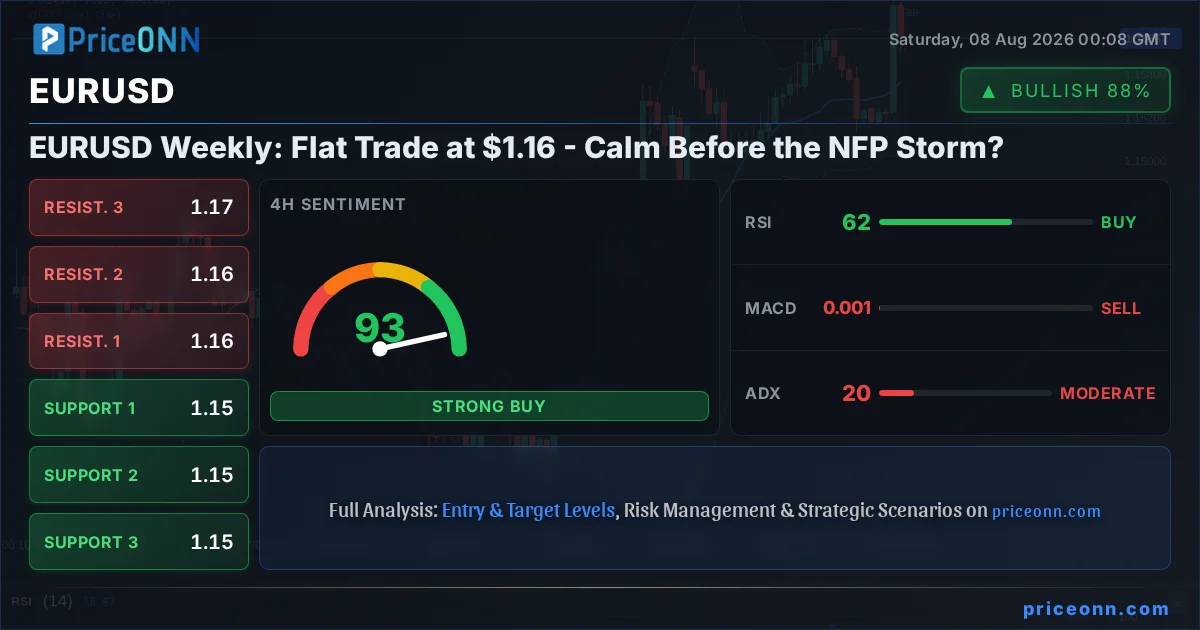
The EURUSD pair has found itself in a peculiar state of equilibrium, hovering around the $1.16 mark as the week draws to a close. This period of relative calm, however, feels less like a stable plateau and more like the quiet before a significant storm. All eyes are now firmly fixed on the upcoming Non-Farm Payrolls (NFP) report from the United States, a data point that has historically wielded immense power over currency markets, particularly for major pairs like EURUSD. The market sentiment is one of cautious anticipation; traders are holding their breath, unwilling to commit to significant positions until this pivotal economic indicator provides a clearer direction. The current price action suggests a market in a holding pattern, with both bulls and bears seemingly pausing their advance, awaiting a catalyst to break the stalemate. This EURUSD today analysis delves into the technical nuances, fundamental undercurrents, and the critical economic events that will shape the pair's trajectory in the coming days.
- EURUSD is consolidating around $1.16, with RSI at 64.22 on the 1H chart indicating neutral momentum but a slight upward bias.
- Critical support for EURUSD is observed around $1.1550, while resistance looms near $1.1575, tested multiple times this week.
- The upcoming US Non-Farm Payrolls report is the major event risk, with forecasts suggesting a potential slowdown in job growth, which could pressure the dollar.
- Correlation analysis shows the DXY at 99.58, currently in a downtrend, which historically supports EURUSD, but this relationship is being tested by incoming NFP expectations.
Navigating the Calm: EURUSD's Technical Stance
The 1-Hour Chart: A Tightrope Walk
On the 1-hour timeframe, EURUSD is painting a picture of indecision, yet with a subtle bullish leaning. The current price of approximately $1.1650 is being nudged by a neutral RSI(14) at 64.22. This isn't an extreme overbought or oversold reading, but it does suggest that the upward momentum, while present, is not yet overpowering. The MACD indicator on this timeframe shows positive momentum, with the MACD line trading above its signal line, a signal that typically suggests buyers are in control. However, the ADX at 40.89 indicates a strong trend is in play, which could mean that current price action is part of a larger move rather than a temporary blip. The Stochastic Oscillator, with K at 67.63 and D at 65.65, shows %K above %D, reinforcing the slightly bullish bias, but it's also approaching overbought territory, hinting at potential consolidation or a minor pullback. The Bollinger Bands are showing the price trading above the middle band, indicating a bullish tendency in the short term, but the proximity to the upper band means any further upward push might be met with profit-taking. The overall signal for this timeframe leans towards 'BUY' (8 buys, 0 sells, 0 neutral), reflecting this short-term bullish inclination, but the lack of strong conviction means this could easily reverse.
The support levels at 1.1597, 1.1555, and 1.1552 are crucial. A sustained break below these could quickly invalidate the short-term bullish sentiment. Conversely, resistance at 1.1567, 1.1599, and 1.15745 needs to be breached decisively for the bulls to gain more confidence. The price action here is delicate, a real tightrope walk where a single misstep could send the pair tumbling. For short-term traders, this environment calls for extreme caution and tight risk management. The market is clearly waiting for a more significant fundamental driver to break this intraday equilibrium.
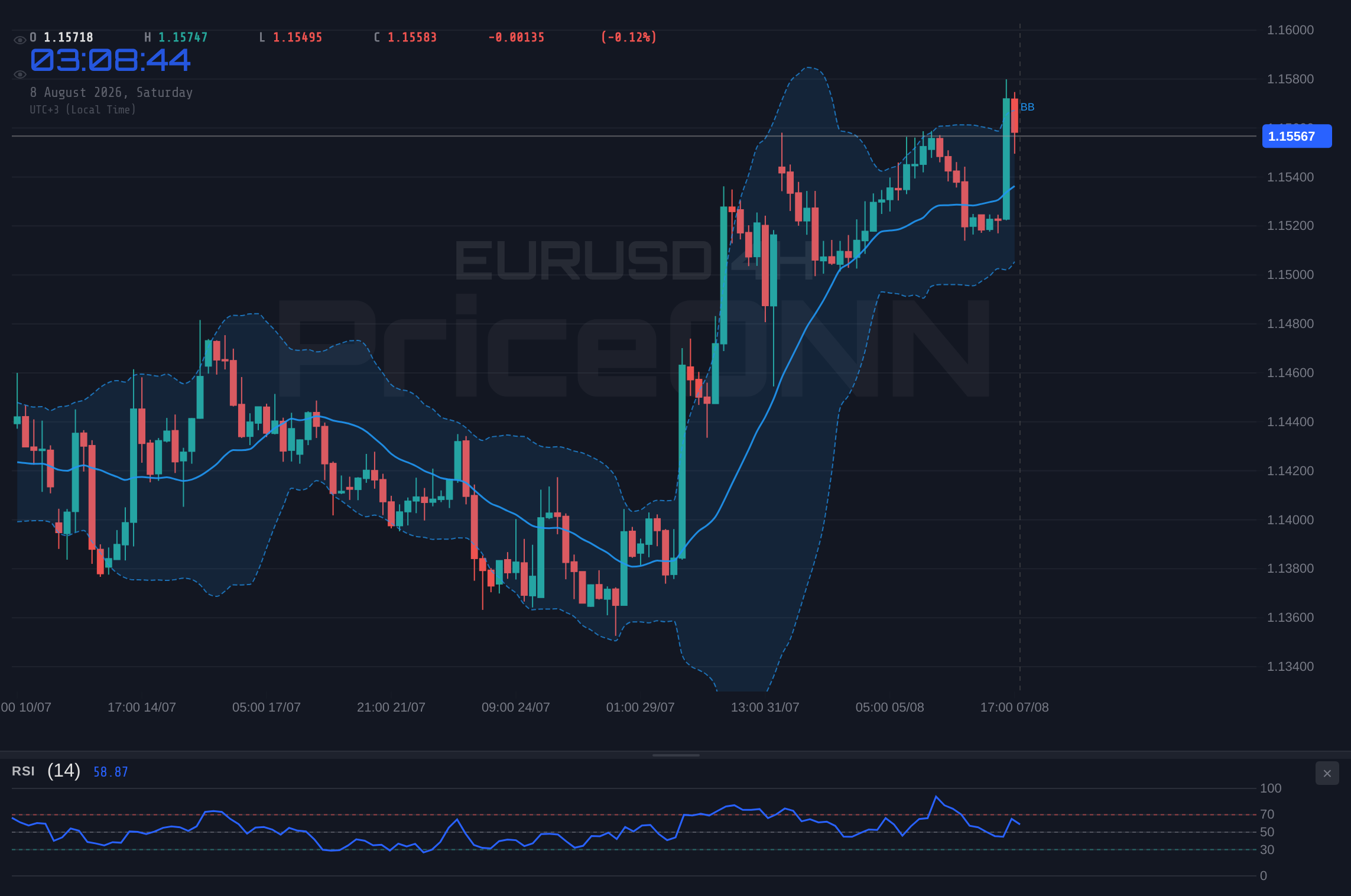
The 4-Hour Chart: Mixed Signals and Trend Strength
Shifting to the 4-hour chart, the picture for EURUSD becomes more nuanced, presenting a blend of bullish tendencies and cautionary signals. The RSI(14) stands at 61.98, firmly in the neutral zone but still leaning towards bullishness, indicating room for further upside before hitting overbought territory. The MACD on this timeframe, however, is showing negative momentum with the MACD line below its signal line. This divergence between the RSI and MACD is a classic sign of a market that might be losing steam on the upside, or at least consolidating before its next move. The Stochastic Oscillator, with K at 58.17 and D at 28.51, strongly favors a bullish signal, with %K significantly above %D and heading towards overbought conditions. This is somewhat contradictory to the MACD's negative momentum. The ADX at 20.37 suggests a moderately strong trend is in play, but it's not yet the kind of aggressive trend that would suggest a runaway move. The overall signal here is also 'BUY' (7 buys, 1 sell, 0 neutral), but the internal conflicts warrant a deeper look. The Bollinger Bands are hugging the middle band, indicating a period of consolidation or range-bound trading is possible, despite the general upward lean.
The key levels to watch on this timeframe are support at 1.1536, 1.1500, and 1.1478, and resistance at 1.1593, 1.1615, and 1.1651. These levels define the immediate trading range. The fact that the 4-hour MACD is showing negative momentum while the RSI and Stochastic are leaning bullish suggests that the market is grappling with conflicting forces. This could be a precursor to a significant move, or it could simply mean that the pair will remain range-bound until a strong external factor emerges. The strength of the trend indicated by the ADX is moderate, implying that while a trend exists, it's not so dominant that counter-trend moves are immediately doomed. This is a chart that requires careful observation, as a break of the immediate support or resistance levels could signal the direction for the next leg of the move.
The Daily Chart: Long-Term Perspective and NFP Anticipation
Looking at the daily chart provides a broader perspective on EURUSD's current position. The RSI(14) at 61.92 remains in neutral territory, showing no signs of being overbought or oversold, which suggests there's ample room for price appreciation or depreciation without immediate technical correction triggers. The MACD is exhibiting positive momentum, with the MACD line above its signal line, reinforcing the bullish sentiment from the lower timeframes. However, the Stochastic Oscillator is flashing a strong warning: K at 89.84 and D at 88.99 are deep in overbought territory. This is a clear indication that the pair is trading at the upper end of its recent range and could be due for a pullback or consolidation, especially if upcoming data disappoints. The ADX at 26.37 indicates a strong uptrend is present, but given the overbought Stochastic, this trend might be nearing exhaustion in the short to medium term. The overall signal is 'BUY' (6 buys, 2 neutral, 0 sells), but the stochastic reading is a significant red flag.
The daily support levels are at 1.1505, 1.1487, and 1.1460, while resistance levels are situated at 1.1550, 1.1576, and 1.1594. These daily levels are critical for determining the longer-term trend. The fact that the pair has been consolidating around the 1.16 area suggests that these levels are being closely watched by institutional players. The current 'BUY' signal strength is tempered by the extreme readings on the Stochastic Oscillator. This suggests that while the trend has been upward, the market is potentially overheated. The true test will come with the NFP report. A significantly weaker-than-expected report could trigger a sharp sell-off, pushing EURUSD towards its support levels. Conversely, a strong report might see it push through resistance, but the overbought conditions would still warrant caution. This daily picture highlights the pair's susceptibility to fundamental news events.
Fundamental Crosscurrents: DXY, NFP, and Central Bank Whispers
The Dollar Index (DXY): A Weakening Foundation?
The US Dollar Index (DXY), a crucial benchmark for the dollar's strength against a basket of major currencies, is currently trading around 99.58. The data shows a daily decline of 0.36%, indicating a weakening dollar sentiment. On the 1-hour chart, the DXY displays a neutral trend with a strong 'SELL' signal (1 buy, 7 sell, 0 neutral). The RSI(14) at 36.17 is in the lower neutral zone, suggesting bearish momentum, and the MACD is also showing negative momentum, reinforcing this view. The ADX at 37.69, however, points to a strong downtrend, which, if sustained, would typically be supportive of EURUSD. The daily chart echoes this bearish sentiment for the dollar, with RSI at 35.01 and negative MACD momentum. The Stochastic Oscillator is in the oversold territory, suggesting potential for a dollar bounce, but the overall trend appears to be downwards. This weakening dollar environment provides a backdrop that is generally favorable for EURUSD.
However, the upcoming Non-Farm Payrolls report poses a significant wildcard. Historically, a weak NFP print has led to dollar depreciation as it dampens expectations for aggressive Federal Reserve rate hikes. Conversely, a strong report could reverse this trend rapidly. The current correlation between DXY and EURUSD suggests that a continued decline in the dollar index would likely see EURUSD push higher, potentially testing its resistance levels. But this relationship is not absolute, and market participants will be dissecting the NFP report for clues about the Fed's future policy path, which could override the immediate DXY movement.
The NFP Catalyst: What to Expect and Why It Matters
The US July Non-Farm Payrolls (NFP) report, due imminently, is the single most critical data release for EURUSD this week. The consensus forecast, as indicated by market analysis, is for a moderate increase in jobs, but the recent news suggests a potential shock. One report mentioned a forecast of +70k, while another indicated an unexpected loss of 23,000 jobs, a stark contrast to projections of +83,000. This discrepancy highlights the potential for a significant market reaction. If the actual number comes in substantially below expectations, it could signal a significant slowdown in the US labor market, leading to reduced expectations for Federal Reserve interest rate hikes. This would likely weaken the dollar across the board, providing a strong tailwind for EURUSD to break above its current resistance levels.
Conversely, a surprisingly strong NFP report, significantly exceeding expectations, could reignite inflation concerns and strengthen the case for the Fed to maintain a hawkish stance or even consider further tightening. This would likely boost the dollar, pushing EURUSD lower towards its support levels. The unemployment rate, also released with the NFP, will be scrutinized. A steady or increasing unemployment rate alongside weak job growth would amplify the bearish dollar signal. Given the conflicting forecasts and the market's sensitivity to labor market data, the NFP report is poised to be the primary driver of EURUSD's direction in the short to medium term. Traders are bracing for volatility, and positions are likely being adjusted to account for potential sharp moves.
Central Bank Signals: A Lingering Dovish Tone?
While the immediate focus is on the NFP, the underlying monetary policy stance of both the European Central Bank (ECB) and the Federal Reserve (Fed) continues to shape the long-term outlook for EURUSD. Recent commentary from Fed officials, while acknowledging persistent inflation, has maintained a cautious tone regarding future rate hikes. Market pricing, as reflected in Fed Fund Futures and OIS data, indicates a significant probability of a pause in rate hikes, and some even price in a small chance of a cut later in the year, especially if economic data weakens. This less aggressive stance from the Fed, compared to earlier expectations, has been a contributing factor to the dollar's recent softness.
On the ECB's side, while inflation remains elevated, growth concerns in the Eurozone have led to a more balanced approach. Recent analysis suggests that the ECB might be nearing the end of its tightening cycle, or at least adopting a data-dependent approach that allows for flexibility. The market is keenly watching for any hints about the future path of interest rates from both central banks. Any indication of divergence, where one central bank signals a more dovish path than the other, could significantly influence EURUSD. For instance, if the Fed signals a faster path to rate cuts than the ECB, it would likely put downward pressure on EURUSD, and vice-versa. Currently, the market seems to be pricing in a relatively balanced approach, contributing to the current consolidation, but the NFP report could easily shift these expectations.
Market Correlations and Geopolitical Undercurrents
The Gold-DXY Relationship: A Tale of Two Safe Havens
The interplay between the US Dollar Index (DXY) and Gold (XAUUSD) is a critical component of understanding EURUSD's environment, as both are often viewed as safe-haven assets, albeit with different drivers. Currently, XAUUSD is showing significant strength, trading around $4,341.51 with a strong daily upward move of 2.38%. The 4-hour chart indicates a strong bullish trend (ADX 40.51), with RSI at 72.44 nearing overbought conditions. The daily chart also shows positive momentum. This strength in gold suggests underlying concerns about inflation or geopolitical risks, which typically coincide with a weaker dollar. The DXY's current downtrend around 99.58 aligns with this narrative, reinforcing the idea that a weaker dollar environment is generally supportive of gold and, by extension, EURUSD.
The recent news that gold prices surged above $4,300 as US job losses mounted further illustrates this inverse correlation. Weak payrolls reduce the odds of September rate hikes, making non-yielding assets like gold more attractive compared to dollar-denominated assets. This dynamic is important for EURUSD because a sustained weakness in the dollar, driven by poor US economic data and potential Fed easing, could lead to a broader risk-on sentiment that benefits EURUSD. However, if geopolitical tensions escalate significantly, gold could see further safe-haven demand, potentially pulling capital away from other riskier assets, including some currencies.
Equity Markets: Risk Appetite and EURUSD
The performance of major equity indices like the S&P 500 and Nasdaq provides another crucial layer of context for EURUSD analysis. The S&P 500 is currently trading around 6,572.87, showing a healthy daily gain of 0.74%. The Nasdaq is also up, trading near 29,706.54. On the 1-hour charts, both indices display positive momentum and 'BUY' signals, suggesting a generally positive risk appetite in the market. This risk-on environment is typically favorable for currency pairs like EURUSD, as investors are more willing to move capital into assets perceived as having higher returns, even if they carry more risk. A strong equity market can reduce demand for safe-haven assets like the dollar, further supporting EURUSD.
However, the daily charts for both S&P 500 and Nasdaq show mixed signals or potential for consolidation. The S&P 500's daily chart has a 'SELL' signal, with RSI at 45.35 and negative MACD momentum, indicating potential headwinds despite the intraday gains. Similarly, the Nasdaq's daily chart shows positive momentum but also potential for overbought conditions on the Stochastic Oscillator. This suggests that while the immediate sentiment is positive, the broader market might be nearing a point of caution. Any significant downturn in equity markets, perhaps triggered by disappointing economic data or escalating geopolitical risks, could lead to a flight to safety, impacting EURUSD. The recent news about the Hormuz crisis and warnings from Saudi Arabia could be potential triggers for such a shift, although the market seems to be shrugging them off for now, awaiting concrete proof of escalation.
Geopolitical Tensions: Hormuz, Saudi Warnings, and US-China
The geopolitical landscape remains a significant, albeit often latent, factor influencing currency markets. The ongoing crisis in the Strait of Hormuz, with reports of Iranian attacks on vessels, has been cited as a factor that could impact oil prices and global trade. While the market seems to have initially shrugged off these concerns, the potential for escalation remains a risk. Disruptions in this critical shipping lane could lead to higher energy prices, potentially reigniting inflation fears and prompting central banks to reconsider their monetary policy stances. This could indirectly affect EURUSD by influencing inflation expectations and risk sentiment.
Furthermore, warnings from Saudi Arabia and ongoing US-China tensions add layers of complexity. While these specific geopolitical events might not have an immediate, direct impact on EURUSD, they contribute to the broader global risk sentiment. A significant escalation in any of these fronts could trigger a flight to safe-haven assets, potentially strengthening the dollar and putting pressure on EURUSD. The fact that markets have stalled despite promises of a Hormuz breakthrough, as noted in recent analysis, highlights a growing skepticism and a need for concrete developments. This underlying geopolitical uncertainty means that even with a seemingly stable technical picture, unexpected news can rapidly shift market dynamics.
Trading Scenarios and Outlook for EURUSD
Bearish Scenario: Dollar Strength Returns
60% ProbabilityConsolidation Scenario: Waiting for Clarity
25% ProbabilityBullish Scenario: Dollar Weakness Persists
15% ProbabilityThe Week Ahead: Key Levels and Events to Monitor
As we look towards the coming week, the EURUSD pair remains at a critical juncture. The current price action around $1.16 is indicative of a market poised for a significant move, heavily dependent on the upcoming US NFP data. The technical indicators present a mixed picture: short-term charts lean bullish, but daily charts show overbought conditions on the Stochastic Oscillator, warranting caution. The DXY's downward trajectory provides some support, but this could quickly reverse with a strong NFP print. The correlation with gold's strength and equity market performance adds further layers of complexity, suggesting underlying risk aversion despite current equity gains.
For traders, the immediate focus must be on the NFP report. A print significantly below expectations could see EURUSD push towards the 1.1615-1.1651 resistance zone. Conversely, a strong report could trigger a sell-off towards the 1.1550-1.1500 support area. The key levels to watch remain the immediate support at $1.1550 and resistance at $1.1575 on the intraday charts. On the daily chart, $1.1500 acts as a significant psychological support, while $1.1600 and above represent areas where the pair has struggled previously. Patience will be key. Waiting for the NFP data to resolve the current indecision is likely the most prudent strategy. Any attempt to trade the current range without clear directional conviction carries significant risk. The market is offering a setup, but clarity is needed before committing substantial capital.
Frequently Asked Questions: EURUSD Analysis
What happens if EURUSD breaks above the $1.1575 resistance after the NFP report?
A decisive break above $1.1575, especially on strong NFP data, could trigger a move towards the $1.1615-$1.1651 resistance zone, indicating persistent dollar weakness.
Should I buy EURUSD at current levels of $1.15577 given the neutral RSI and overbought Stochastic on daily?
Buying at current levels is risky due to conflicting signals; the daily Stochastic at 89.84 is overbought, suggesting caution. A trigger from NFP data would be needed for conviction.
Is the RSI at 64.22 a sell signal for EURUSD on the 1H chart?
An RSI of 64.22 is in the neutral zone with a slight upward bias, not a direct sell signal. It indicates room for upward movement before hitting overbought territory, but suggests caution against aggressive long positions.
How will the US Non-Farm Payrolls data affect EURUSD this week?
A significantly weaker NFP report could weaken the dollar and push EURUSD towards resistance, while a stronger report might pressure EURUSD lower towards support levels, depending on Fed rate hike expectations.
Track markets in real-time
AI-powered analysis, technical indicators and real-time price data.
Join Our Telegram Channel
Breaking market news, AI analysis and trading signals instantly.
Join Channel