

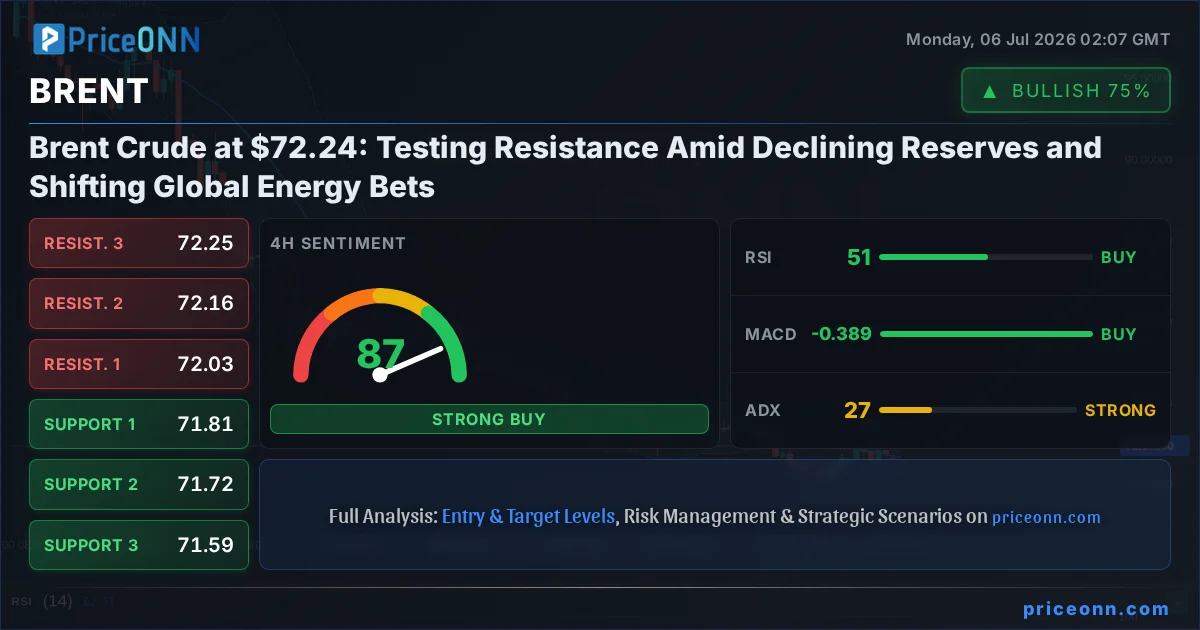
The familiar tug-of-war in the oil markets is back in focus, with Brent crude currently testing critical resistance levels around the $72.24 mark. This isn't just another technical hurdle; it's a pivotal moment shaped by a confluence of factors ranging from dwindling national reserves to a significant, albeit nascent, global shift towards alternative energy sources. As traders and analysts eye the charts, the underlying fundamentals paint a complex picture, suggesting that the path forward for oil prices might be far more nuanced than a simple supply-demand equation. The infrastructure and policy landscapes are evolving, demanding a deeper look beyond the immediate price action.
- Brent crude is currently trading at $72.24, approaching significant resistance.
- Colombia's declining oil reserves highlight a broader trend of falling national energy stockpiles in some regions.
- A growing interest in biofuels across Asia signals a potential long-term shift away from crude oil dependency.
- The DXY is at 100.96, showing strength that typically pressures commodities like Brent.
- With RSI at 27.83 on the daily chart, Brent is in oversold territory, suggesting potential for a bounce, but the strong 42.01 ADX indicates a powerful downtrend remains.
The geopolitical stage, often a volatile catalyst for oil prices, continues to simmer. While specific escalations like those in the Strait of Hormuz haven't recently dictated immediate price surges, the underlying tensions remain a constant background hum. The recent news indicating a rebound in OPEC production in June, as Gulf producers brought shut-in barrels back online, offers a temporary reprieve from immediate supply fears. However, this rebound itself is a delicate balancing act. It suggests that producers are keen to capitalize on current price levels, potentially before market dynamics shift further. This move aims to stabilize markets, but it also highlights the producers' sensitivity to price drops and their reliance on maintaining output, a strategy that could be tested by long-term demand shifts.
Navigating the Shifting Sands: Declining Reserves and Biofuel Bets
Digging deeper into the fundamental landscape, the narrative of shrinking reserves is becoming increasingly prominent. Colombia's struggle with diminishing oil and gas reserves, a situation detailed in recent energy reports, is not an isolated incident. Across various nations, the low-hanging fruit of easily accessible fossil fuel deposits is becoming scarcer. This reality forces producers to confront higher extraction costs, more complex geological challenges, and increasingly stringent environmental regulations. The economic viability of new exploration projects is being questioned, leading to a gradual but undeniable pressure on future supply. This isn't about immediate scarcity, but about the long-term trajectory of production capacity, a factor that underpins price expectations for the coming years.
Simultaneously, a fascinating pivot is underway in Asia, as countries increasingly bet on biofuels to navigate away from Middle East oil dependency. This trend, driven by energy security concerns and the global push for decarbonization, represents a significant potential disruption to crude oil demand. While biofuels are not yet a direct substitute for the sheer volume of crude used globally, their growing adoption signals a strategic diversification. For oil markets, this means that even if current supply remains constrained by geopolitical factors or producer decisions, the long-term demand picture could be fundamentally altered. The investment in biofuel infrastructure and technology today is laying the groundwork for a future where crude oil's dominance might be challenged, influencing price ceilings and overall market sentiment.
Technical Crosscurrents: $72.24 at the Crossroads
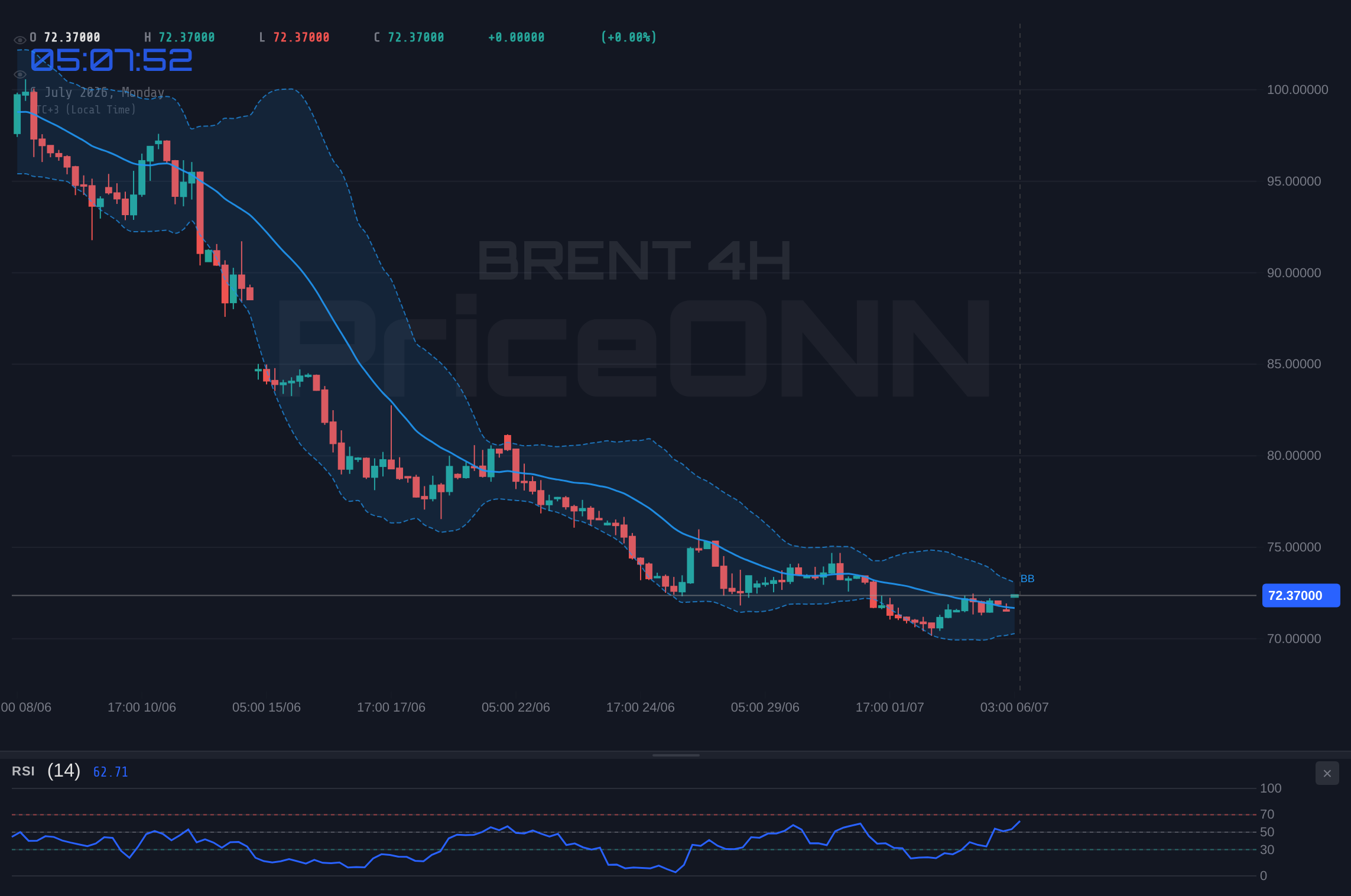
On the technical front, Brent crude's current position at $72.24 is a critical juncture. The 1-hour chart shows a neutral trend with a strong 50% power, but the ADX at 16.92 suggests a weak trend, indicating choppy conditions. However, the daily chart presents a more concerning picture for bulls. The trend is firmly bearish with 100% power, and the ADX at 42.01 signals a strong downtrend. Despite the daily RSI sitting in oversold territory at 27.83, the momentum is clearly with the sellers. The MACD is negative, and Bollinger Bands are below the middle band, all pointing towards further downside potential if the current resistance holds.
The 4-hour timeframe offers a slightly more optimistic, though still cautious, view. The trend is neutral with 50% power, but the ADX at 28.22 indicates a strong trend is developing. Stochastic signals are mixed, with K line above D line, suggesting a potential upward move, but this is happening in an already strong downtrend context. The current price of $72.24 sits just below the 4-hour resistance level of $72.25. A decisive break and hold above this level would be necessary to challenge the prevailing bearish sentiment, but the confluence of daily bearish signals and the overarching downtrend narrative makes this a challenging prospect without significant catalysts.
The Dollar's Shadow: DXY and its Influence
No analysis of commodities, especially oil, is complete without considering the DXY, or Dollar Index. Currently trading at 100.96, the dollar is showing strength, particularly on the 1-hour and 1-day charts, with ADX values of 25.58 and 39.37 respectively. A stronger dollar generally translates to lower commodity prices, as dollar-denominated assets become more expensive for holders of other currencies. This inverse correlation is a key factor weighing on Brent. The dollar's upward momentum, especially on the daily chart where it shows a strong trend, suggests it could continue to act as a headwind for oil prices. Traders are watching closely to see if the dollar's strength can maintain its grip, potentially capping any upside attempts for Brent crude as it tests resistance.
The correlation between the dollar and oil is not always linear, but the current setup presents a clear challenge. With the DXY pushing higher, the cost of oil for non-dollar buyers increases, potentially dampening demand. This is particularly relevant in the context of Asia's growing interest in biofuels; if the dollar remains strong, it further incentivizes these regions to seek alternatives to dollar-priced crude. The strength of the dollar, coupled with the bearish technical signals on the daily Brent chart, creates a formidable barrier for any immediate bullish reversal. The market sentiment appears to be leaning towards risk aversion, a scenario where a strong dollar typically thrives at the expense of riskier assets and commodities.
Market Sentiment and Intermarket Dynamics
The broader market sentiment is a crucial lens through which to view Brent's performance. With the S&P 500 showing a bearish trend on the daily chart (ADX 47.51) and Nasdaq 100 also exhibiting weakness, the risk-off environment is palpable. This decline in equity markets typically correlates with reduced demand for riskier assets, including commodities like oil. Investors tend to seek safer havens, which can include the dollar itself, further reinforcing the inverse relationship. The fact that major indices are under pressure suggests that global economic concerns or geopolitical anxieties are overriding positive sentiment, creating an environment where oil prices may struggle to find sustained upward momentum.
The interplay between energy prices and broader inflation expectations is also a key consideration. While the immediate focus might be on supply disruptions or producer output, sustained higher oil prices have historically been a significant driver of inflation. However, the current narrative seems to be shifting. With central banks worldwide grappling with persistent inflation, any upward pressure from oil could complicate their policy decisions, potentially leading to tighter monetary conditions. This, in turn, could dampen economic growth and, consequently, oil demand, creating a self-reinforcing cycle. The market is thus caught between the immediate supply-side pressures and the potential for demand destruction driven by inflation concerns and central bank responses.
Geopolitical Undercurrents and Supply Chain Resilience
While headlines might not be dominated by immediate Strait of Hormuz disruptions, the ongoing geopolitical complexities in the Middle East remain a constant, albeit often discounted, factor. The news that OPEC production rebounded in June highlights the producers' desire to maintain market share and revenue, but it also underscores their sensitivity to any perceived threat to supply stability. Any escalation or unexpected event in this region can rapidly shift market sentiment, leading to sharp price spikes. The market's current relative calm on this front might be a temporary state, and any significant geopolitical development could quickly reintroduce volatility.
Furthermore, the discussion around supply chain resilience is increasingly relevant. The reliance on specific regions for energy production, coupled with the logistical challenges of transporting these commodities, creates inherent vulnerabilities. Asia's bet on biofuels is, in part, a strategy to enhance energy independence and reduce reliance on long, complex, and potentially volatile oil supply chains. This diversification effort, while long-term, signals a structural shift that could reshape global energy trade patterns. The ability of traditional oil producers to adapt to this changing landscape, and the effectiveness of investments in alternative energy infrastructure, will be critical in determining the future price trajectory of Brent crude.
Trade Scenarios: Navigating the Uncertainty
Given the current technical signals and fundamental crosscurrents, several scenarios warrant consideration for Brent crude trading. The prevailing bearish trend on the daily chart, coupled with dollar strength and risk-off sentiment in equities, points towards a challenging environment for buyers. However, the oversold conditions on the daily RSI and the approaching resistance level create a critical decision point.
Bearish Scenario: Resistance Holds Firm
65% ProbabilityNeutral Scenario: Consolidation Around Resistance
25% ProbabilityBullish Scenario: Breakout Above Resistance
10% ProbabilityFrequently Asked Questions: Brent Crude Analysis
What happens if Brent crude fails to break above the $72.24 resistance level?
If Brent crude fails to sustain a move above $72.24, the prevailing bearish trend on the daily chart is likely to continue. We could see a retest of the $71.59 support level, and potentially a move towards the stronger $70.52 support. This scenario is currently assigned a 65% probability.
Should I consider buying Brent at current levels near $72.24 given the daily RSI is at 27.83?
Buying solely based on the oversold RSI at 27.83 would be highly speculative. While it indicates potential for a bounce, the strong daily downtrend (ADX 42.01) and resistance at $72.24 suggest caution. A confirmation would require a clear break above $72.24, targeting $72.94, which has a lower probability (10%) currently.
Is the daily ADX at 42.01 a strong sell signal for Brent crude?
An ADX reading of 42.01 on the daily chart signifies a very strong trend, and in this context, it's a strong downtrend. This suggests that any upward price movements may be met with significant selling pressure, making it difficult for bulls to gain control until this indicator shows signs of weakening or reversing.
How might Asia's growing interest in biofuels impact Brent crude prices in the coming months?
Asia's increasing investment in biofuels signals a long-term diversification away from crude oil, potentially capping future demand growth for Brent. While not an immediate catalyst, this trend could exert downward pressure on prices over the medium to long term, especially if biofuel technology and infrastructure continue to advance, reducing reliance on traditional oil markets.
Track markets in real-time
AI-powered analysis, technical indicators and real-time price data.
Join Our Telegram Channel
Breaking market news, AI analysis and trading signals instantly.
Join Channel